
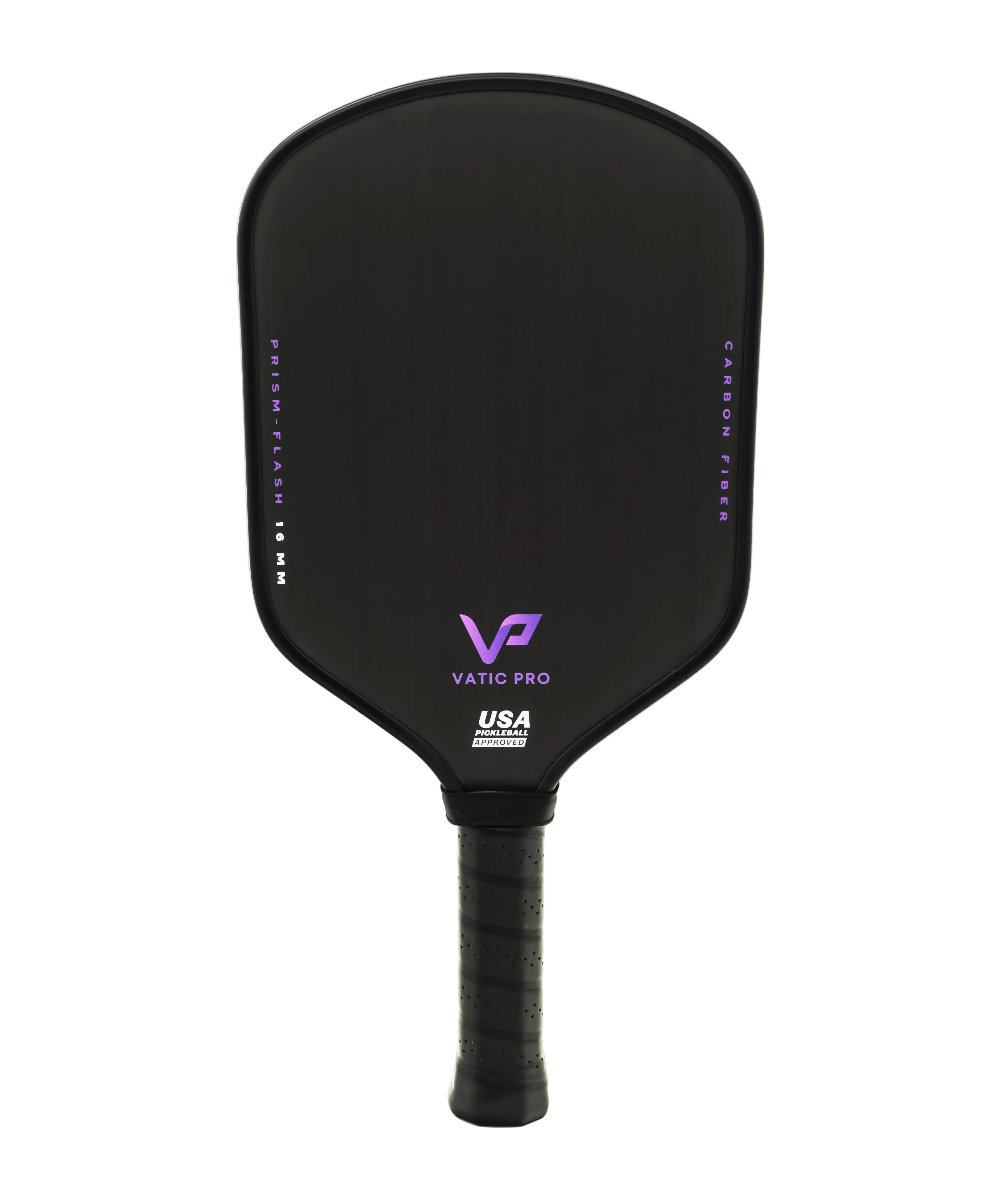
The Vatic Pro Prism Flash review question comes up constantly in budget-paddle forums: can a $99.99 carbon paddle actually compete with the $200-plus tier, or is it just good marketing? We didn’t hit a court with it ourselves. Instead, we pulled the published spec sheet, checked USA Pickleball’s approved equipment list, and worked through verified owner reviews across retailer sites to see where the Prism Flash actually stands.
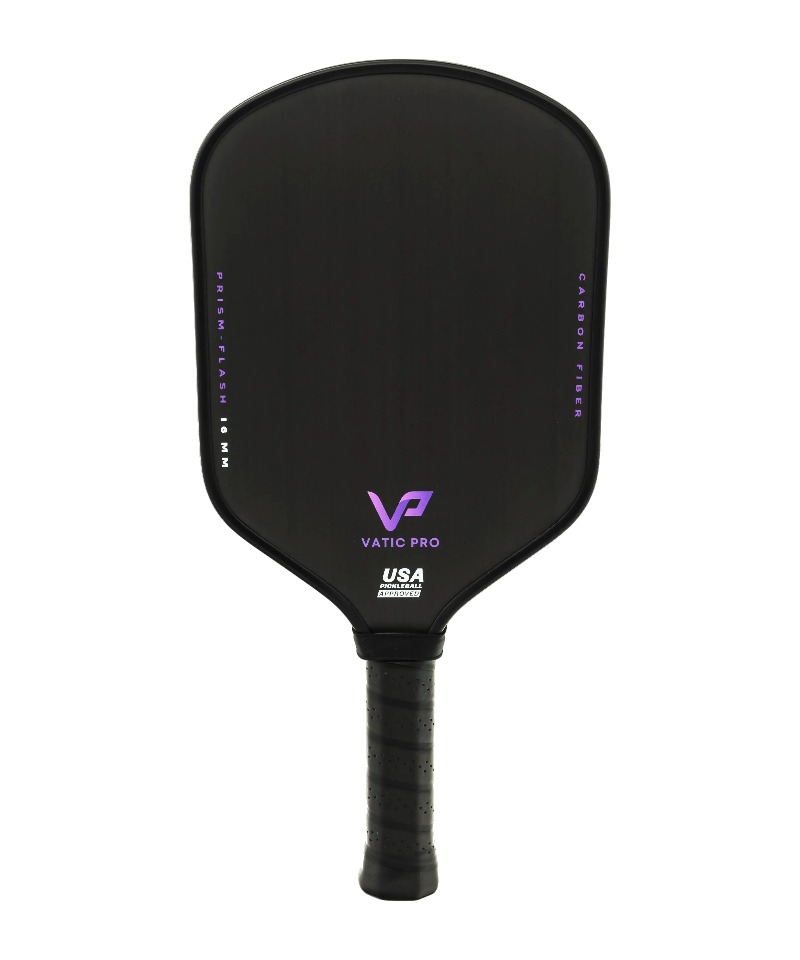
Vatic Pro Prism Flash at a Glance
Vatic Pro built the Prism line as its budget-tier answer to pricier raw-carbon paddles, and the Flash is one of three variants (alongside the V7 and Bloom) sharing the same core construction. At $99.99, it sits squarely in the sub-$100 bracket that dominates first-paddle and second-paddle purchases.
Key Specs Snapshot
Weight runs 7.7-8.2 oz depending on the individual paddle (Vatic Pro, like most manufacturers, ships with natural weight variance). Core is 16mm, with a 14mm version also available for players who want more pop. The face is raw Toray T700 carbon, a fabric widely used across the mid-to-premium tier, which is notable at this price point.
Who This Paddle Is For
Owner review patterns point clearly toward beginner and control-focused players. Vatic Pro markets it that way too, and the feedback backs it up: reviewers describe a plush, forgiving feel that’s easy on the arm and easy to control, rather than a paddle built to hit through the ball.
Verified Specifications
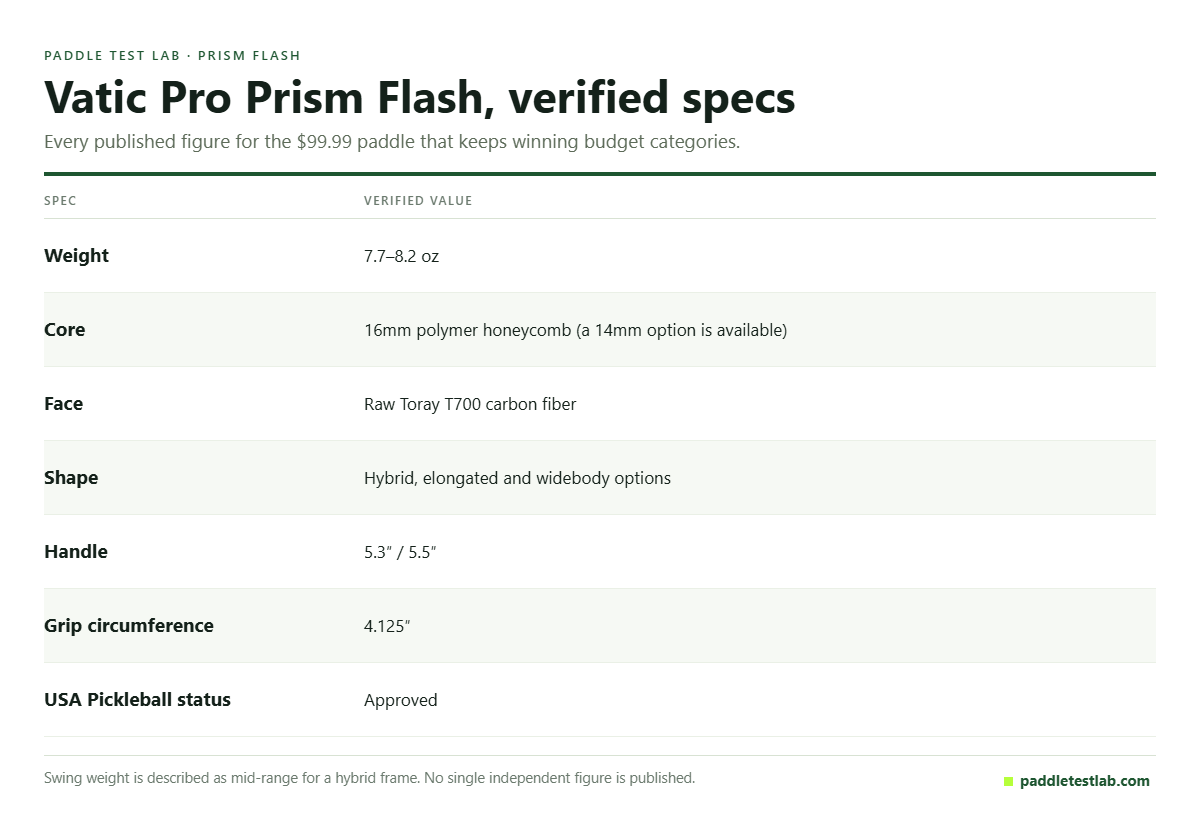
Every spec below comes directly from the published product database entry for the Prism Flash – nothing here is estimated.
Weight, Core & Drop
Weight: 7.7-8.2 oz. Core/drop: 16mm standard, with a 14mm option in the Prism family. That range is typical for the category; owner reports vary on where in that band a given paddle actually lands, since Vatic Pro doesn’t guarantee a specific weight at checkout.
Face Material & Outsole
The face is raw (unpainted) Toray T700 carbon fiber. Raw carbon finishes are prized for higher grit and spin potential versus painted or textured alternatives – at least while the surface is new. Outsole/edge details beyond the face material aren’t broken out separately in the published spec sheet.
Shape & Width
The Prism family ships in hybrid, elongated, and widebody shapes, so buyers aren’t locked into one silhouette just because they want the budget price point.
USA Pickleball Approval Status
Yes. The Vatic Pro Prism Flash is listed as USA Pickleball approved. That matters if you play sanctioned tournaments or league play under USAP rules – always worth a direct check against the official approved paddle list before a big event, since approval status can change.
| Spec | Value |
|---|---|
| Price | $99.99 |
| Weight | 7.7-8.2 oz |
| Core/Drop | 16mm (14mm also offered) |
| Face | Raw Toray T700 carbon |
| Shape/Width | Hybrid/elongated/widebody |
| USAP Status | Approved |
| Tier | Budget |
Manufacturer Claims vs. Owner Evidence
What Vatic Pro Claims
Vatic Pro positions the Prism line as a benchmark budget carbon paddle with a plush, forgiving feel. The brand also markets built-in grip inserts designed to reduce shock and vibration transfer to the arm.
What Verified Owner Reviews Report
Owners largely agree on the forgiving feel – that part of the marketing checks out across a wide swath of reviews. Where the story gets more complicated is durability. Grit on the raw carbon face reportedly wears down faster than owners expect for a carbon paddle, and one tester’s independent measurement put spin loss at roughly 50% after two months of regular use. Several owners also describe the paddle as slightly head-heavy in hand.
Where Claims Hold Up and Where They Don’t
The ‘plush, forgiving’ claim holds up well and shows up repeatedly in review language, often unprompted. The vibration-reduction grip claim isn’t strongly contradicted, but it also isn’t the standout feature owners talk about most – comfort and forgiveness get more attention than the grip tech specifically. The durability picture is the weak spot: this is a paddle that plays like it costs more than $99.99 out of the box, but grit degradation means the spin ceiling doesn’t stay there for long.
| Claim | Owner/Independent Finding |
|---|---|
| Plush, forgiving feel | Confirmed – consistent theme across reviews |
| Benchmark budget carbon paddle | Largely confirmed – frequently cited as the budget standard |
| Shock-reducing grip inserts | Not disputed, but not the top-praised feature either |
| Durable spin surface | Not confirmed – grit wear and ~50% spin loss reported at 2 months by one tester |
| Balanced swingweight | Mixed – some owners call it slightly head-heavy |
What Owners Praise
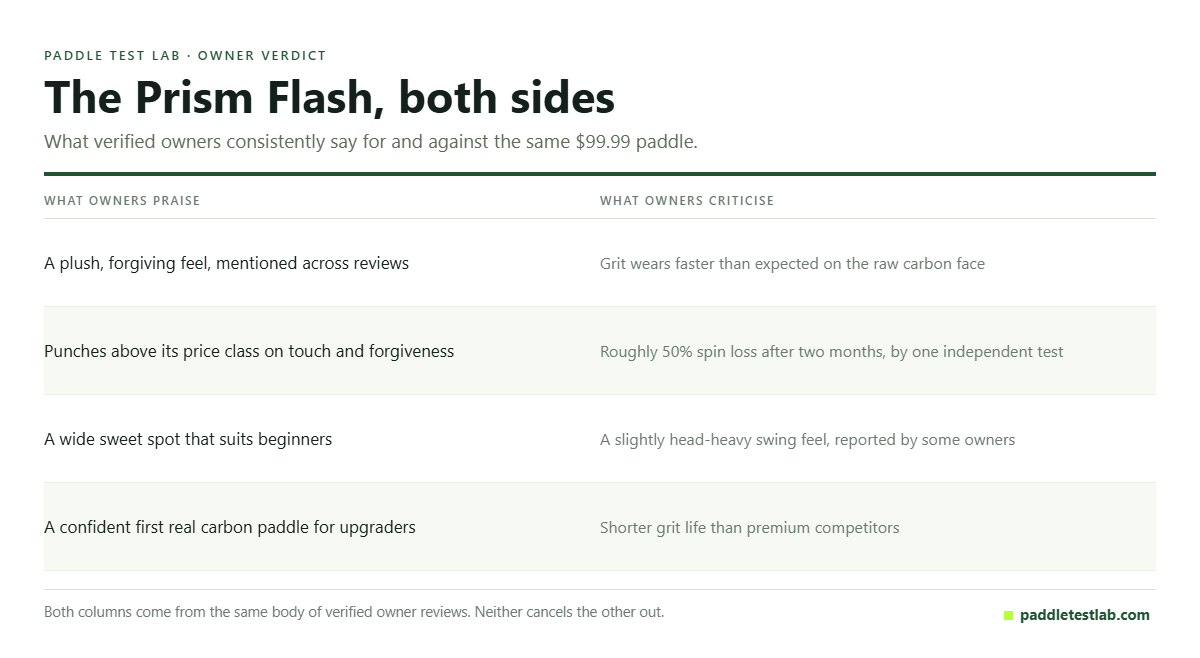
Performance Highlights From Verified Reviews
The dominant theme across owner reviews is value relative to feel. Reviewers repeatedly describe the Prism Flash as punching above its price class on touch and forgiveness – words like ‘plush’ and ‘soft’ show up often, which is unusual language for a raw carbon paddle at this price. The wide sweet spot gets credit for making the paddle beginner-friendly, and the shape variety (hybrid, elongated, widebody) means buyers aren’t stuck compromising on shape just to get the budget price. It’s also frequently recommended as a confident first real carbon paddle for players moving up from composite or wood.
What Owners Criticize
Documented Complaints and Durability Notes
The most consistent complaint is grit wear. Raw carbon faces rely on that texture for spin, and once it smooths out, spin performance drops with it – one tester’s measurement of roughly 50% spin loss after two months is the most concrete data point available, and owner reports in general skew toward ‘faster wear than expected’ even if exact numbers vary. The second recurring note is a slightly head-heavy swing feel, which some players like for putaways but others find fatiguing over long sessions. Neither complaint is unique to Vatic Pro – grit degradation shows up across raw-carbon budget paddles generally – but it’s worth going in with realistic expectations about longevity rather than assuming budget-carbon means premium-carbon durability.
How It Compares
Similar Paddles in the Same Tier
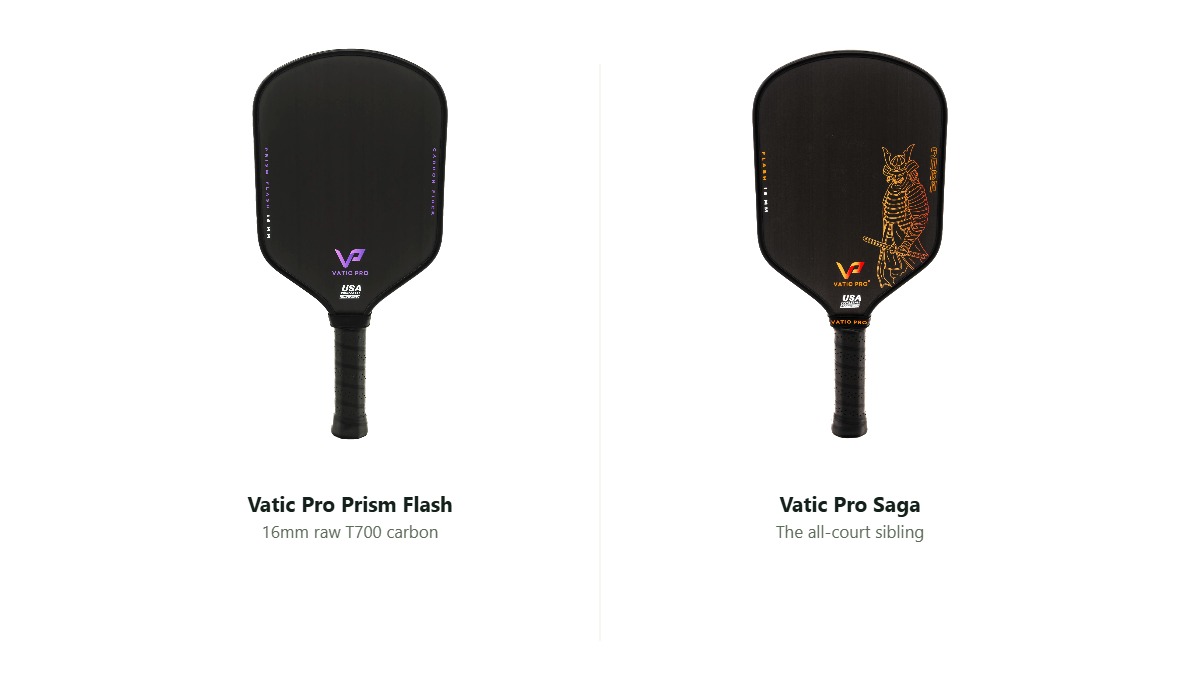
Within the same budget bracket, the Vatic Pro Saga is the closest sibling – same $99.99 price, same brand, but built more as a jack-of-all-trades all-court paddle rather than a control specialist, with a polymer core that owners don’t report the same long-term issues with. The Selkirk SLK Halo XL Control ($99.99 street) is another beginner-leaning option with T700 raw carbon, though owner data shows its spin numbers running lower (roughly 1400-1450 RPM) and its power ceiling more limited for aggressive players. The 11SIX24 Pegasus/Vapor/Hurache-X Jelly Bean line, also $99.99, is frequently cited as the best budget control paddle for forgiveness and twist weight, though it trades away some put-away power and has a smaller sweet spot than foam-core rivals like the Prism Flash. Compared to that trio, the Prism Flash’s edge is its stronger reputation for feel-per-dollar – its weak point is that durability question mark that the others don’t share as prominently. For a broader field of comparisons across tiers, our best pickleball paddles roundup and paddle buying guide break down how budget, mid, and premium options stack up.
Final Verdict
Who Should Buy the Vatic Pro Prism Flash
If you’re a beginner or control-oriented player who wants genuine raw carbon feel without a $200-plus price tag, the Prism Flash is a reasonable, well-evidenced pick. Owner reviews back up the core promise: plush, forgiving, and USA Pickleball approved for anyone who needs sanctioned-play eligibility. As a first serious paddle or a low-risk way to try raw carbon, it holds up.
Who Should Skip It
Players chasing maximum spin longevity, or anyone who plays multiple times a week and expects a carbon face to hold its grit for a full season, should treat the durability reports as a real limitation, not a rare complaint. If sustained spin performance matters more than upfront price, it may be worth comparing against paddles in the mid tier with documented spin-retention data before committing.
Prism Flash vs Prism V7: Same Family, Different Shape
Vatic’s Prism line runs several frames on a shared platform, and the difference between them is shape and weight rather than build quality.
The Prism Flash is the hybrid — roughly 16.25″ long, a usable sweet spot, and the version most players should default to. The Prism V7 is the elongated sibling at about 16.5″ by 7.5″, running slightly heavier at around 8.2–8.5 oz, trading forgiveness for reach and leverage.
Neither is an upgrade on the other. If you play doubles and spend your time at the kitchen line, the Flash’s larger effective sweet spot will serve you better. If you play singles, drive from the baseline, or came from tennis with a grooved swing, the V7’s extra reach is worth the smaller margin for error. Our guide to elongated versus standard shapes covers the trade-off, and the elongated roundup shows how the V7 compares in its shape class.
Vatic Pro Durability: The Honest Limitation
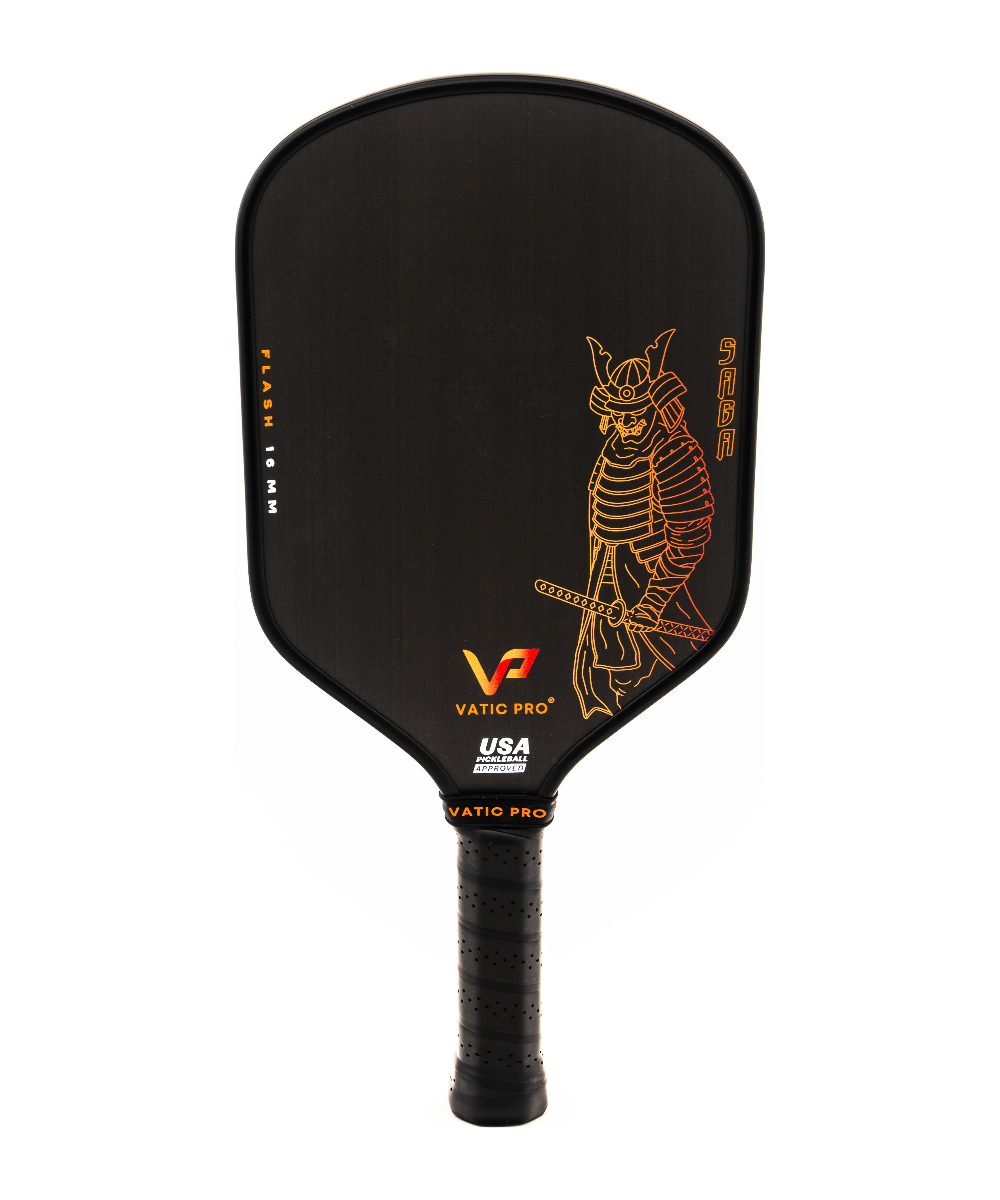
Vatic’s value proposition is real, and so is its main weakness. Owner reports converge consistently on one point: the grit face wears faster than premium rivals. One independent tester recorded roughly a 50% spin loss after two months of heavy play.
Two things are worth separating. First, this is a characteristic of aggressive raw carbon surfaces generally, not a Vatic defect — the same pattern appears on much more expensive paddles. Second, it scales with how much you play. Four sessions a week and you will notice within a season; twice a week and you may never register it.
Structurally the paddles hold up well — the Gen 1.5 build uses edge foam rather than full thermoforming, which reduces exposure to the face-to-core bond failure behind most delamination cases. The honest framing is that you are buying a paddle that performs near premium level for a season or two rather than one that lasts five. At the price, that is a reasonable trade — see the under-$100 roundup for how it compares.
Prism Flash Weight and Swing Weight
| Spec | Prism Flash | Why it matters |
|---|---|---|
| Static weight | 8.0–8.3 oz (varies unit to unit) | The number on the box — the less useful of the two |
| Swing weight | Mid-range for a hybrid frame | Determines how heavy it feels in motion and whether you can defend at the net |
| Core | 16mm polymer honeycomb, foam edge walls | Forgiveness and dwell time |
| Handle | 5.3″ / 5.5″ depending on version | Two-handed backhand comfort |
| Grip | 4.125″ | Runs small — easy to build up, impossible to reduce |
Unit-to-unit variance is normal across the whole industry, so the paddle that arrives may not match the average. If yours lands lighter than you wanted, adding lead tape is straightforward — and swing weight explains why that number matters more than static weight.
Weighing the Prism Flash against its longer sibling? The V7 is the same build in an elongated 16.5-inch frame — and it has no published swing weight at all, which matters more than it sounds: Vatic Pro Prism Flash vs Prism V7.
FAQ
Is Vatic Pro a good budget paddle brand?
It is one of the strongest value plays in the sport. Vatic sells direct, skipping retail markup, which is how a raw carbon face over a 16mm polymer core lands under $100 — construction that cost twice as much three years ago. The trade-offs are honest ones: shorter grit life, a smaller support operation than the major brands, and slower warranty turnaround. For a player who wants premium construction without premium pricing and accepts replacing the paddle sooner, it is an easy recommendation. Our under-$100 roundup covers where it sits against rivals.
Vatic Pro vs Six Zero: which should you buy?
These are the two direct-to-consumer brands most often cross-shopped, and they are genuinely close. Vatic tends to undercut on price and is the better pure-value pick. Six Zero costs a little more and generally holds its surface texture longer, with the Double Black Diamond having the stronger track record across seasons.
If budget is the binding constraint, Vatic. If you play often enough that grit life matters and can stretch, Six Zero. Both ship direct, so factor delivery time into either decision — our Six Zero review covers that side of the comparison.
Is the Vatic Pro Prism Flash USA Pickleball approved?
Yes. It’s listed as USA Pickleball approved, which matters for anyone playing sanctioned tournaments or league matches under USAP rules.
What is the weight range of the Vatic Pro Prism Flash?
Published specs put it at 7.7-8.2 oz, consistent with the natural weight variance seen across the Prism family.
Is the Vatic Pro Prism Flash good for spin?
Out of the box, yes – the raw Toray T700 carbon face is designed for strong grit and spin. Owner reports and at least one independent measurement suggest that spin performance fades meaningfully over time, with roughly 50% spin loss reported after two months in one case.
What do owners say about the durability of the Vatic Pro Prism Flash?
The most consistent criticism across owner reviews is grit wearing down faster than expected on the carbon face. Reports of a slightly head-heavy swing also show up, though less consistently.
Is the Vatic Pro Prism Flash worth the price?
At $99.99, evidence suggests it delivers strong feel and forgiveness relative to its cost, and it’s earned a reputation as a benchmark budget carbon paddle. Whether it’s ‘worth it’ depends heavily on how much sustained spin retention matters to your game, since that’s the documented weak point.
How does the Vatic Pro Prism Flash compare to other paddles in its tier?
Against the Vatic Pro Saga, Selkirk SLK Halo XL Control, and 11SIX24 Pegasus/Vapor/Hurache-X Jelly Bean – all similarly priced – the Prism Flash stands out for feel and forgiveness but shares the tier-wide tradeoff of a lower long-term durability ceiling than premium raw-carbon paddles.

Isacc Shah
Isacc Shah writes PaddleTestLab. He does not test paddles in a lab and says so plainly — there is no rig, no radar gun, no staff hitting balls. Instead he aggregates independent bench measurements, manufacturer specifications, USA Pickleball's approval database and hundreds of verified owner reviews per product, then reports where those sources disagree. Every score on the site carries its evidence count. Where a specification is not published, the site writes UNKNOWN rather than estimating it, and the criticism is printed next to the praise.