
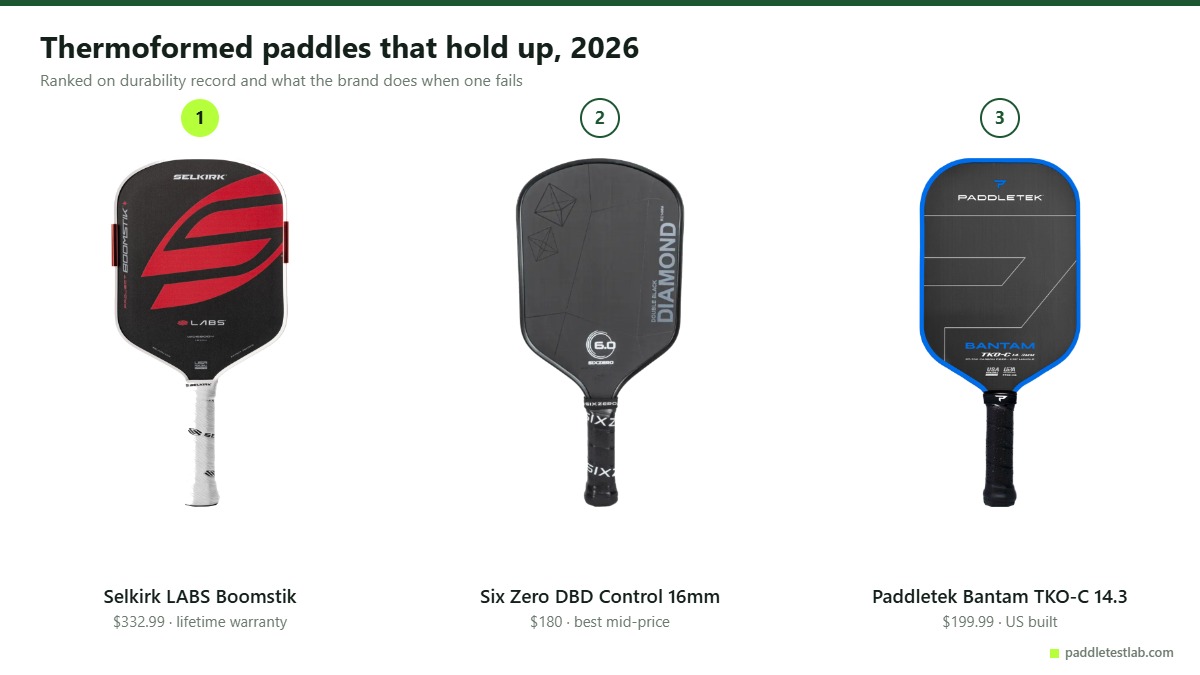
Short answer: the best thermoformed pickleball paddles are the ones with a clean durability record and a warranty behind them, not the ones that felt best in week one. On both counts the Selkirk LABS Project Boomstik leads, with the Six Zero Double Black Diamond Control the best mid-price choice.
Thermoforming gave pickleball the paddles most people now own, and it also gave the sport its worst durability scandal. Both facts belong on the same page.
This ranking is built on track record rather than first impressions. Every paddle below is judged on how the construction has held up, what the brand does when one fails, and which generation of the model to buy.
What Thermoforming Is and Why Brands Moved to It
A traditional paddle is cold-pressed: face sheets glued to a honeycomb core, with a separate plastic edge guard wrapped around the perimeter to hold it together and protect the edge.
A thermoformed paddle is moulded under heat and pressure as a single unit. The carbon face wraps around the edge and bonds to itself, creating a unibody shell. Three things follow:
- The perimeter gets stiff. A rigid edge means less energy lost on off-centre hits, which enlarges the effective sweet spot.
- Pace goes up across the face, not just in the middle. This is why thermoformed paddles felt like a generational jump when they arrived.
- The core takes more load. A stiffer shell transfers more force into the honeycomb behind it — and that is where the trouble started.
Our core types explainer covers how the constructions differ in detail.
Why Early Thermoformed Paddles Delaminated
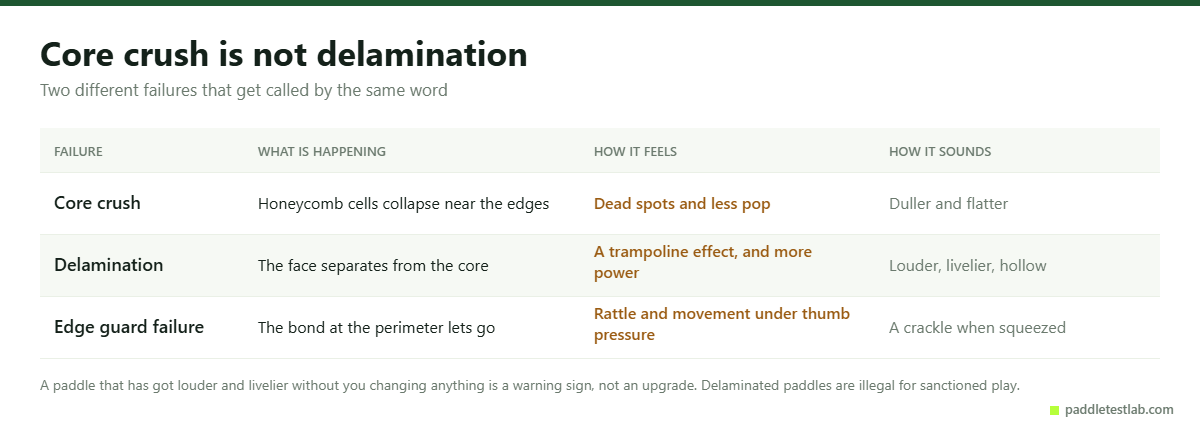
Two distinct failures get lumped together under one word, and telling them apart is the most useful thing on this page.
Core crush is the honeycomb cells collapsing, usually near the edges where the stiff shell concentrates load. The paddle develops dead spots, then a flat, muted sound. It is gradual.
Delamination is the bond between face and core failing. The face separates and starts acting like a trampoline, which — and this is why it became a scandal rather than a warranty issue — makes the paddle hit harder, not softer. A delaminated paddle is illegal and some players kept using them deliberately.
The 2023 to 2025 wave hit first-generation thermoformed paddles from several brands. Manufacturers responded with foam-filled perimeters, revised bonding, and in the Gen-4 case by removing honeycomb entirely. The current generation is materially better. It is not risk-free.
Our guide to spotting delamination covers the sound test and the visual check — do both before buying any thermoformed paddle second-hand.
The Best Thermoformed Pickleball Paddles: Builds With a Clean Record
1. Selkirk LABS Project Boomstik — best record, best warranty
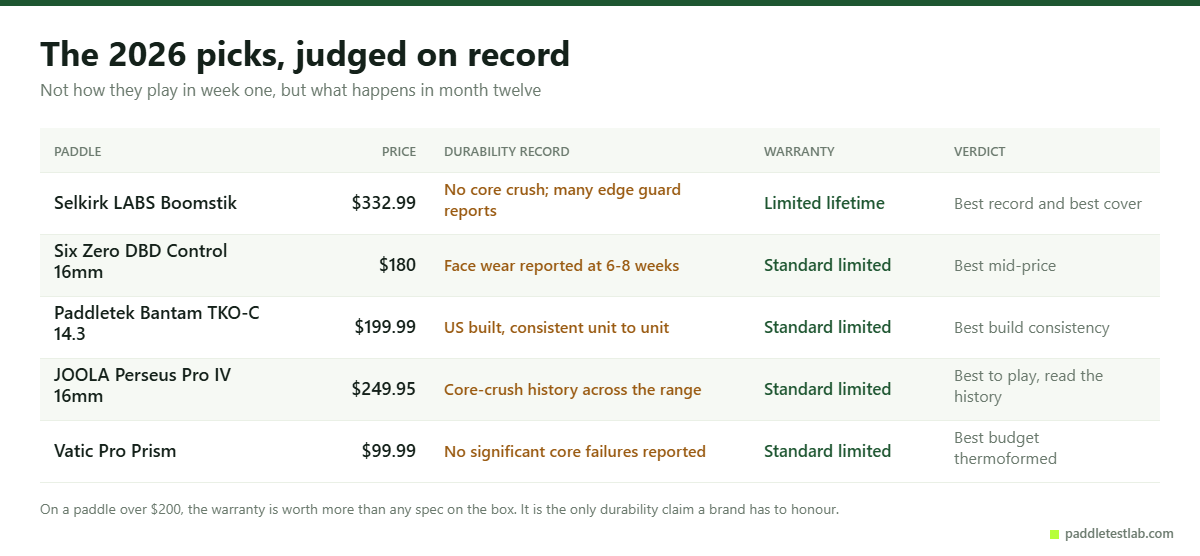
Multistrata T700 carbon with InfiniGrit, no reported core crush, and a limited lifetime warranty. On the two questions this article is about — does it break, and what happens if it does — it has the best answers available.
It is $50 to $100 above comparable paddles and it is hard to control. It also has many reports of loose or failing edge guards. That is a real defect rate, and the only reason it does not sink the paddle is that the warranty covers it.
$332.99 MSRP · 16mm · elongated or widebody · USAP and PPA amateur approved.
2. Six Zero Double Black Diamond Control 16mm — best mid-price
Toray 700K raw carbon, a large sweet spot, strong topspin, and 4.6 out of 5 across 24 reviews at Pickleball Warehouse. The volume of positive feedback is the argument here — this is a paddle a lot of people have played a lot of hours on.
The reported wear pattern is face-side rather than core-side: pop fading and grit wearing within six to eight weeks, and enough face abrasion to scuff balls. The handle is thin. Neither is a structural problem, but both shorten the paddle’s useful life.
$180 · 16mm or 14mm · hybrid.
3. Paddletek Bantam TKO-C 14.3 — best build consistency

Made in the USA, PT-700 raw carbon, and a brand with a long enough history that its manufacturing is a known quantity. Big pop that keeps a usable control floor.
Head-heavy at 116 to 117 swing weight, a stock grip that is not top tier, stiff on soft shots, and very loud. If your court has a noise policy, check it first.
$199.99 MSRP · 14.3mm · elongated · USAP approved since February 2024.
4. JOOLA Perseus Pro IV 16mm — best performance, with a history to read
Easy power, forgiving, large sweet spot, and still the JOOLA most reviewers recommend. As a paddle to play with, it is the best on this list.
Two documented issues rather than rumours: grit and spin fall off after two to four months of heavy use, and JOOLA cores carry a core-crush history. Neither should stop you buying, but both should inform what you pay and how long you expect it to last. Our JOOLA brand review covers the history in full.
$249.95 street ($279.99 MSRP) · 16mm or 14mm · elongated · USAP and UPA-A approved.
5. Vatic Pro Prism — best budget thermoformed
The benchmark $99 carbon paddle: raw Toray T700, plush forgiving feel, three shapes, and grip inserts intended to reduce shock. No significant core-failure reports at this price point, which is genuinely notable.
The face is the weak link — one tester measured around 50% spin loss after two months. Buy it as a control paddle and the wear matters much less.
$99.99 · 16mm or 14mm · three shapes · USAP approved.
The honest alternative: Gearbox GBX Power
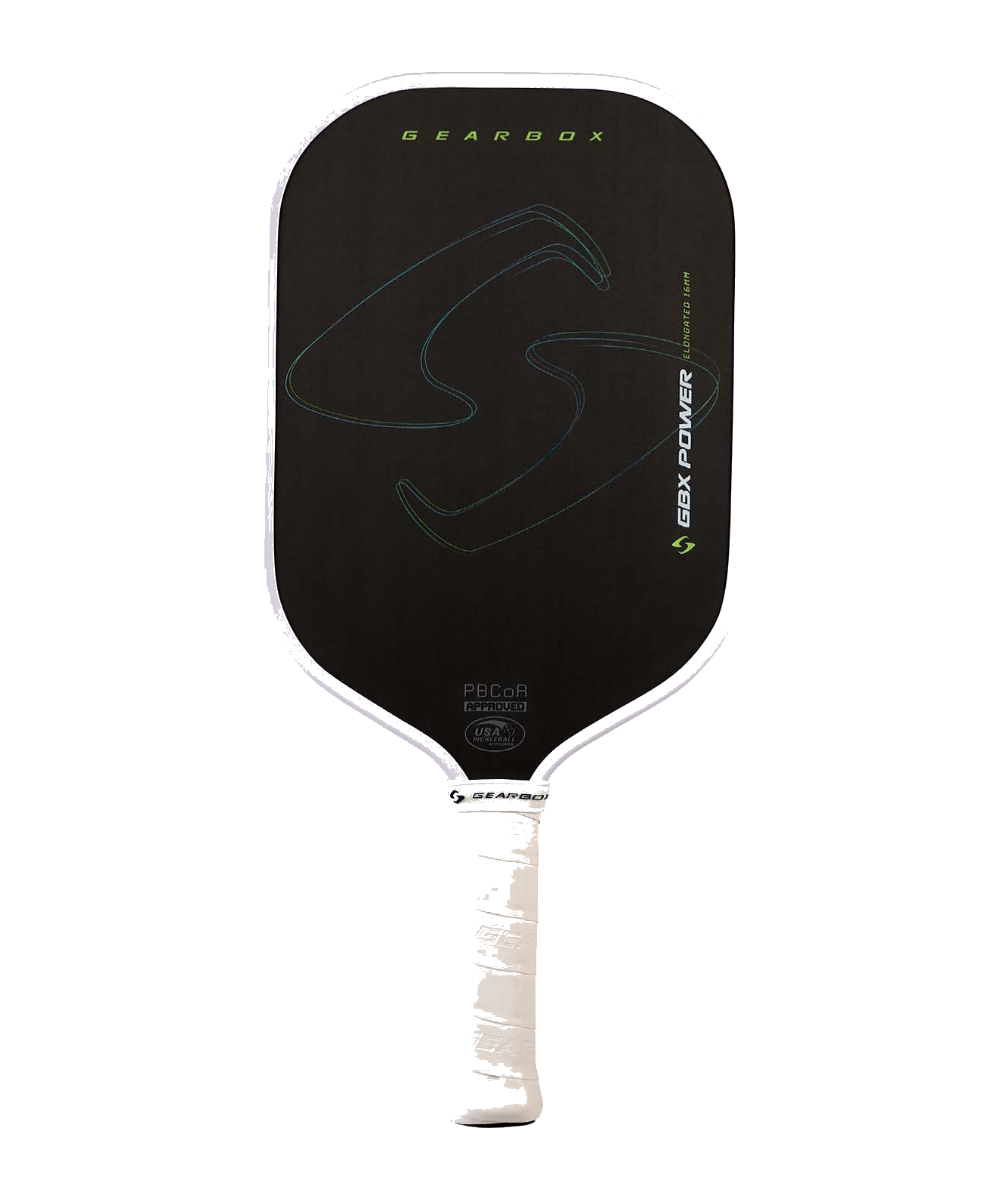
Worth naming because it sidesteps the whole category. Gearbox uses cold-bond construction rather than thermoforming, and the result does not crush or degrade the way pressed cores can. It is stiff, it sacrifices control, spin and forgiveness, and it suits 4.0-plus power players only — but if durability is your overriding concern, it belongs on your shortlist at $179.99.
Warranty Terms, Brand by Brand
A warranty is the only durability claim a brand has to honour, which makes it more informative than any spec.
Selkirk offers a limited lifetime warranty across the LABS line — the strongest terms on this page, and the reason the edge-guard reports are survivable.
Most other brands run a limited period from purchase, typically covering manufacturing defects rather than wear. The practical distinctions are whether the clock starts at purchase or at manufacture, whether the brand pays return shipping, and whether a delaminated paddle counts as a defect or as normal wear. That last one is where claims actually get refused.
We track the current terms side by side in our paddle warranty comparison. Check it before you buy — on a $250 paddle the warranty is worth more than any spec on the box.
How to Check a Paddle for Early Soft Spots
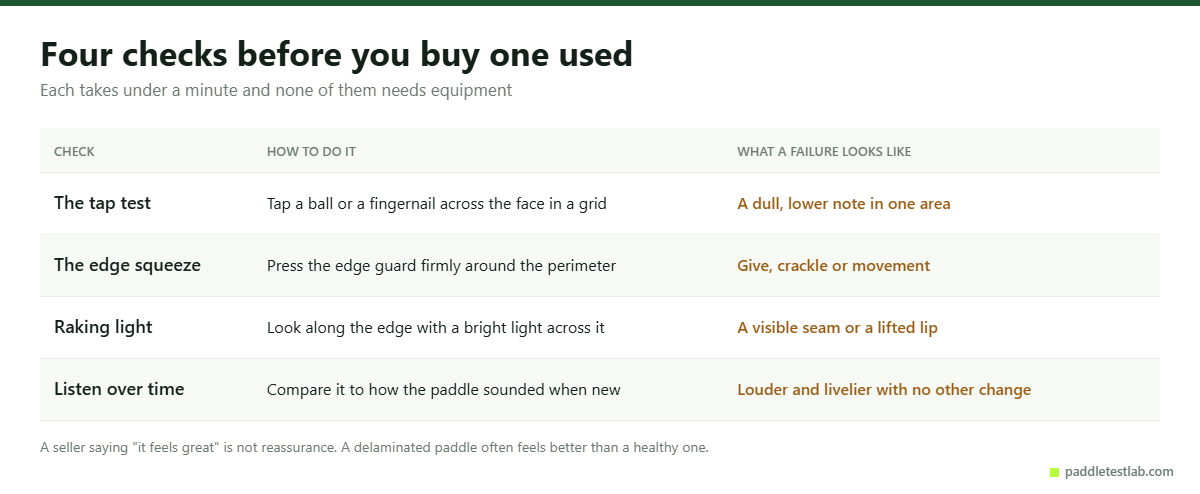
- The tap test. Tap a ball or a fingernail across the face in a grid. A healthy paddle sounds consistent. A dull, lower note in one area is a soft spot.
- The edge squeeze. Press the edge guard firmly around the perimeter. Give, crackle or movement means the bond is going.
- Look along the edge in raking light. A visible seam or lifted lip at the face-to-edge junction is early delamination.
- Listen over time. A paddle that has got noticeably louder and livelier without you changing anything is a warning sign, not an upgrade.
Frequently Asked Questions
Are thermoformed paddles banned?
No. Thermoforming is a manufacturing method, not a regulated property. Individual paddles are approved or not, and every model listed here is approved.
Do all thermoformed paddles delaminate eventually?
No. The wave of failures concentrated on first-generation builds. Current designs use foam-filled perimeters and revised bonding, and the failure rate is far lower — though no brand publishes one.
Should I buy a thermoformed paddle used?
Only after the four checks above, and only at a price that reflects the risk. A delaminated paddle is illegal for sanctioned play and often hits harder, so a seller’s “it feels great” is not reassurance.
Is thermoformed or foam core better?
Foam eliminates core crush and costs more; thermoformed gives you a bigger sweet spot per dollar. For most players below 4.0, a good thermoformed paddle is the better buy — see our foam core guide for the other side.
How long should a thermoformed paddle last?
The face texture typically fades within two to four months of heavy play; the structure should last well beyond a year. If the structure goes first, that is a warranty conversation, not normal wear.
Specifications, warranty terms and prices are checked against each brand’s own store — Selkirk, Six Zero and Paddletek — and were current in July 2026.

Isacc Shah
Isacc Shah writes PaddleTestLab. He does not test paddles in a lab and says so plainly — there is no rig, no radar gun, no staff hitting balls. Instead he aggregates independent bench measurements, manufacturer specifications, USA Pickleball's approval database and hundreds of verified owner reviews per product, then reports where those sources disagree. Every score on the site carries its evidence count. Where a specification is not published, the site writes UNKNOWN rather than estimating it, and the criticism is printed next to the praise.