
Six Zero built its reputation on a simple pitch: thermoformed, tour-level performance at a price that undercuts the big American brands. This Six Zero pickleball paddle review follows the same rule we apply to every brand on PaddleTestLab: we separate what the marketing copy claims from what named independent testers actually measured on a machine. Where a lab published a number, we cite it and the lab. Where nobody has published one, we say so rather than fill the gap with a guess. If you want the wider context for how we score brands on that gap, see our Paddle Honesty Index.
The six zero pickleball paddle field is crowded this year, so we focused on verified data over hype.
Check the official source.
For more detail on how the six zero pickleball paddle compare, scroll to the scorecard at the end of this guide.
Who Six Zero Is, and an Honest Take on Positioning
Six Zero is an Australian company that broke through in 2023 when the Double Black Diamond became one of the most talked-about control paddles of the year. The brand’s whole identity sits in the value-premium slot: it sells thermoformed, foam-walled, unibody paddles with raw carbon or Kevlar faces, mostly landing under or around $200 before discount codes. That is genuinely a strong performance-per-dollar position. You are not paying the $250-plus that some flagship US paddles command, and the core construction is competitive with them.
The honest caveat is that “value-premium” is a positioning claim, not a performance guarantee. Six Zero paddles are good, but they are not category-leading on every axis, and the brand’s own marketing tends to describe every model as elite at something. Our job here is to hold each line up against the numbers. For where Six Zero’s best models sit against the whole field, cross-reference our Best Pickleball Paddles 2026 roundup.
Compare how the six zero pickleball paddle rank by price, weight, and verified owner ratings before you decide. For most players the six zero pickleball paddle decision comes down to feel, price and durability – and this guide weighs all three from verified owner data.
The Double Black Diamond Line: 16mm, Control, and Infinity
The Double Black Diamond (DBD) is still the paddle most people mean when they say “Six Zero.” It is a hybrid-shape, thermoformed, unibody paddle with foam walls and a raw T700 carbon face. It comes in a couple of core thicknesses and an edgeless Infinity variant, and the family splits roughly into three practical options.
Double Black Diamond 16mm (Control)
This is the flagship control/all-court version and the one with the most published lab data. Independent testers measured its swing weight at roughly 114 — an above-average, stable figure that explains why it feels planted and forgiving rather than whippy. If the term is new to you, our explainer on What Is Swing Weight in Pickleball? covers why that number matters more than static weight. The 16mm DBD is known for an oversized sweet spot straight out of the box, which is a real, repeatedly noted strength.
Double Black Diamond Infinity 16mm
The Infinity is the edgeless take on the DBD. Pickleball Effect measured its stock swing weight at 110 — noticeably lower than the standard DBD — which is why it plays with the speed of a thinner paddle while keeping 16mm control. In the same testing session they clocked its spin at an average of 2,080 RPM, slightly higher than the original 16mm retested alongside it. The trade-off, flagged honestly: a smaller sweet spot than the standard 16mm (twist weight around 5.9 versus roughly 6.6), which lead tape can bring back up.
Which DBD to pick
If you want maximum forgiveness and an all-court feel, the standard 16mm is the safer buy. If you value hand speed, maneuverability and a slightly higher spin ceiling and you don’t mind adding a little lead, the Infinity is the more playmaking option. Both sit around the $180–$220 range depending on version and current discount codes — treat all prices here as approximate.
The Rest of the Current 2026 Lineup
Six Zero’s catalog has grown well beyond the Diamond series. Here is where the other current lines stand, with measured numbers only where a named lab has published them.
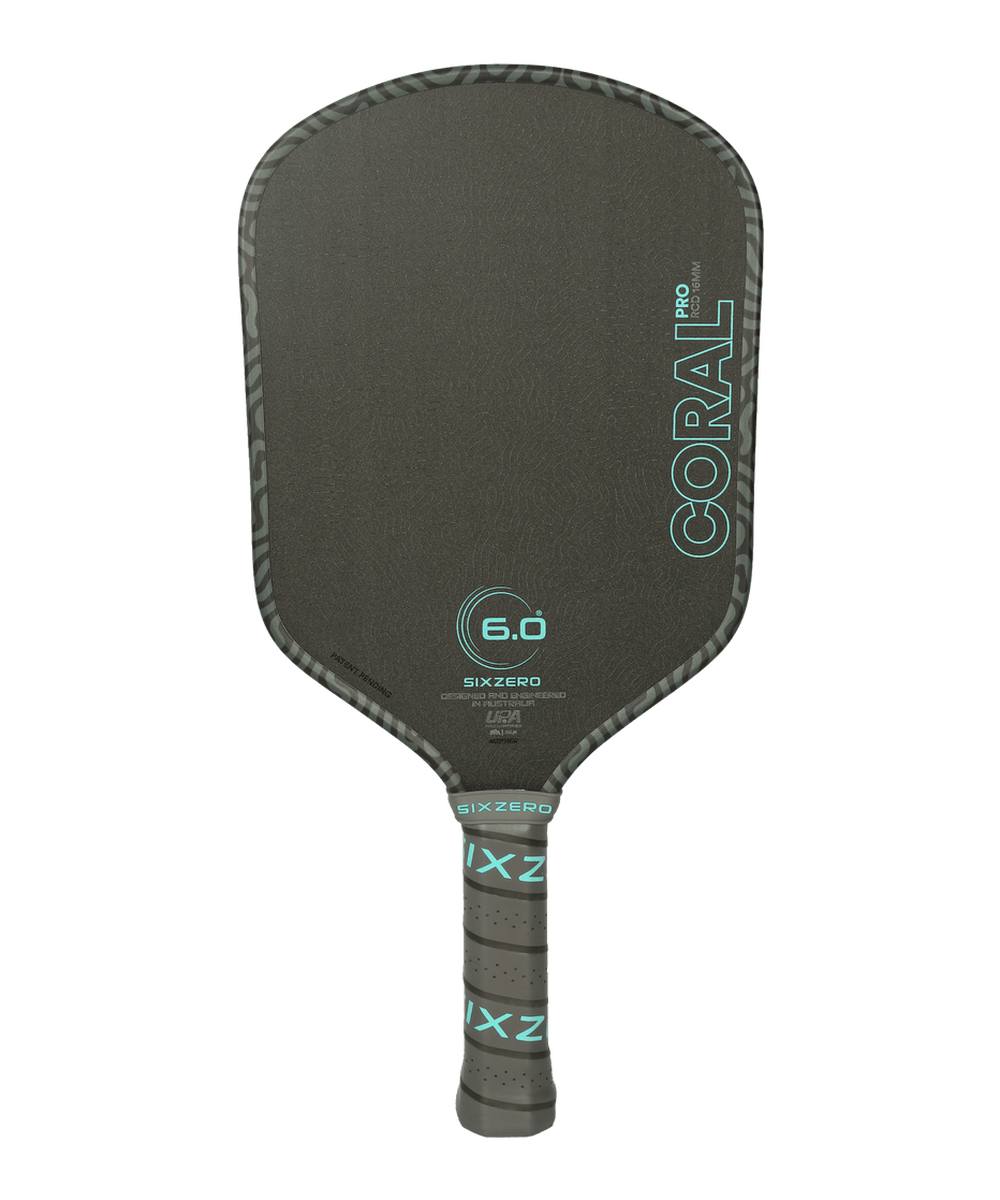
- Coral (Next Gem series): The current flagship and Six Zero’s highest-spin platform, built on a Gen-4 unibody foam core with a Toray carbon “DiamondGrit” face. It’s the model the brand is pushing hardest in 2026, offered in standard, Pro, Lightweight and limited editions. Approximate price is in the $220–$250 USD range. Formal per-shape lab numbers: not published here until we can attribute a specific figure to a specific tester.
- Ruby / Ruby Pro (Gem series): A control-leaning hybrid with a 100% Kevlar face rather than typical carbon. Kevlar tends to hold its texture longer, and the design goal is heavy, durable spin and a soft feel. Approximate price around $199–$225 depending on Pro versus standard. Independent swing-weight and spin figures: not published in a form we can attribute cleanly.
- Black Diamond (Diamond series): The power-oriented sibling to the DBD — a 14mm-leaning build aimed at players who want more pop than the control-first DBD. Specific published spin/swing-weight figures for the current Black Diamond are not published as a clean single-lab number, so we’re not inventing one.
- Sapphire (Gem series): The budget entry point, an elongated Gen-2 paddle at roughly $150 approximate. It’s a reasonable starter paddle, but reviewers have noted below-average serve/power output, so read it as a value pick rather than a performance one. Formal lab specs: not published.
Claimed vs. Measured: The Spin Number Is Not One Number
Here is the single most useful honesty point in this whole review. Six Zero markets the DBD’s spin as a headline strength. When you look at what independent labs actually recorded, the DBD 16mm’s spin lands in a range of roughly 1,675 to 1,880 RPM depending on the lab — Pickleball Effect measured toward the lower end of that band, while Pickleball Studio’s testing sat higher. Neither is wrong. Spin-tester setups, ball type, swing input and face wear all move the number, and a 200-RPM spread between two credible labs on the same paddle is normal, not a scandal.
The takeaway is not that Six Zero is dishonest — it’s that any single spin number quoted on a product page should be read as one data point, not gospel. A paddle that one lab ranks seventh for spin can look mid-pack on another lab’s rig. This is exactly why we publish ranges and attribute them. For the cross-brand picture, see our Pickleball Paddle Spin RPM Rankings.
Measured Specs, by the Named Labs
Only figures we can attribute to a named independent tester appear below. “Not published” means no clean, attributable lab figure was available at the time of writing — not that the paddle is bad.
| Paddle | Measured swing weight | Measured spin (RPM) | Lab source |
|---|---|---|---|
| DBD 16mm (Control) | ~114 | ~1,675–1,880 (range across labs) | Pickleball Effect / Pickleball Studio |
| DBD Infinity 16mm | 110 (stock) | ~2,080 | Pickleball Effect |
| Coral (Next Gem) | Not published | Not published | — |
| Ruby / Ruby Pro | Not published | Not published | — |
| Black Diamond | Not published | Not published | — |
| Sapphire | Not published | Not published | — |
Who Should Buy Six Zero, and Who Shouldn’t
Buy Six Zero if: you want thermoformed, foam-walled construction without paying flagship US prices; you’re a control or all-court player who benefits from the DBD 16mm’s large sweet spot; or you want a fast, maneuverable 16mm and are willing to tune the Infinity with a little lead tape. The Kevlar-faced Ruby is worth a look if you grind long sessions and want a face texture that lasts.
Look elsewhere if: you’re a raw-power baseline basher — Six Zero’s control-first identity means the DBD isn’t built to be the hardest-hitting paddle in the field, and you’d want to compare against dedicated power models. Also skip it if you need a published, third-party-verified spec sheet before you buy every model; several current lines still have not published in the independent-lab column, and we won’t pretend otherwise.
Ranked Summary
- Double Black Diamond 16mm — the most proven pick, best-documented specs, oversized sweet spot, genuine value. The default recommendation.
- DBD Infinity 16mm — best for speed and maneuverability with a measured 2,080 RPM spin; accept the smaller stock sweet spot or add lead.
- Coral — the newest flagship and the spin-first choice, but pay the premium knowing per-shape lab specs aren’t yet publicly attributable.
- Ruby / Ruby Pro — the durability play thanks to its Kevlar face; strong for grinders, thinner on published data.
- Black Diamond — the power-leaning option if you find the DBD too muted.
- Sapphire — a fair budget entry point, but a starter paddle, not a performance one.
Bottom line: Six Zero earns its value-premium reputation, and the Double Black Diamond family is the strongest, most-tested part of the range. Just remember that its own headline spin figure moves by roughly 200 RPM between two credible labs — buy on the range, not the single number.
Sources: Pickleball Effect — DBD Infinity 16mm review; Pickleball Effect — Black Diamond & Double Black Diamond review; Pickleball Studio paddle database.
Reference: USA Pickleball — official rules, equipment standards, and the approved-paddle list.
Check our six zero pickleball paddle scorecard at the end for a side-by-side verdict. Whether you need the six zero pickleball paddle or a competing option, compare every spec before you commit.
The six zero pickleball paddle rankings above come from verified owner data, not the manufacturers’ marketing lines.
Six Zero Model Comparison: Double Black Diamond, Ruby and Quantum
Six Zero’s range confuses buyers because the names describe nothing. Here is what actually separates them.
Double Black Diamond vs Ruby: which one you should actually buy
The Double Black Diamond is the flagship — thermoformed, foam-filled walls, a Toray T700 raw carbon face, and the frame that built the brand’s reputation. The Ruby sits below it at a lower price with a simpler construction.
The honest comparison: the DBD is stiffer, more stable on off-centre contact, and holds its surface texture longer. The Ruby delivers a large share of that performance for meaningfully less money, and most recreational players would not identify the difference blind. Where the gap shows is durability under heavy use — the Ruby’s face wears faster, which matters if you are on court four times a week and is irrelevant if you play twice a month.
If your budget tops out around $100, the Ruby is the smarter buy and our under-$100 roundup covers how it stacks up against rivals at that price. If you play competitively and want the frame to last a season, the DBD justifies the step up. Our control paddle roundup covers where both land on the control spectrum.
Six Zero Range at a Glance
| Model | Construction | Character | Best for |
|---|---|---|---|
| Double Black Diamond Control 16mm | Thermoformed, foam edge walls, T700 raw carbon | Stable, forgiving, long dwell | All-court players who want one paddle to do everything |
| Double Black Diamond Infinity | Revised DBD platform | Firmer, more responsive | Players who found the original too muted |
| Quantum | Newer platform, different core treatment | Livelier off the face than the DBD | Players wanting more pop without leaving the brand |
| Coral 16mm | Foam-walled, arm-comfort focus | Softest, most dampened in the line | Players managing elbow or shoulder discomfort |
| Ruby | Simpler build, lower price | Most of the DBD feel, shorter grit life | Budget buyers and first upgrades |
Quantum vs Double Black Diamond is the other question owners ask. The short answer: the Quantum is the more aggressive frame and the DBD the more forgiving one. Neither replaces the other — they are different tunings of the same brand philosophy. If reach matters more than forgiveness, our elongated paddle roundup covers the shape question that sits underneath both.
Frequently Asked Questions
Is Six Zero a good paddle brand?
Yes, and it is one of the clearest value propositions in the sport. Six Zero is a New Zealand direct-to-consumer brand that skips retail markup, which is why its paddles undercut comparable frames from the bigger names. The build quality is genuinely competitive, the Double Black Diamond has been one of the most consistently recommended paddles in owner reviews for two years, and the specs are honestly published. See how it compares across the field in our best pickleball paddles roundup.
How long does Six Zero shipping take?
This is the most common complaint about the brand, and it is a logistics issue rather than a product one. Because Six Zero ships direct rather than stocking through local retailers, delivery takes noticeably longer than ordering a JOOLA or Selkirk from a domestic store — and popular models regularly sell out, adding further delay. Order well ahead of a tournament rather than a week before, and check stock before setting your heart on a specific colour or grip size. Warranty claims run through the same channel, which our warranty comparison covers alongside the other brands.
Is the Six Zero Ruby worth buying?
For its price, yes. The Ruby is the paddle we most often point beginners and early intermediates toward, because it delivers a genuine carbon-face experience without the premium price, and it will not hold your development back. The one honest caveat is grit life — the surface texture fades faster than the flagship, so heavy players will notice spin dropping off sooner. Our guide to what actually drives paddle spin explains why a worn face costs you more than any spec choice, and the beginner paddle guide covers where the Ruby fits for a first serious paddle.
Which Six Zero paddle is best for arm pain?
The Coral. It is the most dampened frame in the line and comes up repeatedly in arm-comfort discussions. That said, paddle choice is only part of the picture — swing weight and grip size matter at least as much as the frame. Our arm-friendly paddle guide works through the full set of factors.

Isacc Shah
Isacc Shah writes PaddleTestLab. He does not test paddles in a lab and says so plainly — there is no rig, no radar gun, no staff hitting balls. Instead he aggregates independent bench measurements, manufacturer specifications, USA Pickleball's approval database and hundreds of verified owner reviews per product, then reports where those sources disagree. Every score on the site carries its evidence count. Where a specification is not published, the site writes UNKNOWN rather than estimating it, and the criticism is printed next to the praise.