

Short answer: in CRBN vs Six Zero, CRBN is the performance brand and Six Zero is the usable one. The CRBN 1 TruFoam Genesis gives more dwell, more spin and more swing weight; the Six Zero Coral gives more comfort, more shapes and about eighty dollars back.
CRBN and Six Zero end up on the same shortlist constantly, because they are solving the same problem for the same buyer: a serious paddle, modern construction, somewhere between $180 and $280, without paying for a pro signature.
Nobody has written this comparison properly, so here it is — range against range, price against price, and a straight answer on where the extra hundred dollars actually goes.
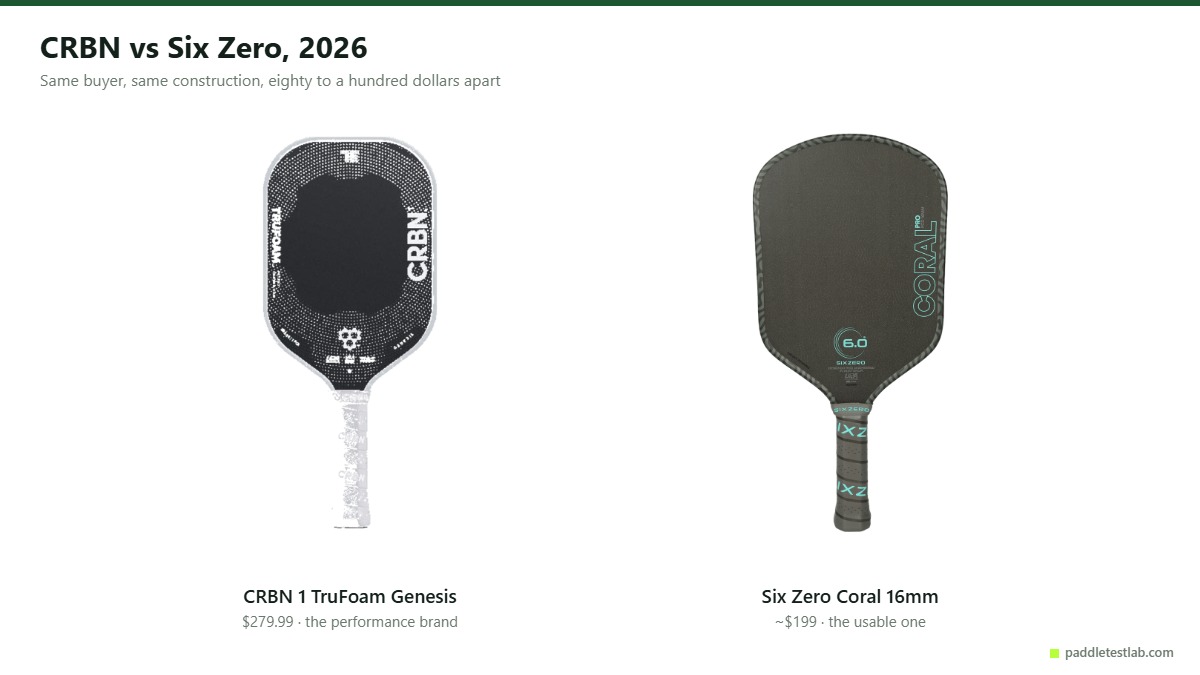
Two Brands Built on the Same Idea
Both are direct-to-consumer brands that skipped the retail markup and the endorsement budget, and both moved early to foam construction when core crush became the sport’s defining defect.
CRBN is the more aggressive of the two. Its TruFoam Genesis line is 100% foam, it is built for spin and power, and it asks for technique in return. CRBN paddles tend to be elongated, high in swing weight, and unforgiving of poor contact.
Six Zero is the more accommodating. The Double Black Diamond built the brand’s reputation on a large sweet spot and strong topspin at a mid price, and the newer Coral takes the comfort route with a dense but soft full-foam core. Six Zero paddles are generally easier to play.
That is the headline: CRBN is the performance brand, Six Zero is the usable one.
Shape for Shape — What Each Range Offers
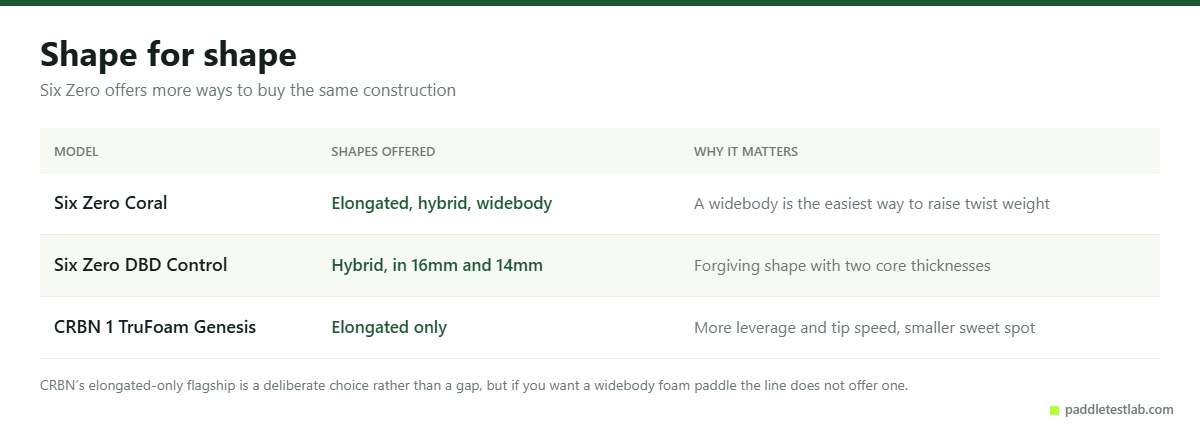
Six Zero is broader. The Coral is offered in elongated, hybrid and widebody; the Double Black Diamond comes as a hybrid in 16mm and 14mm. A widebody option matters more than most spec sheets suggest — it is the single easiest way to raise twist weight and make off-centre hits stop stinging.
CRBN‘s TruFoam Genesis is elongated. That is a deliberate choice rather than a gap: elongated shapes give more leverage and tip speed, which is what the paddle is for. But if you want a widebody foam paddle, CRBN’s flagship line does not offer you one.
If you are unsure which shape suits you, our elongated vs standard guide covers the trade-offs, and the widebody roundup explains when the extra stability is worth it.
CRBN vs Six Zero, Spec for Spec
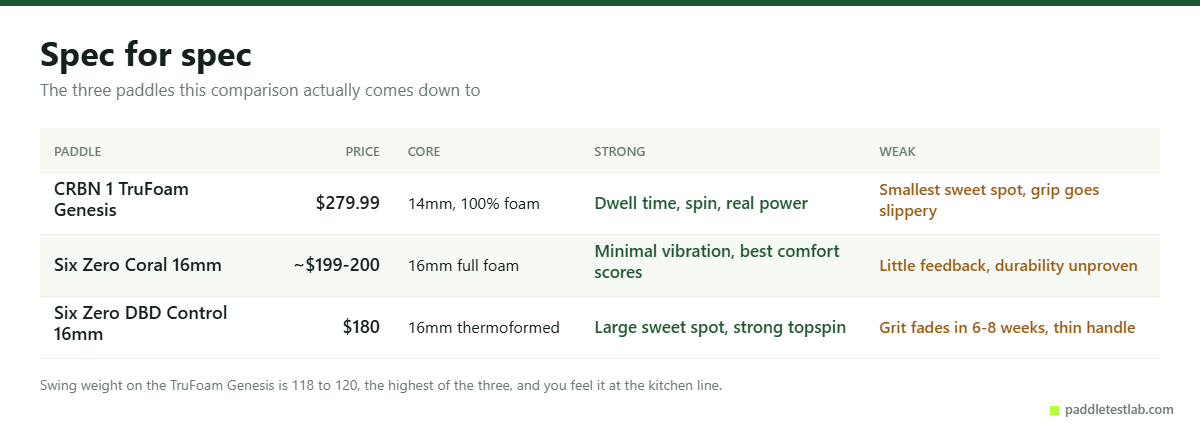
CRBN 1 TruFoam Genesis
$279.99 MSRP · 14mm, 100% foam core · T700 raw carbon and fiberglass face · elongated · 7.8–8.1 oz · swing weight 118–120 · USAP approved.
Strong: excellent dwell time and spin, no core crush by construction, genuine power.
Weak: smallest sweet spot in CRBN’s series, stock grip reported to go slippery, the highest swing weight in this comparison.
Six Zero Coral 16mm
~$199–200 MSRP · 16mm dense soft full-foam core · Diamond Tough raw carbon face · elongated, hybrid or widebody · 7.9–8.2 oz (avg 8.05) · USAP approved.
Strong: minimal vibration and the best comfort scores of any paddle we track, three shapes, no core crush.
Weak: gives little feedback, long-term durability unproven, thick grip that suits large hands only.
Six Zero Double Black Diamond Control 16mm
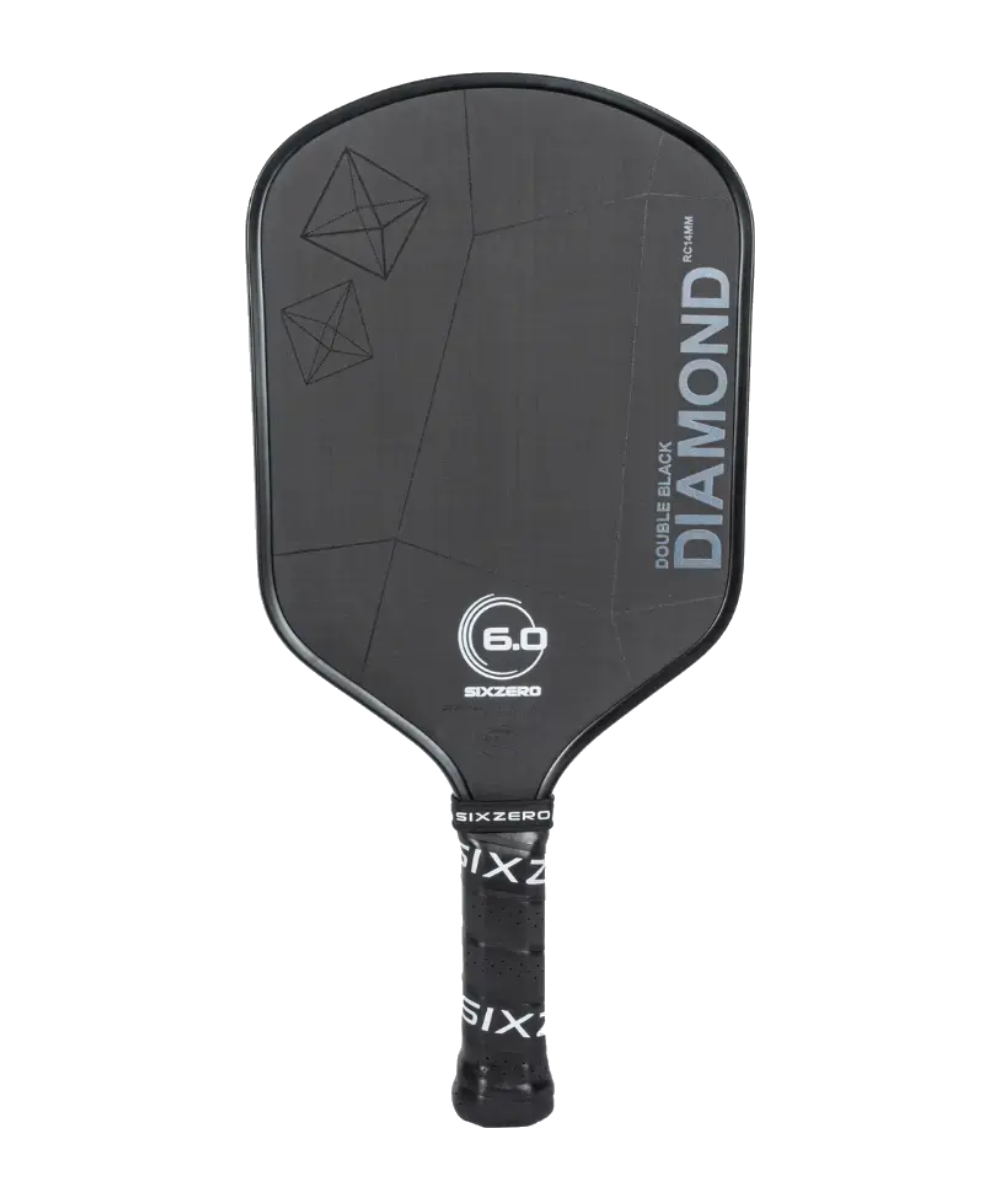
$180 · 16mm (14mm also offered) · Toray 700K raw carbon face · hybrid · 8.1 oz average.
Strong: large sweet spot, strong topspin, 4.6 out of 5 across 24 reviews at Pickleball Warehouse.
Weak: reports of pop fading and grit wearing within six to eight weeks, thin handle, enough face abrasion to scuff balls.
Price After Discount Codes, Not MSRP
Both brands sell direct and both discount, which makes MSRP comparison close to meaningless.
The real spread is roughly this: Six Zero’s DBD Control at $180 is the cheapest serious paddle in the comparison; the Coral sits around $199 to $200; CRBN’s TruFoam Genesis sits at $279.99. Codes move all three, and Six Zero discounts more often.
So the practical question is not “CRBN or Six Zero” but “is the TruFoam Genesis worth eighty to a hundred dollars more than a Coral?” The answer depends entirely on whether you will use what it gives you.
Where the Extra Hundred Dollars Goes
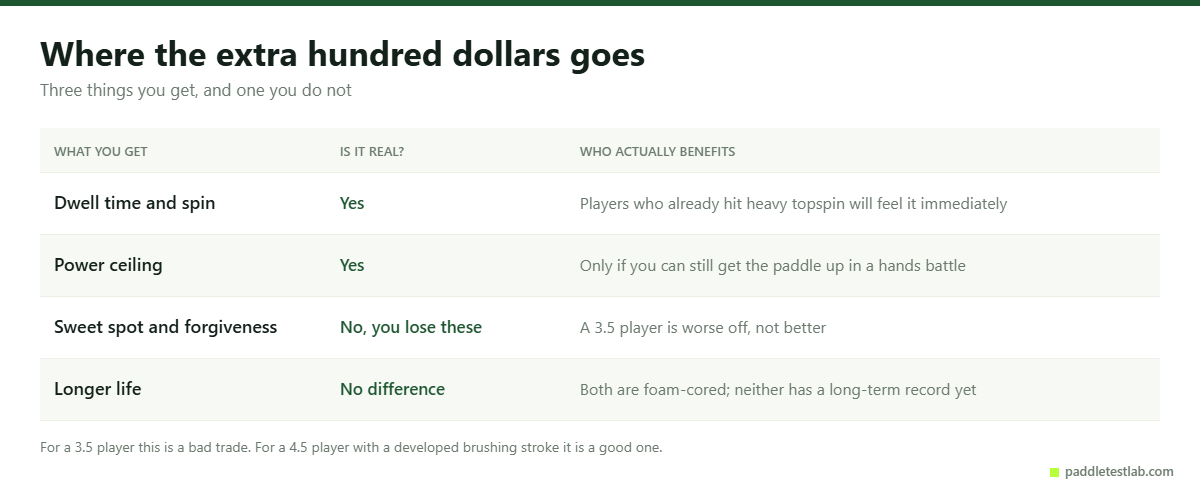
Three things, honestly stated.
Dwell time and spin. CRBN’s 14mm all-foam build produces a longer contact window than Six Zero’s 16mm foam, and that converts a brushing stroke into more rotation. If you already hit heavy topspin, you will feel this.
Power ceiling. The higher swing weight carries more momentum into the ball. Whether that is a feature depends on whether you can still get the paddle up in a hands battle.
Nothing on durability. Both are foam-cored, both eliminate core crush, and neither has a long-term record because the construction is too new. You are not paying CRBN for a longer life.
What you give up for that hundred dollars is sweet spot, forgiveness, and shape choice. For a 3.5 player that is a bad trade. For a 4.5 player with a developed brushing stroke it is a good one.
Durability and Warranty Compared
Neither brand offers anything like Selkirk’s limited lifetime warranty, which is worth knowing before you spend at this level. Both run standard limited terms covering manufacturing defects.
On failures, the picture is: no core crush reported on either brand’s foam builds, which is the point of foam. Face wear is the live issue, and it is Six Zero’s DBD that carries the reports — grit and pop fading within six to eight weeks of regular play. The Coral and the TruFoam Genesis are both too recent for a verdict.
Our warranty comparison tracks the current terms for both.
The Verdict by Playing Style
- 4.5-plus power and spin player: CRBN 1 TruFoam Genesis. You will use the dwell time and the swing weight, and the small sweet spot will not cost you.
- 3.5 to 4.0 all-court player: Six Zero Coral. Comfort, three shapes, and eighty dollars saved.
- Value buyer who wants topspin: Six Zero Double Black Diamond Control at $180, accepting that the face will fade inside a season.
- Anyone with arm trouble: Six Zero Coral, and it is not close. The Coral has the best comfort scores we track; the TruFoam Genesis has the highest swing weight here.
- Small hands: neither, without trying first. Both brands have thick-grip complaints.
Frequently Asked Questions
Which is closer to a JOOLA Perseus?
CRBN’s TruFoam Genesis — elongated, high swing weight, power-first. It is the more demanding of the two, in the same way the Perseus is. Our JOOLA vs Selkirk comparison covers that side of the market.
Which is better for a 3.5 player?
Six Zero, in either model. The larger sweet spot and lower swing weight will produce better results than the CRBN’s extra ceiling, which a 3.5 game cannot reach yet.
Do either of them delaminate?
Foam cores eliminate core crush, not delamination — the two get confused constantly. Neither brand’s foam line has a significant delamination record, but both are recent. Our delamination guide explains what to check.
16mm or 14mm?
The CRBN is 14mm and the Six Zeros are 16mm, so this choice is partly made for you by the brand. In general 16mm gives more control and vibration damping, 14mm more pop — see our 14mm vs 16mm comparison.
Where can I read full reviews of each?
We cover both brands in depth: the CRBN paddle review and the Six Zero paddle review.
Ranges, specifications and prices are checked against CRBN and Six Zero directly, and were current in July 2026.

Isacc Shah
Isacc Shah writes PaddleTestLab. He does not test paddles in a lab and says so plainly — there is no rig, no radar gun, no staff hitting balls. Instead he aggregates independent bench measurements, manufacturer specifications, USA Pickleball's approval database and hundreds of verified owner reviews per product, then reports where those sources disagree. Every score on the site carries its evidence count. Where a specification is not published, the site writes UNKNOWN rather than estimating it, and the criticism is printed next to the praise.