
Pickleball paddle delamination signs matter because a paddle that looks fine can already be failing where you can’t see it — inside the bond between the face and the core. This guide pulls together what verified owners actually report when their paddles start to go, cross-checked against manufacturer warranty language and the material realities of core-to-face construction. No single tester’s paddle story. Just the aggregated pattern.
What Is Paddle Delamination and Why It Happens
Delamination is the separation of the paddle’s face material — usually carbon fiber or fiberglass — from the core underneath it. Think of a paddle as a sandwich: two thin skins bonded to a foam or polymer core. When that bond weakens or breaks, the skin stops transferring energy evenly into the core, and the paddle’s performance goes patchy.
Core-to-face bond failure explained
Paddle faces are glued or thermally bonded to the core during manufacturing. That bond is under constant stress every time the paddle strikes a ball — thousands of small impacts, over and over. Over time, especially with paddles that use traditional bonding rather than thermoformed unibody construction, that adhesive layer can weaken. Once it separates in one spot, the surrounding area tends to follow.
Common causes: heat, humidity, impact stress
Owner reports point to three repeat offenders. Heat is the biggest one — paddles left in a hot car trunk or garage show up again and again in complaint threads as the trigger for early bubbling. Humidity swings get blamed too, particularly for players who store paddles in un-climate-controlled sheds or bags left outdoors. And straightforward impact stress — mishits off the edge, paddle-on-paddle contact, drops on concrete — accelerates bond fatigue even on paddles that never see extreme temperatures.
The Telltale Signs of a Delaminating Paddle
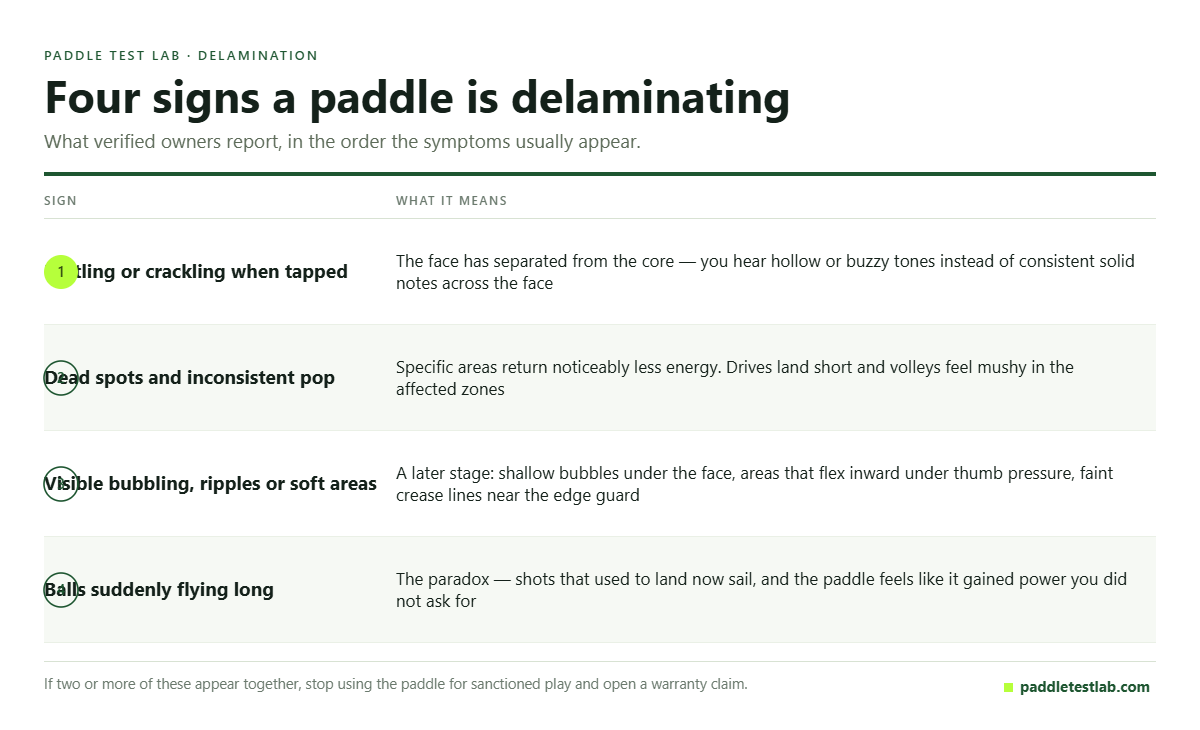
Here’s what shows up most often in verified owner accounts, roughly in the order players notice them.
Rattling or crackling sound when tapped
This is the single most-cited early warning sign. Owners describe a rattle or crackle when tapping the paddle face, distinct from the solid “thock” of a healthy face. The sound comes from the separated skin flexing against the core instead of moving with it. Tap the face lightly with a knuckle in a grid pattern from throat to tip — a healthy paddle sounds consistent everywhere, while a delaminating one changes pitch or buzzes over the failed zone.
Dead spots and inconsistent pop
The second most-reported sign is a dead spot: a region of the face where the ball comes off with noticeably less energy. Owners describe drives that suddenly land short and volleys that feel mushy through one section of the paddle while the rest still feels lively. Because the failed bond stops transferring energy into the core, the effect is localized — which is exactly what separates delamination from ordinary, even wear.
Visible bubbling, ripples, or soft areas
In later stages, the separation becomes something you can see or feel. Owners report shallow bubbles or ripples under the face sheet, a spot that flexes inward under thumb pressure, or a faint crease line near the edge guard. By this point the paddle is usually past saving, and complaint threads shift from “what is this sound” to “how do I file a warranty claim.”
What to Do If You Suspect Delamination
Document it and check your warranty window
Photograph or record the tap test, note when the symptoms started, and check the manufacturer’s warranty terms before doing anything else. Major paddle brands generally cover delamination as a manufacturing defect within a limited window — terms vary by brand and retailer, so read the specific policy for your paddle rather than assuming. Warranty threads consistently show that claims filed with clear photo or video evidence get resolved faster than descriptions alone.
Retire it from competitive play
A delaminating paddle doesn’t just perform worse — a failing core changes how the face responds, which can push a paddle outside the behavior it was approved with. If a paddle fails the tap test, stop using it for sanctioned play and start the warranty process.
How to Reduce the Risk
You can’t prevent a genuine manufacturing defect, but owner-report patterns point to three habits that cut avoidable failures: never leave a paddle in a hot car or direct sun, store it indoors in a climate-stable space rather than a garage or shed, and use a cover or padded bag so edge knocks and drops don’t stress the bond. None of this is exotic — the same heat-and-impact story repeats across nearly every delamination complaint thread.
The Bottom Line
Delamination announces itself early if you know what to listen for. The progression owners report is consistent: rattle or crackle first, dead spots second, visible bubbling last. Check your paddle with the tap test every few weeks, keep it out of hot cars, and act inside your warranty window the moment the sound changes. A paddle that fails the tap test won’t heal — but caught early, it’s usually the manufacturer’s problem to fix, not yours.
How to Test a Paddle for Delamination
Four checks, in order of how reliable they are. None needs equipment.
1. The knuckle tap. Hold the paddle by the handle and tap across the face with a knuckle in a grid pattern — centre, then out toward each edge. A healthy paddle produces a consistent note everywhere. A delaminated one changes pitch over the affected area, usually going hollower or duller, and sometimes produces a faint rattle. Compare against an identical paddle if you can.
2. The edge inspection. Run a fingernail along the seam where the face meets the edge guard. Any lifting, gapping or softness is a problem. On thermoformed paddles the face wraps the perimeter, so separation frequently shows here first.
3. The flex test. Press firmly on the face with your thumb in several places. It should feel uniformly solid. Any area that gives more than the rest, or feels spongy, indicates the bond underneath has failed.
4. The play test. This is the one owners notice first without looking for it. A delaminated paddle gets livelier, not deader — balls start flying long off shots that used to land, and the paddle feels like it has gained power you did not ask for. If your dinks have suddenly started sailing, check the face before you blame your technique.
If two or more of these point the same way, stop using the paddle for sanctioned play and start a warranty claim — our brand warranty comparison covers who covers delamination and who treats it as wear.
Which paddles delaminate most?
The honest answer is a construction type rather than a brand: thermoformed paddles. Thermoforming bonds the face to a foam-filled perimeter under heat and pressure, and that bond is the thing that fails. Any paddle built this way carries the risk.
JOOLA gets named most often, but that reflects scale and visibility rather than a uniquely bad failure rate — several brands have had models decertified over it, and the issue tracked the industry-wide shift to thermoforming around 2023. What genuinely reduces exposure is a construction with no face-to-core bond at all: full-foam cores and unibody carbon frames remove the failure mode entirely rather than engineering around it.
Worth separating from delamination is core crush, where the honeycomb collapses under repeated impact. That makes a paddle noticeably deader rather than livelier, usually in a specific spot. Both are terminal; they just fail in opposite directions. Our guide to paddle core types covers which constructions are exposed to which failure.
Is a Delaminated Paddle Illegal?
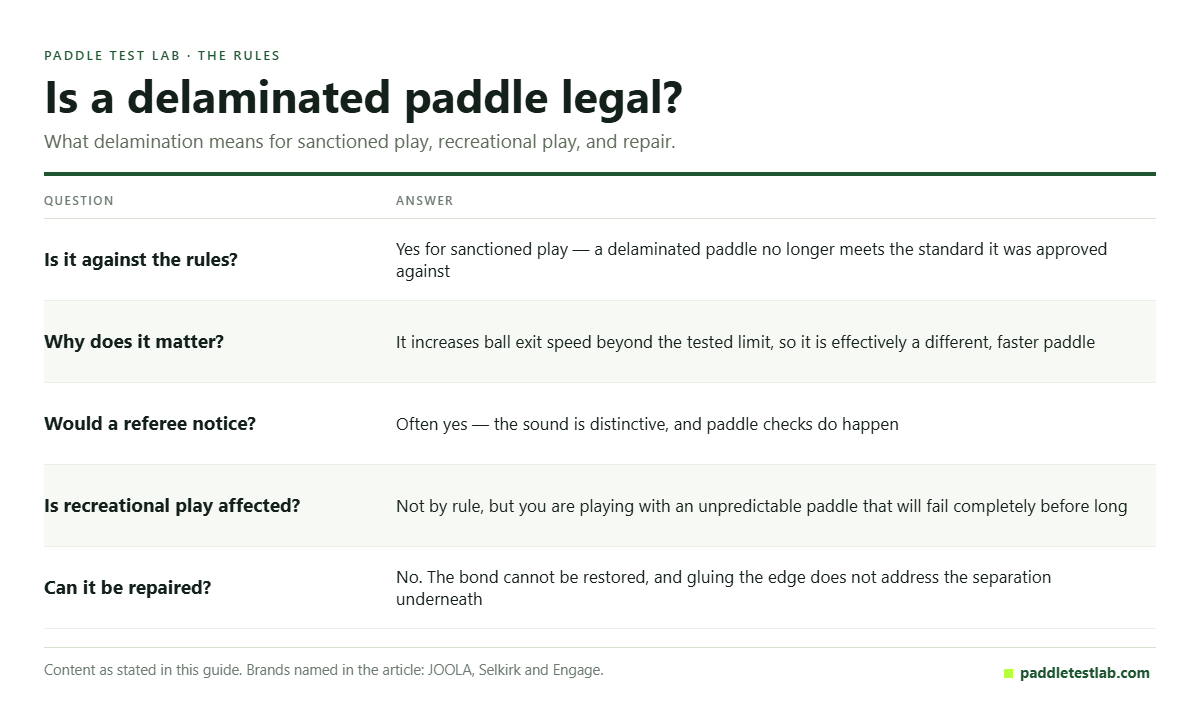
| Question | Answer |
|---|---|
| Is it against the rules? | Yes for sanctioned play — a delaminated paddle no longer meets the standard it was approved against |
| Why does it matter? | Delamination increases ball exit speed beyond the tested limit, so the paddle is effectively a different, faster paddle |
| Would a referee notice? | Often yes — the sound is distinctive, and paddle checks do happen |
| Is recreational play affected? | Not by rule, but you are playing with an unpredictable paddle that will fail completely before long |
| Can it be repaired? | No. The bond cannot be restored, and gluing the edge does not address the separation underneath |
The compliance point catches people out because the paddle was legal when they bought it. Approval attaches to the paddle as manufactured, and a failed bond changes its behaviour — our explainer on how USA Pickleball approval works covers why models get removed from the list and how to check yours.
Frequently Asked Questions
What does a delaminated paddle sound like?
Hollower, and often rattly. A healthy paddle gives a consistent, fairly crisp note across the whole face. A delaminated one produces a duller or more echoing sound over the separated area, and some develop an audible buzz or rattle as loose material moves inside.
The change is usually gradual enough that the owner does not register it, which is why the knuckle-tap comparison is worth doing periodically rather than only when you suspect something. Players who practise against a wall notice it soonest, because the repetitive identical contact makes any change in tone obvious. As an aside, a delaminated paddle is also louder in play — which matters if you play somewhere with noise restrictions, as our guide to quiet paddles and HOA rules covers.
Will a warranty cover a delaminated paddle?
It depends entirely on the brand, and this is where warranty terms stop being a marketing line and start mattering.
Selkirk advertises lifetime coverage across much of its range and delamination falls squarely within manufacturing defect. Engage‘s no-dead-spot term explicitly names a related failure. JOOLA handles cases individually, and reported outcomes vary — which is the most common complaint about the brand. Smaller direct-to-consumer brands generally honour claims but turn them around more slowly.
What helps your claim: photographs showing the lifting or separation, a clear description of the sound change, proof of purchase from an authorised seller, and filing promptly rather than after another three months of play. What sinks it: buying second-hand, buying from a marketplace seller, or continuing to play until the paddle fails completely. Our warranty comparison across brands sets out who covers what.

Isacc Shah
Isacc Shah writes PaddleTestLab. He does not test paddles in a lab and says so plainly — there is no rig, no radar gun, no staff hitting balls. Instead he aggregates independent bench measurements, manufacturer specifications, USA Pickleball's approval database and hundreds of verified owner reviews per product, then reports where those sources disagree. Every score on the site carries its evidence count. Where a specification is not published, the site writes UNKNOWN rather than estimating it, and the criticism is printed next to the praise.