

If you searched for the best pickleball paddle cover, you probably expected a top-five list with prices and star ratings. We’re not going to fake one. This article explains exactly what a good paddle cover needs to do, what owners across the broader gear category consistently complain about, and why we’re holding off on naming specific cover models until we’ve pulled the same kind of verified owner-review data we use for paddles, shoes, and bags.
How We Evaluated Pickleball Paddle Covers
We built this guide the same way we build every buying guide on PaddleTestLab: by aggregating verified owner reviews and independent published data, not by handing down a single opinion. For paddles, shoes, and bags, that process means pulling review text from major retailers and manufacturer sites, then looking for patterns — what gets praised over and over, what gets criticized over and over, and where manufacturer marketing claims don’t match what owners actually report months into ownership.
Our research process: aggregating owner reviews and published data
For every product category we cover, we look at review volume, review recency, and specific complaint clusters — things like zipper failures, sizing mismatches, or material breakdown after repeated use. We cross-check any manufacturer claim — waterproofing, padding, zipper quality — against what owners actually report after months of use. For paddle covers specifically, that model-level review base isn’t deep enough yet for us to rank individual products honestly, so this guide covers what the evidence does support: the features that matter and the failure patterns owners report across gear categories.
What a Good Paddle Cover Actually Needs to Do

Protect the face and edge guard from impact
The core job is blunt: stop dings. A cover with structured padding protects the paddle face and edge guard from the knocks that accelerate core-to-face bond fatigue — the same failure chain we documented in our paddle delamination guide. A thin fabric sleeve keeps dust off; it does very little against a drop onto concrete.
Shield against heat and UV
Heat is the most-cited environmental killer in paddle complaint threads — hot cars especially. No cover makes a hot trunk safe, but a padded, light-colored cover slows heat soak and blocks direct UV, which matters for players who carry gear between courts all day.
Manage moisture without trapping it
Across bag and gear reviews, a repeated owner complaint is trapped moisture: zip a sweat-damp paddle into a sealed cover and the grip stays wet, odors build, and adhesives suffer. Look for ventilation — or at minimum, don’t seal a wet paddle inside one.
Failure Patterns Owners Report Across Gear Categories
Model-level cover data is thin, but the complaint clusters in the wider paddle-gear category are consistent: zippers fail before fabric does, cheap stitching separates at corners under daily use, and “waterproof” claims usually mean water-resistant in practice. Whatever cover you buy, the zipper is the part to inspect first — it’s the most common failure point owners report on bags and sleeves alike.
When We’ll Publish a Ranked List

When we can pull enough verified owner reviews on specific cover models to see real patterns — the same threshold we apply to paddles and shoes — we’ll publish a ranked list in the same claim-versus-reality format we use everywhere else. Until then, we’d rather give you an honest framework than a fabricated top five.
The Bottom Line
Buy a cover with real padding, a quality zipper, and enough ventilation not to trap sweat — and remember that no cover cancels out a hot car trunk. A cover is cheap insurance for the bond between your paddle’s face and core; the habits around it matter as much as the product.
Paddle Cover vs Paddle Bag: Which Do You Need?

They solve different problems and most regular players end up with both.
A paddle cover is a sleeve that goes directly on the paddle. It protects the face from scuffs and the edge guard from knocks, and it stops your paddle rubbing against keys, water bottles and other paddles. It adds almost no bulk and costs very little.
A paddle bag carries everything — paddles, balls, shoes, water, a change of shirt. It protects by separation and padding rather than by wrapping the paddle itself.
The practical answer: if you carry one paddle to a nearby court, a cover is enough. If you carry two or more paddles plus gear, you want a bag, and a cover inside it for whichever paddle you care about most. The failure a cover prevents that a bag does not is paddle-on-paddle contact — two unprotected paddles in the same compartment scuff each other every trip. Our bag guide covers what to look for in a bag.
Protecting the edge guard
The edge guard takes the damage that would otherwise reach the frame, and on most paddles it is glued rather than moulded in. Once it starts lifting, moisture and grit get underneath, and on thermoformed paddles that is uncomfortably close to the bond whose failure causes delamination.
What actually damages it: scraping the court on low volleys, paddle taps with partners, dropping the paddle on concrete, and being knocked about loose in a bag. The first two are part of the game. The last two are avoidable, which is the whole argument for a cover.
Two habits worth having. Check the edge guard periodically by running a fingernail along the seam — lifting caught early can sometimes be sealed before moisture gets in. And never leave a paddle in a hot car, because heat is the single most cited factor in owner reports of edge guard separation and core problems.
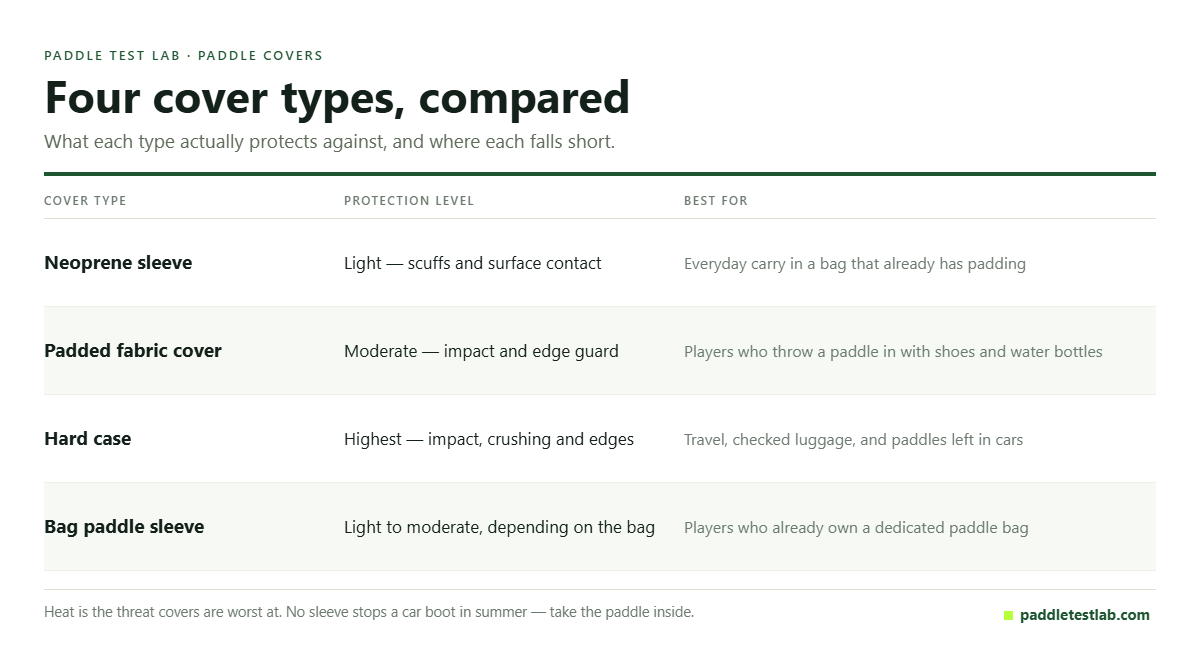
Cover Types Compared
| Type | Protection | Best for |
|---|---|---|
| Neoprene sleeve | Good against scuffs and moisture, minimal impact protection | Everyday carry, one paddle, light bulk |
| Padded fabric cover | Better impact absorption, slightly bulkier | Paddles carried loose in a bag with other gear |
| Hard case | Best protection, least convenient | Air travel, shipping, expensive paddles in transit |
| Bag paddle sleeve | Separation from other contents, built in | Players who already own a dedicated pickleball bag |
For most players a neoprene sleeve is the right balance — cheap, light, and it prevents the damage that actually happens. Hard cases are worth it for flying with a premium paddle and overkill for anything else. Our guide to pickleball bags covers models with dedicated paddle compartments, which reduce the need for a separate cover.
Frequently Asked Questions
Do I need a pickleball paddle cover?
Not strictly, but it is one of the cheapest ways to protect a paddle that cost you a hundred pounds or more.
You do want one if: you carry more than one paddle in the same compartment, your paddle travels loose in a general bag with keys and bottles, you play outdoors on abrasive courts, or you have a premium paddle you intend to keep for years.
You can skip it if: your paddle lives in a dedicated pickleball bag with a padded paddle sleeve, or you play with an inexpensive paddle you expect to replace within the season anyway. The failure modes covers prevent — face scuffs and edge guard knocks — are cosmetic at first and structural later. See our accessories guide for where a cover sits against everything else worth buying.
Neoprene or hard case?
Neoprene for everyday use, hard case for travel.
Neoprene is thin, light, cheap and slips on in a second, which matters because a cover you find annoying is a cover you stop using. It protects against the damage that actually happens day to day: scuffs, rubbing, and minor knocks in a bag.
A hard case protects against crushing and impact, which is a real risk in checked luggage and essentially none in a bag on your shoulder. It is bulky and slow to use, so it tends to live in a cupboard between trips.
If you are buying one, buy neoprene. If you fly to tournaments with a paddle you would be upset to break, buy both and use the hard case only for the journey. Our bag guide covers carrying everything else.

Isacc Shah
Isacc Shah writes PaddleTestLab. He does not test paddles in a lab and says so plainly — there is no rig, no radar gun, no staff hitting balls. Instead he aggregates independent bench measurements, manufacturer specifications, USA Pickleball's approval database and hundreds of verified owner reviews per product, then reports where those sources disagree. Every score on the site carries its evidence count. Where a specification is not published, the site writes UNKNOWN rather than estimating it, and the criticism is printed next to the praise.