
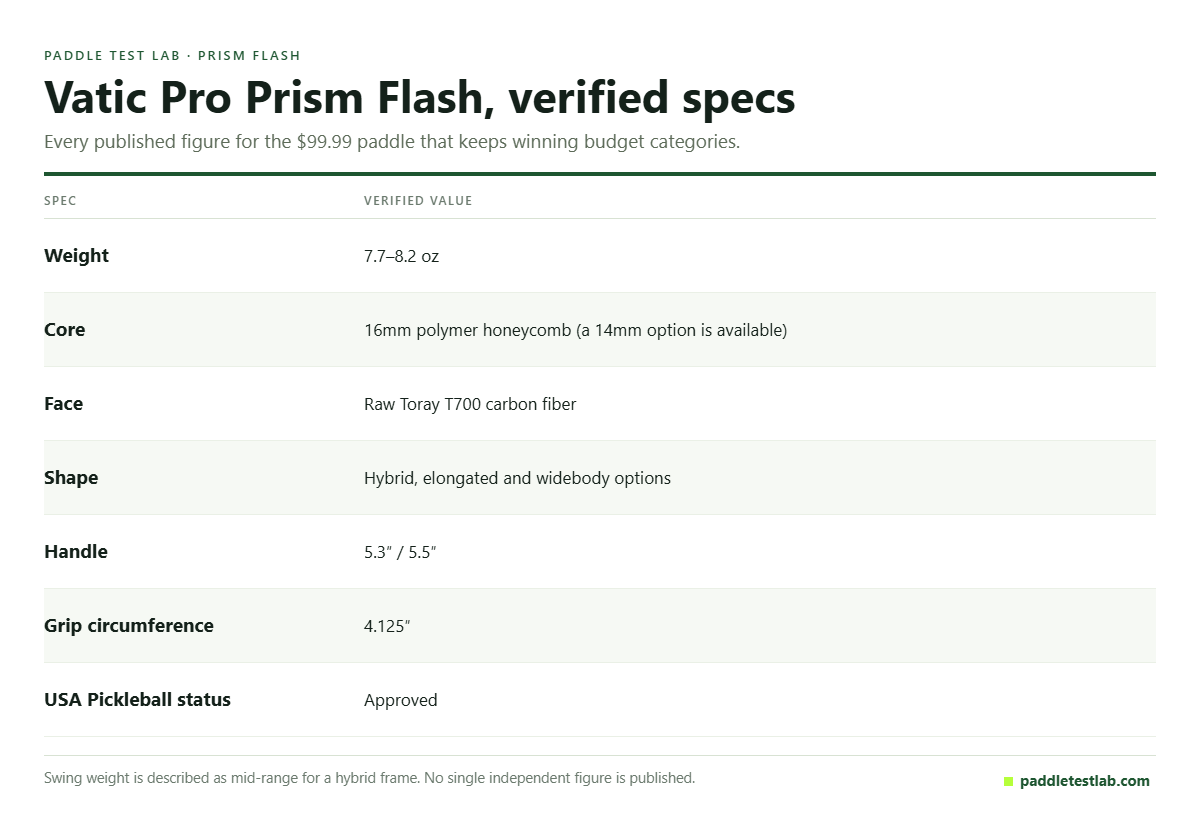
The Vatic Pro Prism Flash and Prism V7 are the same paddle built to two different shapes. They share a core, a face material and a grip size, and they differ in length, width and advertised weight. One of them has been independently measured and the other has not — and that asymmetry is the most useful thing on this page.
Last verified 18 September 2026.
The short answer: buy the Flash if you want the lighter advertised band, a shorter hybrid face and the version with published independent measurements. Buy the V7 if you want reach and are happy to carry roughly 0.2 oz more on the spec sheet. They are the same construction, so this is a shape and weight decision, not a performance-tier decision.
We do not test paddles — here is where every number comes from
PaddleTestLab does not operate a testing rig. Specifications below are manufacturer-published figures compiled in our paddle database. Measured figures are taken from independent labs named against each entry in the Paddle Honesty Index.
One thing to flag before the tables. The Flash has independent measurements in our sources. The V7 does not. We have not found swing weight, spin or measured static weight for the V7 published by any of the three labs we track. This page does not estimate them, and a comparison table with a gap in it is more honest than one with a plausible-looking number in it.
Specifications side by side
| Prism Flash 16mm | Prism V7 | |
|---|---|---|
| Shape | Hybrid | Elongated |
| Core | 16mm polymer honeycomb, foam edge | 16mm polymer honeycomb, foam edge |
| Face | Raw carbon fibre | Raw carbon fibre |
| Advertised weight | 8.0–8.3 oz | 8.2–8.5 oz |
| Length × width | 16.25–16.37 × 7.7 in | 16.5 × 7.5 in |
| Handle length | 5.3 / 5.5 in | 5.5 in |
| Grip circumference | 4.125 in | 4.125 in |
| Construction note | Gen 1.5 build — edge foam, not fully thermoformed | Longer, heavier sibling of the Flash |
Four rows are identical or near-identical: the core, the face, and the grip circumference. The handle is 5.5 inches on the V7 against 5.3 or 5.5 on the Flash, depending on the variant. The real splits are shape and advertised weight.
What has actually been measured
| Measured | Prism Flash 16mm | Prism V7 |
|---|---|---|
| Measured static weight | 7.93 oz | not published in our sources |
| Swing weight | 114 | not published in our sources |
| Measured spin | 2,059 RPM | not published in our sources |
| Lab source | Matt’s Pickleball, Dash | — |
Two things worth reading from that table. First, the Flash measured 7.93 oz against an advertised 8.0–8.3 oz band, which means it landed at or just below the bottom of its own claim. That is a paddle arriving lighter than advertised rather than heavier, and it is the opposite of the direction most buyer complaints run.
Second, the V7’s advertised band starts where the Flash’s measured weight sits. On the spec sheets, the V7 is the heavier paddle of the two — but because nobody has published a measured figure for it, that is a claim rather than a measurement. If you are choosing between them on weight, you are comparing a measured number against a printed one.
On the 2,059 RPM figure
Treat that number as a single lab’s result rather than a property of the paddle. Our research found the same paddle measured anywhere from 1,675 to 1,880 RPM by two different reputable labs — a spread far wider than most of the differences buyers argue about. A spin figure is only meaningful alongside the method behind it, which is covered in who measures pickleball spin, and why the numbers disagree.
The Gen 1.5 construction note, explained
The Flash carries a construction note that the V7 does not: Gen 1.5 build — edge foam, not fully thermoformed. That is a meaningful distinction in this category, and it is worth understanding before you buy either paddle.
Fully thermoformed paddles are bonded under heat and pressure as a single unit, which is the construction associated with the hardest-hitting and most durable faces — and which sits behind the PBCoR power issues that prompted USA Pickleball’s delisting rounds. A Gen 1.5 build uses edge foam for stability without a full thermoforming process. In practice, that usually means a softer feel, less peak pop, and a different durability profile.
Which paddles have actually lost their approval, and why, is tracked with dates and named sources in the USA Pickleball delisting list.
For a fuller picture of how cores and bonds differ, see pickleball paddle core types explained. If durability and compliance over time matter to you, our guide to delamination and core crush covers what actually goes wrong as a paddle ages.
Which one should you buy?
Because the construction is the same, this comes down to shape, weight band, and whether you value having independent data on the paddle you are buying.
Buy the Prism Flash if…
- You want the lighter advertised band, 8.0–8.3 oz against the V7’s 8.2–8.5 oz
- You prefer a hybrid face — a little more width, a little less length than the V7
- You want the variant with a 5.3-inch handle, if a shorter handle suits your grip
- You want the version that someone has actually measured, so you know what you are getting
Buy the Prism V7 if…
- You want the extra reach of an elongated 16.5-inch paddle
- You are comfortable carrying roughly 0.2 oz more on the advertised spec
- You hit a two-handed backhand and want the full 5.5-inch handle
- You have already played the Flash and want the same build with more length — which is exactly what the V7 is
An honest note on the third Flash bullet: the Flash ships in handle variants, 5.3 and 5.5 inches, so “the Flash” is not one physical object. If handle length is the deciding factor for you, check which variant you are buying before you compare it against the V7’s fixed 5.5 inches.
Frequently asked questions
Is the Prism V7 worth it over the Flash?
It is the same paddle in a longer, slightly heavier form, so “worth it” depends entirely on whether you want reach. If you want a longer face and the full 5.5-inch handle, the V7 is the correct choice in this pair. If you want the lighter advertised band and published independent measurements, the Flash is.
Which is better for beginners, the Flash or the V7?
The Flash, on balance. It is advertised lighter, its measured static weight came in at 7.93 oz, and a hybrid face is slightly more forgiving to swing than an elongated one for a new player. The V7 is not a hard paddle to use, but the Flash is the easier starting point.
Is the V7 more powerful than the Flash?
Probably, marginally, and nobody can currently prove it. The V7 is advertised at a heavier band and has a longer face, both of which usually mean more swing weight and more leverage. But there is no published swing-weight measurement for the V7 in our sources, so that remains a reasonable inference rather than a measured fact. The Flash measures 114.
Does the V7 have more spin?
There is no published spin measurement for the V7, so this cannot be answered with data. Both paddles use the same raw carbon fibre face, so the spin mechanism is identical and the difference should be within measurement noise — but that is reasoning, not evidence. The Flash has one published figure, 2,059 RPM, from Matt’s Pickleball and Dash.
What does “Gen 1.5” mean on the Flash?
It describes a build that uses edge foam for stability without being fully thermoformed. Thermoformed paddles are bonded under heat and pressure as one unit, which is associated with more power and more durability — and also with the PBCoR issues behind USA Pickleball’s delisting rounds. Gen 1.5 is a middle ground, typically with a softer feel and less peak pop.
Which is better for doubles?
Doubles rewards quick hands at the net, which favours the lighter advertised paddle — the Flash. The V7’s extra length helps on serves, overheads and reach, so if you play a driving, baseline-oriented game it is the better of the two despite the extra weight.
Why is there no swing weight for the V7?
Because none of the three independent labs we track has published one. Swing weight is not printed on the box, so without an independent measurement there is no figure at all — the manufacturer does not publish it and we do not estimate it. That gap is itself a reason some buyers choose the Flash.
Sources
- Specifications — manufacturer-published figures, compiled in the PaddleTestLab paddle database.
- Measured static weight, swing weight and spin for the Flash — Matt’s Pickleball and Dash, compiled in the Paddle Honesty Index.
- Protocol-gap context — who measures pickleball spin, and why the numbers disagree.
Last verified: 18 September 2026. If a figure here disagrees with the lab or the manufacturer, they are right and this page is wrong — tell us and it gets corrected and dated.
Related guides
- Vatic Pro Prism Flash review
- Paddle database 2026
- The Paddle Honesty Index
- Elongated vs standard and widebody paddles
- What is swing weight?
- Pickleball paddle core types explained
- Delamination and core crush signs

Isacc Shah
Isacc Shah writes PaddleTestLab. He does not test paddles in a lab and says so plainly — there is no rig, no radar gun, no staff hitting balls. Instead he aggregates independent bench measurements, manufacturer specifications, USA Pickleball's approval database and hundreds of verified owner reviews per product, then reports where those sources disagree. Every score on the site carries its evidence count. Where a specification is not published, the site writes UNKNOWN rather than estimating it, and the criticism is printed next to the praise.