

Learning how to add weight to a pickleball paddle is the cheapest performance upgrade in the sport, and for some popular lightweight paddles it’s practically a required setup step — owner threads for several current models openly discuss the weighting recipe that makes them play right. Here’s the method that keeps showing up in successful owner reports, and the mistakes that fill the unsuccessful ones.

How to Add Weight to a Pickleball Paddle: The Basics
The tool is weighted tape — lead or tungsten strips with adhesive backing, sold in pre-cut segments or rolls. It goes on the edge guard, and where you place it changes what it does. That placement question is most of the skill.
Placement: what each position does
Think of the paddle face as a clock with 12 at the tip. Tape at 3 and 9 o’clock — the sides — widens the stable zone and calms twisting on off-center hits; owners describe it as making the sweet spot feel bigger. This is the most-recommended starting position in owner threads. Tape at 12 o’clock adds head weight: more plow-through and drive pace, at the cost of slower hands. Tape near the throat or handle adds overall mass while keeping the swing quick — the subtlest change of the three.
The method owners report works
Start small — a couple of grams per side, not a full roll. Clean the edge guard first so the adhesive actually holds. Press the tape down firmly along its whole length, and consider a thin strip of clear tape over it if your tape brand is known for lifting. Then play several sessions before judging. The single most common regret in owner threads is stacking on a big load day one, deciding the paddle feels like a brick, and stripping it all off — small increments find your number faster.
The Mistakes That Fill Owner Threads
Overloading at once — covered above, and by far the most common. Taping the face — rules require weight additions to stay on the edge guard or handle; tape on the hitting surface is a legality problem, not just a feel problem. Ignoring balance — adding all the weight at 12 o’clock turns a balanced paddle head-heavy, which is exactly the configuration owners with elbow trouble report switching away from; if your arm is sensitive, keep additions low and split to the sides. Forgetting it changes swing weight more than scale weight — a few grams at the tip changes how the paddle swings far more than the number on a scale suggests.
Legality and Warranty: Check Before You Stick

Weight tape on the edge guard or handle is broadly accepted in sanctioned play, but alterations to the hitting surface are not — when in doubt, check the current equipment rules on the USA Pickleball site. On warranties: policies vary on modifications, and our warranty comparison found brands are vague about exactly what voids coverage. Tape on the edge guard is normally fine; anything involving removing or altering parts of the paddle is where claims get denied. Keep your tape removable and your receipts.
When Adding Weight Is the Wrong Fix
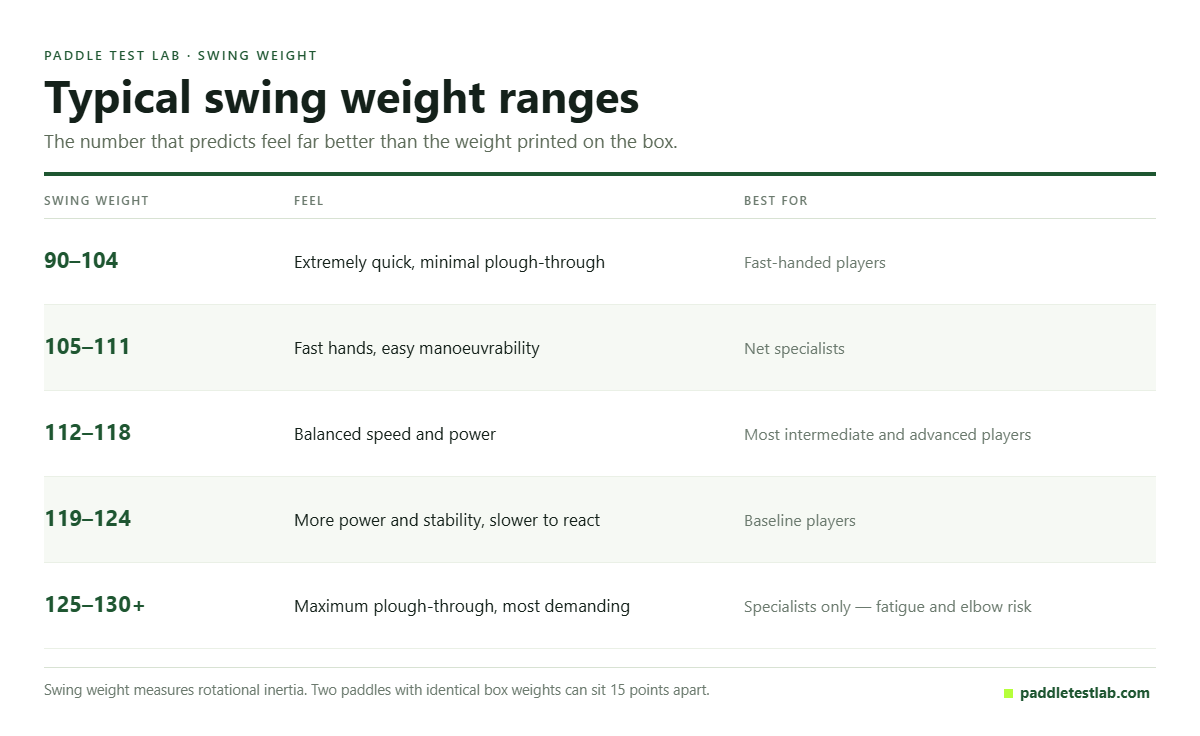
If the paddle feels unstable AND heavy already, more mass won’t save it — the shape or build is the issue. If your problem is a slippery or undersized handle, that’s a grip fix, not a weight fix. And if you’re still choosing your base weight class, sort that first with our paddle weight guide — tape tunes a paddle; it shouldn’t rescue a fundamentally wrong purchase.
Where to Put Lead Tape on a Pickleball Paddle
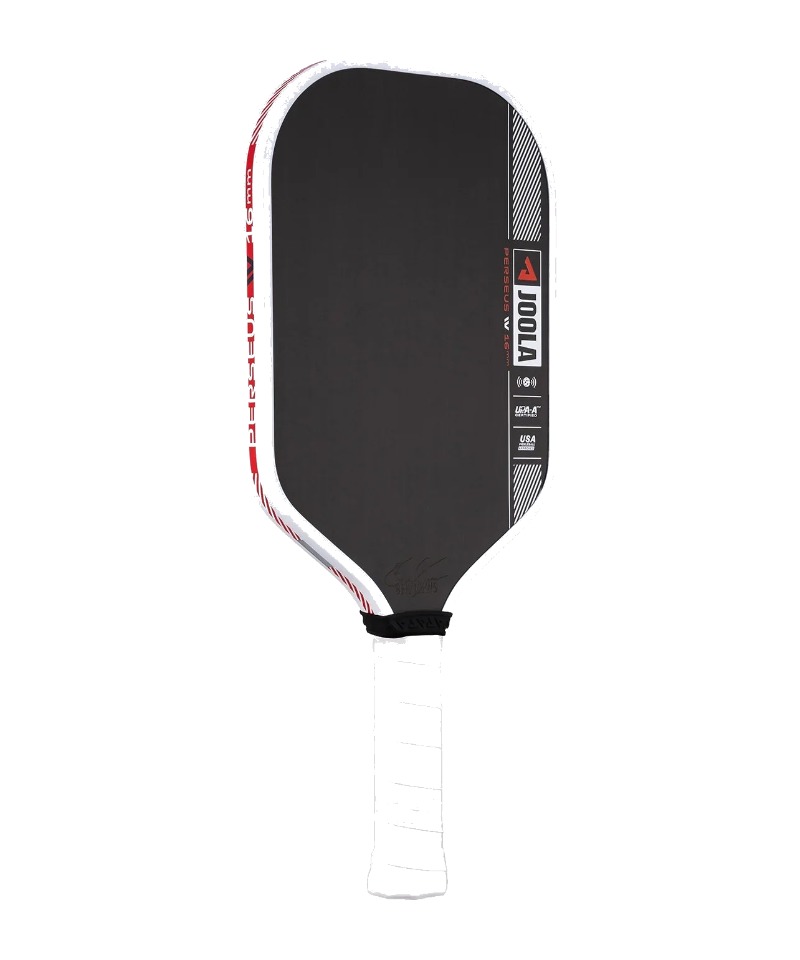
Placement changes what you get far more than quantity does. Think of the paddle face as a clock, viewed with the handle at six.
3 and 9 o’clock (the sides). The most useful placement for most players. Weight at the sides raises twist weight — resistance to the face rotating when you catch the ball off-centre — so mishits lose less pace and direction. This is the “bigger sweet spot” people describe. It adds stability without slowing the paddle much.
12 o’clock (the top). Maximum effect on power and swing weight, because the mass sits furthest from your hand. Adds plough-through on drives and serves. Also the fastest way to make a paddle feel sluggish, so add sparingly.
Under the grip (the handle). Raises static weight while lowering effective swing weight, because it pulls the balance point toward your hand. This is how you make a head-heavy paddle feel manageable without losing mass. Wrap lead tape around the handle under the overgrip.
The throat (just above the handle). A compromise — adds stability with minimal effect on swing weight.
Start at 3 and 9. It gives the largest perceived improvement per gram and is the hardest placement to get wrong. Our guide to swing weight explains why the same gram behaves so differently depending on where it sits.
Handle vs head: choosing which end to weight
The decision follows from what is going wrong in your games rather than from a preference.
Weight the head if your drives lack depth, your serves are landing short, or the paddle gets pushed around when you block hard shots. You are buying stability and power at the cost of hand speed.
Weight the handle if the paddle feels sluggish, you are late in hands exchanges at the kitchen line, or your arm tires late in matches. You are buying speed and comfort, and you will lose a little plough-through.
The counter-intuitive part: adding weight to the handle can make a paddle feel lighter in play, because feel is governed by balance rather than mass. Players who conclude their paddle is too heavy have often diagnosed the wrong end. Our guide to choosing paddle weight covers how the two numbers relate when you are buying rather than tuning.
Lead vs Tungsten Tape
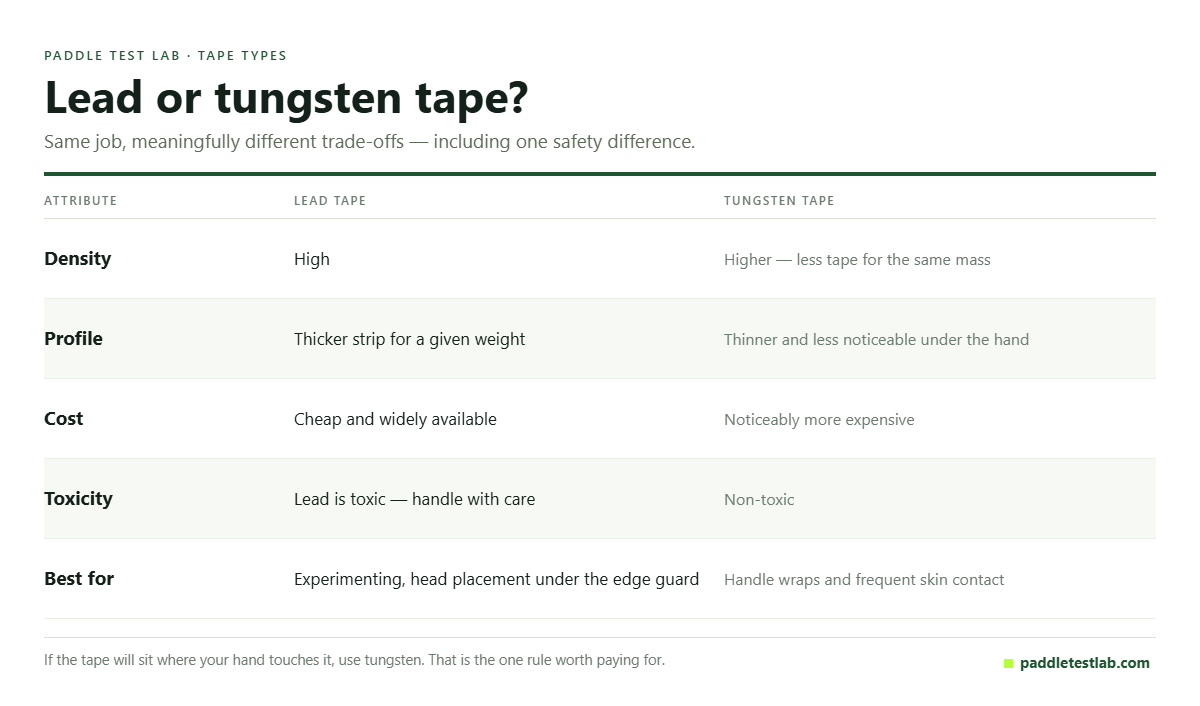
| Lead tape | Tungsten tape | |
|---|---|---|
| Density | High | Higher — less tape for the same mass |
| Profile | Thicker strip for a given weight | Thinner, less noticeable under the hand |
| Cost | Cheap and widely available | Noticeably more expensive |
| Toxicity | Lead is toxic — handle with care | Non-toxic |
| Best for | Experimenting, head placement under an edge guard | Handle wraps and anywhere skin contact is frequent |
A genuine safety note on lead: it is toxic on repeated skin contact and should never be handled by children. Wash your hands after applying it, and keep it covered rather than exposed — under the edge guard, or beneath an overgrip if you are weighting the handle. If you are weighting a handle you grip for hours a week, tungsten is worth the extra cost purely for that reason. Most pickleball “lead tape” sold today is genuinely lead; some is a lead-free substitute, and the packaging will say which.
Frequently Asked Questions
How much lead tape should you add?
Start with 2–4 grams total and play with it before adding more. That is roughly two to four inches of standard quarter-inch tape per side, and it is enough to feel.
Add symmetrically — the same amount at 3 and 9 o’clock — unless you are deliberately biasing the paddle, which almost nobody should be. Play at least two full sessions before adjusting again, because the difference takes time to read and it is easy to over-correct after one bad game.
Practical ceilings: much beyond 8–10 grams and you have changed the paddle into something quite different, usually slower than you intended. And check tournament rules before competing — lead tape is generally permitted, but anything altering the face texture is not. Our explainer on USA Pickleball approval covers what modifications are allowed.
What is the best lead tape for pickleball?
Quarter-inch width is the standard and the easiest to work with — half-inch is harder to place precisely and sits proud enough to catch on things. Golf lead tape works identically to anything sold as pickleball-specific and usually costs less for more.
What actually matters more than brand: adhesive quality, because tape that lifts at the edge under an edge guard is worse than useless, and a clean surface before application. Wipe the area with isopropyl alcohol and let it dry — tape applied over court dust and ball residue will peel within a fortnight.
If you want to experiment before committing, painter’s tape over the lead lets you reposition without residue while you find the placement you like. Our guide to pickleball accessories covers the rest of the kit worth owning.
Where should I put lead tape on my pickleball paddle first?
The 3 and 9 o’clock positions — the sides of the face — are the consensus starting point in owner threads. They add stability and perceived sweet-spot size without making the swing feel dramatically heavier.
How much weight should I add to my paddle?
Start with a few grams total, split between the sides, and play multiple sessions before adding more. Owners who report success almost always describe an incremental process; the ones who report stripping it all off usually loaded up in one go.
Is lead tape legal in pickleball tournaments?
Weight added to the edge guard or handle is broadly accepted; altering the hitting surface is not. Rules evolve, so check the current USA Pickleball equipment standards before sanctioned play.
Will adding lead tape void my paddle warranty?
Usually not when it’s removable tape on the edge guard, but brand policies differ and are often vague about modifications. Remove tape before filing any claim, and read your brand’s specific policy.
Lead vs tungsten tape — does it matter?
Tungsten delivers the same mass in a smaller strip and avoids lead-handling concerns; lead is cheaper and easier to find. Owners report both working fine — it’s a preference call, not a performance one.

Isacc Shah
Isacc Shah writes PaddleTestLab. He does not test paddles in a lab and says so plainly — there is no rig, no radar gun, no staff hitting balls. Instead he aggregates independent bench measurements, manufacturer specifications, USA Pickleball's approval database and hundreds of verified owner reviews per product, then reports where those sources disagree. Every score on the site carries its evidence count. Where a specification is not published, the site writes UNKNOWN rather than estimating it, and the criticism is printed next to the praise.