
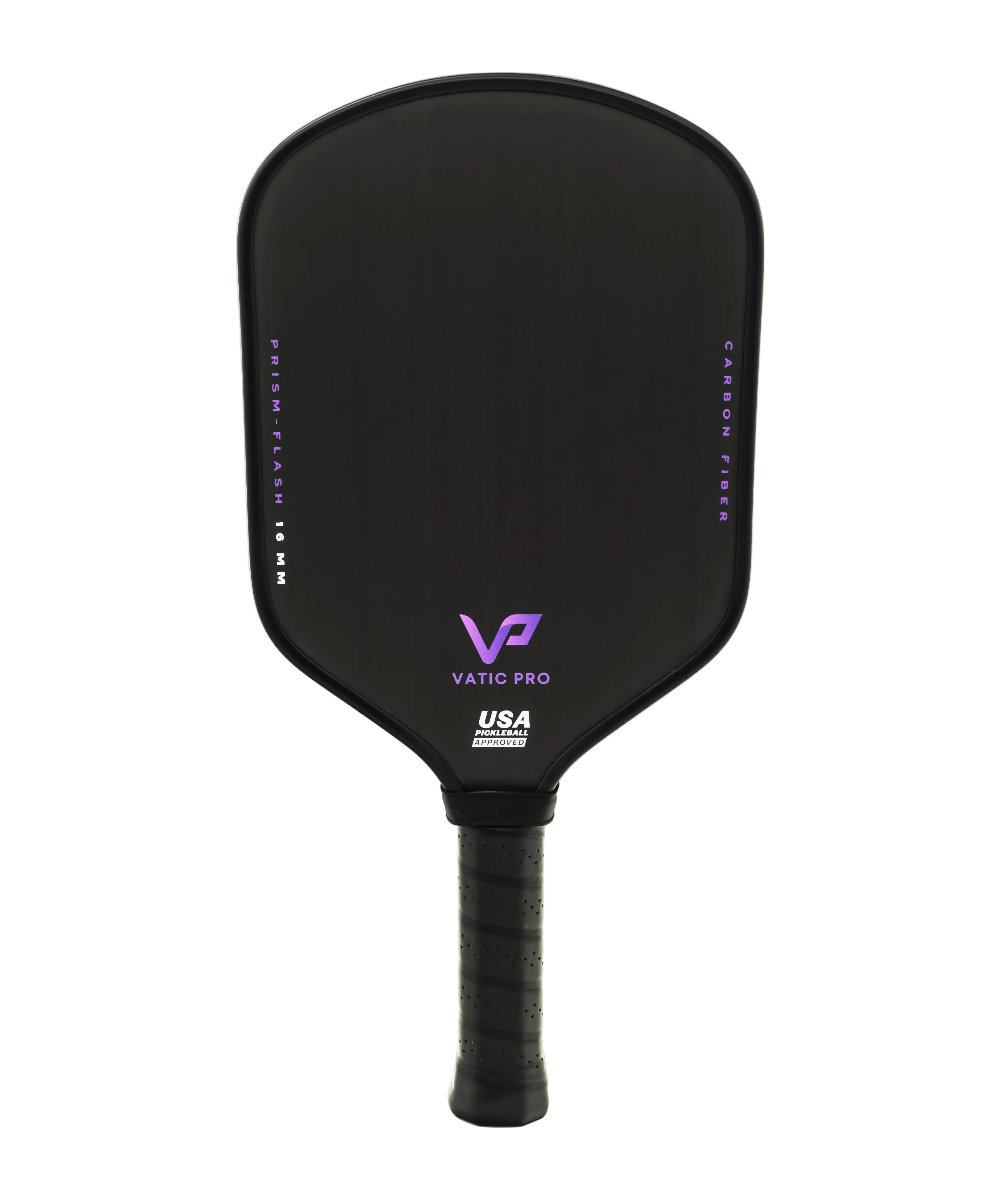
Short answer: in Vatic Pro vs Six Zero, the $99 Vatic Pro Prism matches the $180 Six Zero on core durability and nearly matches it on feel. What the extra money buys is a bigger sweet spot and a higher spin ceiling — and at 3.5 and below, neither will change your results.
This is the comparison that runs constantly in pickleball forums and has never had a proper answer written for it. Vatic Pro sells a raw carbon paddle for $99.99. Six Zero sells one for $180 to $200. Both get recommended by the same people, often in the same thread.
So: does the cheaper one actually match the dearer one? Partly. Here is exactly where, and exactly where it does not.
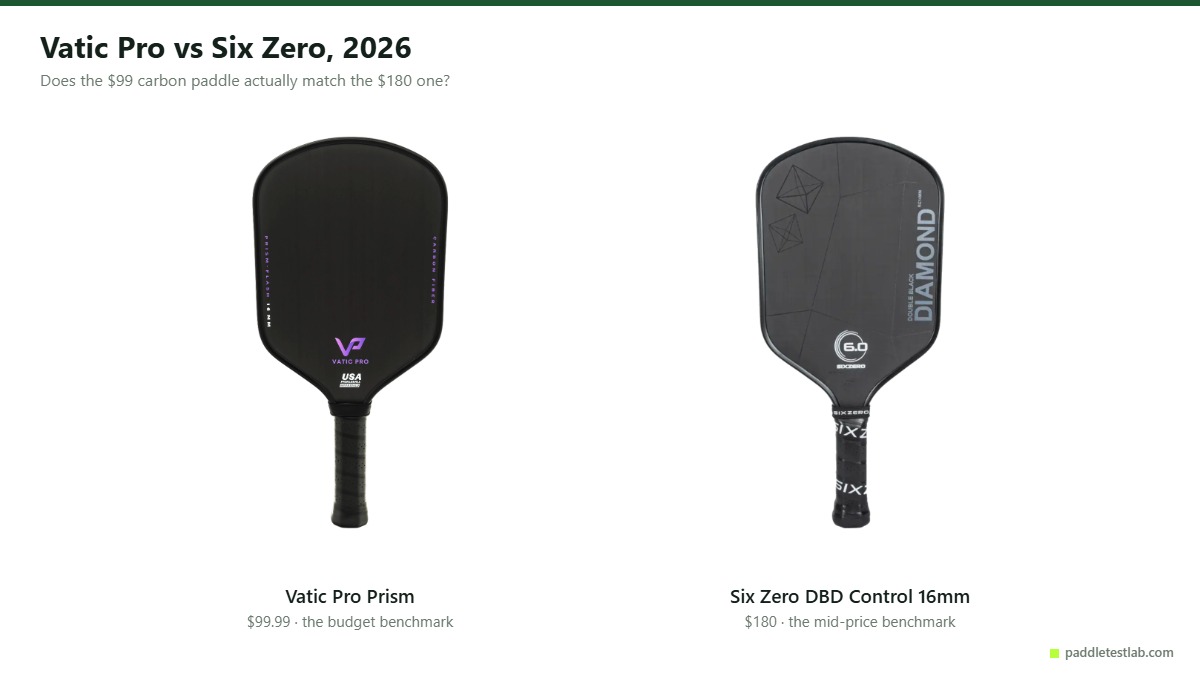
The Budget Paddle That Keeps Getting Recommended
Vatic Pro’s Prism is the benchmark $99 carbon paddle and it earned that status honestly. Raw Toray T700 face, a plush and forgiving feel, every shape offered, USAP approved, and grip inserts marketed specifically to reduce shock. For a first carbon paddle it is close to unbeatable value, which is why it leads our under-$100 roundup.
Six Zero’s Double Black Diamond built its reputation differently: a large sweet spot, strong topspin, and 4.6 out of 5 across 24 reviews at Pickleball Warehouse. It is the most-played mid-price paddle we track.
Both are thermoformed-era carbon paddles aimed at a player who wants control and spin rather than raw pace. On paper they are the same kind of thing at twice the price difference.
Vatic Pro vs Six Zero, Spec for Spec: Prism vs Double Black Diamond
Vatic Pro Prism (Flash / V7 / Bloom)
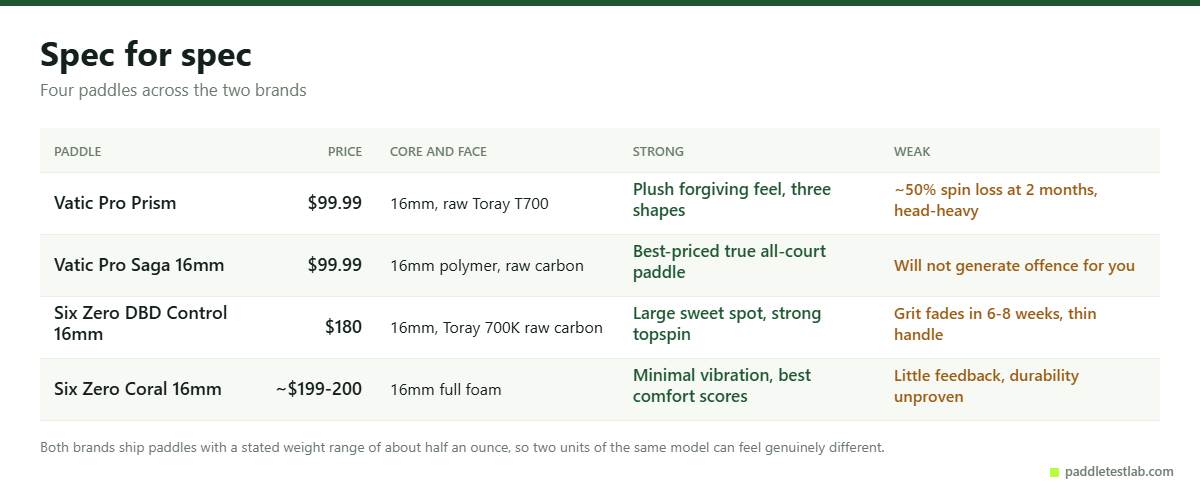
$99.99 · 16mm core (14mm also offered) · raw Toray T700 carbon face · hybrid, elongated or widebody · 7.7–8.2 oz depending on model · USAP approved.
Strong: plush forgiving feel, three shapes, shock-reducing grip inserts, no significant core-failure reports at this price.
Weak: grit wears fast — one tester measured roughly 50% spin loss after two months — and it is slightly head-heavy.
Six Zero Double Black Diamond Control 16mm
$180 · 16mm core (14mm also offered) · Toray 700K raw carbon face · hybrid · 8.1 oz average.
Strong: large sweet spot, strong topspin RPM, and the deepest pool of positive owner feedback of any paddle in the comparison.
Weak: reports of pop fading and grit wearing within six to eight weeks, thin handle, and enough face abrasion to scuff balls noticeably.
The other two worth knowing
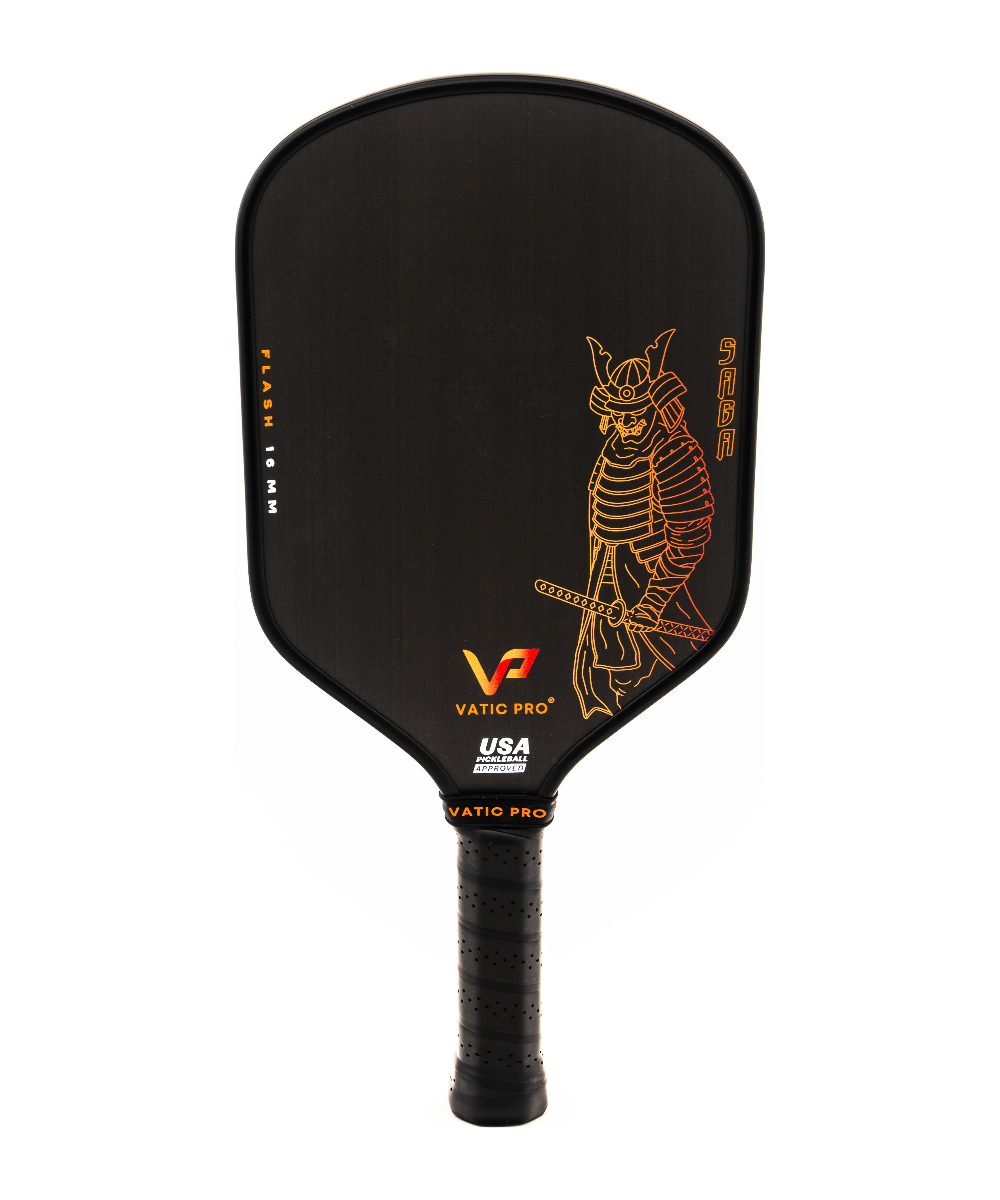
Vatic Pro Saga 16mm at $99.99 is the best-priced true all-court paddle we track, with a polymer core that has no long-term crushing issues. It is a jack of all trades and will not generate offence for you.
Six Zero Coral 16mm at around $199–200 is the comfort pick: a dense soft full-foam core with minimal vibration and the highest comfort scores we record. It gives little feedback and its long-term durability is unproven.
Where the $100 Actually Goes
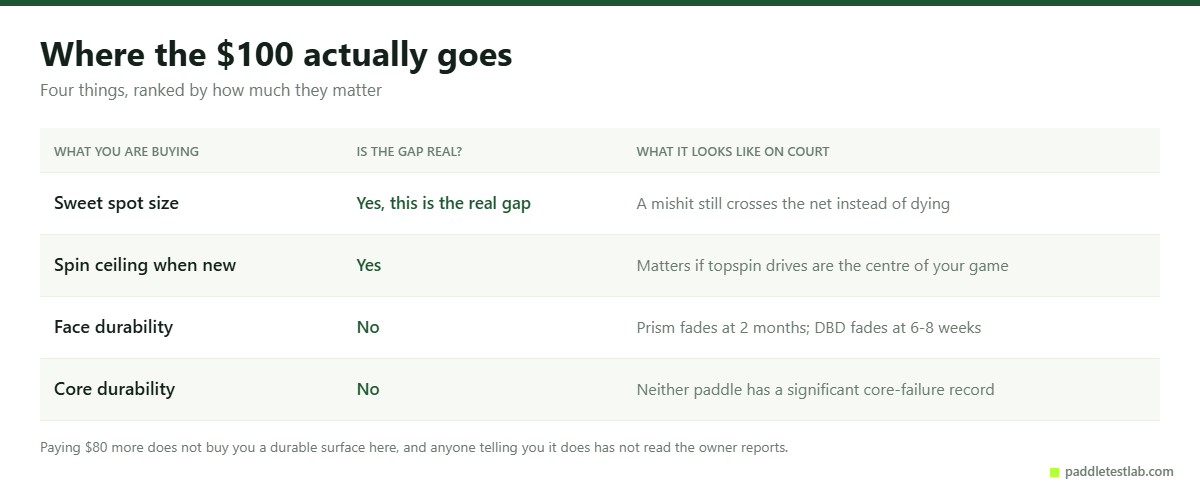
Four things, ranked by how much they matter.
1. Sweet spot size. This is the real gap. The DBD’s sweet spot is larger than the Prism’s, and on a mishit the difference shows up as a ball that still crosses the net rather than one that dies. Over a whole game this is worth more than any spec sheet line.
2. Spin ceiling when new. Both generate spin; the DBD generates more. If topspin drives are the centre of your game, the Six Zero is the better tool on day one.
3. Face wear — and this one is closer than the price suggests. The Prism loses about half its spin in two months. The DBD’s grit and pop fade in six to eight weeks. Both faces wear out inside a season. Paying $80 more does not buy you a durable surface here, and anyone telling you it does has not read the owner reports.
4. Nothing on core durability. Neither paddle has a significant core-failure record. The Prism at $99 is as structurally sound as the DBD at $180.
Unit-to-Unit Consistency
The least visible difference and the one that catches people out on a replacement.
Both brands manufacture overseas and both ship paddles with a stated weight range — the Prism 7.7 to 8.2 ounces, the DBD around 8.1 ounces average. A half-ounce spread within one model means two units of the same paddle can feel genuinely different, and that is true of both brands here. Neither offers the tight consistency you get from a US manufacturer like Selkirk or Paddletek — see our Paddletek vs Selkirk comparison for what that buys.
Practical advice either way: if you find a unit you love, note its weight, and buy the same weight next time if the retailer lists it.
The Verdict — and Who Should Still Spend More
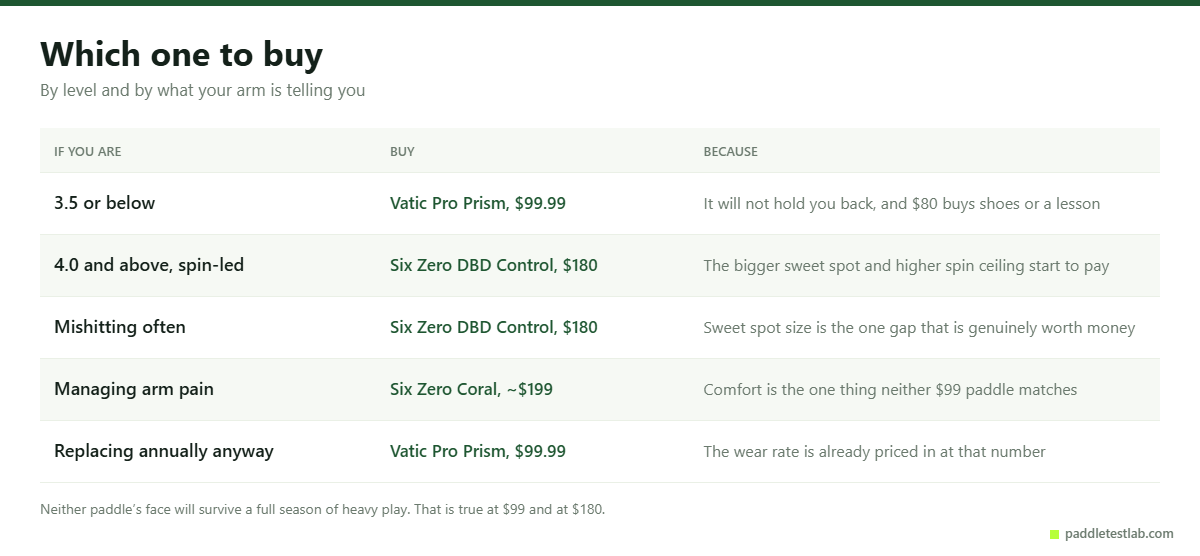
Buy the Vatic Pro Prism if: this is your first or second carbon paddle; you are below 4.0; you want to try a widebody or elongated shape without committing $200 to the experiment; or you already know you replace paddles annually, in which case the wear rate is priced in.
Buy the Six Zero DBD if: topspin is central to your game and you want the higher ceiling now; you mishit often enough that the bigger sweet spot changes results; or you want the paddle with the most owner feedback behind it.
Buy the Six Zero Coral instead of either if: your arm hurts. Comfort is the one thing neither $99 paddle matches, and the Coral’s full-foam core is the reason. Our tennis elbow guide covers why that matters.
The honest summary: at 3.5 and below, the $99 Prism will not hold you back and the $80 saved is better spent on shoes, balls or a lesson. At 4.0 and above, the DBD’s sweet spot and spin ceiling start to justify themselves. Neither paddle’s face will survive a full season of heavy play.
Frequently Asked Questions
Is Vatic Pro as good as the reviews say?
For the money, yes. The reviews are accurate about feel, forgiveness and value. The one thing they under-report is how quickly the face texture goes.
Which shape should I get?
Both brands offer multiple shapes. Widebody for the largest sweet spot and most stability, hybrid for a balance, elongated for reach and leverage. See our elongated vs standard guide.
When should I upgrade from a $99 paddle?
When you can identify what you want the next paddle to do differently. “More power,” “a bigger sweet spot,” “less shock into my elbow” are good reasons. “It has been a year” is not.
Do either have warranty problems?
Neither has a notable warranty controversy, but neither offers anything close to Selkirk’s lifetime terms. Our warranty comparison has the current details.
Where can I read a full review of the Vatic Prism?
We cover it in detail in the Vatic Pro Prism Flash review, and Six Zero’s full range in the Six Zero brand review.
Specifications and prices are checked against Vatic Pro and Six Zero directly, and were current in July 2026.

Isacc Shah
Isacc Shah writes PaddleTestLab. He does not test paddles in a lab and says so plainly — there is no rig, no radar gun, no staff hitting balls. Instead he aggregates independent bench measurements, manufacturer specifications, USA Pickleball's approval database and hundreds of verified owner reviews per product, then reports where those sources disagree. Every score on the site carries its evidence count. Where a specification is not published, the site writes UNKNOWN rather than estimating it, and the criticism is printed next to the praise.