
USA Pickleball approved paddles explained, without the forum folklore: what the list is, what the equipment tests actually measure, why the spin and power rules exist, and what it means for the paddle in your bag. This guide sticks to how the system works — for current specifics, always check the official source, because the details are updated over time.
USA Pickleball Approved Paddles Explained: What the List Is
USA Pickleball maintains a public database of paddles approved for sanctioned tournament play. Manufacturers submit paddles for testing against the current equipment standards; paddles that pass get listed. If your league or tournament follows USA Pickleball rules — most organized play does — your paddle needs to be on that list. For casual games, nobody checks. The list lives on the official USA Pickleball site and is searchable by brand and model.
What the equipment standards cover
The standards constrain the properties that decide how much a paddle can do to the ball: overall dimensions, surface roughness and friction (which govern spin), deflection and trampoline effect (which govern power), and prohibitions on things like altered hitting surfaces. The published standards evolve — which is exactly why this guide describes categories rather than quoting numbers that may be superseded.
Why Spin and Power Rules Exist

Paddle technology moved faster than the rulebook for several years. Gritty faces pushed spin rates up; aggressive thermoformed builds pushed power up. The governing bodies responded with tighter surface and power testing — including limits aimed at the spin rates a paddle surface can generate. The intent is straightforward: keep the sport’s balance between offense and defense, and keep equipment from deciding matches. Our spin benchmark roundup tracks how current paddles compare on published spin data.
Delisting: approval isn’t permanent
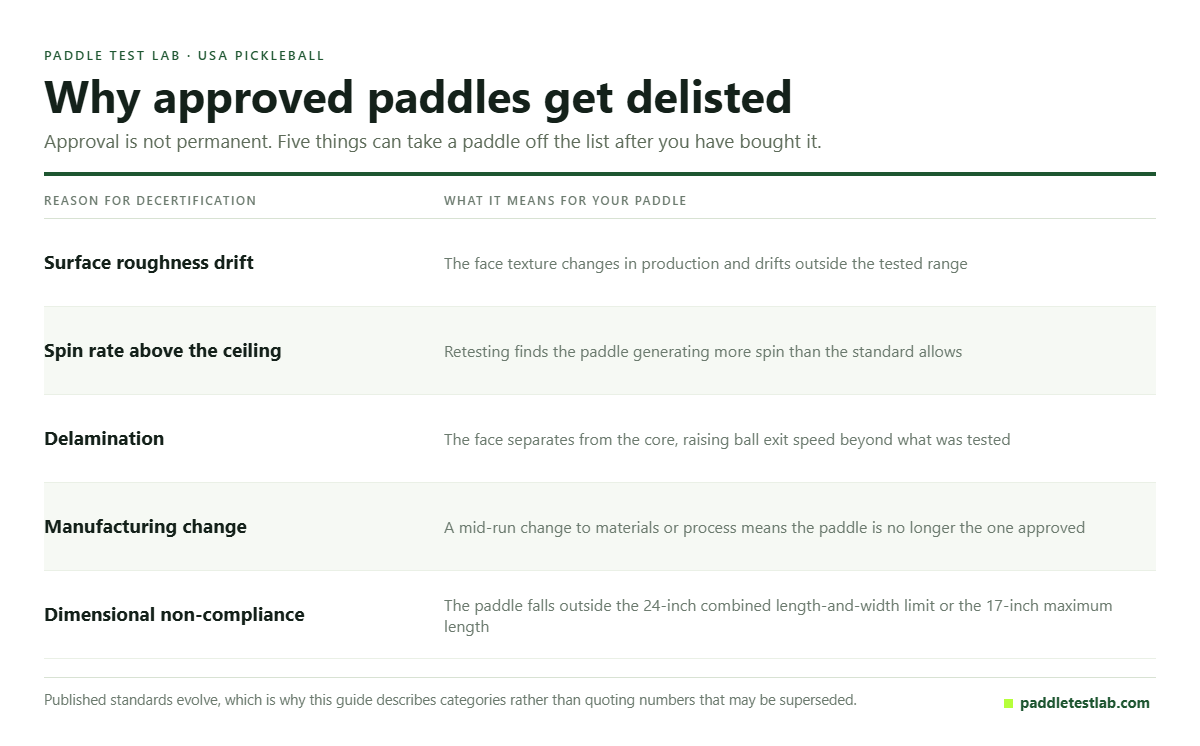
The part that surprises owners most: a paddle can be approved at purchase and removed from the list later — it has happened to prominent, popular models. Delisting typically follows retesting, standard changes, or manufacturing drift from the submitted sample. That’s why the honest advice is to check the list twice: once before buying, and again before any event that matters to you.
How to Verify a Specific Paddle
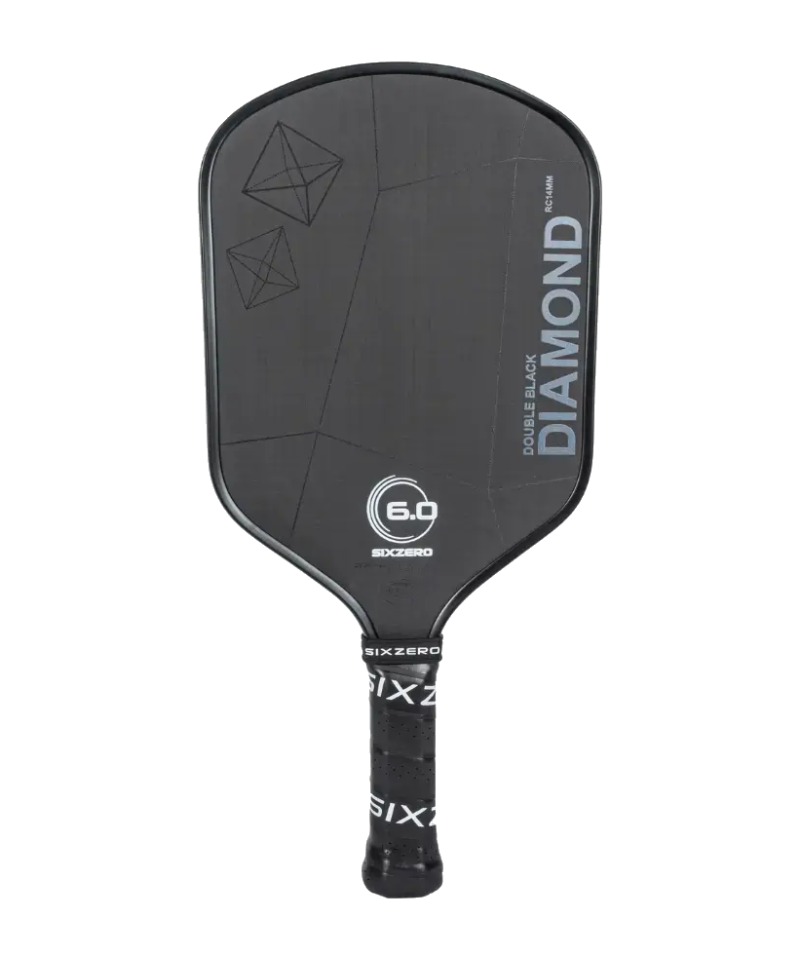
Search the official database for the exact brand and model name — not the product family. Approval attaches to specific models, and brands often sell near-identical variants where one is listed and another isn’t yet. If a listing seller claims approval, verify it yourself; retailer pages go stale. Newer releases sit in a gray period between launch and listing, which owner threads flag model by model — two of the paddles in our own beginner picks roundup carried unconfirmed status at the time of writing, and we said so rather than guessing.
What This Means for Your Buying Decision

If you play or plan to play organized pickleball: treat list status as a hard requirement, same as price. If you’re purely recreational: it still functions as a quality signal — an approved paddle met independent standards — but it shouldn’t outrank fit, comfort, and budget. And if you modify your paddle, know the line: adding weight tape to the edge guard is generally accepted, altering the hitting surface is not — details in our paddle weighting guide.
How to Check if a Paddle Is USA Pickleball Approved
Do not trust the product page. Sellers state “USAPA approved” loosely, and it is frequently wrong — sometimes because the listing is old, sometimes because a different generation of the same model was the one approved.
Go to the source. USA Pickleball maintains a searchable approved equipment database on its own site. Search by manufacturer and model, and check the result against what is actually in your hands.
Match the exact generation. This is where most people go wrong. “JOOLA Perseus” is not a model — the Perseus has appeared across several generations, and approval attaches to a specific one. Check the full name including any generation marker and core thickness.
Look for the stamp. Approved paddles carry a USA Pickleball logo, usually near the throat or on the edge guard. Its absence is a red flag; its presence is not proof, since a paddle can be decertified after manufacture.
Check the date. The list is a live document. A paddle approved when you bought it may not be approved now, which matters if you are entering an event.
For a shortcut on models we cover, our main paddle roundup flags approval status per pick — but verify against the official database before a tournament rather than trusting any third party, including us.
How the testing process works
Paddles submitted for approval are tested against several criteria rather than one. Surface roughness is measured to control how much texture the face carries, and it is the criterion most models fail. Deflection checks how much the face gives under load, which governs how much energy it returns. Dimensions are checked against the 24-inch combined length-and-width limit and the 17-inch maximum length. And spin generation is now assessed against a defined ceiling.
The important thing to understand is that approval tests the paddle as submitted. A production run that drifts, or a paddle that changes through use, is no longer the item that passed — which is the mechanism behind most decertifications. Our page on what drives paddle spin covers the roughness question that sits at the centre of it.
Why Paddles Get Decertified
| Reason | What happens |
|---|---|
| Surface roughness drift | Production texture exceeds the tested limit — the most common cause |
| Spin rate above the ceiling | Paddle generates more spin than the standard permits |
| Delamination in the field | The failed bond makes the paddle livelier than the version that passed |
| Manufacturing change | A revised build sold under the same name is effectively a different paddle |
| Dimensional non-compliance | Rare, but a supplier change can push a frame outside tolerance |
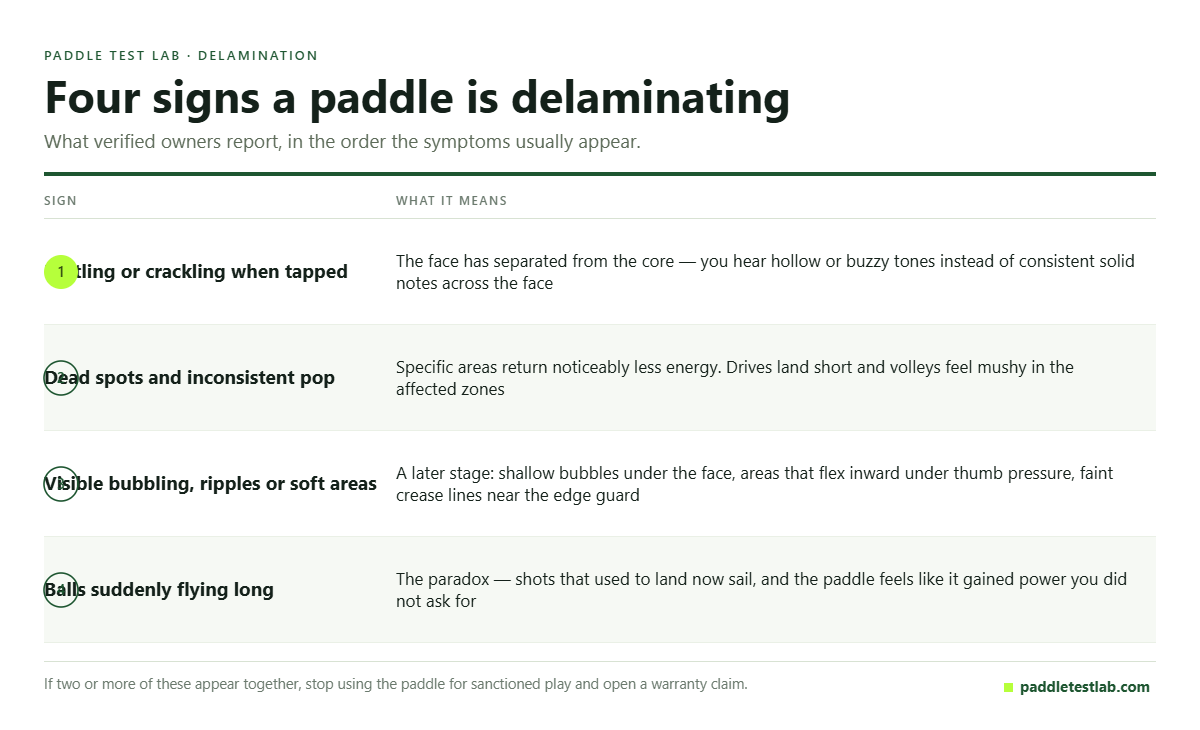
Decertification is retrospective in effect and awkward in practice: the paddle you legally bought becomes unusable in sanctioned play, and manufacturers vary widely in whether they offer any remedy. Delamination is the one you can cause yourself just by playing — our guide to spotting delamination covers how to catch it, and the warranty comparison covers who stands behind a decertified frame.
Frequently Asked Questions
What happens if you use a non-approved paddle?
In recreational play, nothing — nobody is checking at your local courts, and a non-approved paddle is not dangerous or unfair in a casual game.
In sanctioned play it is a different matter. Paddles are checked, referees do notice, and the consequences range from being told to change paddles before the match to forfeiting. If a non-approved paddle is discovered mid-event, results can be affected retrospectively depending on the tournament’s rules.
The practical advice for anyone entering events: verify before you travel, and bring a second approved paddle. Turning up with one paddle that fails check-in ends your tournament before it starts. Our advanced player guide covers what else matters at competitive level.
How often is the approved list updated?
Continuously rather than on a schedule. New paddles are added as they pass testing, which happens in a rolling fashion, and models are removed when they fail re-testing or when a manufacturing change is identified.
Because there is no fixed publication date, a saved screenshot or a third-party list — including ours — can be out of date within weeks. Check the live database rather than any copy of it, and check again before an event rather than relying on a verification you did when you bought the paddle.
This is also why buying a heavily discounted previous-generation paddle carries a risk that is not obvious: deep discounts sometimes follow decertification rather than a new model launch. If a premium paddle is suddenly half price, check its status before assuming you found a bargain. Our page on spin and surface rules covers why roughness is the criterion most often involved.
Do I need a USA Pickleball approved paddle for league play?
If the league follows USA Pickleball rules — most do — yes. Check the specific league’s equipment policy; a few recreational leagues don’t enforce it, but sanctioned events do.
How do I check if my paddle is approved?
Search the official USA Pickleball equipment database for your exact brand and model. Don’t rely on retailer claims or the box — the live list is the source of truth, and it changes.
Can an approved paddle lose its approval?
Yes. Paddles have been delisted after retesting or standard changes, including well-known models. If tournament legality matters to you, re-verify before events rather than assuming approval is permanent.
What is the spin-rate rule about?
Surface testing constrains how much friction — and therefore spin — a paddle face can generate, alongside power-related limits. The specific test methods and thresholds are published and updated by the governing body, so check the current standards documents for exact figures rather than secondhand numbers.
Are non-approved paddles bad paddles?
Not necessarily — some are new releases awaiting listing, and some are intentionally built beyond the limits for recreational players who want maximum spin or power. They’re only ‘bad’ if you need them for sanctioned play.
Related guides

Isacc Shah
Isacc Shah writes PaddleTestLab. He does not test paddles in a lab and says so plainly — there is no rig, no radar gun, no staff hitting balls. Instead he aggregates independent bench measurements, manufacturer specifications, USA Pickleball's approval database and hundreds of verified owner reviews per product, then reports where those sources disagree. Every score on the site carries its evidence count. Where a specification is not published, the site writes UNKNOWN rather than estimating it, and the criticism is printed next to the praise.