

The search for quiet pickleball paddles is usually driven by a letter — from an HOA, a neighbor, or a parks department. The noise complaint wave around the sport is real, and equipment is one of the few levers a player controls. Here’s what actually determines paddle noise, what the quiet category offers, and how to shop it honestly.
Quiet Pickleball Paddles: Why the Sport Is Loud
That distinctive pop is an impact sound: a hard plastic ball meeting a stiff composite face over a resonant core, dozens of times a minute, on a court that’s often closer to houses than a tennis court would be. Frequency matters as much as volume — the pop sits in a sharp, attention-grabbing range that carries. Three equipment factors shape it: the core (structure and thickness), the face stiffness, and the ball.
What makes a paddle quieter
The construction patterns owners and manufacturers consistently associate with lower noise: softer, thicker cores — a 16mm core damps impact more than a thin one, the same property that makes it feel soft (see our thickness guide); foam in the core — full-foam and foam-augmented designs damp vibration, which is part of why foam-core owner reviews mention a duller, deeper sound; and less stiff, less ‘poppy’ faces — the same builds marketed for control. The pattern is convenient: quiet-leaning construction and control-leaning construction largely overlap, so shopping our control paddle roundup already points you toward the quieter end of the market.
The official quiet category
USA Pickleball has developed quiet-equipment standards and testing aimed exactly at the noise-restricted-community problem — paddles engineered and verified to produce less sound. The category is young and the model list is short but growing. If your community enforces noise rules, check the current quiet-category information on the official USA Pickleball site — that’s the defensible answer to an HOA, in a way that ‘this paddle feels quiet to me’ is not.
How many decibels is a pickleball paddle?
The figure people usually quote is that a pickleball strike registers somewhere around 70 dB at close range, against roughly 40 dB for a tennis ball — but treat any single number with suspicion. A decibel reading depends entirely on how far the meter sits from the contact point, whether it records peak or averaged sound, which ball is used, how hard the player is hitting, and whether the court is open or enclosed. Two measurements of the same paddle can differ by 10 dB purely on method.
Two things matter more than any specific number. First, the decibel scale is logarithmic: a 10 dB increase is perceived as roughly twice as loud, so differences between paddles that look small on paper are larger in the ear than they appear. Second, what actually generates complaints is not average volume but the sharp, repetitive, high-frequency crack of impact. That sound carries further and is far harder to tune out than steady background noise, which is why a court can measure lower than a nearby road and still be the thing neighbours object to.
We have not independently measured paddle decibel output, and we will not publish numbers we did not produce. Where an objective figure matters — for an HOA rule or a council application — USA Pickleball’s own Quiet Category testing is the standard worth citing.
What Owners Report About Quiet-Oriented Gear

Two consistent themes. First, the trade-off is real but acceptable for the use case: quiet-engineered paddles give up some pop and crispness — the sound and the liveliness come from the same physics — and owners buying them for restricted communities generally accept that deal. Second, the ball matters as much as the paddle: foam and softer training balls cut noise dramatically, and several noise-restricted communities have standardized on them. If your problem is a specific court’s neighbors, changing the ball is often the bigger win.
How to Reduce Pickleball Noise for Neighbours

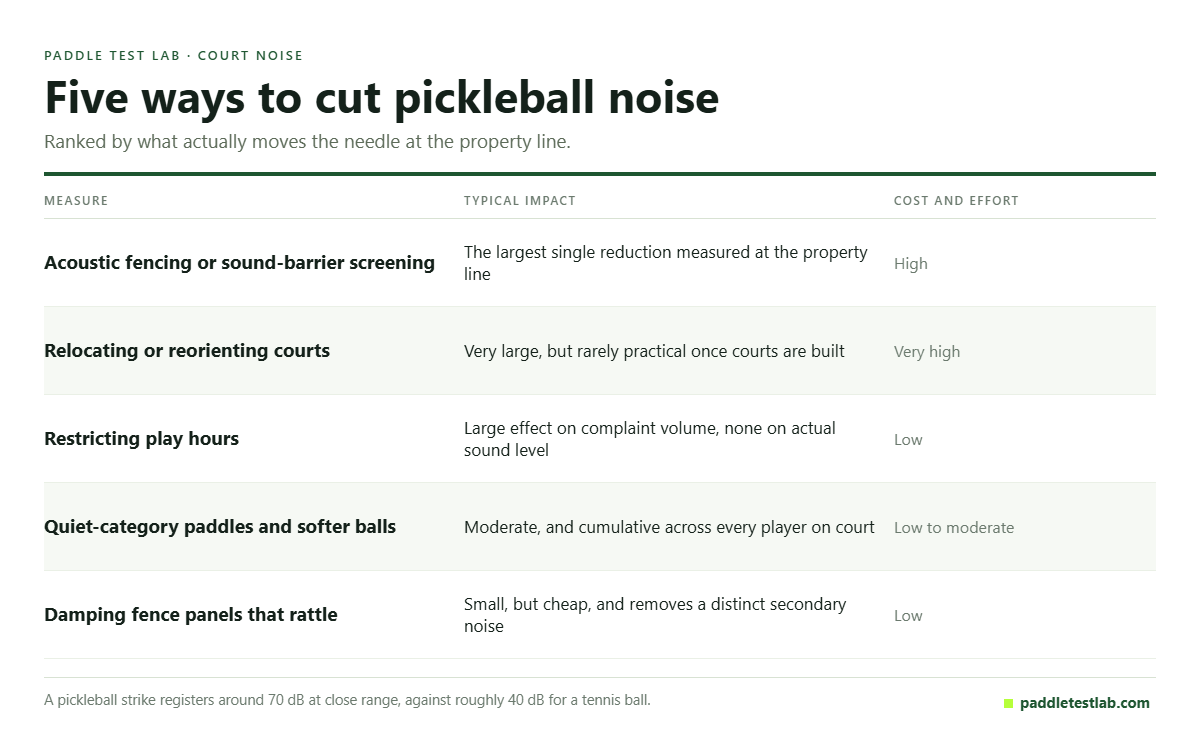
If your goal is keeping courts open rather than simply buying a quieter paddle, the paddle is rarely the biggest lever available. Ranked roughly by how much difference each makes relative to the cost and effort involved:
| Measure | Typical impact | Cost and effort |
|---|---|---|
| Acoustic fencing or sound-barrier screening around the court | The largest single reduction measured at the property line | High |
| Relocating or reorienting courts away from the nearest homes | Very large, but rarely practical once courts are built | Very high |
| Restricting play hours, especially early morning and late evening | Large effect on complaint volume, none on actual sound level | Low |
| Moving the group to quiet-category paddles and softer balls | Moderate, and cumulative across every player on court | Low to moderate |
| Damping fence panels that rattle on ball contact | Small, but cheap, and removes a distinct secondary noise | Low |
Ball choice deserves far more attention than it usually gets, because the ball contributes as much to the impact sound as the paddle face does. Softer indoor-style balls are audibly duller off the face than hard outdoor balls — our guide to the best indoor pickleball balls covers which ones behave that way. In practice, a community that combines a barrier, sensible play hours and a quiet-paddle policy resolves complaints far more reliably than one that mandates paddles alone and expects the problem to disappear.
An Honest Shopping Checklist
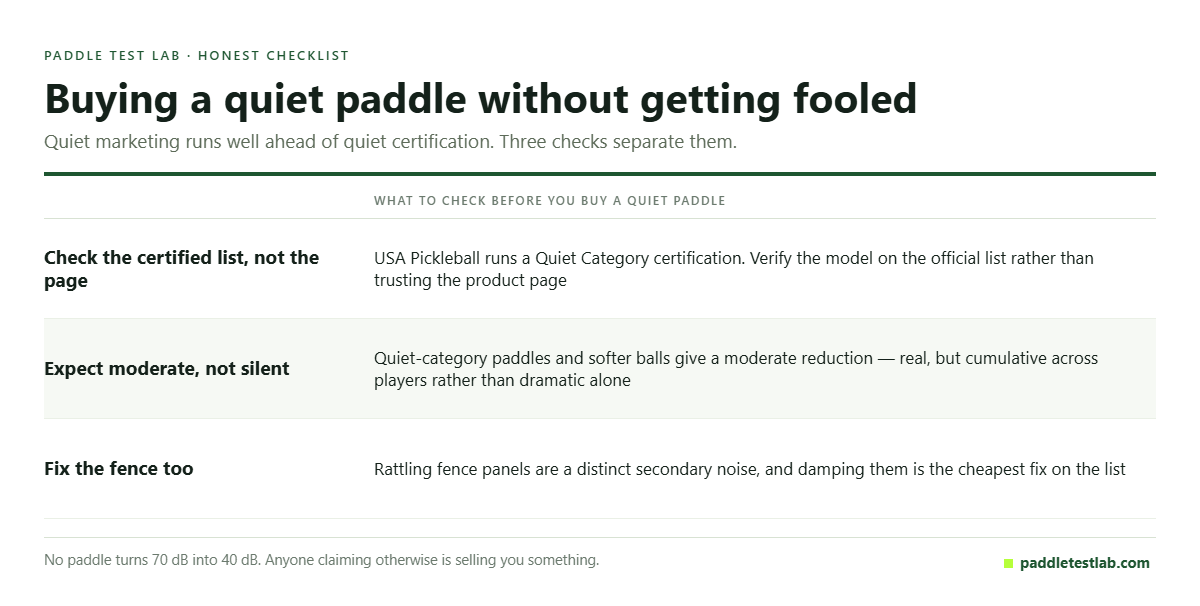
If you need genuinely quieter equipment: check the official quiet category list first if compliance matters. Otherwise favor 16mm, softer, control-oriented builds — thick polymer or foam cores, no power-focused thermoformed slabs. Pair the paddle with a quieter ball where the venue allows it. And set expectations: you’re turning a sharp crack into a duller thud, not achieving silence. We don’t publish a ranked quiet-paddle list yet — model-level owner-review data on noise specifically is still too thin to rank honestly, and we’d rather give you the selection framework than a fabricated top five.
What is the quietest pickleball paddle in 2026?
The only defensible answer is: whichever paddles currently hold USA Pickleball Quiet Category certification, because that is the one measurement taken under controlled, comparable conditions. Marketing terms like “whisper”, “silent” or “HOA-friendly” carry no testing requirement at all, and are used freely by brands that have never submitted a paddle for evaluation. Check the official certified list rather than the product page — our explainer on how USA Pickleball approval and certification actually works covers the difference between the two lists. Among non-certified paddles, thick-core control models sit at the quieter end of the range, so our control paddle roundup is a reasonable starting point.
Do foam-injected paddles reduce noise?
Usually yes, though less dramatically than the marketing implies. Foam injected around the perimeter fills the hollow cavity at the paddle’s edge, and that cavity is where much of the ringing, hollow component of the sound is generated. Owners commonly describe foam-perimeter paddles as sounding duller or deader than an equivalent unfilled paddle, and that is a real effect rather than a placebo. What foam does not change much is the initial crack of ball-on-face contact, which is driven by face material and core thickness rather than by the edge. For the mechanics behind that, see our breakdown of pickleball paddle core types.
Frequently Asked Questions

Do quiet pickleball paddles actually work?
They reduce and change the sound — owners describe a deeper, duller impact instead of the sharp pop — but no paddle eliminates it. Paired with a softer ball, the total reduction is meaningful; the paddle alone is a partial fix.
Is there an official standard for quiet paddles?
USA Pickleball has developed quiet-equipment standards and maintains information on compliant equipment. If you’re answering to an HOA or facility rule, verified quiet-category equipment is the documentation-friendly route — check the official site for the current list.
What makes one paddle louder than another?
Core structure and thickness, face stiffness, and overall build rigidity. Thin, stiff, power-oriented builds produce the sharpest sound; thick, soft, control-oriented and foam-core builds damp it.
Will a quiet paddle hurt my game?
Expect the feel of a control paddle — less pop, softer response. For dink-and-reset players that’s barely a sacrifice; power players will notice. Which is the same trade-off as every other spec: it depends on the game you play.
Related guides

Isacc Shah
Isacc Shah writes PaddleTestLab. He does not test paddles in a lab and says so plainly — there is no rig, no radar gun, no staff hitting balls. Instead he aggregates independent bench measurements, manufacturer specifications, USA Pickleball's approval database and hundreds of verified owner reviews per product, then reports where those sources disagree. Every score on the site carries its evidence count. Where a specification is not published, the site writes UNKNOWN rather than estimating it, and the criticism is printed next to the praise.