
Every paddle USA Pickleball has removed from its Approved Paddle List — with the date it happened, the reason, and whether it is still off the list today. Last verified 18 September 2026.
The short answer: six paddles are currently decertified for USA Pickleball sanctioned play — the JOOLA Perseus 14mm and 16mm Mod TA-15, the Gearbox Pro Power Elongated, and the ProKennex Black Ace Ovation, Black Ace Pro and Black Ace XF. All six were announced on 27 December 2024 and took effect on 1 July 2025. A seventh paddle, the ProKennex 11mm Black Ace LG, was on that original list and was reinstated on 3 June 2025 after passing the PBCoR test. Most pages still say seven. It is six.
This page is the record: who was removed, when, why, and whether they came back. If you want the wider context — what the Approved Paddle List actually is, how a paddle gets certified in the first place, and how the equipment standards work — that is covered separately in USA Pickleball approved paddles explained.
We do not test paddles — here is where every number comes from
PaddleTestLab does not certify, test, measure or approve paddles. We cannot: certification is done by USA Pickleball and UPA-A, through independent laboratories we have no access to. So nothing on this page is our own measurement, and we never present it as one.
Every date, threshold, model name and status below is taken from a named primary source and linked at the bottom of the page: USA Pickleball’s own announcements and equipment FAQ, UPA-A’s published testing rules, or the manufacturer’s own statement. Where a detail comes from industry reporting rather than a governing body, the page says so explicitly. If a figure here ever disagrees with the primary source, the primary source wins and this page is corrected — the same rule we apply to our Paddle Honesty Index.
One more thing worth saying plainly: “delisted” and “banned” are not the same word. USA Pickleball’s own terminology is decertified, delisted or sunset. Nothing here is a safety recall, and a delisted paddle is not a badly made paddle. It is a paddle that no longer complies with a performance rule it once complied with.
The current decertified list
| Paddle | Brand | Announced | Effective | Reason | Status today |
|---|---|---|---|---|---|
| Perseus 14mm Mod TA-15 | JOOLA | 27 Dec 2024 | 1 Jul 2025 | Exceeded the PBCoR power limit | Decertified |
| Perseus 16mm Mod TA-15 | JOOLA | 27 Dec 2024 | 1 Jul 2025 | Exceeded the PBCoR power limit | Decertified |
| Pro Power Elongated | Gearbox | 27 Dec 2024 | 1 Jul 2025 | Exceeded the PBCoR power limit | Decertified |
| Black Ace Ovation | ProKennex | 27 Dec 2024 | 1 Jul 2025 | Exceeded the PBCoR power limit | Decertified |
| Black Ace Pro | ProKennex | 27 Dec 2024 | 1 Jul 2025 | Exceeded the PBCoR power limit | Decertified |
| Black Ace XF | ProKennex | 27 Dec 2024 | 1 Jul 2025 | Exceeded the PBCoR power limit | Decertified |
| Black Ace LG (11mm) | ProKennex | 27 Dec 2024 | reinstated 3 Jun 2025 | Passed all testing including PBCoR on retest | Legal again |
All six decertified models were removed for the same reason: they exceeded USA Pickleball’s PBCoR power threshold. The restriction applies to sanctioned tournament play, and USA Pickleball described the six-month gap between announcement and effect as a deliberate “sunset period” — a phased transition it developed with manufacturers so the industry and players had time to adjust. The normal sunset period is around 18 months; USA Pickleball shortened it for this round because of how quickly high-power paddles had spread.
Why the count is six, not seven
The ProKennex 11mm Black Ace LG was on the original delisting notice, but USA Pickleball reversed it. Its announcement of 3 June 2025 is unusually specific about why, and the distinction is the most useful thing on this page:
ProKennex’s Black Ace 11mm line was first certified in June 2022, before the PBCoR standard existed. USA Pickleball found that ProKennex had not altered the specifications or modified the paddles to achieve accelerated velocity through an engineered trampoline effect — the pattern it observed “in other brands that introduced models in late 2023 and 2024.” The Black Ace LG derives its power from build quality and its 11mm profile instead. On retest, it passed PBCoR and was reinstated.
USA Pickleball still delisted the other three 11mm Black Ace models. Its stated reason is that those paddles also had not been tampered with — but their status had to “remain unchanged” under the process. In other words: two paddles can be removed for the same nominal reason while having arrived there by very different routes. If you take one thing from this page, take that one. It is the difference between a brand engineering around a rule and a brand building a paddle that the rule later caught up with.
What PBCoR is, and the current limits
PBCoR stands for Paddle/Ball Coefficient of Restitution. USA Pickleball introduced it in Q4 2024 to measure and cap the “trampoline effect” — the way a paddle face can deform on impact and spring the ball back, adding speed beyond what the materials alone would produce. USA Pickleball’s wording is that paddles exceeding the threshold “are now in violation of rule 2.E.6.f and are decertified.”
| Standard | Current limit | In force from |
|---|---|---|
| PBCoR (power) | 0.43 | 1 Nov 2025 (previously 0.44) |
| Spin rate | 2,100 RPM maximum for new certification submissions | 1 Oct 2026 |
| Surface roughness | Upper threshold replaced by a “measurement of record” | 1 Oct 2026 |
| Coefficient of friction | Upper threshold replaced by a “measurement of record” | 1 Oct 2026 |
| Maximum length | 17 in / 43.18 cm | current |
| Length + width combined | 24 in / 60.96 cm, including edge guard and butt cap | current |
| Weight and thickness | No published maximum | — |
Two cautions about that table, because both matter. First, USA Pickleball’s spin test is the live change: from 1 October 2026 every paddle submitted for certification must measure 2,100 RPM or less, and the old pass/fail upper thresholds for surface roughness and coefficient of friction are replaced by measurements of record. USA Pickleball developed that test with Image Systems using a dual-camera system, and published the standard operating procedure on 15 July 2026. Until 1 October 2026, paddles that meet the existing surface-roughness and friction requirements can still be certified and added to the list. Do not treat the two frameworks as one — they have different implementation dates. Second, thresholds move. The authority is the Equipment Standards Manual and USA Pickleball’s current announcements, not this page.
The two bodies: USA Pickleball vs UPA-A
There are two certification systems in US pickleball now, and they are not interchangeable. This trips up more players than any other part of the topic, so here it is side by side.
| USA Pickleball (USAP) | UPA-A | |
|---|---|---|
| Governs | USA Pickleball-sanctioned tournaments | Professional events at PPA and MLP, including PPA Challenger Series, PPA Pro Qualifiers, PPA Tour Asia, and all PPA and MLP events in Australia |
| Amateur play | The standard | Not mandatory, provided the paddle is USAP-certified and currently on the USAP Approved Paddle List |
| Testing lab | Element U.S. Space & Defense (independent third party) | Pickle Pro Labs, with the University of Massachusetts Lowell — the testing facility for Major League Baseball |
| Power test | PBCoR, limit 0.43 | Average Deflection Force: both faces must measure 46 lb or more at 70–75°F |
| Spin test | 2,100 RPM maximum for submissions from 1 Oct 2026 | Spin rate cannot exceed 2,200 RPM at any angle |
| Public list | Approved Paddle List, plus a Compliance List | Approved Paddles list, plus a De-Listed Paddles Report |
| Cost to certify | Not published | $10,000 a year per brand, plus $3,000 per paddle |
Two numbers there are worth reading twice. UPA-A caps spin at 2,200 RPM; USA Pickleball’s new test caps it at 2,100 RPM for anything submitted from 1 October 2026. So the two systems do not draw the line in the same place, and a paddle can be perfectly legal in one context and not the other.
What that means in practice: if you play rec, leagues or age-group tournaments, USA Pickleball is the list that matters to you. UPA-A only becomes relevant if you enter professional divisions at PPA or MLP events. For players in Europe, the position is that USAP-approved paddles remain eligible at all levels through 2026, while UPA-A certification is required for professional play as PPA Europe begins. UPA-A’s published fees — $10,000 a year per brand plus $3,000 per paddle for a 24-month certification that takes eight weeks — are also a useful reminder of why smaller brands appear on one list and not the other.
How often paddles actually fail on-site testing
If you assume delisting only affects six old models, the on-site testing numbers will surprise you. Since 2026, USA Pickleball has tested amateur players’ paddles at every USA Pickleball-managed Golden Ticket event, and it reports that of more than 2,000 paddles tested, 6 percent did not meet specifications. A separate USA Pickleball-reported testing round of over 1,000 paddles found a 7 percent failure rate, with most of those paddles failing because they had reached the end of their playable life.
Roughly one player in seventeen arriving at a sanctioned event is carrying a paddle that no longer passes — and by definition, every one of them was legal when it was bought. The mechanics of how that happens are set out below.
The practical detail from the 2026 Golden Ticket player instructions: each player may submit up to two paddles, testing must be completed no later than 15 minutes before your scheduled match, and a test usually takes five to seven minutes. Paddles that pass get an NFC approval sticker on the edge guard, and referees verify the sticker on court before each match. A paddle without a sticker is not permitted for play, which means arriving without your paddle tested can cost you a match regardless of whether the paddle is compliant.
Why a paddle that was legal stops being legal
This is the part that catches people out, and USA Pickleball states the principle directly: a paddle “must comply with all certification requirements throughout its entire lifecycle,” including concerns about paddles improving in performance as they “break in.”
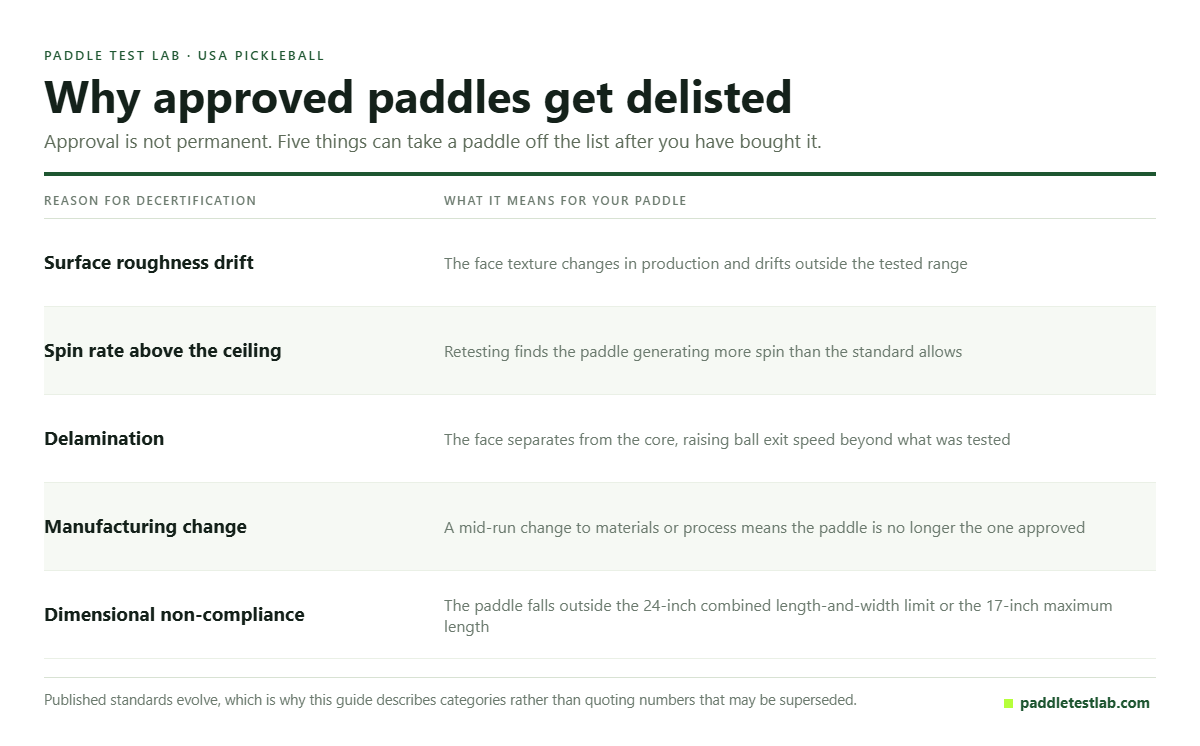
In practice that means a honeycomb polypropylene core — the construction behind the majority of paddles — compresses with repeated impact. The core softens, the face flexes more on contact, and the trampoline effect increases. Power drifts upward over months of play, and a paddle that measured comfortably inside the limit when new can measure outside it a season later. The same mechanism is why core crush and delamination are the most common causes of on-site failure.
If that is your situation, the relevant guide is our breakdown of the signs of paddle delamination and core crush, and the underlying construction differences are covered in pickleball paddle core types explained. This is also why a used paddle is a different proposition from a new one, and why “it passed when I bought it” is not a defence at the testing table.
Earlier enforcement cases, and what they teach
PBCoR is the newest reason a paddle gets removed, but it is not the only one. The earlier cases were about process rather than power, and they are why USA Pickleball now emphasises that certification covers the whole production life of a model.
JOOLA Gen 3 — May to June 2024
On 14 and 15 May 2024, JOOLA told USA Pickleball that it had submitted the wrong paddles for certification back in November 2023. The Gen 3 paddles had originally been certified in September 2023. USA Pickleball de-listed the affected models immediately, and its statement on the point is unambiguous: “Paddles that do not appear on USA Pickleball’s Approved Paddle list are not certified for use in USA Pickleball-sanctioned tournaments.”
JOOLA resubmitted, and on 4 June 2024 USA Pickleball announced that the newly submitted paddles “did not meet our approved equipment standards” — so they stayed off the list. JOOLA offered full refunds to anyone who bought a Gen 3 between 16 April and 15 June 2024, said the paddles it submitted were “materially and structurally the same” as those approved in September 2023, and stated it intended to dispute the decision and the process “in forthcoming legal proceedings.” It then released the Perseus Mod TA-15 as a Gen 3 replacement — which is one of the six paddles PBCoR delisted a year later. All JOOLA Gen 3 models remain decertified.
The lesson: this was not a testing failure at all. It was a discrepancy between the sample submitted and the product shipped.
CRBN — April to May 2022
All CRBN paddles were removed from the Approved Paddle List in late April 2022, during the US Open Championships, for failing surface roughness testing — the faces carried more grit than the rules allowed. CRBN told customers the roughness “issues were isolated to a single batch,” and on 26 May 2022 announced that its newest batch “and all subsequent paddles” had been added back to the list. It also said USA Pickleball would not reinstate the earlier Gen 1 and Gen 2 paddles without “100% guaranteed compliance,” and that it had decided not to fight that.
This is the case that established face texture, not just power, as a live compliance risk — and it is why “excessive surface grit” keeps reappearing in the cases below. Our full CRBN paddle review covers the current models.
Luzz — UPA-A, 2025
On the UPA-A side, all Luzz paddles were removed from the UPA-A approved list in early 2025 after UPA-A found that the “Cannon” had been submitted as a design variation of the approved “ZZ” model when the two paddles were actually constructed differently, with different performance characteristics. Four Luzz models had been re-approved by March 2026: the Pro Blade 2, the Pro-4 Inferno, the Pro-Cannon and the Tornazo. UPA-A also lists restrictions covering Luzz paddles that have not been resubmitted, and the Selkirk Boomstik Elongated 16mm with MOI clamps. (Source: industry reporting, not a UPA-A statement — see the sources note below.)
Under investigation is not the same as delisted
USA Pickleball also publishes a Compliance List, and a model can sit on it without being removed from the Approved Paddle List. The distinction matters, because a paddle under investigation is still legal until USA Pickleball says otherwise. As of the most recent reporting:
- The Peacock and the Tide 14S were reported as “Under Investigation,” both remaining on the Approved Paddle List while the investigations continued since late May. Speedup and Proton were also reported as under investigation.
- The Facolos Pro Series Elite X was removed from the Approved Paddle List after it “was found to exceed USA Pickleball’s allowable surface roughness standards,” and — critically — “Facolos acknowledged that the production version of the paddle differed from the version originally submitted for certification testing.” That is the JOOLA Gen 3 pattern repeating.
- R.A.W. Reign and Win was listed in March for “Unauthorized use of the USAP logo” across several models. That status now reads “Compliance Issue Resolved.”
Note the theme: excessive surface grit sits behind most of these investigations, not power. (Source: industry reporting citing the USAP Compliance List — verify current status on the list itself before relying on any of it.)
How to check your own paddle in four minutes
- Read the exact model name on the paddle. Generation and thickness are part of the identity. “Perseus 16mm Mod TA-15” and “Perseus 16mm” are different entries, and one of them is delisted.
- Search the USA Pickleball Approved Paddle List for that exact model and confirm the status reads Pass. A model being on the list is not the same as any paddle of that shape being legal.
- Check the Compliance List for an open investigation, a compliance issue, or a logo-authorisation problem against the model or brand.
- If you play professional divisions at PPA or MLP events, check UPA-A as well — the Approved Paddles list and the De-Listed Paddles Report. USAP approval alone is not enough there.
- Check the date on whatever you are looking at. Both lists change constantly — the USAP list added models as recently as 10 September 2026 — so a screenshot or a forum post from last season proves nothing about today.
And if you are buying used, or a model that has been on the market for a couple of seasons, assume nothing about its compliance. Core crush is invisible from the outside and is the single most common reason paddles fail on-site testing.
Frequently asked questions
How many paddles has USA Pickleball delisted?
Six are currently decertified from sanctioned play: the JOOLA Perseus 14mm and 16mm Mod TA-15, the Gearbox Pro Power Elongated, and the ProKennex Black Ace Ovation, Black Ace Pro and Black Ace XF. Seven were originally announced on 27 December 2024, but the ProKennex 11mm Black Ace LG was reinstated on 3 June 2025 after passing PBCoR on retest. All JOOLA Gen 3 models also remain decertified from the 2024 case.
Is “banned” the right word?
USA Pickleball uses decertified, delisted or sunset. “Banned” is common in forum discussion but it is not the official term, and it is not a safety recall. A delisted paddle has failed to meet a certification requirement, usually a performance limit.
Can I still use a delisted paddle for rec play?
USA Pickleball’s position is that paddles not on the Approved Paddle List “are not certified for use in USA Pickleball-sanctioned tournaments,” so the restriction governs sanctioned competition. Casual play is not sanctioned play, and CRBN put the same distinction to its customers during its 2022 removal, noting the paddles could still be used outside tournament play. If you play in a league or at a facility that adopts USA Pickleball rules, check with the organiser — they may apply the list even though the event is not USAP-sanctioned.
Does delisting mean the paddle is badly made?
No, and this is the most misread part of the whole subject. The ProKennex Black Ace LG case proves it: USA Pickleball reinstated that paddle after concluding ProKennex had not modified it to create an engineered trampoline effect, and that its power came from build quality and its 11mm profile. A paddle can be excellently constructed and still exceed a performance limit — or be removed because the sample submitted did not match the product shipped.
Can a delisted paddle come back?
Yes, and it has happened more than once. The ProKennex 11mm Black Ace LG was reinstated on 3 June 2025. All CRBN paddles were removed in April 2022 and CRBN announced on 26 May 2022 that its newest batch “and all subsequent paddles” were back on the list. Four Luzz models were re-approved by UPA-A by March 2026.
What is PBCoR?
Paddle/Ball Coefficient of Restitution — the test USA Pickleball introduced in Q4 2024 to measure and cap the “trampoline effect,” where a paddle face deforms on impact and springs the ball back for extra speed. Paddles exceeding the threshold are, in USA Pickleball’s words, “in violation of rule 2.E.6.f and are decertified.” The current published limit is 0.43.
What are the current equipment limits?
PBCoR 0.43; a maximum length of 17 inches; combined length plus width no more than 24 inches including edge guard and butt cap; and no published maximum weight or thickness. From 1 October 2026, new certification submissions must measure 2,100 RPM or less on USA Pickleball’s spin test, and the previous surface-roughness and coefficient-of-friction thresholds become measurements of record.
Do I need UPA-A certification as well as USA Pickleball approval?
Only for professional divisions at PPA and MLP events, where UPA-A certification is required. UPA-A states that amateur competition accepts its own standards but does not mandate them, provided the paddle has USAP certification and is currently on the USAP Approved Paddle List.
Why did my paddle fail testing when it was legal when I bought it?
Almost always core crush or delamination. Honeycomb polypropylene cores compress with repeated impact, the face flexes more, and the trampoline effect increases, so measured power drifts upward over months of play. USA Pickleball’s own framing is that a paddle “must comply with all certification requirements throughout its entire lifecycle,” including changes as it breaks in.
How often do paddles fail on-site testing?
USA Pickleball reports that of more than 2,000 paddles tested at Golden Ticket events, 6 percent did not meet specifications, and a separate round of over 1,000 paddles produced a 7 percent failure rate, mostly attributed to paddles reaching the end of their playable life. That is roughly one player in seventeen.
Where do I check whether my paddle is approved?
The USA Pickleball Approved Paddle List is the authority for sanctioned play, and USA Pickleball also publishes a Compliance List. For professional PPA and MLP events, use the UPA-A Approved Paddles list and its De-Listed Paddles Report as well. The links are in the sources below.
Sources
Primary sources — USA Pickleball:
- Paddle Certification Updates — the 27 December 2024 announcement naming the seven paddles and the 1 July 2025 sunset date.
- Statements on de-certified JOOLA paddles and equipment testing standards — the 16 May and 4 June 2024 statements.
- ProKennex 11mm Black Ace LG officially relisted — the 3 June 2025 reinstatement.
- Update regarding the spin rate test and implementation timeline — the 2,100 RPM limit and the 1 October 2026 date.
- Equipment Submission FAQ — why equipment is decertified, the sunset period, and the Element U.S. Space & Defense lab.
- USA Pickleball Approved Paddle List — the live list, and the authority for any specific paddle.
- 2026 Golden Ticket player instructions — amateur on-site testing, NFC stickers and the five-to-seven-minute test.
Primary sources — UPA-A:
- Paddle Testing — which events require certification, the labs, the fees, the 46 lb ADF requirement and the 2,200 RPM spin limit.
- Approved Paddles — the live list, plus the De-Listed Paddles Report.
Primary sources — manufacturers:
- CRBN’s statements regarding the USA Pickleball removal, including the 26 May 2022 reapproval notice.
- JOOLA’s Gen 3 update of 5 June 2024, including the refund window and the stated intention to dispute the decision.
Secondary sources, used only where marked above and not treated as authoritative:
- The Dink for the Compliance List reporting, the Facolos Pro Series Elite X removal, and the Peacock, Tide 14S, Speedup and Proton investigations.
- 11 PICKLES for the Luzz timeline on the UPA-A side and the PBCoR threshold history.
How to read this page
Last verified: 18 September 2026. Certification is a moving target — USA Pickleball added models to the Approved Paddle List as recently as 10 September 2026, and investigations open and close without notice. This page is a record of what the governing bodies have published, dated at the point each statement was made, and it is checked periodically rather than continuously.
If anything here disagrees with USA Pickleball or UPA-A, they are right and this page is wrong and we will correct it. That is the same standard we apply to the Paddle Honesty Index: if a figure disagrees with a named source, the named source wins. If you spot something out of date, tell us and it gets fixed and dated.
The two deliberately unresolved points, so you can judge them yourself: the current published PBCoR limit of 0.43, and the earlier 0.44 value, are reported from equipment-industry trackers of USA Pickleball’s standards rather than quoted here from the Equipment Standards Manual itself. Treat the Manual as the authority for any threshold. And every item labelled as industry reporting — the Luzz timeline, the compliance investigations — is second-hand until you confirm it on USA Pickleball’s or UPA-A’s own list.