
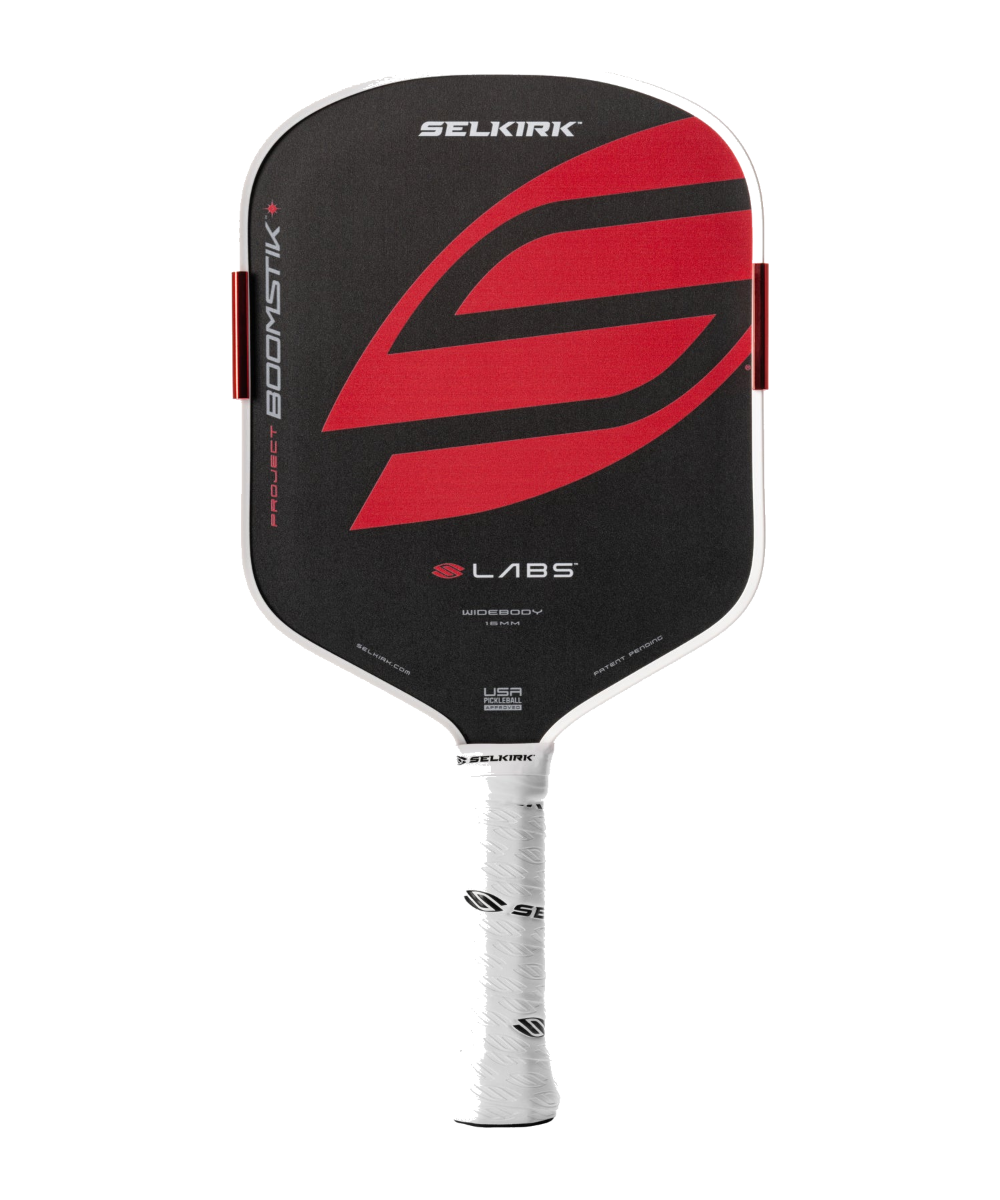
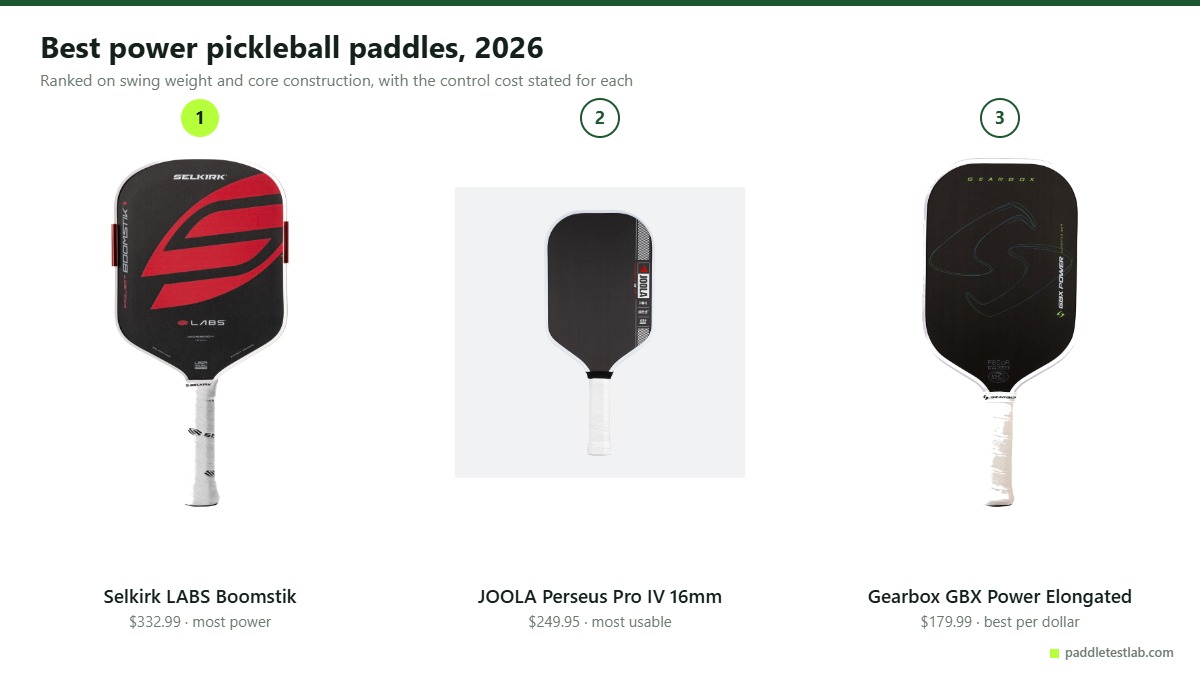
Short answer: the best power pickleball paddles in 2026 are the Selkirk LABS Project Boomstik for outright pace, the JOOLA Perseus Pro IV for power you can actually use, and the Gearbox GBX Power Elongated for value. All three earn it through swing weight and core stiffness, not through anything printed on the box.
“Power” is the least regulated word in pickleball marketing. It appears on paddles that are genuinely fast off the face, on paddles that are simply heavy, and on paddles whose only claim to it is a black-and-red colourway.
There are really only three things that make a paddle hit hard, and none of them is a name. This ranking explains those three, then applies them to seven paddles that are actually available in 2026 — with the control cost stated for every one, because there is always a control cost.
What Actually Makes a Paddle Powerful
Swing weight. This is mass distribution, not total weight, and it is the single biggest driver of pace. A paddle with more mass out towards the tip carries more momentum into the ball. Two paddles can weigh the same 8.0 ounces on a kitchen scale and behave completely differently because one carries its mass in the handle. Swing weight above roughly 115 is a power paddle; below about 108 is a hands-battle paddle. Our guide to swing weight in pickleball explains how it is measured.
Core stiffness and construction. A stiff core returns more of the ball’s energy instead of absorbing it. Thermoformed and cold-bonded builds are stiffer than traditional cold-pressed honeycomb; foam-filled walls add stiffness at the perimeter. Stiffer means more pace and less feel — that trade is not negotiable.
Shape. Elongated paddles put the sweet spot further from your hand, which is more leverage and more tip speed. They also shrink the sweet spot and slow your reactions at the kitchen line. Our elongated vs standard comparison covers what you give up.
Notice what is not on that list: face material. Carbon versus fiberglass changes feel and spin far more than it changes pace.
The Swing-Weight Number Brands Hide
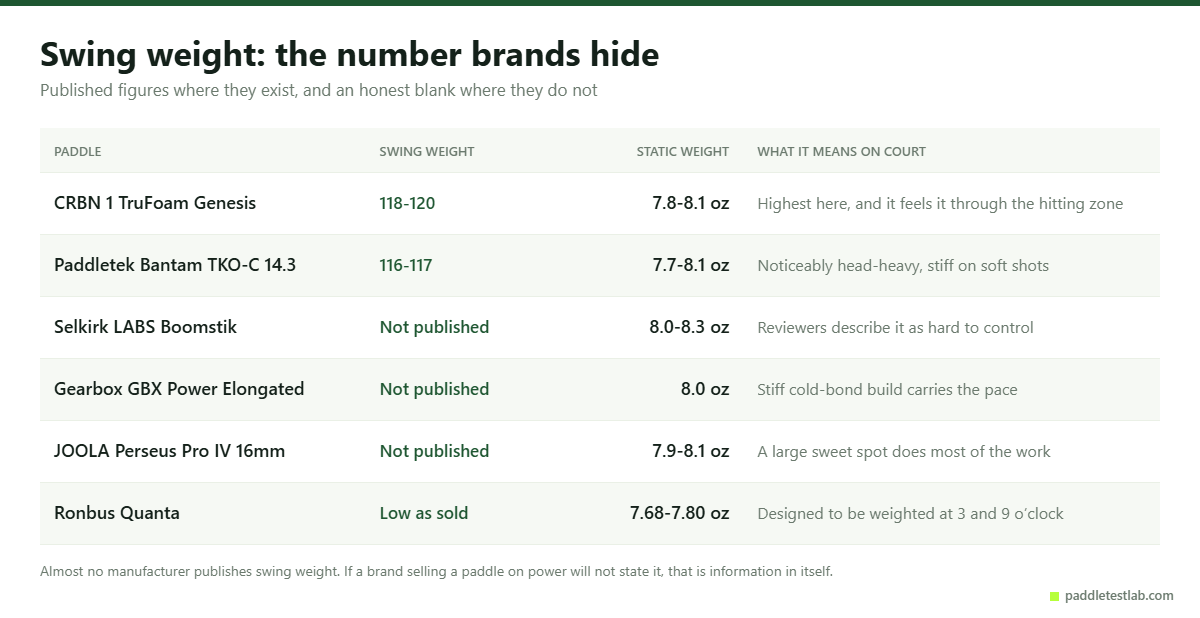
Almost no manufacturer publishes swing weight. They publish static weight, because static weight is cheap to measure and sounds meaningful. The result is that the most important power specification in the sport is one you have to get from third-party testers.
Where a figure exists for the paddles below, it is quoted. Where it does not, that is stated rather than guessed. A short table of what is known:
- CRBN 1 TruFoam Genesis — 118 to 120. The highest here, and it feels it.
- Paddletek Bantam TKO-C 14.3 — 116 to 117, and noticeably head-heavy.
- Selkirk LABS Project Boomstik — not published; reviewers describe it as hard to control, which is consistent with a high figure.
- Ronbus Quanta — low as sold, by design, and intended to be raised with added weight.
If a brand will not tell you the swing weight of a paddle it is selling on power, that is information in itself.
The Best Power Pickleball Paddles: 2026 Rankings
1. Selkirk LABS Project Boomstik — the most power, and the most caveats
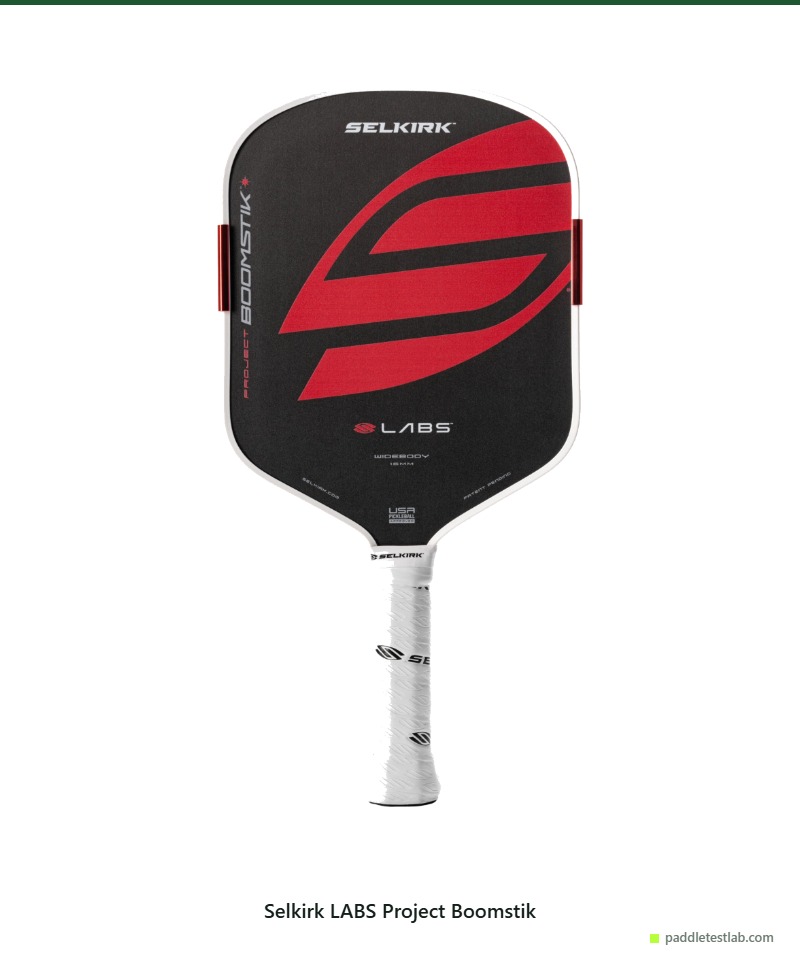
Explosive and durable, built on a Multistrata T700 carbon face with InfiniGrit, and the only paddle here with no reported core crush and a limited lifetime warranty behind it. If raw pace is the brief, this wins.
The costs are real. It is hard to control — that is not a soft criticism, it is the consistent reviewer finding. It sits $50 to $100 above comparable paddles. And there are many reports of loose or failing edge guards, which the warranty covers but which still takes the paddle out of your hand for a fortnight.
$332.99 MSRP · 16mm · elongated (widebody offered) · USAP and PPA amateur approved.
2. JOOLA Perseus Pro IV 16mm — the most usable power
Easy power off a large, forgiving sweet spot. This is the paddle for the player who wants pace without reorganising their whole game around it, and it is still the model most reviewers recommend over JOOLA’s newer, dearer flagship.
Two documented issues: grit and spin fall away after two to four months of heavy play, and JOOLA cores carry a core-crush history worth reading before you spend $250. We go through both in the JOOLA brand review.
$249.95 street ($279.99 MSRP) · 16mm and 14mm · elongated · USAP and UPA-A approved.
3. Gearbox GBX Power Elongated 16mm — best power per dollar
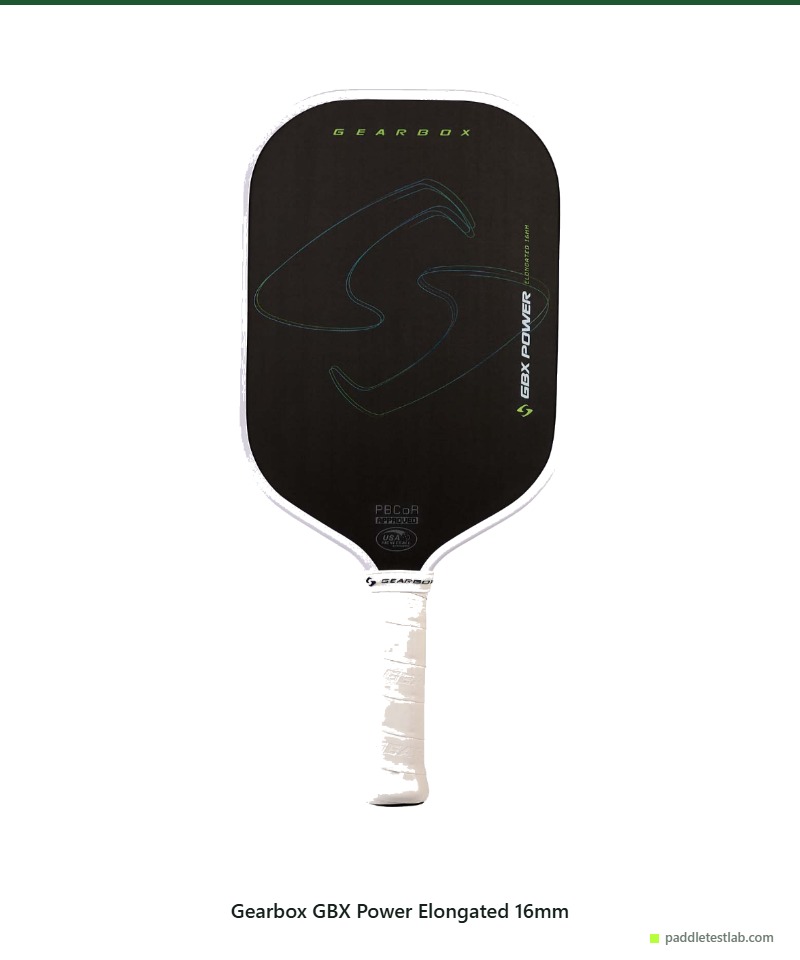
Gearbox’s cold-bond construction does not crush or degrade the way pressed cores can, and the GBX Power delivers current-generation pace about $100 below Gearbox’s own GX2. For a player who already has the technique, this is the value pick of the category.
It is also the most demanding paddle on this list. It is stiff, and it sacrifices control, spin and forgiveness to be so. Reviewers are unanimous that it suits 4.0-and-above power players and punishes everyone else. If you are not sure whether that is you, it is not.
$179.99 MSRP · 16mm · elongated (hybrid offered) · UPA-A and PBCoR approved.
4. Paddletek Bantam TKO-C 14.3 — power with a control floor
Big pop that does not entirely abandon control, made in the USA, and the most complete paddle here for a player who wants to drive but still has to reset. The PT-700 raw carbon face and 14.3mm core are a deliberately unusual combination and it works.
Three honest drawbacks: it is head-heavy at a 116 to 117 swing weight, the stock grip is not top tier, and it is stiff on soft shots — drops and dinks take real attention. It is also very loud, which matters if you play anywhere with a noise policy. See our quiet paddle guide if that is a constraint.
$199.99 MSRP · 14.3mm · elongated · USAP approved since February 2024.
5. CRBN 1 TruFoam Genesis — power from dwell, not stiffness
A different route to pace. The 100% foam core gives long dwell time, which produces heavy, spinning drives rather than flat ones, and the Gen-4 construction means no core crush at all.
It has the highest swing weight in this group at 118 to 120, the smallest sweet spot in CRBN’s series, and a grip that owners report going slippery. It rewards a player who can find the middle of the face consistently and frustrates one who cannot.
$279.99 MSRP · 14mm, 100% foam · elongated · USAP approved.
6. Ronbus Quanta — the budget power build
Under $120, often $99 with a code, with a Gen-4 EPP foam core that does not crush. As it ships it is light and manoeuvrable rather than powerful. Add 7.5 to 15 grams at 3 and 9 o’clock and it becomes a genuine power paddle — that is how every reviewer who rates it has set it up.
Treat the weighting as mandatory, not optional. Our guide to adding weight to a paddle covers where to put it.
$119.99 MSRP, $99 with codes · 16mm EPP foam · four shapes · USAP approved, PBCoR .43.
7. JOOLA Perseus Pro V 16mm — the flagship we would not buy
JOOLA’s current flagship, launched March 2026, with a refined Perseus feel and a Charged Carbon face. It is a good paddle and it is on this list for completeness.
It is also widely called overpriced, and the recurring reviewer verdict is to buy the Pro IV instead and keep the fifty dollars. It does not have a full-foam core, which at $299.95 in 2026 is a fair thing to raise. Buy it if you want the newest Perseus. Do not buy it expecting a step change.
$299.95 MSRP · 16mm · elongated · USAP and UPA-A approved.
Power Without the Elbow Bill
Stiff, head-heavy paddles transmit more shock into the forearm. That is the mechanism behind most paddle-related elbow pain, and it is why several of the paddles above are poor choices for anyone with a history of it.
If you want pace and have a sensitive arm, three adjustments help more than paddle choice alone: move down a swing-weight bracket, add a slightly thicker overgrip to reduce grip tension, and take the 16mm core over the 14mm. A player who needs to start from comfort rather than power should begin with our tennis elbow paddle guide instead of this page.
Thermoformed, Foam Wall, Full Foam — Where the Pace Comes From
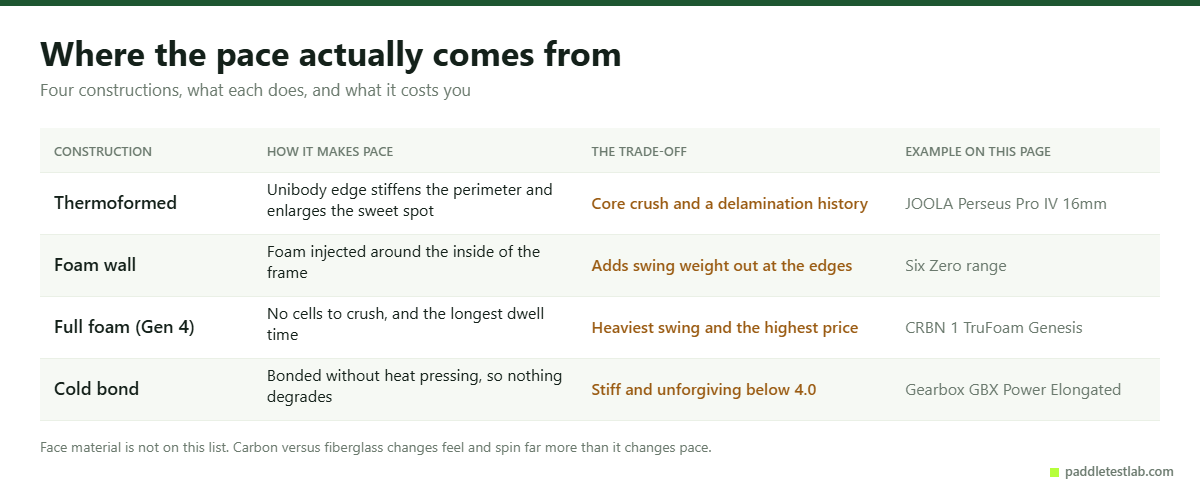
Three constructions dominate the power category and they do not feel the same.
Thermoformed paddles are moulded under heat and pressure with a unibody edge, which stiffens the perimeter and enlarges the effective sweet spot. This is the mainstream power build, and it is also the build behind the delamination reports of the last three years — see the signs of delamination before buying used.
Foam wall paddles inject foam around the inside of the frame. Pace at the edges improves without the whole paddle becoming a trampoline.
Full foam replaces the honeycomb entirely. No cells to crush, longer dwell, heavier swing. It is the most durable route to power and the most expensive.
Our core types explainer goes through all three in detail.
Adding Power to a Paddle You Already Own
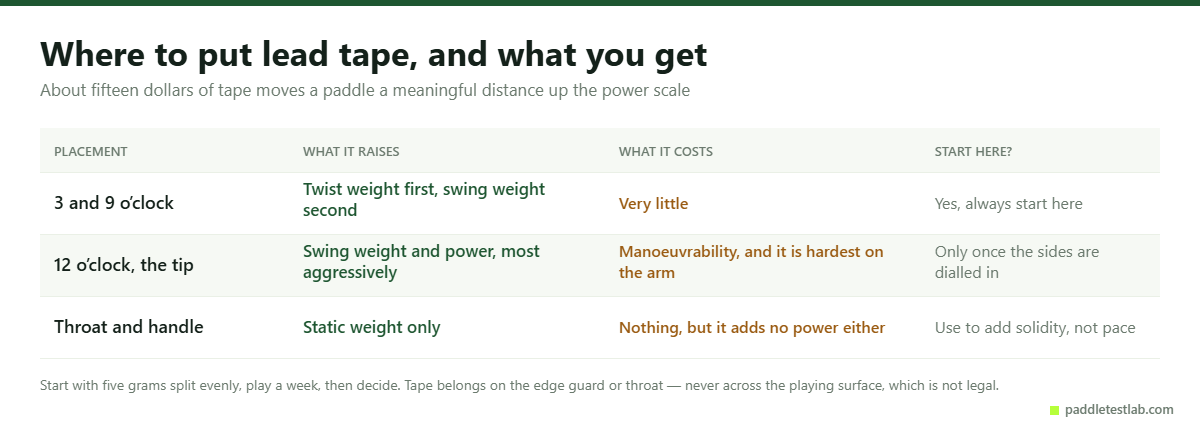
Before spending $250, it is worth knowing that a roll of lead or tungsten tape costs about fifteen dollars and moves a paddle a meaningful distance up the power scale. Swing weight is the main driver of pace, and swing weight is something you can change.
Where you put the tape decides what you get.
- 3 and 9 o’clock — the sides of the face. Raises twist weight and stability first, swing weight second. This is the placement that enlarges the effective sweet spot and makes off-centre hits behave. Start here.
- 12 o’clock — the tip. The most aggressive placement for power, because the mass is furthest from your hand. It also costs the most manoeuvrability, and it is the placement most likely to make your arm ache.
- Throat and handle. Raises static weight without raising swing weight. Use this to make a paddle feel more solid without making it harder to swing — the opposite of a power modification.
How much. Start with five grams total, split evenly between the two sides, and play a week before adding more. Most players end up somewhere between five and fifteen grams. Adding tape takes two minutes; working out that you have added too much takes a month of a sore elbow.
Keep it symmetrical. Uneven tape twists the paddle in the hand on contact, which is the same jolt an off-centre hit produces. Measure the strips rather than eyeballing them.
Check it is still legal. Added weight is permitted, but altering the playing surface is not — tape belongs on the edge guard or the throat, never across the face. Our guide to approved paddles covers what modifications the rules allow, and the adding weight guide has the step-by-step.
One honest caveat: tape cannot make a soft paddle stiff. If the core absorbs energy, weight will make the paddle swing heavier without returning more of it. Weighting works on a stiff paddle that is simply too light; it does not turn a control paddle into a power paddle.
Technique: Where Pace Actually Comes From
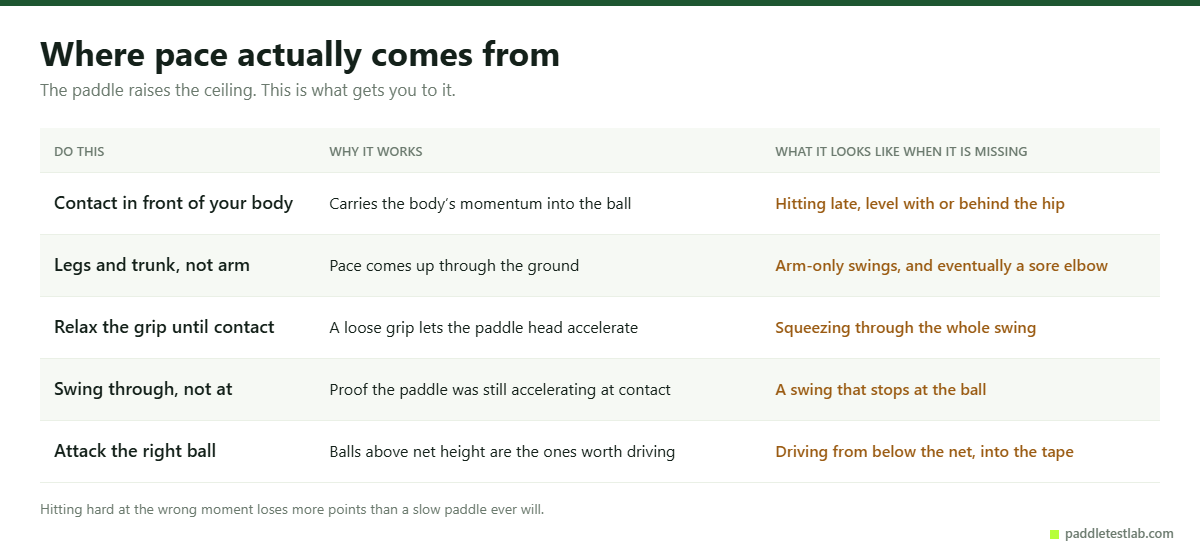
The paddles above raise the ceiling. What gets you to the ceiling is mostly free.
Contact point in front of your body. The single biggest source of lost pace in club pickleball is hitting late, with the ball level with or behind the hip. A drive struck out in front carries the body’s momentum into it; one struck late is an arm swing and nothing else.
Legs and trunk, not arm. Pace comes up through the ground: load the back leg, rotate the trunk, and let the arm be the last thing that moves. Players who generate power purely from the arm are also the players who end up in our tennis elbow guide.
Relax the grip until contact. A tight grip through the whole swing slows the paddle head. Hold it loosely, firm up at contact. This is counter-intuitive and it is worth ten miles per hour to most people.
Swing through, not at. A full follow-through means the paddle was still accelerating at contact. A swing that stops at the ball was decelerating before it, which is where pace disappears.
Pick the right ball to attack. Power on a ball below net height is a fault waiting to happen. The shots worth driving are the ones that sit up above the net — everything else is a reset. Hitting hard at the wrong moment loses more points than a slow paddle ever will.
What You Are Actually Trading Away
Every paddle on this page buys pace with something, and it is worth naming the currency before you spend it.
Hand speed at the kitchen. A high swing weight is slower to move. In a speed-up exchange at the net, the player with the lighter, more manoeuvrable paddle gets the first counter, and first counter usually wins the point. If your game is built on hands battles, the top of this list is the wrong end of it.
Soft-shot feel. A stiff core returns energy rather than absorbing it, which is exactly what you do not want on a drop or a reset. Stiff paddles make third-shot drops harder, and the third-shot drop is the shot that decides most games below 4.5.
Forgiveness. Elongated shapes buy leverage and tip speed by moving the sweet spot away from your hand and making it smaller. Mishits on a long, stiff paddle are punished harder than on a widebody.
Your elbow. Stated plainly because it is the cost people discover last. Stiff, head-heavy paddles transmit more shock into the forearm, and the players most likely to buy a power paddle are the ones most likely to then need our control paddle guide six months later.
None of that is an argument against buying one. It is an argument for buying one because you have decided the trade is worth it, rather than because the box said power.
Frequently Asked Questions
Does a heavier paddle mean more power?
Only if the extra mass is in the head. An 8.3-ounce paddle with a heavy handle can swing lighter than a 7.9-ounce paddle with a heavy tip. Static weight is the wrong number to shop on.
Is 14mm or 16mm better for power?
14mm cores are generally punchier and 16mm cores more controlled, but the difference is smaller than the difference between two 16mm paddles with different core constructions. Our 14mm vs 16mm guide covers when the thickness genuinely matters.
Can I add power to a paddle I already own?
Yes, and it is the cheapest upgrade available. Lead or tungsten tape at 3 and 9 o’clock raises swing weight and stability; tape at 12 raises power most aggressively and costs the most manoeuvrability. Start with 5 grams and play a week before adding more.
Do power paddles wear out faster?
The face does, on any paddle with a grit surface. The core is a different question: cold-bonded and full-foam builds have the cleanest records, while pressed honeycomb cores are where core crush happens.
Are power paddles legal everywhere?
Every paddle on this list is approved, but approval bodies differ and lists change. Check the model before a sanctioned tournament — our guide to approved paddles explains how.
Specifications and prices are checked against each brand’s own store — Selkirk, JOOLA and Gearbox — and were current in July 2026.

Isacc Shah
Isacc Shah writes PaddleTestLab. He does not test paddles in a lab and says so plainly — there is no rig, no radar gun, no staff hitting balls. Instead he aggregates independent bench measurements, manufacturer specifications, USA Pickleball's approval database and hundreds of verified owner reviews per product, then reports where those sources disagree. Every score on the site carries its evidence count. Where a specification is not published, the site writes UNKNOWN rather than estimating it, and the criticism is printed next to the praise.