
Short answer: padel scoring is tennis scoring — 15, 30, 40, game, then six games with a two-game lead to take a set. The one real complication is 40-40: either advantage scoring or a single golden point, and which you play depends on where you booked the court.
Padel borrowed its scoring wholesale from tennis, which makes it instantly familiar to half the people who try it and completely opaque to the other half.
There is one genuine complication: padel has two different ways of resolving a tied game, and which one you are playing depends on where you booked the court. Get that settled before the first serve and everything else follows.
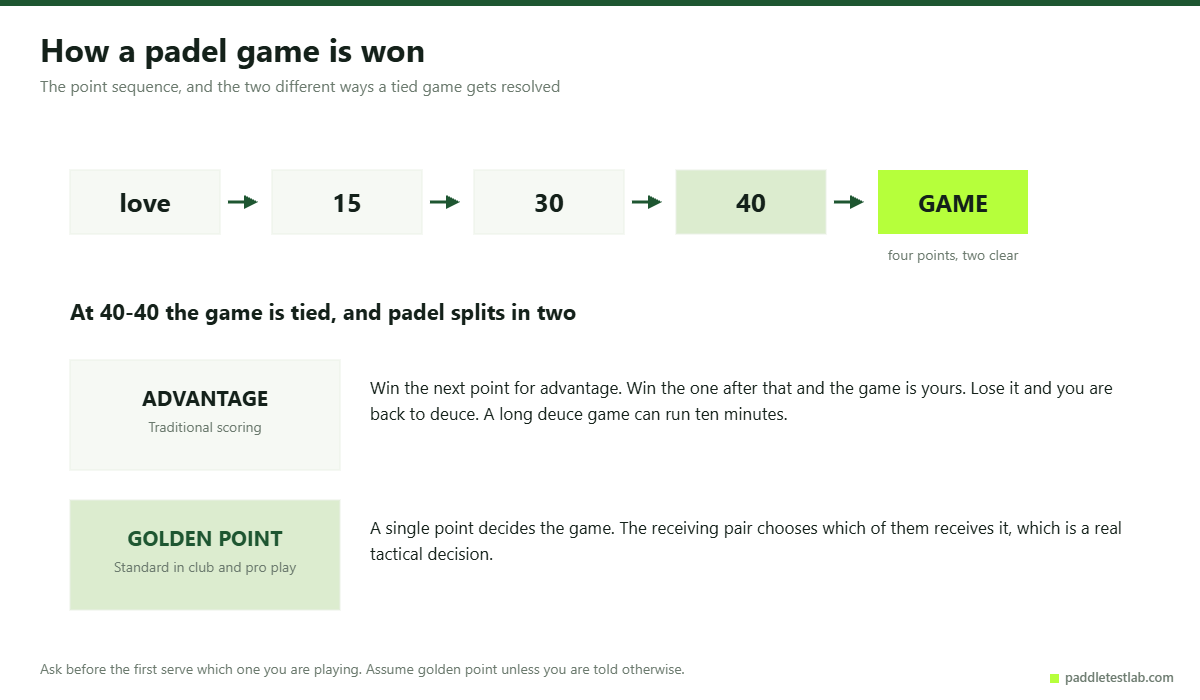
15, 30, 40 — the Tennis Inheritance
Within a game, points are called in this sequence:
- 0 is called “love”
- First point: 15
- Second point: 30
- Third point: 40
- Fourth point: game, provided you are two points clear
The server’s score is called first, always. “30-15” means the serving pair has two points and the receiving pair has one.
The numbers are historical and mean nothing mathematically. Do not look for logic in them; there is none left.
One important difference from pickleball: in padel, a point is won on every rally regardless of who served. There is no side-out, no second server, and no situation where winning a rally earns you nothing. If you are coming from pickleball, that is the biggest mental adjustment — our pickleball scoring guide covers the system you are leaving behind.
Deuce, Advantage, and the Golden Point Alternative
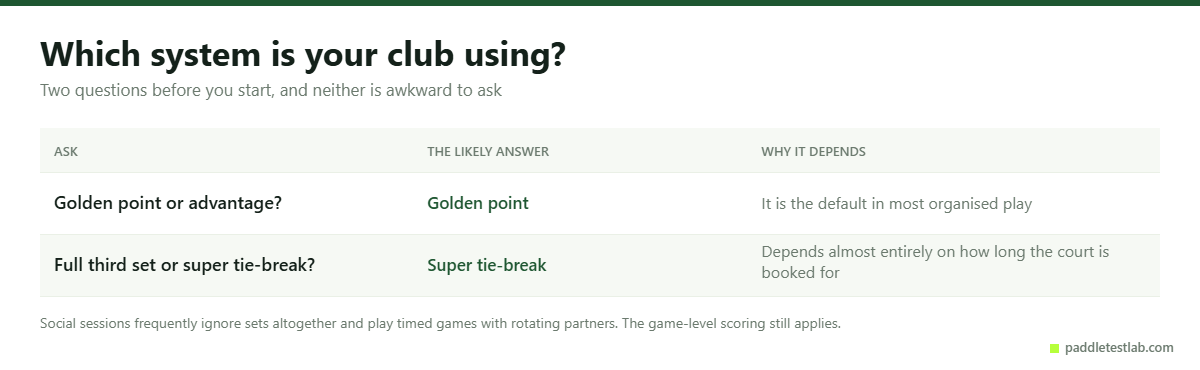
At 40-40 the game is tied, and this is where padel splits into two systems.
Advantage scoring — the traditional route
40-40 is called deuce. The next point won is advantage to that pair. Win the following point and you take the game; lose it and the score returns to deuce. This repeats until one pair wins two points in a row.
A long deuce game can run for ten minutes. That is either the best part of the sport or the worst, depending on which side of it you are on.
Golden point — the modern default
At 40-40, a single point decides the game. No advantage, no repeats. Win it and the game is yours.
The receiving pair chooses which of them receives the golden point, and that choice is a real tactical decision — you put your better returner in, or you target the weaker server’s weaker diagonal.
Golden point is standard at professional level and in most organised club play. It keeps matches to a predictable length, which is why tournaments and court-booking systems favour it.
Games, Sets and Match Formats
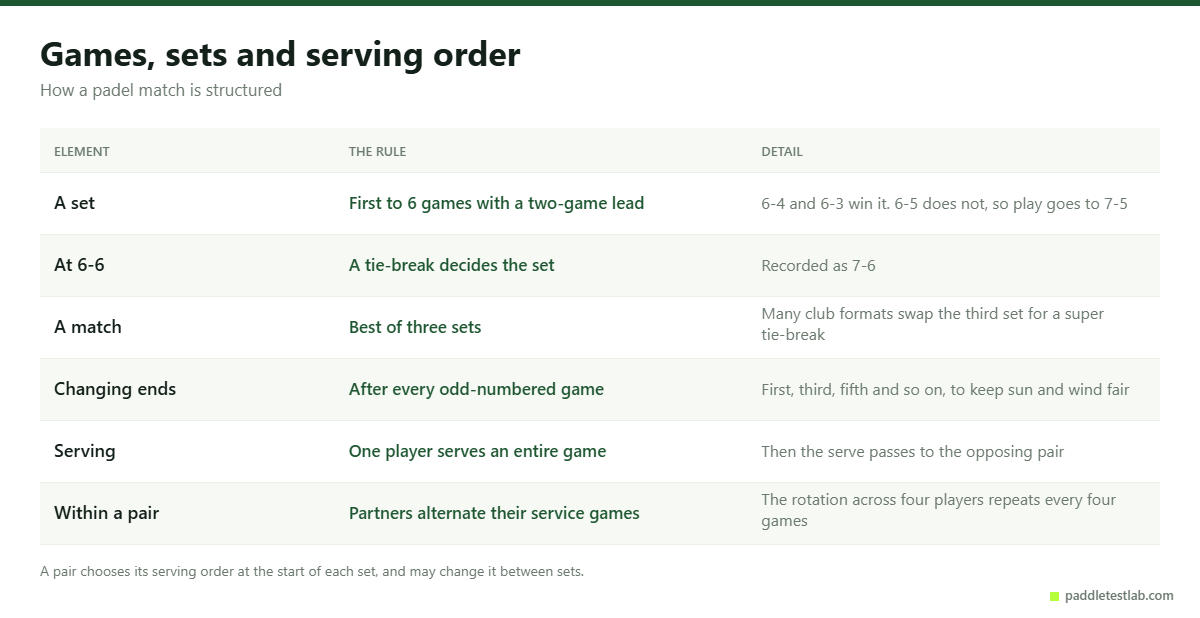
- A set goes to the first pair to win 6 games with a two-game lead. So 6-4 and 6-3 win a set; 6-5 does not — play continues to 7-5.
- At 6-6, a tie-break decides the set.
- A match is normally best of three sets.
- Ends change after every odd-numbered game — after the first, third, fifth and so on — which keeps sun and wind fair.
Serving order. One player serves an entire game, then the serve passes to the opposing pair. Within each pair, the two partners alternate their service games, so the rotation across four players repeats every four games. The pair chooses its serving order at the start of each set, and can change it between sets.
Tie-Breaks and the Super Tie-Break
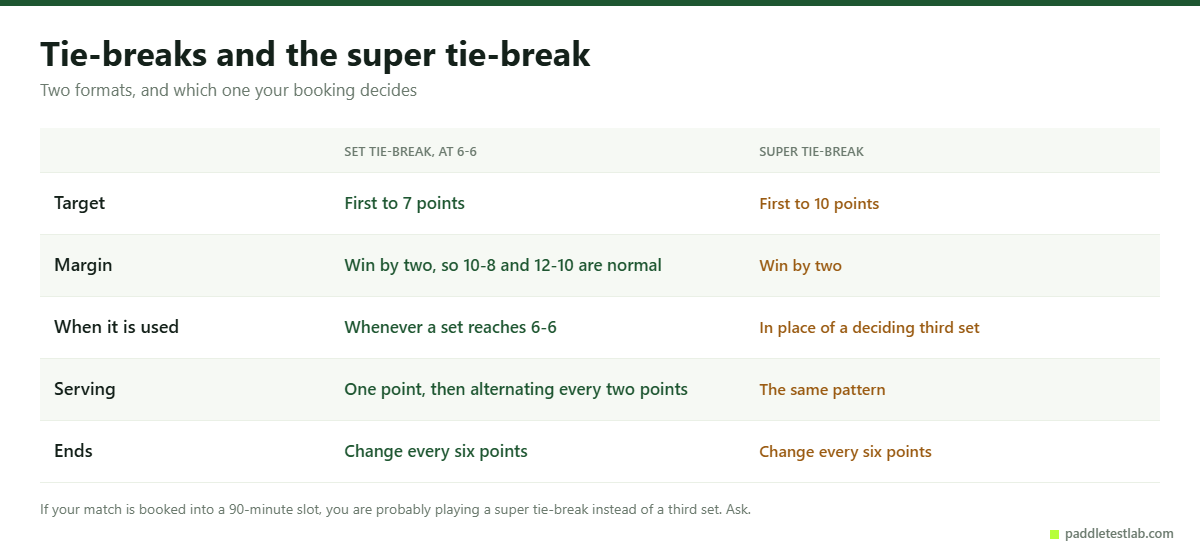
The set tie-break at 6-6. First pair to 7 points, with a two-point lead. If it reaches 6-6 inside the tie-break, play continues until someone is two clear — 10-8, 12-10 and so on.
Serving inside a tie-break runs differently from the rest of the set. One player serves the first point, then the serve alternates every two points, rotating through all four players. Ends are changed every six points. The set is recorded as 7-6.
The super tie-break. Many club leagues and time-limited formats replace the deciding third set with a super tie-break: first to 10 points, win by two, using the same serving pattern. If your match is scheduled in a 90-minute slot, this is probably what you are playing. Ask.
Which System Is Your Club Using?
Two questions before you start, and neither is awkward to ask:
- Golden point or advantage? Assume golden point unless told otherwise — it is the default in most organised play.
- Full third set or super tie-break? Depends almost entirely on how long the court is booked for.
Social sessions frequently ignore sets altogether and play timed games with rotating partners. That is fine, and the game-level scoring above still applies.
Padel Scoring vs Pickleball Scoring, Side by Side
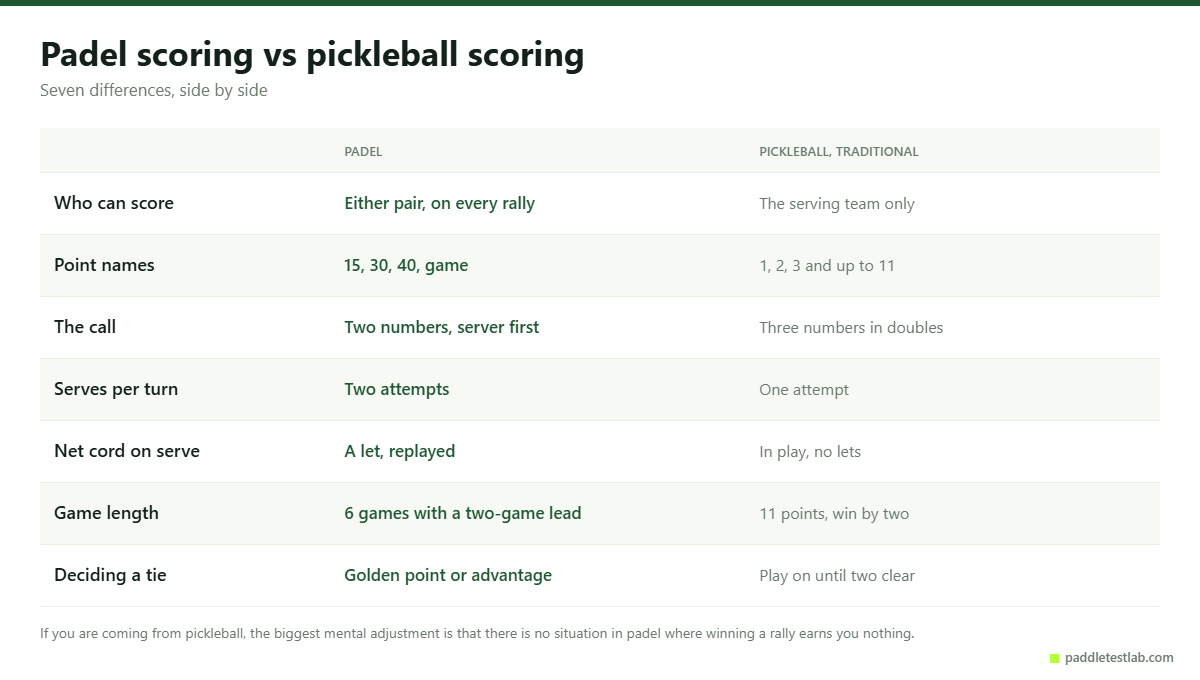
| Padel | Pickleball (traditional) | |
|---|---|---|
| Who can score | Either pair, every rally | Serving team only |
| Point names | 15, 30, 40, game | 1, 2, 3 … up to 11 |
| Score call | Two numbers, server first | Three numbers in doubles: server score, receiver score, server number |
| Serves per turn | Two attempts | One attempt |
| Net cord on serve | Let, replayed | In play, no lets |
| Game length | 6 games, win by 2, to a set | 11 points, win by 2 |
| Deciding a tie | Golden point or advantage | Play on until two clear |
The full rules differences — walls, serve, court size — are in our padel rules guide and our padel vs pickleball comparison.
A Worked Padel Game, Point by Point

Ana and Alex are serving. Bruno and Bea are receiving. The club is playing golden point, which is the usual default.
Ana serves the whole game — in padel, one player serves an entire game rather than alternating within it.
- 0-0. Ana serves. Her pair wins the rally. The serving pair’s score is called first, so it becomes 15-0.
- 15-0. The receiving pair wins the rally. In padel that is a point, not just a change of serve: 15-15.
- 15-15. Serving pair wins: 30-15.
- 30-15. Receiving pair wins: 30-30.
- 30-30. Receiving pair wins again: 30-40. Bruno and Bea are now one point from the game.
- 30-40. Serving pair wins: 40-40. Deuce.
- Golden point. Bruno and Bea choose which of them receives it. Bea takes it, wins the rally, and the game is theirs. Games: 0-1.
Two things to take from that. First, every rally moved the score — there is no rally in padel that earns nobody anything, which is the biggest single difference from pickleball. Second, the game ended at 40-40 rather than running through advantages, because golden point was in use. Under advantage scoring, point seven would have been “advantage Bruno and Bea” and the game could have gone on for several more minutes.
The serve now passes to Bruno or Bea’s pair, and Alex will serve the game after that — partners alternate their service games, so the rotation across all four players repeats every four games.
Common Scoring Mistakes in Club Padel
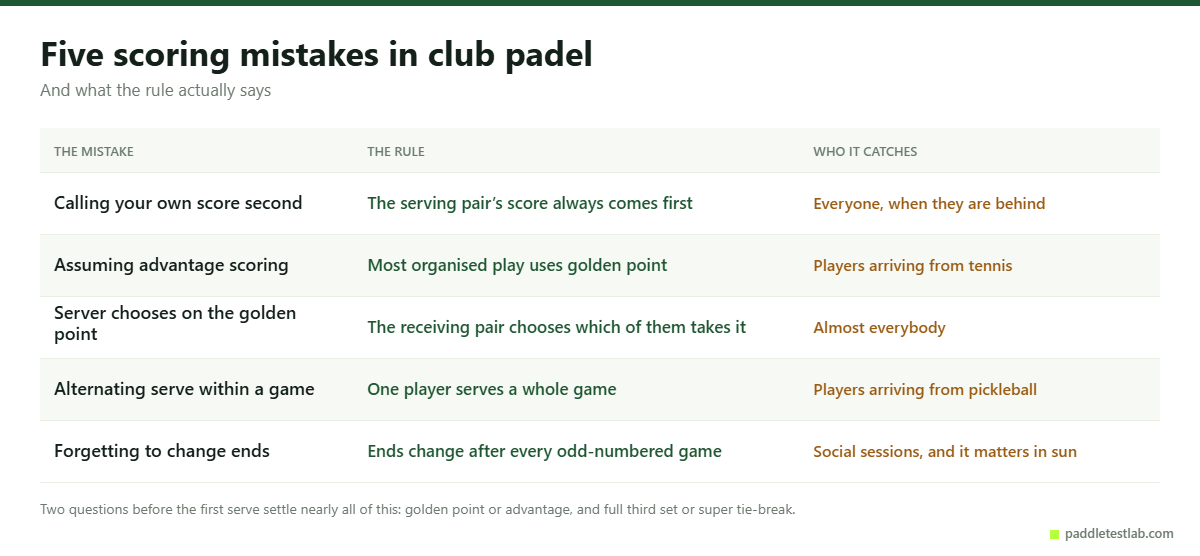
Five that account for most of the confusion, and none of them is complicated once you have seen it named.
Calling your own score second. The serving pair’s score always comes first, in every format. “40-15” from the serving pair means they lead. This is the same convention as tennis and the opposite of what people instinctively do when they are behind.
Assuming advantage scoring. Most organised play now uses golden point, and turning up expecting deuces produces a very confusing 40-40. Ask before the first serve.
Forgetting who chooses on the golden point. The receiving pair decides which of them takes it, not the server. It is a genuine tactical choice and it gets skipped constantly.
Alternating serve within a game. One player serves a whole game. Partners alternate between their service games, not during one — this catches pickleball players especially, because pickleball has two servers per team per turn.
Forgetting to change ends. Ends change after every odd-numbered game — the first, third, fifth and so on. In a social session it is easy to miss, and it matters on an outdoor court where one end has the sun.
If you are arriving from pickleball, our pickleball scoring guide sets out the system you are switching away from, and the padel rules guide covers everything that is not scoring.
Keeping Score Without a Scoreboard
Most club courts have no scoreboard, and a padel match has three separate things to track at once: points in the current game, games in the current set, and sets in the match. Three habits keep it straight.
The server calls the score before every point, out loud, serving pair first. This is not just etiquette — it is the running record, and a game played in silence is a game nobody can reconstruct.
Use the end changes as your checkpoint. You change ends after every odd-numbered game, so every time you swap you can confirm the games score with the other pair. Two pairs agreeing every two games is far more reliable than four people remembering independently for a whole set.
Keep the balls with the server. Whoever holds the balls is serving, which sounds obvious and solves the most common argument in social padel: whose serve is it. It also makes the four-player rotation self-evident, because the balls travel in the same order every set.
If a game gets genuinely lost, take the lower of the two claimed scores and carry on. A replayed point costs less than a five-minute argument on a court you are paying for by the hour.
Frequently Asked Questions
What is a golden point in padel?
A single decisive point played at 40-40 instead of advantage scoring. The receiving pair chooses which player takes it.
Why is it called love for zero?
The most commonly repeated explanation traces it to the French l’œuf, an egg, for the shape of a nought. It is folklore rather than documented fact, and padel inherited the term along with the rest of tennis scoring.
Do you have to win by two games?
Yes, up to 6-6. At 6-6 a tie-break settles the set, so a set can finish 7-5 or 7-6 but never 6-5.
Who serves first in a tie-break?
The player whose turn it would have been to serve the next game. They serve one point, then the serve alternates every two points through all four players.
Does the server’s score always come first?
Yes, in every format. “40-15” from the serving pair means they lead.
Is padel scoring the same as tennis?
At game, set and match level, yes. The golden point is the main departure, and it is now more common in padel than the advantage scoring tennis still uses.
Scoring in this guide follows the current International Padel Federation regulations. Last reviewed 15 September 2026.

Isacc Shah
Isacc Shah writes PaddleTestLab. He does not test paddles in a lab and says so plainly — there is no rig, no radar gun, no staff hitting balls. Instead he aggregates independent bench measurements, manufacturer specifications, USA Pickleball's approval database and hundreds of verified owner reviews per product, then reports where those sources disagree. Every score on the site carries its evidence count. Where a specification is not published, the site writes UNKNOWN rather than estimating it, and the criticism is printed next to the praise.