
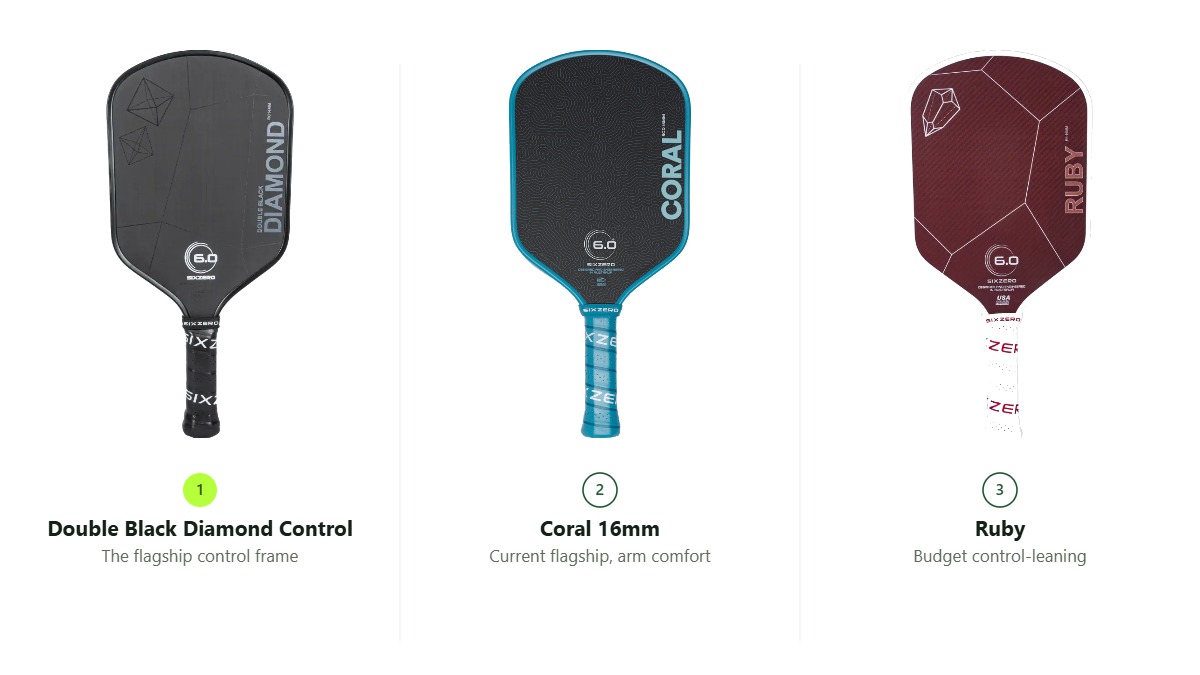
The Six Zero Double Black Diamond Control 16mm and the Six Zero Coral 16mm are the closest-matched pair on this site. Same brand, same shape, same core thickness, same face dimensions, same handle length, same grip circumference. In the database they are near-identical rows.
That narrows the decision to two things: the carbon the face is built from, and what each paddle is positioned to do. Last verified 18 September 2026.
The short answer: the Double Black Diamond Control is the reference paddle of the two, built on Toray T700 carbon with published independent measurements behind it. The Coral is positioned as the arm-friendly evolution of that design, advertised in a narrower band. If you want the documented quantity, take the DBD. If arm comfort is your priority, the Coral is the one Six Zero built for you — but with no published swing weight, you would be buying on the positioning rather than on a measurement.
We do not test paddles — here is where every number comes from
PaddleTestLab does not operate a testing rig. Specifications are manufacturer-published figures from our paddle database. Measured figures come from independent labs, named per entry in the Paddle Honesty Index. Where a number does not exist, this page says so.
Specifications side by side
| Double Black Diamond Control 16mm | Coral 16mm | |
|---|---|---|
| Shape | Hybrid | Hybrid |
| Core | 16mm honeycomb polymer, foam edgewalls | 16mm polymer, foam edgewalls |
| Face | Toray T700 raw carbon | Raw carbon fibre |
| Advertised weight | 7.9–8.3 oz (avg 8.1) | ≈8.0–8.3 oz |
| Length × width | 16.3 × 7.7 in | 16.3 × 7.7 in |
| Handle length | 5.5 in | 5.5 in |
| Grip circumference | 4.25 in | 4.25 in |
| Database note | Balance point 9.38 in | Positioned as the arm-friendly DBD evolution |
Six of those eight rows match or nearly match. The face material is the clearest split — Toray T700 on the DBD against unspecified raw carbon on the Coral — and the advertised weight band is slightly narrower on the Coral.
What has actually been measured
| Measured | Double Black Diamond 16mm | Coral 16mm |
|---|---|---|
| Swing weight | 114 | not published in our sources |
| Measured spin | 1,675–1,880 RPM | not published in our sources |
| Lab source | Pickleball Studio, Pickleball Effect | — |
The Coral has no independent measurements in our sources. That is worth stating plainly, because a comparison page where one column is empty is telling you something real: one of these paddles has been verified and the other has not. We do not estimate the missing figures.
The measured spin range is the most useful number on this page
Note that the DBD’s spin figure is a range — 1,675 to 1,880 RPM — not a single value. It is not that we are being vague. Two different reputable labs measured the same paddle and landed 205 RPM apart, and both figures are real.
That spread is the single best illustration of why a lone spin number should never decide a purchase. The gap between the two labs is far larger than the gap between most paddles buyers agonise over, including the paddles on this page. If you are comparing the DBD and the Coral on spin, you are comparing a measurement against a blank, and the blank is not the problem — the assumption that a single spin figure is meaningful is. Our breakdown of who measures pickleball spin and why the numbers disagree goes into the methods behind that spread.
A naming note that matters more than it sounds
Six Zero’s model names are easy to conflate, and this page is a good place to be precise about it. Our database records the paddle as the Double Black Diamond Control 16mm. The independent measurement above sits against the Double Black Diamond 16mm entry in the Honesty Index.
If Six Zero treats the Control as a distinct model from the original Double Black Diamond, then the measurement should be attributed to the specific model the lab tested, and the other variant’s numbers are unverified. We have flagged it rather than smoothed it over, because this is exactly the pattern that catches paddle buyers out elsewhere: “Perseus 16mm” and “Perseus 16mm Mod TA-15” are different entries on the USA Pickleball approved list, and one of them is decertified.
The practical rule: when you check a paddle against any list, match the exact model name, including the generation and the thickness. Anything looser and you may be checking a different paddle.
What “arm-friendly” actually means — and what we can verify
The Coral’s position in the database is explicit: positioned as the arm-friendly DBD evolution. That is Six Zero’s claim, not a measured result, and it is worth unpacking because arm comfort in pickleball comes down to three variables and only one of them is the paddle.
- Swing weight — how heavy the paddle feels in motion. This is the variable that loads the arm on every shot, and it is the one most relevant to the Coral’s claim.
- Grip size — a grip that is too small makes players squeeze harder than they need to, and that tension runs up the forearm. Both paddles here are 4.25 inches, so this is a wash between them.
- Grip pressure — how hard the player holds the handle. This costs nothing to change and is the most common culprit.
Here is the honest problem with evaluating the Coral’s central claim. The claim is about swing weight, and the Coral has no published swing weight. The DBD measures 114, a moderate figure. Whether the Coral sits above or below it is unknown — the advertised weight band is slightly narrower and slightly higher at the bottom (≈8.0–8.3 against 7.9–8.3), which on paper says very little, because static weight and swing weight are different quantities and frequently disagree. Our explainer on swing weight covers why the number on the box is a poor guide to the number in your hand.
So: the Coral is positioned as the arm-friendly option, and that positioning may well be correct. But nobody has published the measurement that would confirm it, and we will not assert it on Six Zero’s behalf.
The balance point figure
The database carries a balance point of 9.38 in for the DBD. Balance point describes where the paddle sits level on a fulcrum, and it is most useful when compared against paddles of the same length — here, both are 16.3 inches. No balance point is published for the Coral, so the two cannot be compared on this measure either, and half a comparison is worth less than a clear gap.
Which one should you buy?
Buy the Double Black Diamond Control if…
- You want the paddle with independent measurements behind it — swing weight 114, spin 1,675–1,880 RPM across two labs
- You want Toray T700 carbon specifically, rather than unspecified raw carbon
- You are choosing your first serious paddle and want the documented quantity
- You would rather buy the reference model than its evolution
Buy the Coral if…
- Arm comfort is your primary constraint and you are willing to buy on the manufacturer’s positioning
- You have arm trouble with your current paddle and the DBD’s 114 swing weight is already at the top of what you can manage
- You want the newer design in the line and accept that verification has not caught up
One further caution, and it applies to every paddle: a paddle that is legal and comfortable when new can drift. Honeycomb cores compress with use, the face flexes more, and measured power creeps upward over a season. That is why paddles fail on-site testing at tournaments despite having passed at purchase. Our guide to delamination and core crush signs covers what to watch for, and it applies equally to either paddle here.
Frequently asked questions
Six Zero Double Black Diamond or Coral — which should I buy?
Buy the Double Black Diamond Control if you want the model with published independent measurements, a Toray T700 face and a documented swing weight of 114. Buy the Coral if arm comfort is your priority and you are comfortable buying on Six Zero’s positioning, because no swing weight or spin figure has been published for it in our sources.
Is the Coral more arm-friendly than the DBD?
That is Six Zero’s positioning for it, and it is plausible. But arm-friendliness is driven by swing weight, and the Coral has no published swing weight — so the claim is currently unverified rather than confirmed. Both share the same 4.25-inch grip, so grip size is not the differentiator.
Does the Coral have less power than the DBD?
Unknown. Neither has a published power measurement, and the only relevant proxy would be swing weight, which exists for the DBD at 114 and not at all for the Coral. The advertised weight bands overlap almost entirely.
Is Toray T700 carbon better than other raw carbon faces?
T700 is a named, specified carbon grade rather than a generic description, which is why the database records it explicitly. A named grade tells you what the face is, which a “raw carbon fibre” listing does not. That is a sourcing advantage rather than a proven performance one, and we would not claim more than that on the evidence available.
Is the Coral a newer version of the DBD?
The database positions it as the arm-friendly evolution of the DBD, so it is a development of the same design rather than a replacement. Both remain current, and they share identical face dimensions, handle length and grip.
What is a paddle’s balance point?
It is the point along the paddle where it balances level, and it describes how mass is distributed between the handle and the head. It is most meaningful when comparing paddles of the same length. The DBD’s database entry records 9.38 in; no figure is published for the Coral.
Sources
- Specifications — manufacturer-published figures, compiled in the PaddleTestLab paddle database.
- Swing weight and measured spin — Pickleball Studio and Pickleball Effect, compiled in the Paddle Honesty Index.
- Protocol-gap context — who measures pickleball spin, and why the numbers disagree.
Last verified: 18 September 2026. If a figure here disagrees with the lab or the manufacturer, they are right and this page is wrong — tell us and it gets corrected and dated.
Related guides
- Six Zero paddle review 2026
- Paddle database 2026
- The Paddle Honesty Index
- What is swing weight?
- Best paddles for intermediate players 2026
- Delamination and core crush signs
- Pickleball paddle core types explained

Isacc Shah
Isacc Shah writes PaddleTestLab. He does not test paddles in a lab and says so plainly — there is no rig, no radar gun, no staff hitting balls. Instead he aggregates independent bench measurements, manufacturer specifications, USA Pickleball's approval database and hundreds of verified owner reviews per product, then reports where those sources disagree. Every score on the site carries its evidence count. Where a specification is not published, the site writes UNKNOWN rather than estimating it, and the criticism is printed next to the praise.