
CRBN’s TruFoam Genesis line ships in three shapes — Elongated, Widebody and Hybrid — and they are not three different paddles. They share one core, one face material and one advertised weight band. The only thing that changes is the geometry of the face and the length of the handle.
That makes this comparison unusually clean. Most paddle comparisons mix several variables at once: different cores, different faces, different weights. Here, the variables are stripped out. Last verified 18 September 2026.
The short answer: if you want reach and a longer handle, buy the Elongated. If you want the most forgiving face and quicker hands at the net, buy the Widebody. The Hybrid splits the difference and is the safest pick if you have not played with either shape before. On measured power and spin, the Elongated and Widebody are effectively indistinguishable — the differences people argue about online are smaller than the measurement noise between labs.
We do not test paddles — here is where every number comes from
PaddleTestLab does not operate a testing rig. Every specification on this page is the manufacturer’s published figure, compiled in our paddle database. Every measured figure — swing weight, spin rate, measured static weight — was produced by an independent lab and is named against each entry in our Paddle Honesty Index.
Where a number does not exist, this page says so rather than filling the gap. If a figure here ever disagrees with the named source, the named source wins and this page is corrected.
The three shapes, side by side
| Elongated | Widebody | Hybrid | |
|---|---|---|---|
| Core | 14mm 100% TruFoam | 14mm 100% TruFoam | 14mm 100% TruFoam |
| Face | Raw carbon fibre | Raw carbon fibre | Raw carbon fibre |
| Advertised weight | ≈7.9–8.2 oz | ≈7.9–8.2 oz | ≈7.9–8.2 oz |
| Length × width | 16.5 × 7.35 in | 16.0 × 7.85 in | 16.5 × 7.5 in |
| Handle length | 5.5 in | 5.0 in | 5.5 in |
| Grip circumference | 4.25 in | 4.25 in | 4.25 in |
| Shape note | 14mm core reported to play closer to 16mm | Largest face of the Genesis line | Middle-ground shape |
Read that table again and note how much of it is identical. Same core, same face, same weight band, same grip. The Elongated and Widebody differ in exactly two ways: face geometry and handle length.
What the independent measurements show
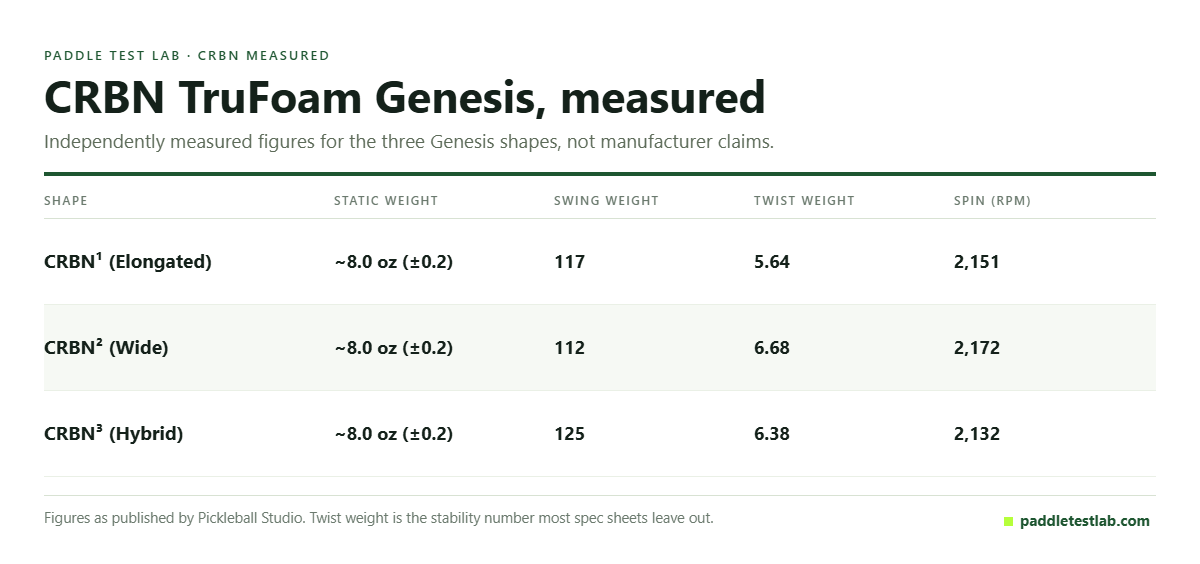
Both shapes have been measured by Pickleball Studio, which is one of the three labs publishing repeatable paddle data. Because both figures come from the same lab, they are directly comparable — which is rarer than it sounds.
| Measured | Elongated | Widebody | Difference |
|---|---|---|---|
| Measured static weight | 8.0 oz ±0.2 | 8.0 oz ±0.2 | none |
| Swing weight | 117 | 112 | 5 points |
| Measured spin | 2,151 RPM | 2,172 RPM | 21 RPM |
| Lab source | Pickleball Studio | Pickleball Studio | same lab |
Both measured static weights landed at 8.0 oz with the same ±0.2 oz tolerance, which means you are not choosing between a heavy paddle and a light one. You are choosing where the mass sits and how much leverage the face gives it.
The swing weight gap is real, and it favours the Elongated
117 against 112 is a five-point difference. In practical terms the Elongated asks slightly more of your arm on every shot, and gives slightly more back through the ball. If you have arm trouble, that gap runs the wrong way for you — the Widebody is the easier swing of the two at the same advertised weight. If you are chasing drive power and you are already comfortable with a heavier-feeling paddle, the Elongated is the one. Our explainer on what swing weight actually measures covers why this is the number that matters rather than the one on the box.
The spin gap is not real
2,151 against 2,172 is 21 RPM, or about one percent. That is inside the range you would expect from re-testing the same paddle twice, and it is far smaller than the gap between testing protocols. To put the scale in context: our research found the same paddle measured anywhere from 1,675 to 1,880 RPM by two different reputable labs — a spread roughly ten times larger than the difference between these two shapes.
So if you are choosing between the Genesis shapes on spin, you are optimising something you cannot detect. Do not pick a shape on spin. Pick it on face geometry and handle length, which you will notice on the first game.
Handle length: the difference nobody mentions
This is the most under-discussed specification on the page, and in a three-shape line it is the one you will feel fastest.
The Elongated and Hybrid both give you a 5.5-inch handle. The Widebody gives you 5.0 inches. Half an inch of handle is the difference between having room for a second hand and not. If you hit a two-handed backhand, the Widebody’s 5.0-inch handle may not leave you enough real estate above your bottom hand — and no amount of face size compensates for that.
So the Widebody has a hidden condition attached. It offers the most forgiving face in the line, but it asks you to play one-handed, or to have small enough hands that a 5.0-inch handle still fits two. That single measurement eliminates it for a meaningful number of players, and it is buried in a spec sheet most buyers never open.
Which shape should you buy?
Because the core, face and weight band are identical, this decision reduces almost entirely to geometry and handle. Work down the list until one applies.
Buy the Elongated if…
- You hit a two-handed backhand and need the 5.5-inch handle
- You want maximum reach for serves, overheads and stretching volleys
- You are comfortable carrying slightly more swing weight (117 versus 112)
- You drive the ball rather than dink it, and want the extra leverage through contact
Buy the Widebody if…
- You play one-handed off both wings, so the 5.0-inch handle is not a constraint
- You want the largest effective hitting area in the line, which matters most on off-centre contact
- You block and reset at the net and value a quicker swing over reach
- You have arm or elbow sensitivity, or you simply want the easier swing of the two
Buy the Hybrid if…
- You have not played both shapes before and do not want to guess
- You want the 5.5-inch handle and more face than the Elongated offers
- You would rather buy once than buy twice
Worth stating plainly: the Hybrid is the compromise, and a compromise is only the wrong answer if you already know which side of it you sit on. If you do not know, it is the right answer.
What does not change between the shapes
This is the part buyers most often get wrong. Changing shape does not change:
- The core. All three are a 14mm 100% TruFoam core. The feel and the trampoline behaviour come from the same construction.
- The face. All three are raw carbon fibre, so the spin mechanism is the same. Only face area differs.
- The advertised weight band. All three are quoted at ≈7.9–8.2 oz, and both measured samples landed at 8.0 oz ±0.2.
- The grip circumference. 4.25 inches across the line, so switching shapes does not mean relearning your grip size.
The 14mm core note is worth explaining, because it is the line’s headline claim. CRBN reports that the 14mm TruFoam core plays closer to a 16mm paddle than the thickness would suggest — which is the reason the line sits at 14mm while most control-oriented paddles sit at 16mm. For the general version of that trade-off, see our guide to 14mm versus 16mm cores. For shape consequences beyond this line, see elongated versus standard and widebody shapes.
Where the owner consensus lives
Shape consequences are geometry, and we can describe them exactly. Owner sentiment about how a specific paddle actually plays — the weight-of-shot feel, the durability pattern over months, the grip wear — is a different kind of evidence, and it belongs with the full review rather than compressed into a comparison table.
If you want that layer, start with our CRBN TruFoam Genesis review, which aggregates verified owner reports across major retailers. The shape decision on this page is the part you can make from measurements alone.
Frequently asked questions
Is the CRBN Genesis Elongated or Widebody better?
Neither is better in absolute terms, and on measured power and spin they are effectively the same paddle — 117 versus 112 swing weight and 2,151 versus 2,172 RPM, both measured by Pickleball Studio. The decision comes down to geometry and handle: the Elongated offers reach and a 5.5-inch handle, the Widebody offers the largest face but only a 5.0-inch handle.
Does the Widebody have a bigger sweet spot?
The Widebody has the largest face in the line at 16.0 × 7.85 inches, against 16.5 × 7.35 for the Elongated. A larger face means more effective hitting area away from the centre, so yes — but the practical gain is on off-centre contact rather than on well-struck shots, and it comes with the shorter handle.
Is the Elongated better for power?
It measures higher on swing weight, 117 against 112, which means more leverage through contact. Both share the same core and face, so the difference is mechanical rather than a different power profile. Whether that converts into power depends more on your swing than on the two spec sheets.
Which Genesis shape is best for beginners?
The Widebody, if you play one-handed, because the larger face is more forgiving on mishits. If you hit two-handed, the Hybrid is the better starting point — it keeps the 5.5-inch handle while offering more face than the Elongated.
What is the Genesis Hybrid for?
It is the middle shape at 16.5 × 7.5 inches, with the 5.5-inch handle. It offers more face than the Elongated without the Widebody’s handle compromise, which makes it the safest choice if you are unsure between the other two.
Is the 14mm Genesis core really like a 16mm?
That is CRBN’s stated claim about the 100% TruFoam core, and it is the reason the line sits at 14mm. It is a manufacturer claim rather than an independently measured equivalence, so treat it as positioning rather than a lab result. The general trade-off between core thicknesses is covered in our 14mm versus 16mm guide.
Which Genesis shape is better for doubles?
Doubles rewards forgiveness and hand speed at the net, which points to the Widebody — provided the 5.0-inch handle suits your grip. Two-handed hitters should take the Hybrid instead, because the handle matters more than the face size at that level.
Should I choose a paddle based on swing weight?
Swing weight is the most useful single number available, because it reflects how heavy the paddle feels in motion rather than what it weighs on a scale. But it is not printed on the box, it varies between units, and it is not a quality ranking — higher is not better, it is different. It is a fit question.
Sources
- Specifications — manufacturer-published figures, compiled in the PaddleTestLab paddle database.
- Swing weight, measured static weight and spin — Pickleball Studio measurements, compiled in the Paddle Honesty Index with the lab named against each entry.
- Protocol-gap context — who measures pickleball spin, and why the numbers disagree.
Last verified: 18 September 2026. If a figure here disagrees with the lab or the manufacturer, they are right and this page is wrong — tell us and it gets corrected and dated.
Related guides
- Paddle database 2026 — full specifications for every paddle we track
- The Paddle Honesty Index — claimed versus measured
- What is swing weight?
- 14mm vs 16mm pickleball paddles
- Elongated vs standard and widebody paddles
- Pickleball paddle core types explained
- Best pickleball paddles 2026

Isacc Shah
Isacc Shah writes PaddleTestLab. He does not test paddles in a lab and says so plainly — there is no rig, no radar gun, no staff hitting balls. Instead he aggregates independent bench measurements, manufacturer specifications, USA Pickleball's approval database and hundreds of verified owner reviews per product, then reports where those sources disagree. Every score on the site carries its evidence count. Where a specification is not published, the site writes UNKNOWN rather than estimating it, and the criticism is printed next to the praise.