
Short answer: pickleball comes down to five rules. The ball must bounce once on each side before anyone volleys. You cannot volley from the kitchen. The serve is underhand and diagonal. Only the serving side scores. And every line is in except the kitchen line on a serve. This page explains each one briefly and links to our full guide on it.
Most pickleball arguments on a public court come down to a handful of rules, not the whole rulebook. This page is the starting point: one short, accurate section per rule, then the disputes that stop games, then what changed in 2026. Where a topic needs more depth, we have a dedicated guide and link to it rather than repeat it here.
Start Here: Our Rules Guides
| Topic | What it covers | Full guide |
|---|---|---|
| The kitchen | Every non-volley-zone fault, momentum, and what you are allowed to do in there | Kitchen rules explained |
| Serving | Legal volley serves, the drop serve, foot faults and 2026 wording changes | Pickleball serving rules |
| Scoring | Side-out and rally scoring, the three-number call, doubles and singles | Pickleball scoring explained |
| The court | Every regulation measurement, net height and how much space you need | Court dimensions and layout |
1. The Two-Bounce Rule
After the serve, the ball must bounce once on the receiving side, and then once again on the serving side, before anyone is allowed to volley. In practice: the serve bounces, the return bounces, and only from the third shot onward can a ball be hit out of the air.
This single rule is why pickleball plays the way it does. Without it, the serving team would rush the net immediately and the sport would collapse into a serve-and-volley game. It is also the rule beginners break most often, usually by stepping in and volleying the return of serve out of habit.
The practical consequence: the serving team starts the rally pinned at the baseline, which is why the third shot (usually a soft drop into the kitchen) matters so much. It is the shot that lets the serving team move forward.
2. The Kitchen (Non-Volley Zone)
The kitchen is the seven-foot zone on each side of the net. You may not volley while touching it, and the line counts as part of the zone. You can stand in it whenever you like and play any ball that has bounced. Momentum counts too: a legal volley that carries you into the kitchen afterwards is still a fault.
That covers most recreational calls. For the full list of faults, including partner contact, dropped paddles and the Erne, read our kitchen rules guide.
3. The Serve
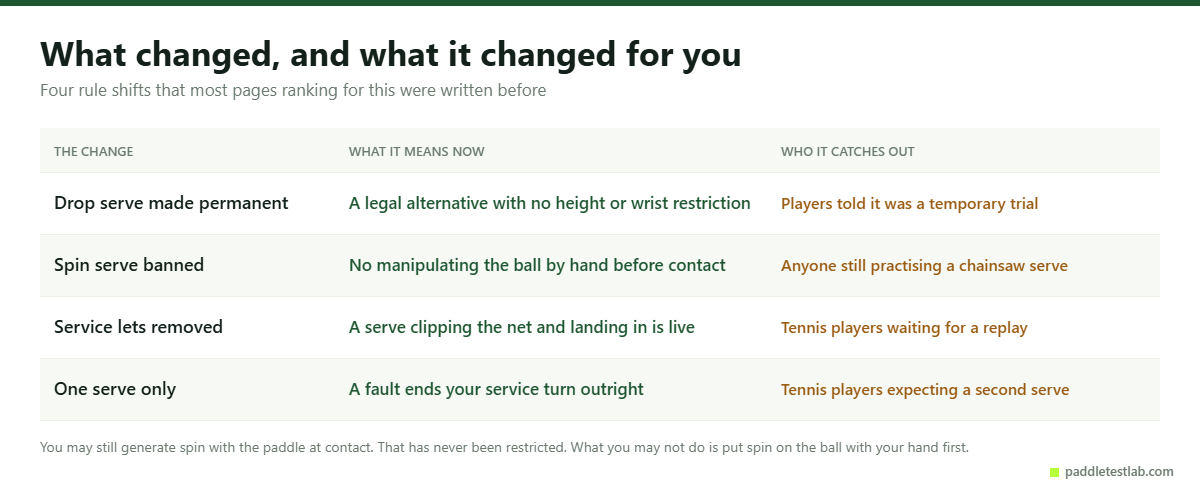
Serves are underhand and diagonal, hit from behind the baseline into the opposite service court, and must clear the kitchen and its line. A volley serve needs an upward arc, contact below the waist and the paddle head below the wrist. The drop serve, where you let the ball bounce first, removes those three requirements and is the easier serve to keep legal.
Foot faults, the 2026 wording change and serve placement are all covered in our pickleball serving rules guide.
4. Scoring
Traditional pickleball uses side-out scoring: only the serving side scores. Games go to 11, win by two. In doubles the score is called as three numbers (your score, their score, and server one or two), and the game opens at 0-0-2 because the first serving team gets only one server.
Rally scoring, singles scoring and how to recover a disputed score are in our pickleball scoring guide.
5. The Court
A regulation court is 20 by 44 feet for both singles and doubles, with the net at 36 inches at the posts and 34 inches in the centre. Every line and measurement, plus how much total space a court needs, is in our court dimensions guide.
The Rules People Get Wrong Most Often
These are the disputes that stop games at public courts, roughly in order of how often they come up.
“You were in the kitchen” after a bounced ball. Standing in the kitchen is legal. The fault is volleying from it. If the ball bounced first, there is no fault.
Line calls. Every line is in, except the kitchen line on a serve. A serve landing on the baseline or sideline of the correct service box is good. A serve landing on the kitchen line is a fault.
Net serves. A serve that clips the net and lands in the correct box is live. There is no let on a serve under current rules.
The net post. A ball that hits the net post is out.
Switching hands or hitting two-handed. Both entirely legal.
Getting hit by the ball. If a ball in the air strikes you or your clothing, the point goes to the opponent, even if it was heading out.
What Changed in the 2026 Rulebook
USA Pickleball updates the rulebook every year. The 2026 changes that matter most to ordinary players are summarised below. Rule wording gets clarified during the year, so check the official change document before relying on this for a tournament.
| Area | What changed | Who it affects |
|---|---|---|
| Volley serve wording | “Clear” and “clearly” added to the upward-arc, below-waist and below-wrist requirements | Anyone with a borderline volley serve in refereed play. Details in our serving guide |
| Non-volley zone momentum | Tightened wording on momentum faults in doubles | Doubles players who crowd the kitchen line |
| Adaptive Standing Division | Formalised for players with significant mobility or balance impairments, with a two-bounce allowance | Adaptive players and event organisers |
Equipment Rules Worth Knowing
For sanctioned play, your paddle must be on the current approved list, and that list changes. Paddles do get decertified, usually over surface roughness. Our explainer on USA Pickleball approved paddles shows how to check a specific model.
A paddle that has delaminated through use becomes illegal even if it was approved when you bought it. Our guide to spotting paddle delamination covers the tap test and what to look for at the edge guard.
Frequently Asked Questions
What are the basic rules of pickleball?
Serve underhand and diagonally. Let the ball bounce once on each side before volleying. Do not volley from the kitchen. Only the serving side scores, and games go to 11, win by two. Those rules cover nearly every recreational game.
Does the ball have to bounce twice in pickleball?
Once on each side, at the start of every rally: the serve must bounce, and the return must bounce. From the third shot onward either side may volley. This is the two-bounce or double-bounce rule.
Is pickleball singles played with different rules?
The rules are the same, with the same court. The only real difference is scoring, because there is no second server: the score is called with two numbers, and you serve from the right when your score is even and from the left when it is odd. Our scoring guide walks through it.
Where can I read the official rulebook?
USA Pickleball publishes the current rulebook and an annual change document on its own site. This page is a plain-English summary; referees work from the official text.

Isacc Shah
Isacc Shah writes PaddleTestLab. He does not test paddles in a lab and says so plainly — there is no rig, no radar gun, no staff hitting balls. Instead he aggregates independent bench measurements, manufacturer specifications, USA Pickleball's approval database and hundreds of verified owner reviews per product, then reports where those sources disagree. Every score on the site carries its evidence count. Where a specification is not published, the site writes UNKNOWN rather than estimating it, and the criticism is printed next to the praise.