
Short answer: the pickleball court dimensions are 20 feet by 44 feet, identical for singles and doubles, with a 7-foot non-volley zone each side of the net and a net 36 inches high at the posts and 34 at the centre. Building one needs far more ground than that — 30 by 60 feet as a minimum.
Two different people search for pickleball court dimensions. One is settling an argument about how deep the kitchen is. The other is working out whether a court will fit on their land.
Most pages answer only the first. This one answers both — the regulation numbers, and then the numbers nobody publishes: how much total space a court actually needs once you allow room to chase a ball.
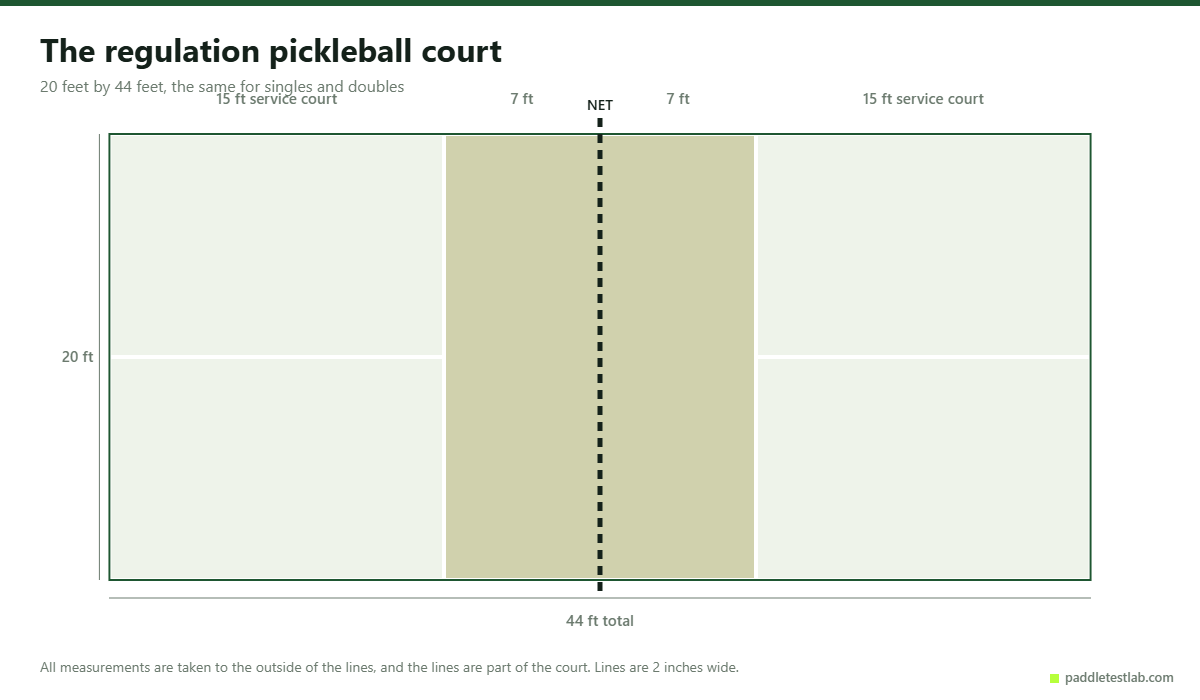
Pickleball Court Dimensions: the Regulation Court
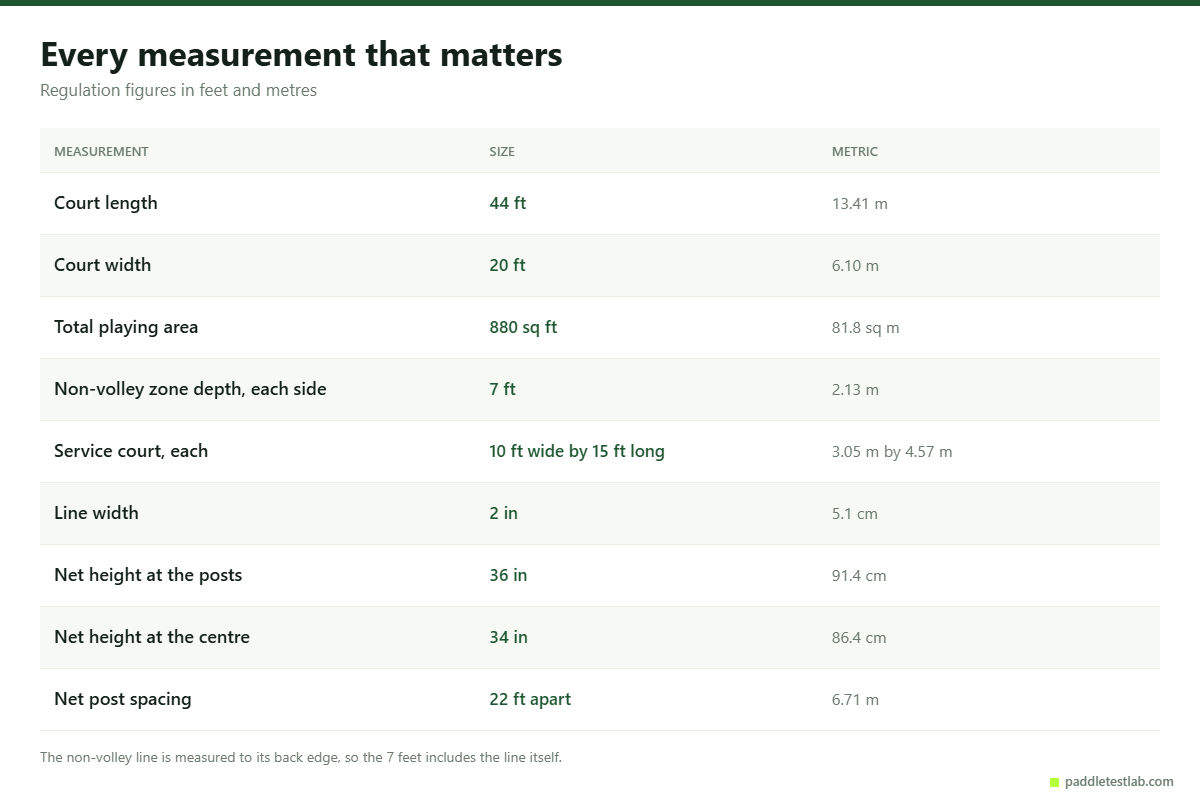
The playing surface is the same for singles and doubles. There is no narrower singles court in pickleball, which is one of the things that separates it from tennis and badminton.
| Measurement | Size |
|---|---|
| Court length | 44 ft (13.41 m) |
| Court width | 20 ft (6.10 m) |
| Total playing area | 880 sq ft |
| Non-volley zone depth, each side | 7 ft (2.13 m) |
| Service court, each | 10 ft wide × 15 ft long |
| Line width | 2 in (5.1 cm) |
| Net height at the posts | 36 in (91.4 cm) |
| Net height at the centre | 34 in (86.4 cm) |
| Net post spacing | 22 ft apart, 1 ft outside each sideline |
All measurements are taken to the outside of the lines, and the lines themselves are part of the court. The exception is the non-volley line, which is measured to its back edge — the 7 feet includes the line.
How the 44 Feet Divides Up
Working from the net outwards on one side:
- 7 feet of non-volley zone.
- 15 feet of service court, split down the middle by the centreline into two boxes 10 feet wide.
- That is 22 feet per side, and 44 feet in total.
The kitchen therefore takes up nearly a third of each half of the court — which is why so much of the game is played from one line, and why the non-volley rules matter as much as they do. Our kitchen rule explainer covers what you can and cannot do inside it.
Why the Net Is Two Inches Lower in the Middle
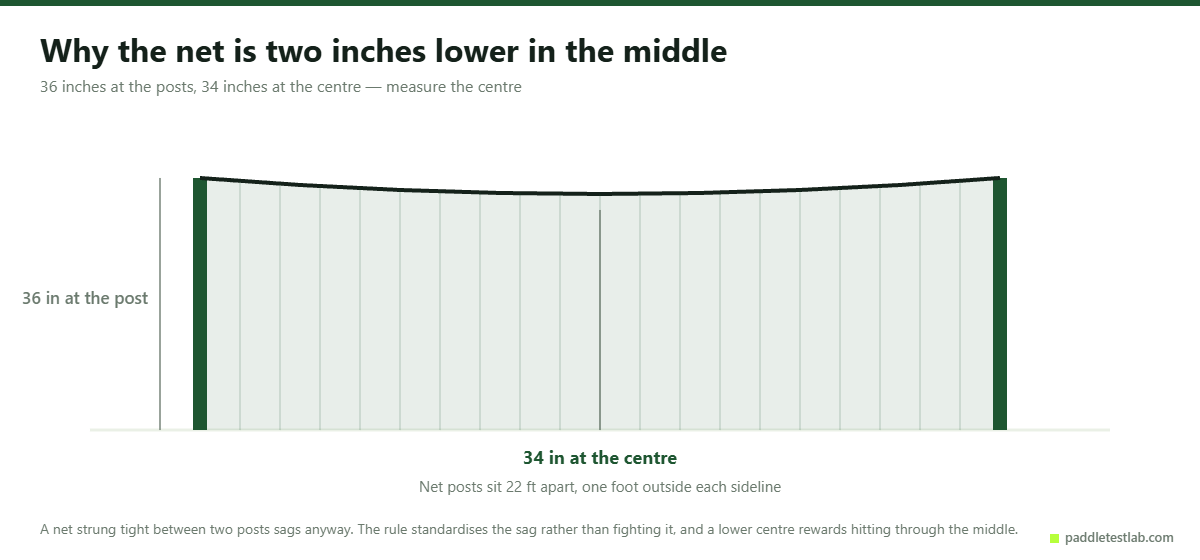
Thirty-six inches at the posts, thirty-four at the centre. The two-inch drop is partly practical — a net strung tight between two posts sags anyway, and the rule standardises the sag rather than fighting it — and partly by design, because a lower centre rewards hitting through the middle of the court.
If you are setting up a portable net, measure the centre height rather than the posts. A net that measures 36 inches in the middle is two inches too high, and every dink and drop you practise on it will behave wrong on a proper court.
The Total Space You Actually Need
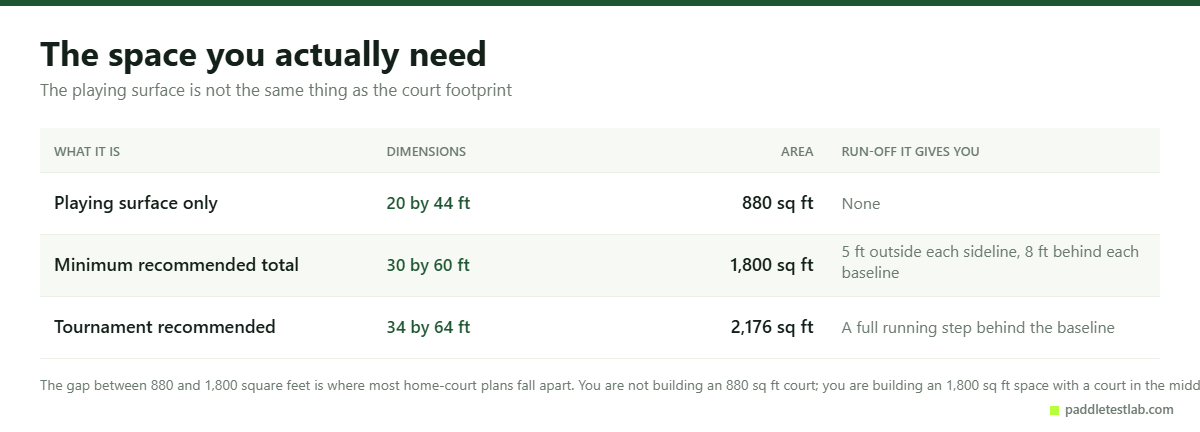
This is the number that matters for anyone building, and it is not 20 by 44.
The playing surface is 880 square feet. The minimum recommended total area, including run-off space behind the baselines and outside the sidelines, is 30 feet by 60 feet — 1,800 square feet. That gives roughly 5 feet outside each sideline and 8 feet behind each baseline.
For tournament play the recommendation rises to 34 feet by 64 feet — 2,176 square feet, which allows a full running step behind the baseline rather than a stumble into a fence.
The gap between 880 and 1,800 square feet is where most home-court plans fall apart. You are not building an 880-square-foot court; you are building a 1,800-square-foot space with a court painted in the middle of it.
Home Builds: Driveway, Garage and Garden Reality
A standard two-car driveway is roughly 20 by 20 feet. That is not a court. It is a kitchen and a bit — fine for dinking practice, nowhere near a playable court.
A long driveway of 20 by 44 feet gives you the playing surface with zero run-off. Playable for casual games if the surroundings are forgiving, uncomfortable if there is a garage door at one end and a road at the other.
A back garden at 30 by 60 feet is the real minimum for a proper court. In practice that means a garden of at least 35 by 65 to allow for fencing and edges.
Ceiling height indoors is the constraint people forget. Lobs need clearance, and 18 to 20 feet is the usual recommendation. A domestic garage at 8 to 10 feet will not do.
If space is tight, a blended-line court on an existing surface is far cheaper than a dedicated build, and portable nets meeting the 34-inch centre height are widely available.
Converting a Tennis or Badminton Court
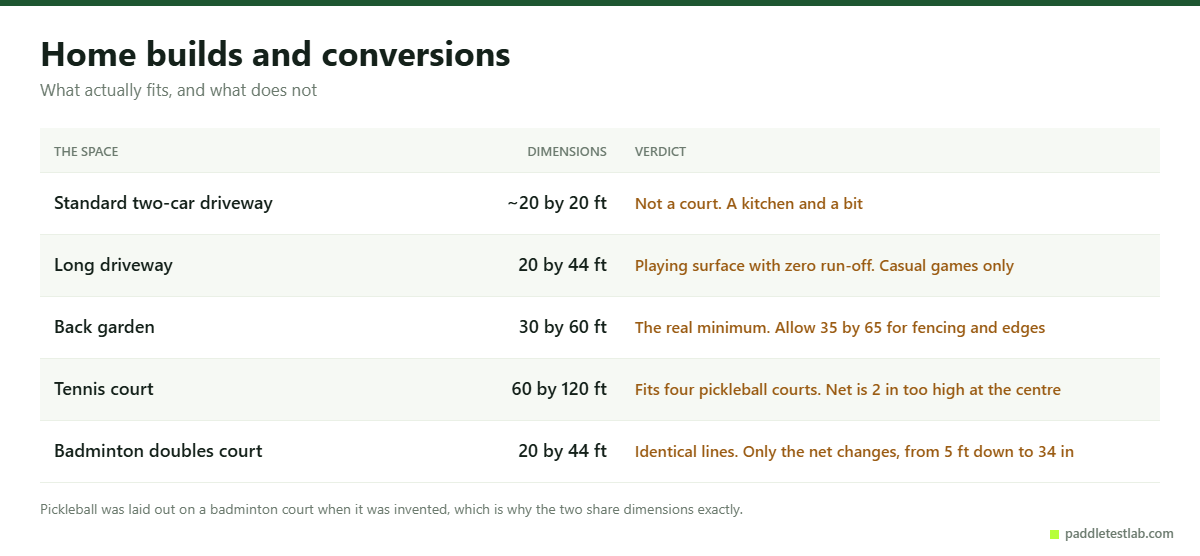
Tennis. A full tennis court including run-off is typically 60 by 120 feet. A pickleball court at 30 by 60 fits inside that four times over, which is why so many clubs now blend four pickleball courts onto one tennis court. A single pickleball court can also be laid over one half of a tennis court with room to spare. The net is the complication — a tennis net is 36 inches at the centre, two inches too high, so you either drop it or use a portable net.
Badminton. A badminton doubles court is 20 by 44 feet — exactly the same as a pickleball court. That is not a coincidence; pickleball was laid out on a badminton court when it was invented. The lines transfer directly. Only the net changes: badminton nets sit at 5 feet, far too high, and must be replaced.
Marking Out a Court Yourself
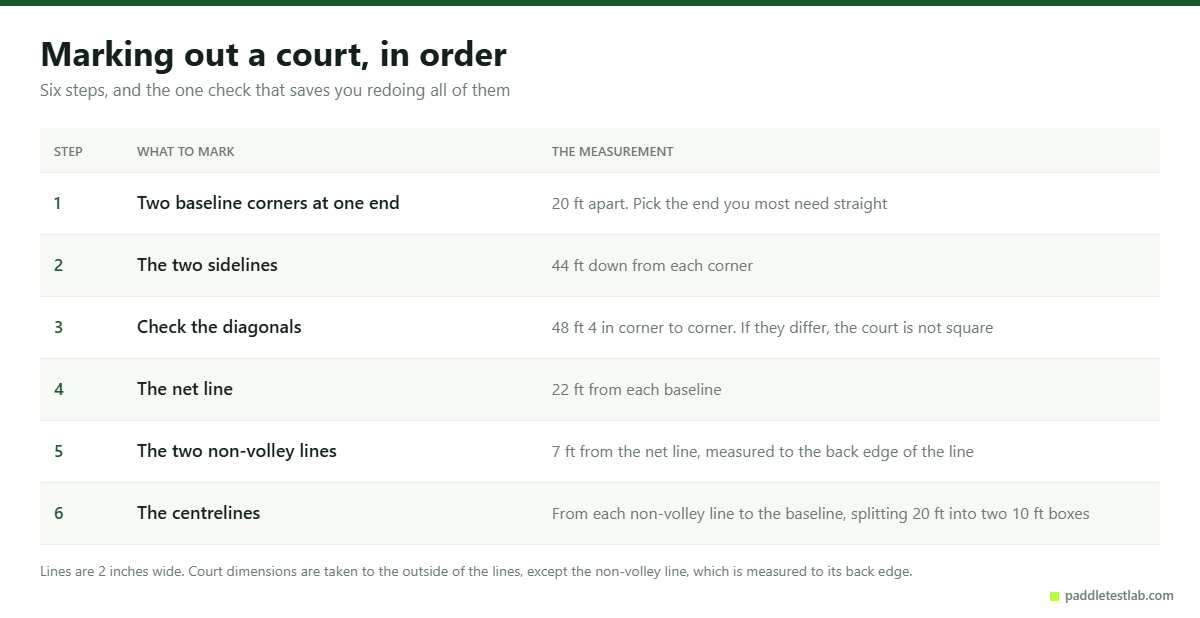
Laying out a court is mostly one job done carefully: getting a true 20-by-44-foot rectangle. Everything else measures off it.
Work in this order and you will not have to redo it:
- Set the two baseline corners at one end, 20 feet apart. This is your reference edge, so pick the end you care most about being straight — the one against a fence or a wall.
- Run 44 feet down each sideline and mark the far corners.
- Check the diagonals. A true 20-by-44 rectangle has diagonals of 48 feet 4 inches corner to corner. If the two diagonals do not match, the rectangle is a parallelogram and every line inside it will be wrong. Adjust the far corners until they agree.
- Mark the net line across the middle, 22 feet from each baseline.
- Mark the two non-volley lines 7 feet from the net line on each side, measuring to the back edge of the line.
- Mark the centrelines from each non-volley line back to the baseline, splitting the 15-foot service area into two 10-foot boxes.
Lines are 2 inches wide and should contrast strongly with the surface — white on green or blue is the convention, and it is a convention because it is the easiest to see under floodlights. Paint the line so the measurement lands on the correct edge: court dimensions are taken to the outside of the lines, except the non-volley line, which is measured to its back edge and counts as part of the kitchen.
For a temporary court, textured court tape holds well on asphalt and concrete and lifts without residue. Chalk and marker cones are fine for a driveway game but will not survive a session.
Surfaces: What to Play On, and What to Avoid

The surface changes how the ball bounces, how your shoes grip and how your knees feel after two hours. Five are common.
Acrylic-coated asphalt or concrete is the dedicated-court standard. A textured acrylic coating over a solid base gives consistent bounce and predictable grip, and it is what you will find at most clubs. Cushioned acrylic systems add a rubber layer underneath, which is noticeably kinder to joints and costs more.
Bare concrete is the most durable and the least forgiving. The bounce is true, the surface lasts decades, and it is the hardest thing you can play on. If you are converting a slab you already own, add a coating rather than playing on raw concrete.
Bare asphalt is cheaper to lay and cracks sooner, especially where the ground freezes. It also gets soft and sticky in high heat. Treat it as a base to coat, not a finished surface.
Modular plastic tiles snap together over an existing slab. They drain well, flex underfoot, can be lifted and moved, and turn an unusable cracked surface into a playable one without resurfacing. The bounce is slightly lower than acrylic and the tiles are noisier.
Indoor sport flooring and gym wood are fast, quiet and excellent to play on, provided they are clean. Dust on a wooden floor is the single most common cause of slips in indoor pickleball.
Whatever the surface, shoe choice matters as much as the court does — our pickleball shoe guide covers outsole patterns for indoor and outdoor play.
Indoor Courts: Ceiling, Lighting and Floor
Indoors, the constraint is rarely the footprint. It is the height.
Ceiling clearance of 18 to 20 feet is the usual recommendation, and it exists because the lob is a real shot. Below about 16 feet, lobs start hitting the roof and the game changes character — playable, but not the same sport. A domestic garage at 8 to 10 feet is not a court.
Lighting should be even and above the court rather than behind the baselines. Lights behind a baseline put the serving player’s own shadow across the service box and glare into the receiver’s eyes. Aim for fixtures running along the sidelines, and avoid single high-output lamps that produce hard shadows at the kitchen line.
Run-off still applies indoors. A 20-by-44 court inside a 24-foot-wide hall leaves two feet to the wall, which is how people get hurt chasing a wide ball. Keep the 30-by-60 minimum wherever the building allows it, and pad any wall that sits closer than five feet to a sideline.
Ball choice changes indoors too. Indoor balls have larger, fewer holes and fly slower than outdoor balls, and using the wrong one on a wooden floor makes the game unrecognisable. Our guides to indoor balls and outdoor balls cover the difference.
Which Way Round to Build It
Orientation is the cheapest thing to get right and the most expensive to fix, because fixing it means relaying the court.
Run the long axis north to south. A court aligned east to west puts the low morning and evening sun directly behind one baseline, which means one player is serving into glare for a third of the playing day. North-south keeps the sun off both baselines for most of it. This is the same reason tennis courts are laid out that way, and it matters more in pickleball because the court is shorter and the server is closer to the receiver’s eyeline.
Think about wind across the court, not down it. A crosswind pushes dinks and drops sideways and makes the game frustrating for everyone equally. A headwind or tailwind down the long axis at least affects both ends in turn as you change ends. If your site has a prevailing wind, orient so it runs along the court rather than across it — and if that fights the sun rule, take the sun rule.
Leave the gate at the back, not the side. An entrance in the middle of a sideline puts people walking across the kitchen line to get in. A gate behind a baseline keeps traffic out of the playing area.
If you are fitting several courts, run them side by side sharing the long axis, with at least 10 feet between adjacent sidelines. Less than that and a wide ball from one court lands in the middle of a rally on the next.
Frequently Asked Questions
Is the singles court smaller than the doubles court?
No. Both are 20 by 44 feet. Unlike tennis, pickleball does not narrow the court for singles — which is why singles is so much more running.
How deep is the kitchen?
Seven feet from the net on each side, full width of the court, with the line included in the zone.
How high is a pickleball net?
36 inches at the posts and 34 inches at the centre. Measure the centre.
How much space do I need for a home court?
30 by 60 feet as a minimum, 34 by 64 for comfortable play. The 20 by 44 playing surface alone is not enough unless the surroundings are unusually forgiving.
Are pickleball lines in or out?
All lines are in, with one exception: a serve landing on the non-volley line is a fault. Our serving rules guide covers that case.
How many pickleball courts fit on one tennis court?
Four, at recreational spacing, using the full tennis court area including run-off.
How does a padel court compare?
Padel courts are 20 metres by 10 metres, enclosed in glass and mesh, and roughly two and a half times the footprint of a pickleball court. Our padel vs pickleball comparison covers the differences in full.
Measurements in this guide follow the current USA Pickleball rulebook. Last reviewed 15 September 2026.
Keep reading: quiet pickleball paddles.

Isacc Shah
Isacc Shah writes PaddleTestLab. He does not test paddles in a lab and says so plainly — there is no rig, no radar gun, no staff hitting balls. Instead he aggregates independent bench measurements, manufacturer specifications, USA Pickleball's approval database and hundreds of verified owner reviews per product, then reports where those sources disagree. Every score on the site carries its evidence count. Where a specification is not published, the site writes UNKNOWN rather than estimating it, and the criticism is printed next to the praise.