
Short answer: the pickleball serving rules require an underhand motion, contact below the waist, the paddle head below the wrist, and at least one foot behind the baseline — unless you use the drop serve, which removes the middle two conditions entirely.
The serve is the most rules-dense moment in pickleball, and the rules around it have changed more than any other part of the game in the last five years. The drop serve went permanent. The spin serve was banned. Service lets were removed entirely.
A lot of the advice still circulating predates those changes. This page covers the rules as they stand for the 2026 season, with the recent changes marked.
Pickleball Serving Rules: the Four Conditions for a Legal Serve
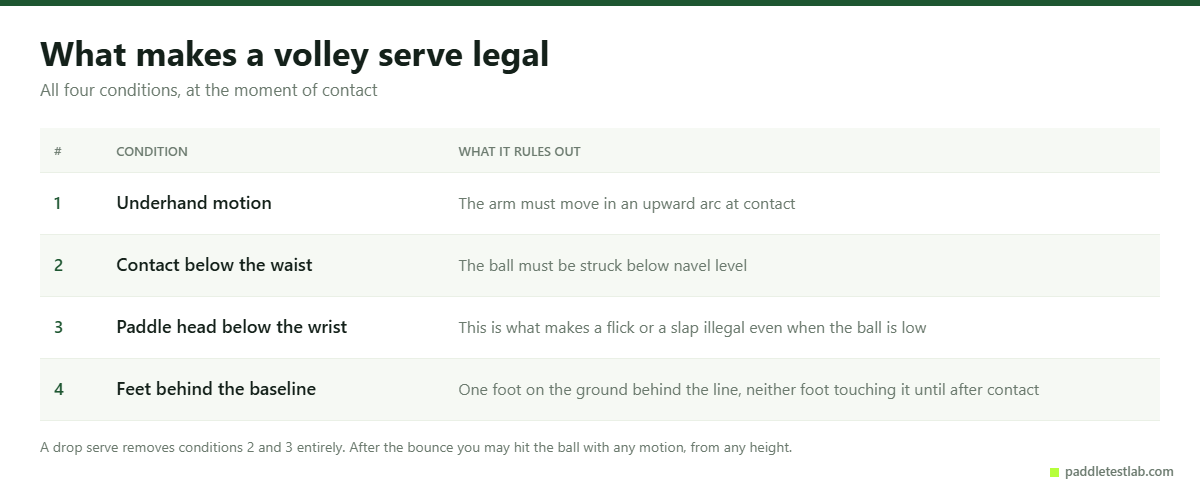
A standard volley serve — the ball struck out of the air, not dropped — must satisfy all four:
- Underhand motion. The arm must move in an upward arc at the point of contact.
- Contact below the waist. The ball must be struck below navel level.
- Paddle head below the wrist. At contact, the highest point of the paddle head must not be above the highest part of your wrist. This is the condition that makes a flick or a slap illegal even when the ball is low.
- Feet in the right place. At least one foot must be in contact with the ground behind the baseline, and neither foot may touch the baseline or the court until after the ball is struck.
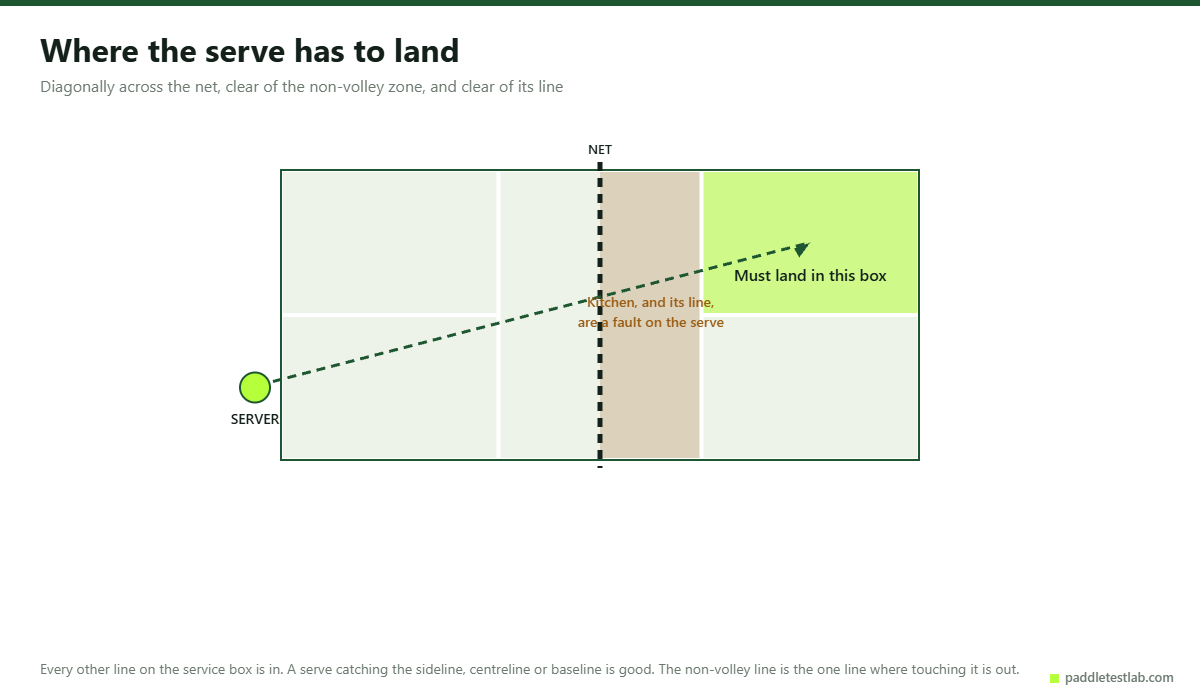
The serve is then hit diagonally cross-court and must land in the opposite service box.
Where the Serve Has to Land
It must clear the non-volley zone completely. A serve that lands in the kitchen is a fault — and, unusually, a serve that lands on the kitchen line is also a fault. That is the one line in pickleball where touching it is out.
Every other line on the service box is in. A serve catching the sideline, centreline or baseline is good.
Our court dimensions guide has the measurements if you want to see exactly how much room that leaves.
The Drop Serve, and What It Lets You Get Away With
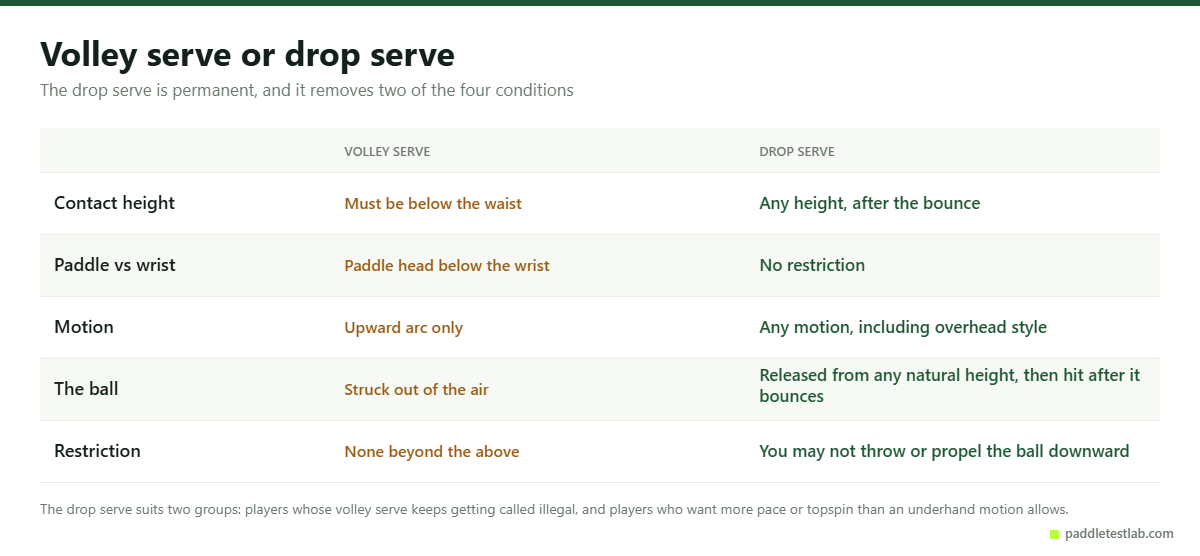
The drop serve is now a permanent option rather than a trial rule, and it is worth understanding because it removes two of the four conditions above.
How it works: release the ball from any natural height and let it bounce, then hit it after the bounce. You may release from your hand or off the paddle face. You may not throw or propel the ball downward — it has to fall under its own weight. The ball may bounce anywhere, including behind the baseline.
What it removes: with a drop serve, the below-the-waist and paddle-below-the-wrist requirements do not apply. You may hit the bounced ball with any motion, from any height, including a full overhead-style swing.
That is a genuine advantage for two groups: players whose volley serve keeps getting called illegal, and players who want more pace or topspin on the serve than an underhand motion allows. The cost is that the ball is lower after the bounce, which some players find harder to time.
Foot Faults: What the Line Actually Requires
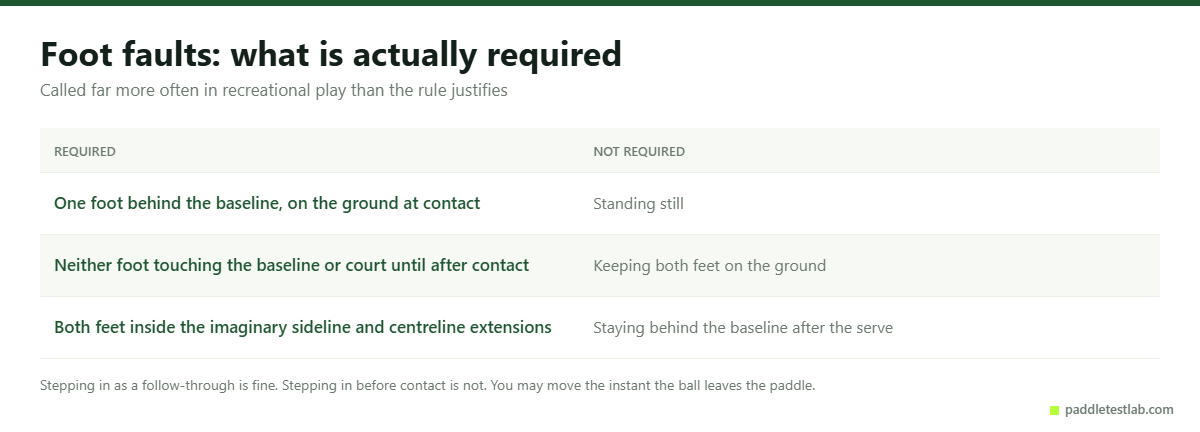
Foot faults are called far more often in recreational play than the rule justifies. Three things are required, and nothing else:
- At least one foot behind the baseline and in contact with the ground at the moment of contact.
- Neither foot touching the baseline or the court until after the ball is struck. Stepping in as a follow-through is fine; stepping in before contact is not.
- Both feet within the imaginary extensions of the sideline and the centreline. You cannot serve from beyond the side of the court or from across the centre.
What is not required: standing still, keeping both feet on the ground, or staying behind the baseline after the serve. You may step forward the instant the ball leaves the paddle.
Why the Spin Serve Was Banned
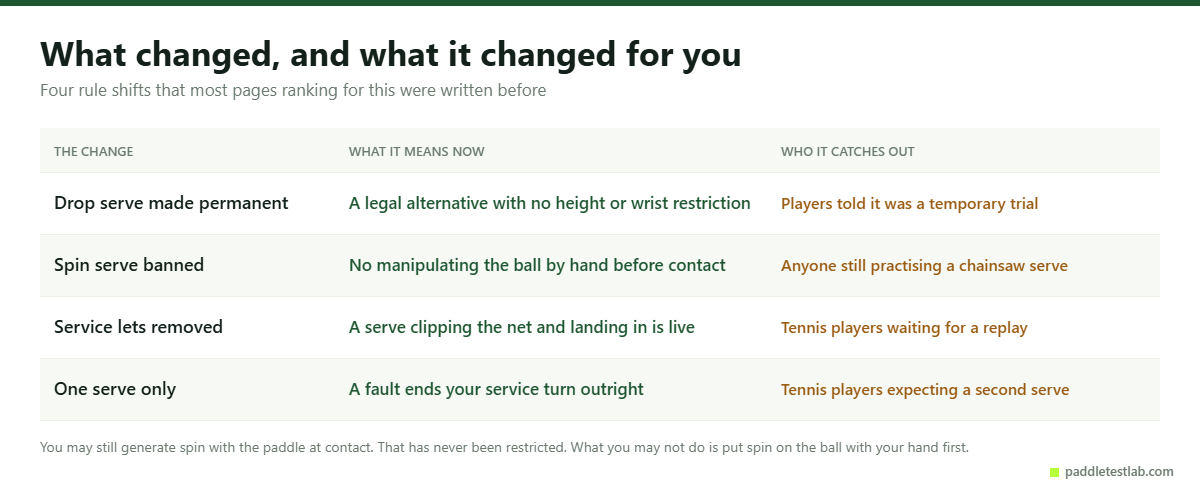
For a couple of seasons, players were spinning the ball with their non-paddle hand before striking it — the so-called chainsaw serve. Done well, it produced a serve that kicked sideways off the bounce in ways a returner could not read, and it turned the serve from a rally starter into a weapon.
It was banned. The release must now be a clean one, with no manipulation of the ball to impart spin before contact. You may still generate spin with the paddle at contact — that has never been restricted. What you may not do is put spin on the ball with your hand first.
The practical effect is that serve returns became readable again, which is what the rule was for.
One Serve, No Lets
Two rules that catch tennis players constantly:
There is no second serve. A fault on the serve ends your service turn — it goes to your partner if you are the first server, or it is a side out. There is no safety net, which is why a reliable serve beats an ambitious one.
There are no service lets. A serve that clips the net and lands in the correct service box is live and in play. Nobody replays it. If it clips the net and lands in the kitchen or out, it is simply a fault.
Serving Order and Who Serves First
The team serving first in a game gets only one server rather than two — which is why the opening call is “0-0-2”. The serving team’s first server starts from the right-hand court.
Position is set by the serving team’s score: even score, serve from the right; odd score, serve from the left. The server must call the score out loud before serving, loudly enough for the receiving team to hear.
Our scoring guide walks a complete game through this, point by point.
After the Serve: the Two-Bounce Rule
The serve must bounce before the receiving team returns it, and the return must bounce before the serving team plays it. Only after those two bounces may either side volley.
This is why the serving team cannot rush the net behind their serve, and it is the reason pickleball rallies develop the way they do. The sequence is: serve, bounce, return, bounce, and only then is the ball live in the air. The non-volley zone rules take over from there — see our kitchen rule explainer.
Serve Strategy: Depth, Placement and Why the Middle Works
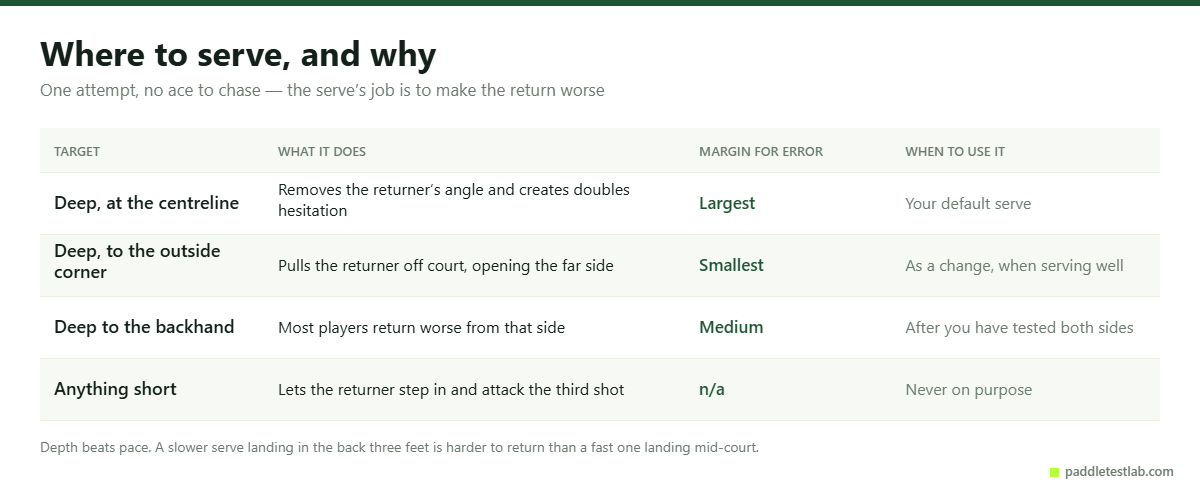
The serve cannot be a weapon in pickleball the way it is in tennis — one attempt, underarm, and the receiving team gets to let it bounce. What it can be is a shot that makes the return worse.
Depth beats pace. A serve that lands within the last two or three feet of the service court pushes the returner back and makes their third-shot situation harder. A fast serve that lands mid-court is easier to return than a slower one that lands deep. If you improve one thing about your serve, make it depth.
Aim for the middle more than you think. A deep serve to the centreline does three useful things: it takes away the returner’s angle, it creates a moment of hesitation about who is taking it in doubles, and it gives you the largest margin for error because the centreline is the furthest target from any sideline. Most club players serve wide by default and hand back the angle for free.
Use the wide serve as a change, not a staple. Serving to the outside corner pulls the returner off court and opens the opposite side for your third shot. It also has the smallest margin on the sideline, so it is a shot to use when you are serving well, not when you are struggling.
Serve to the weaker side, but confirm it first. Most players are weaker on the backhand return, but not all, and a two-handed backhand returner may prefer it. Two or three serves each way early in a game tells you more than an assumption does.
Do not chase an ace. A fault costs your entire service turn — there is no second serve. A serve that goes in every time at 80% effort produces more points than one that goes in seven times out of ten at 100%.
Practising a Legal Serve on Your Own
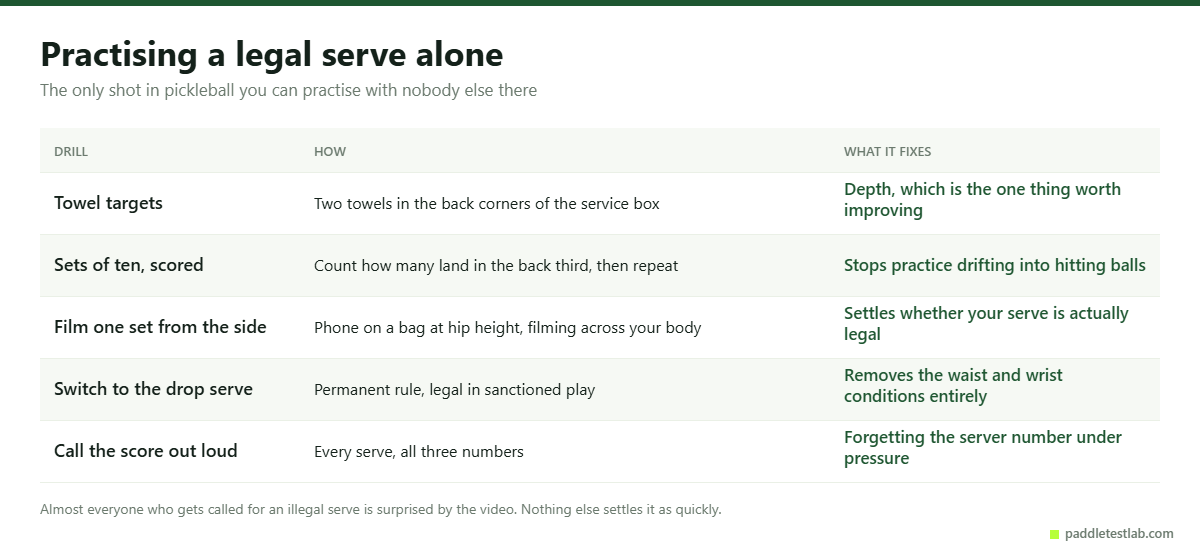
The serve is the only shot in pickleball you can practise completely alone, and it is the shot most club players never practise at all.
Set up targets rather than aiming at a box. Put two towels or cones in the back corners of the service court, one at the centreline and one at the sideline. Serving at a 20-by-15-foot box teaches you nothing; serving at a towel teaches you depth.
Serve in sets of ten, and score yourself. Count how many land in the back third of the box. Ten balls, note the number, repeat. The number is the only feedback that matters and it stops practice drifting into hitting balls.
Film one set from the side. A phone propped on a bag at hip height, filming across your body, will show you in thirty seconds whether your contact is below the waist and your paddle head is below your wrist. Almost everyone who gets called for an illegal serve is surprised by the video, and nothing else settles the argument as quickly.
If your volley serve keeps getting called, switch to the drop serve. It is a permanent rule, it is legal in sanctioned play, and it removes the below-the-waist and paddle-below-the-wrist conditions entirely. There is no virtue in defending a motion that keeps costing you service turns.
Practise the score call out loud. It sounds trivial and it is not: calling three numbers while starting a motion is a coordination habit, and players who have never practised it are the ones who forget the server number under pressure. Our scoring guide covers the call.
One Note on the Return
The serve is heavily regulated and the return is barely regulated at all, which tells you where the advantage sits in pickleball.
The receiving team must let the serve bounce, and their return must also bounce before the serving team can play it. That double-bounce sequence hands the receiving team the net: they can move forward behind their return while the serving team is still pinned at the baseline waiting for the ball to land.
The practical consequence is that a deep return is worth more than a deep serve. Serve deep to make the return worse, but expect to be on the back foot at the start of every point you serve. That is the design of the game, not a flaw in your serve.
Frequently Asked Questions
Can you serve overhand in pickleball?
Not with a volley serve — the motion must be upward and contact below the waist. With a drop serve you may use any motion after the bounce, which is the closest thing to an overhand serve the rules allow.
Is the drop serve legal in tournaments?
Yes. It is a permanent rule, not a provisional one, and it is legal in sanctioned play.
What happens if my serve hits the net?
If it lands in the correct service box, play continues — there are no service lets. If it lands anywhere else, it is a fault.
Do I get a second serve?
No. One attempt per service turn.
Can I bounce the ball before serving, like in tennis?
You may drop it once and hit it after that bounce — that is the drop serve. Repeatedly bouncing the ball to settle yourself and then hitting a volley serve is a different thing and not part of the serve motion.
Does my paddle matter for a legal serve?
The serve rules do not restrict equipment, but the paddle itself must be approved for sanctioned play. Our guide to USA Pickleball approved paddles explains how to check a specific model.
Rules in this guide follow the current USA Pickleball rulebook. Last reviewed 15 September 2026.

Isacc Shah
Isacc Shah writes PaddleTestLab. He does not test paddles in a lab and says so plainly — there is no rig, no radar gun, no staff hitting balls. Instead he aggregates independent bench measurements, manufacturer specifications, USA Pickleball's approval database and hundreds of verified owner reviews per product, then reports where those sources disagree. Every score on the site carries its evidence count. Where a specification is not published, the site writes UNKNOWN rather than estimating it, and the criticism is printed next to the praise.