
Short answer: pickleball scoring uses three numbers in doubles — your team’s score, the other team’s score, and whether you are the first or second server. Only the serving team can score, and court position follows your own score: even from the right, odd from the left.
Pickleball scoring is not complicated. It is just explained badly almost everywhere, usually as a list of rules with no game attached.
So this page does it the other way round. First the three numbers and what each one means, then a complete doubles game played out point by point so you can see the call change in front of you, then singles, then the five mistakes that cause most on-court arguments.
Pickleball Scoring: the Three Numbers, in Order
In traditional doubles, the server calls three numbers before every serve. Always in this order:
- Your team’s score. The serving team’s score comes first, always.
- The other team’s score.
- The server number — 1 or 2. Whether you are the first or the second of your team’s two servers in this service turn.
So “4-6-2” means: my team has 4, your team has 6, and I am the second server. If my team loses this rally, the serve goes to the other team.
Two rules govern everything else:
- Only the serving team can score. If the receiving team wins the rally, they do not get a point — they get the serve, or the other server on the serving team steps up.
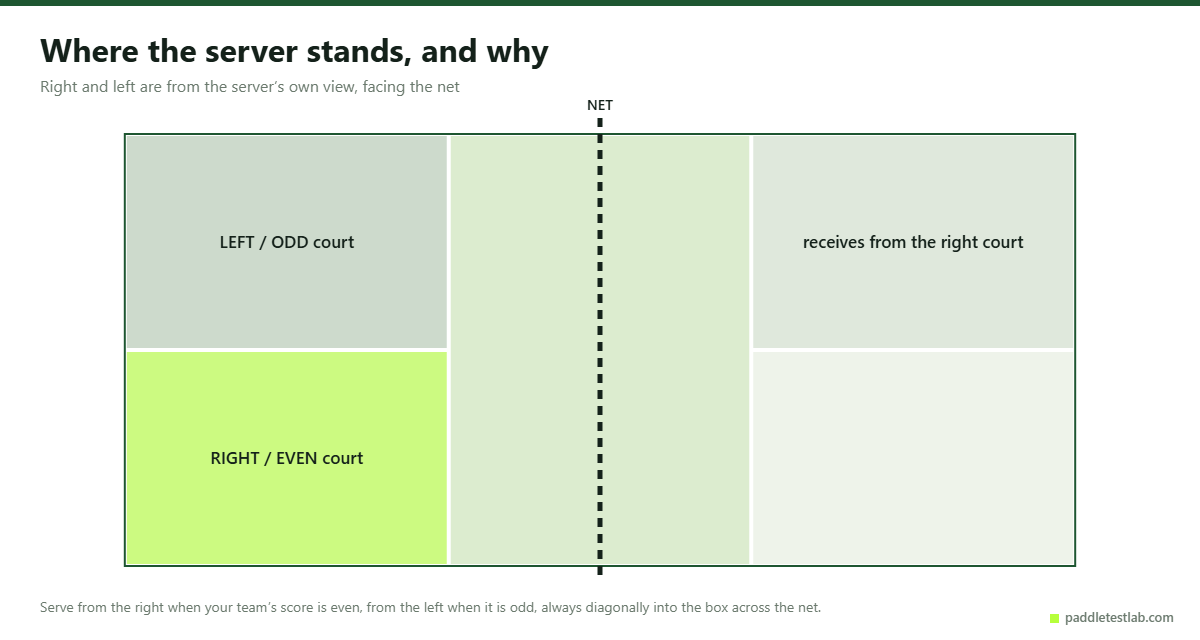
- Your position is set by your team’s score. When your team’s score is even (0, 2, 4…) the server serves from the right. When it is odd, from the left. This is the check that tells you instantly whether anyone is standing in the wrong place.
Games are normally to 11, win by 2. Tournament play also uses 15 and 21 point games, and in a game to 11 teams typically switch ends when one side reaches 6.
A Full Doubles Game, Point by Point
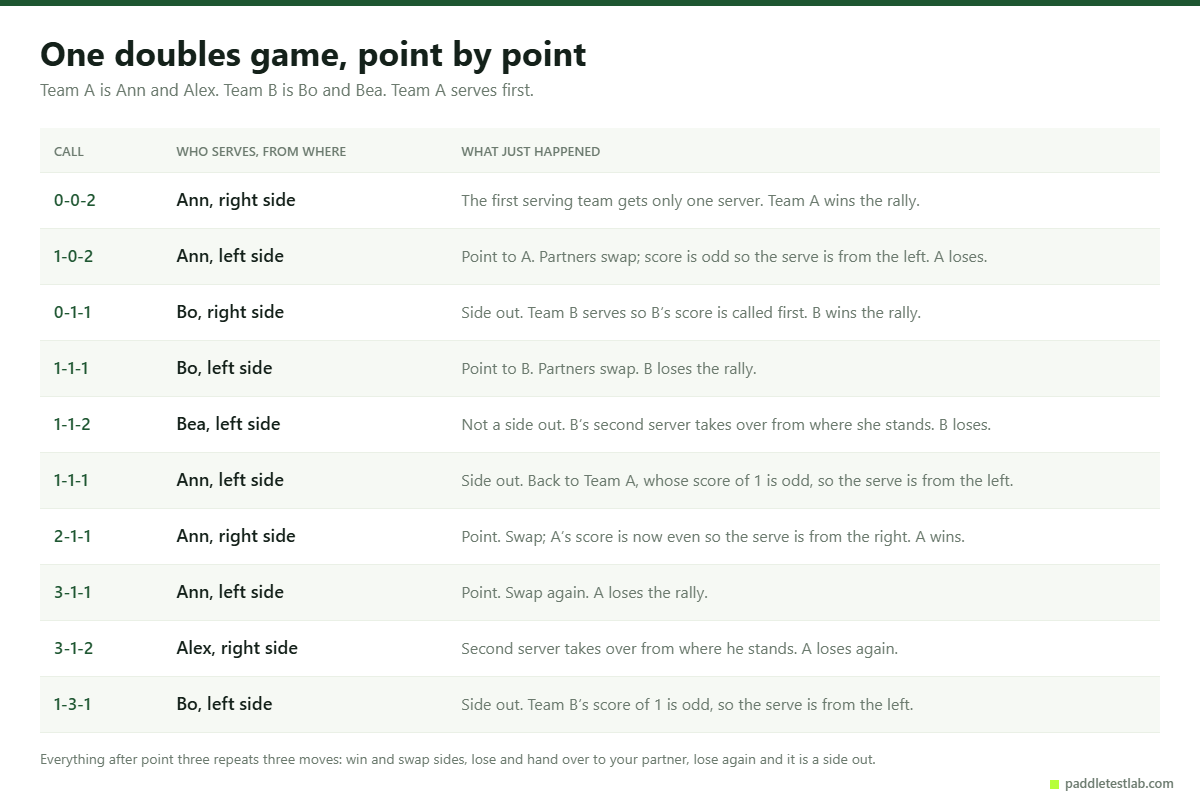
Team A is Ann and Alex. Team B is Bo and Bea. Team A serves first.
| Call | Who serves, from where | What happens |
|---|---|---|
| 0-0-2 | Ann, right side | The game starts. The first serving team gets only one server — that is why the call is “2”. Team A wins the rally. |
| 1-0-2 | Ann, left side | Point to Team A. Ann and Alex swap sides; Ann serves again from the left because Team A’s score is now odd. Team A loses the rally. |
| 0-1-1 | Bo, right side | Side out. Team B serves, so Team B’s score is called first. Bo is server 1. Team B wins the rally. |
| 1-1-1 | Bo, left side | Point to Team B. Bo and Bea swap; Bo serves from the left. Team B loses the rally. |
| 1-1-2 | Bea, left side | Not a side out. Team B’s second server takes over from wherever she is standing. Team B loses the rally. |
| 1-1-1 | Ann, left side | Side out. Back to Team A, score called first. Team A’s score is 1, so the server stands left. Team A wins. |
| 2-1-1 | Ann, right side | Point. Swap; Team A’s score is even so the serve is from the right. Team A wins. |
| 3-1-1 | Ann, left side | Point. Swap again. Team A loses the rally. |
| 3-1-2 | Alex, right side | Second server. Alex serves from wherever he is. Team A loses. |
| 1-3-1 | Bo, left side | Side out. Team B’s score of 1 is odd, so the serve is from the left. |
Read that table twice and the system is yours. Everything after point three repeats the same three moves: win the rally and swap sides, lose it and hand over to your partner, lose it again and it is a side out.
Why You Start at 0-0-2
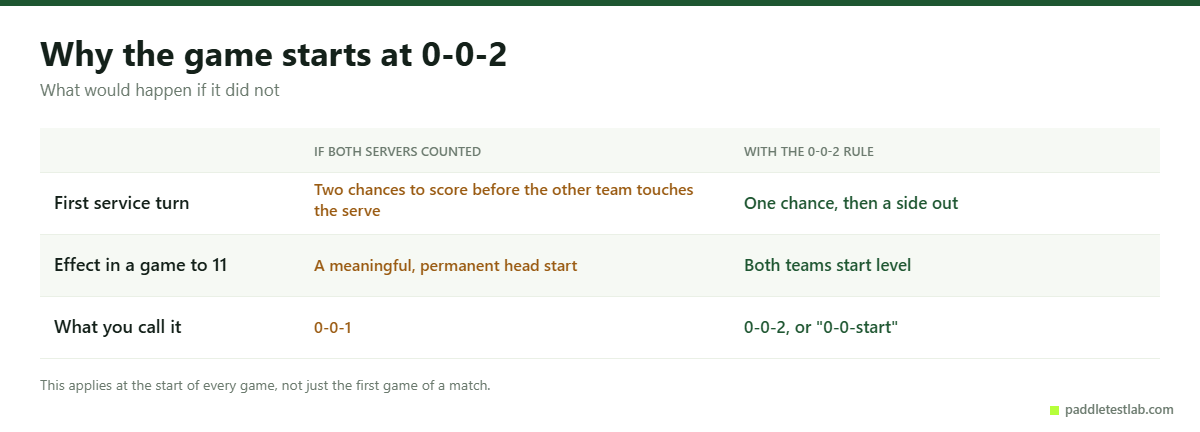
The team serving first in a game gets only one server, not two. If they got both, they would have two chances to score before the other team ever touched the serve — a meaningful advantage in a game to 11.
Calling that first service turn “0-0-2” is the fix: it labels the server as the second one, so when they lose the rally it is a side out rather than a handover to their partner. Some players and referees say “0-0-start” instead, which means exactly the same thing and is arguably clearer.
This applies at the start of every game, not just the first game of a match.
Singles Scoring — the One Rule That Changes
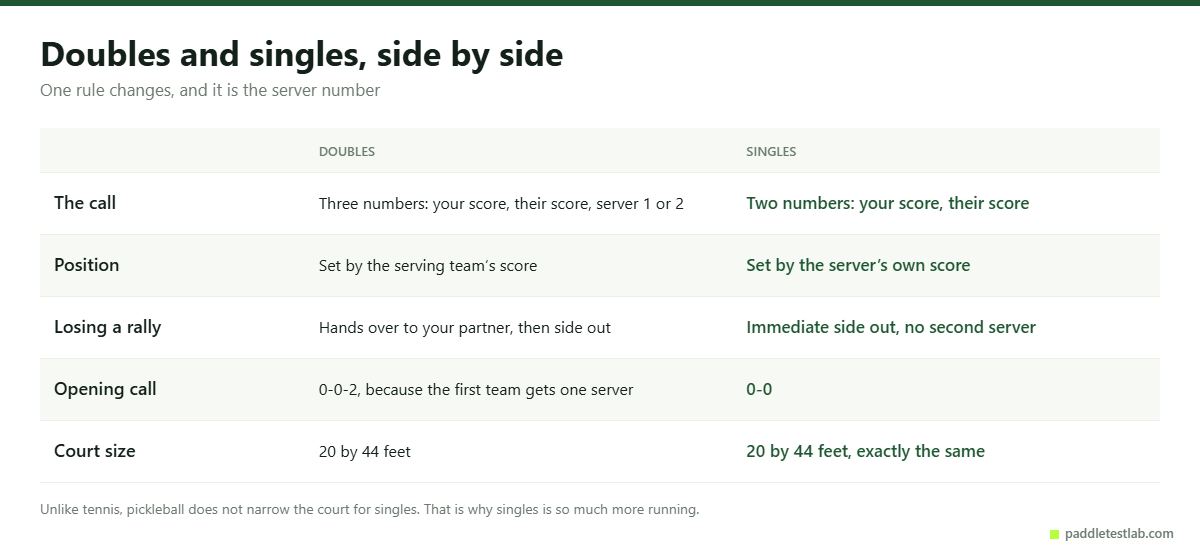
Singles is simpler. There is no partner, so there is no server number:
- Two numbers only: your score, then your opponent’s. “5-3” and nothing else.
- Position is still set by the server’s own score. Even score, serve from the right. Odd score, serve from the left.
- Lose the rally and it is a side out immediately. No second server exists.
The position rule does more work in singles than people expect: because your position depends on your own score, your receiver always knows which box you are serving into before you move. If you find yourself on the wrong side, check your score rather than your memory.
Rally Scoring and Where You Will Meet It
In rally scoring, a point is awarded on every rally regardless of who served. It is faster, easier to follow, and easier to broadcast, which is why it appears in team-league formats and some tournament events.
Two things change. Games run longer in points — often to 15 or 21 — because points come twice as fast. And the serving advantage largely disappears, which shifts strategy towards holding the rally rather than protecting a service turn.
Traditional side-out scoring remains the default in recreational play and in most USA Pickleball sanctioned events. If you are unsure which you are playing, ask before the first serve rather than during the third rally.
The Five Mistakes That Cause Most Arguments
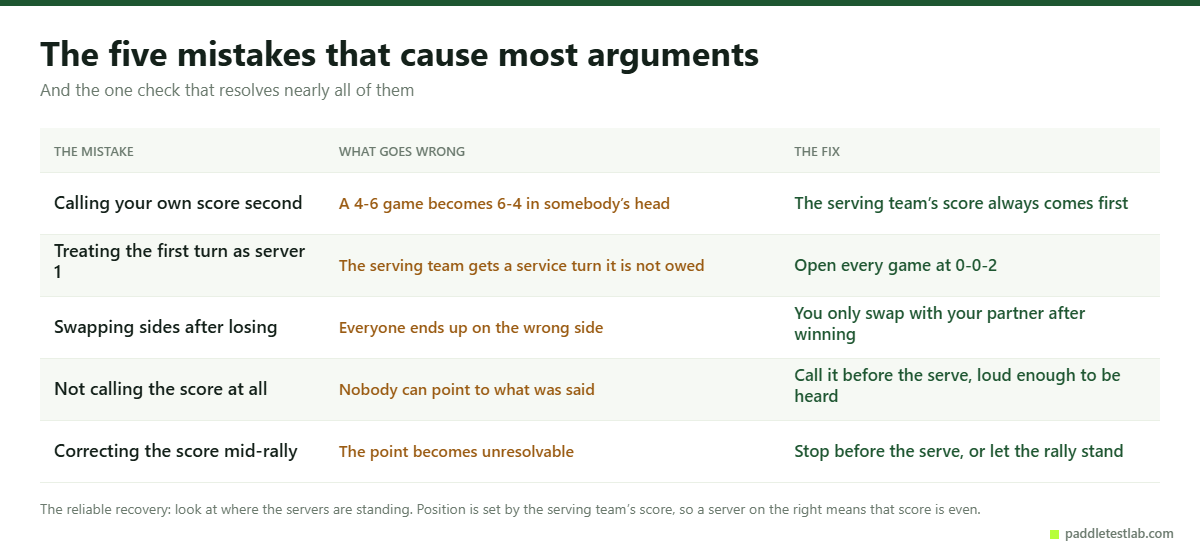
- Calling your own score second. The serving team’s score always comes first. Getting this backwards is the single most common error, and it turns a 4-6 game into a 6-4 game in someone’s head.
- Forgetting the first service turn is server 2. A team that serves first and treats itself as server 1 gets an extra service turn it is not entitled to.
- Swapping sides after losing a rally. You only swap with your partner after winning a point. Losing changes nothing about where you stand.
- Not calling the score at all. The score must be called before the serve, loudly enough for the receiving team to hear. Serving in silence is how disagreements become unresolvable — nobody can point to what was said.
- Correcting the score mid-rally. If the score was called wrong, stop before the serve. Once the ball is in play the rally stands.
The reliable recovery when a game gets tangled: look at where the servers are standing. Position is determined by the serving team’s score, so if the server is on the right, that team’s score is even. That one check resolves most disputes without anyone needing a better memory than anyone else.
Rally Scoring in Full
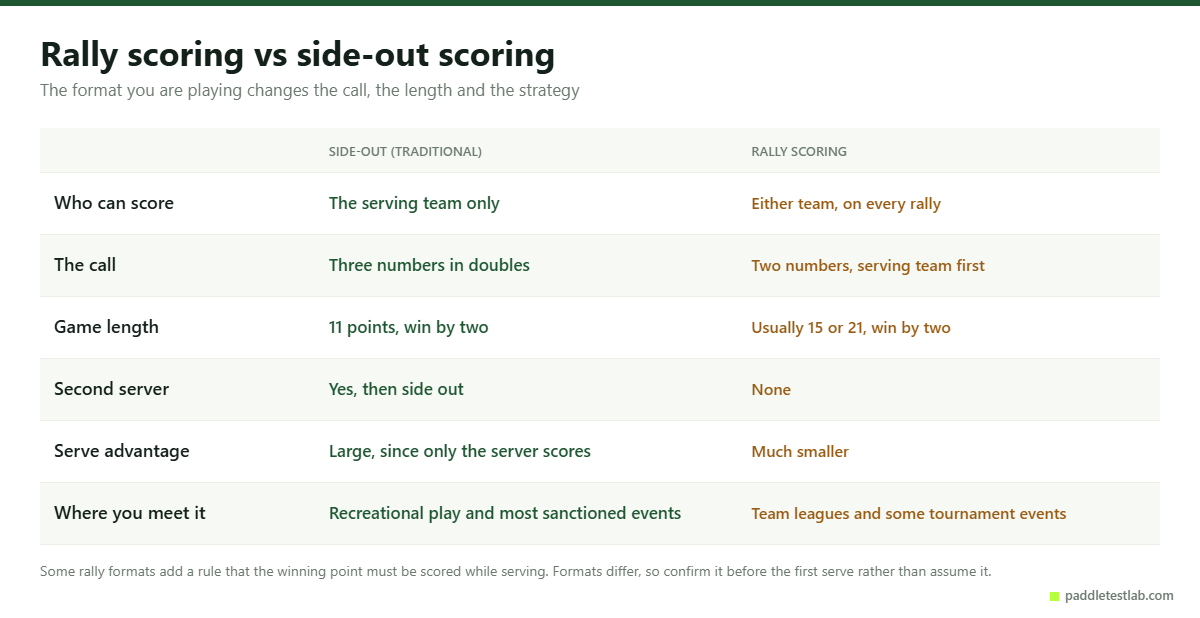
Rally scoring is the format you will meet in team leagues and in a growing number of tournament events, and it is worth knowing properly rather than discovering mid-match.
The core rule: a point is scored on every rally, whoever served. There is no side-out, no second server, and no situation where winning a rally earns you nothing.
Four things follow from that:
- The call gets shorter. Two numbers, serving team first. The server number disappears because there is no second server to track.
- Games run to a higher number. Points arrive roughly twice as fast, so games are usually played to 15 or 21 rather than 11, still winning by two.
- The serve matters less. In side-out scoring, holding serve is how you score at all. In rally scoring the receiving team scores just as readily, so strategy shifts towards winning the rally rather than protecting a service turn.
- Matches finish on time. This is the real reason organisers like it. A rally-scored game has a predictable length, which is what makes it broadcastable and what makes court bookings work.
One variation to ask about before you start: some rally formats add a rule that the winning point has to be scored while serving, which stops a game ending on a return. Formats differ on this, so confirm it rather than assume it.
Which are you playing? Traditional side-out scoring remains the default in recreational play and in most USA Pickleball sanctioned events. If nobody has said, it is side-out. Ask before the first serve rather than during the third rally.
Fixing a Game Nobody Can Agree On
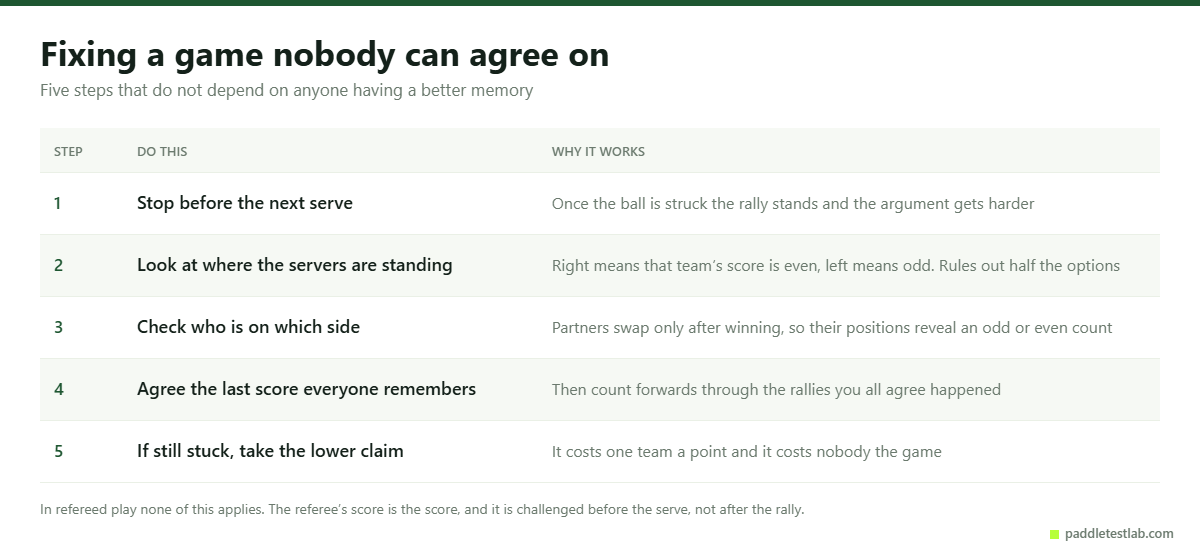
It happens in every session. Two people remember 7-5, one remembers 6-5, and the fourth was not listening. There is a reliable way out that does not depend on anyone having a better memory.
- Stop before the next serve. Once the ball is struck the rally stands, and the argument gets harder.
- Look at where the servers are standing. Position is set by the serving team’s score. A server on the right means that team’s score is even; on the left, odd. That alone rules out half the candidate scores.
- Check who is on which side. Partners swap only after winning a point, so the pair’s positions relative to where they started tells you whether they have scored an odd or even number of points.
- Agree the last score everyone remembers, then count forwards through the rallies you all agree happened.
- If you still cannot agree, take the lower of the two claims. It costs one team a point and it costs nobody the game.
In refereed play none of this applies: the referee’s score is the score, and a player who thinks it is wrong should say so before the serve, not after the rally.
Calling the Score: Etiquette and What the Rules Require
The score has to be called before the serve, and loudly enough for the receiving team to hear it. That is a rule, not a courtesy, and most scoring disputes trace back to somebody quietly not doing it.
A few habits that make a self-officiated game run cleanly:
- Call all three numbers, every time. Not “four-six” and a shrug. The server number is the part people forget, and it is the part that decides whether the next fault is a side out.
- Call it before you start your motion, not during it. A score called mid-serve is a score nobody heard.
- Let the receiver settle. Serving before the receiving team is ready is technically legal in most situations and socially indefensible. Look up first.
- Correct a wrong call immediately. If you hear a score you disagree with, say so before the ball is struck. After that, the rally plays out and the correction is made afterwards.
- Do not coach the score. Calling out “that’s game point” to pressure an opponent is not scoring, it is gamesmanship.
The rest of the on-court rules that generate arguments are covered in our kitchen rule guide and the serving rules guide.
Frequently Asked Questions
Do you have to win by two?
Yes in standard play. A game to 11 continues past 11 until one side leads by two, so 12-10 and 15-13 are both normal finishes. Some tournament formats cap the score; check before you play.
What happens if the score is called wrong?
Stop play before the serve and correct it. If the ball has been served, the rally plays out and the correction is made afterwards. In refereed play the referee’s score stands.
When do teams switch ends?
In a game to 11, teams normally switch when one side reaches 6. In a game to 15 the switch is at 8, and to 21 it is at 11. Recreational games often skip this entirely.
Can the receiving team score a point?
Not in traditional side-out scoring — winning a rally as the receiver earns you the serve, not a point. In rally scoring, yes.
Which side does the second server serve from?
Wherever they are already standing. The second server does not move to a particular side; they simply take over. Positions only change when a point is won.
Where can I read the rest of the rules?
Scoring is one part of it. Our serving rules guide covers what makes a serve legal, and the kitchen rule explainer covers the non-volley zone — the two areas that generate more questions than scoring does.
Scoring in this guide follows the current USA Pickleball rulebook. Last reviewed 15 September 2026.

Isacc Shah
Isacc Shah writes PaddleTestLab. He does not test paddles in a lab and says so plainly — there is no rig, no radar gun, no staff hitting balls. Instead he aggregates independent bench measurements, manufacturer specifications, USA Pickleball's approval database and hundreds of verified owner reviews per product, then reports where those sources disagree. Every score on the site carries its evidence count. Where a specification is not published, the site writes UNKNOWN rather than estimating it, and the criticism is printed next to the praise.