
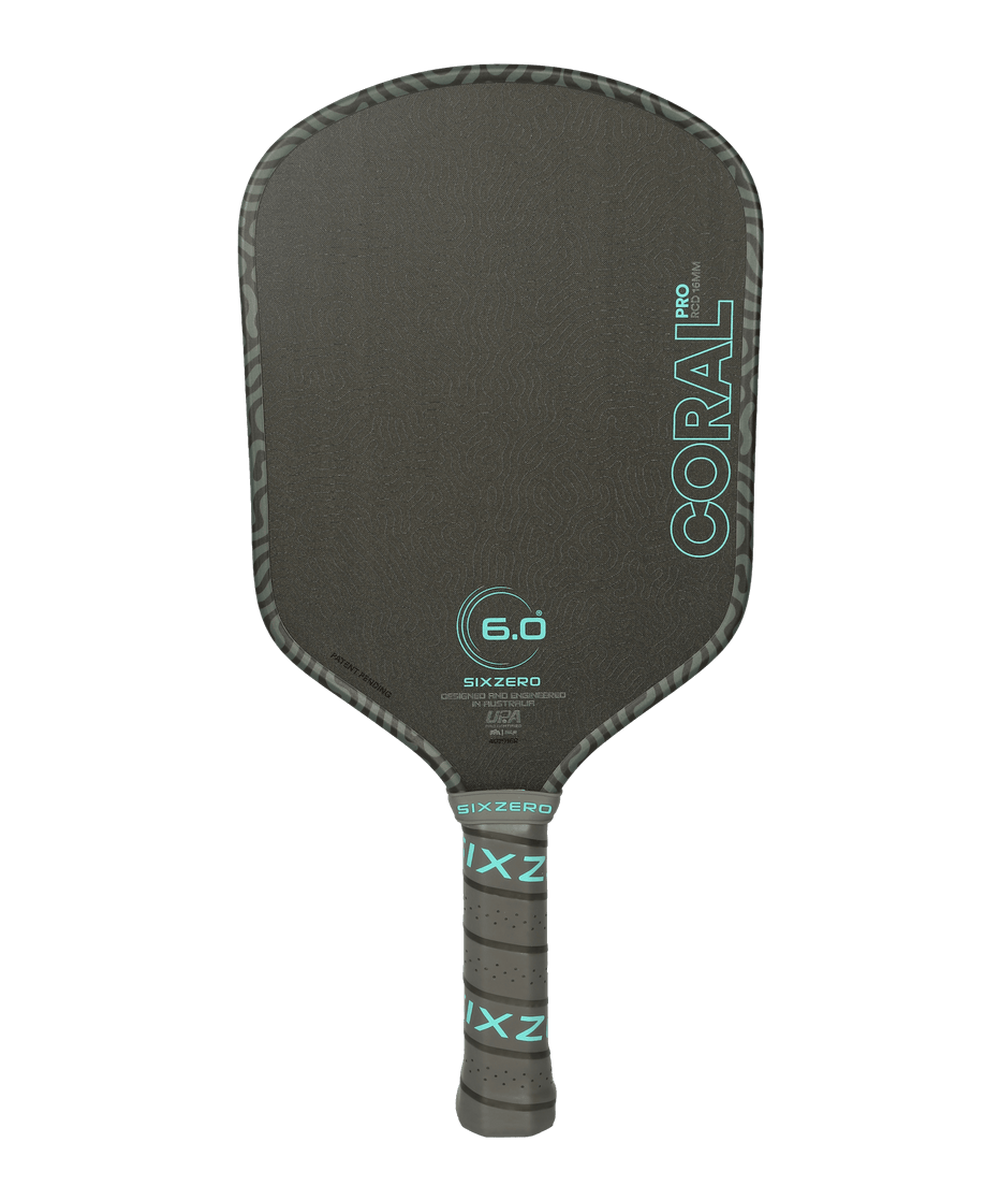
Short answer: the best foam core pickleball paddles in 2026 are the Six Zero Coral for all-court comfort and the CRBN 1 TruFoam Genesis for spin and power. Foam removes core crush, which is the point of it, and introduces two problems nobody selling it puts in writing.
Foam core is the loudest argument in paddle construction right now, and “loudest” is doing double work in that sentence. Replacing honeycomb with foam solves the single most persistent failure in modern paddles — core crush — and it introduces two new problems that almost nobody selling foam will put in writing.
This page covers what foam actually changes, the paddles worth buying in 2026, and the specific players who are better off spending less on a good thermoformed paddle instead.
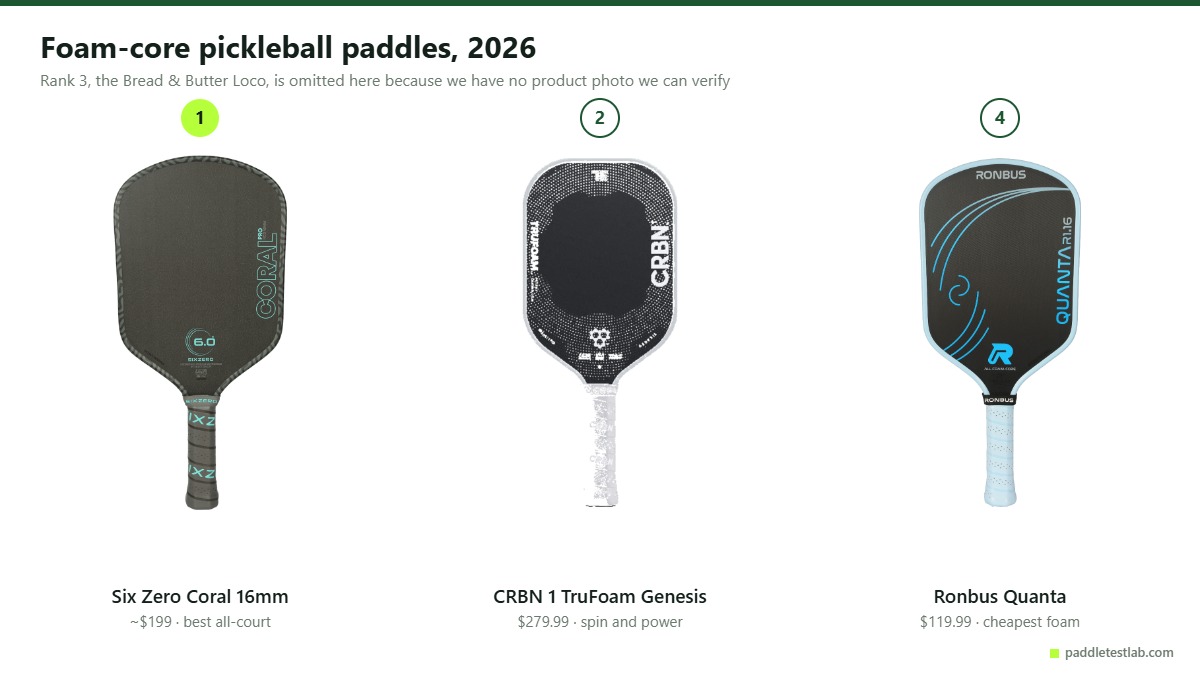
Foam Wall vs Full Foam vs Polymer Honeycomb
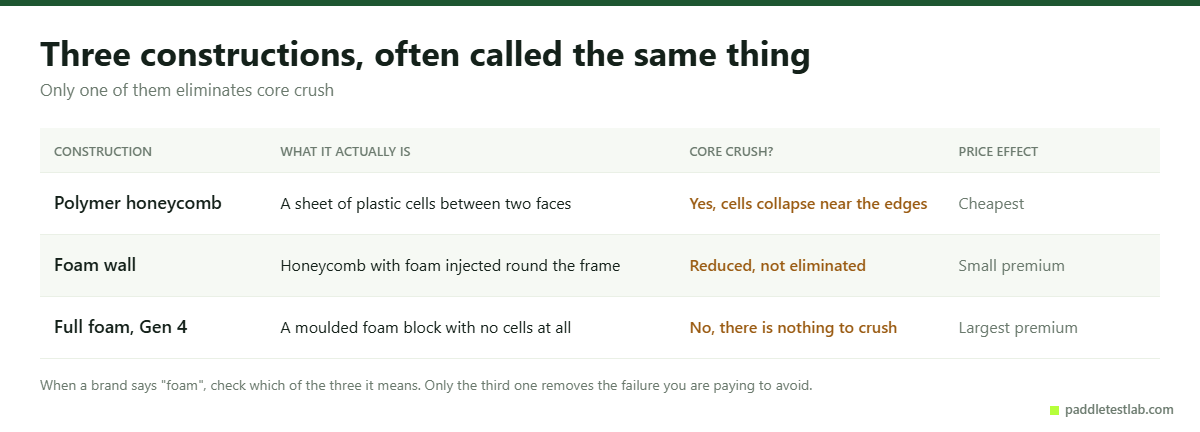
Three constructions, often described with the same word.
Polymer honeycomb is the traditional core: a sheet of plastic cells between two faces. Light, cheap, well understood, and the source of core crush — cells collapse near the edges over months of hard hitting, and the paddle develops dead spots. Our core types explainer covers how it is made.
Foam wall keeps the honeycomb but injects foam around the inside perimeter of the frame. This stiffens the edges, expands the usable sweet spot and adds pace on off-centre hits. It is the most common “foam” paddle on the market and it is not the same thing as a foam core.
Full foam — Gen 4 — replaces the honeycomb entirely with a moulded foam block. There are no cells, so there is nothing to crush. The ball sits on the face longer, which produces heavier, more spun drives and a distinctly different feel.
When a brand says “foam,” check which of the three it means. Only the third one eliminates core crush.
What Foam Actually Changes on Court
- Dwell time goes up. The ball stays on the face fractionally longer, which converts a brushing stroke into more rotation and makes drives feel heavy rather than flat.
- Durability goes up, in one specific way. No honeycomb means no core crush. Faces still wear and edge guards still fail.
- Swing weight goes up. Foam is denser than air-filled cells. The CRBN TruFoam Genesis sits at 118 to 120, which is high, and you feel it at the kitchen line.
- Noise changes. Different, not automatically quieter. If you play somewhere with a decibel policy, check the specific model rather than assuming — our quiet paddle guide covers what HOAs actually measure.
- Price goes up. Moulded foam cores cost more to produce than sheet honeycomb, and that shows up at the till.
The Best Foam Core Pickleball Paddles: 2026 Picks
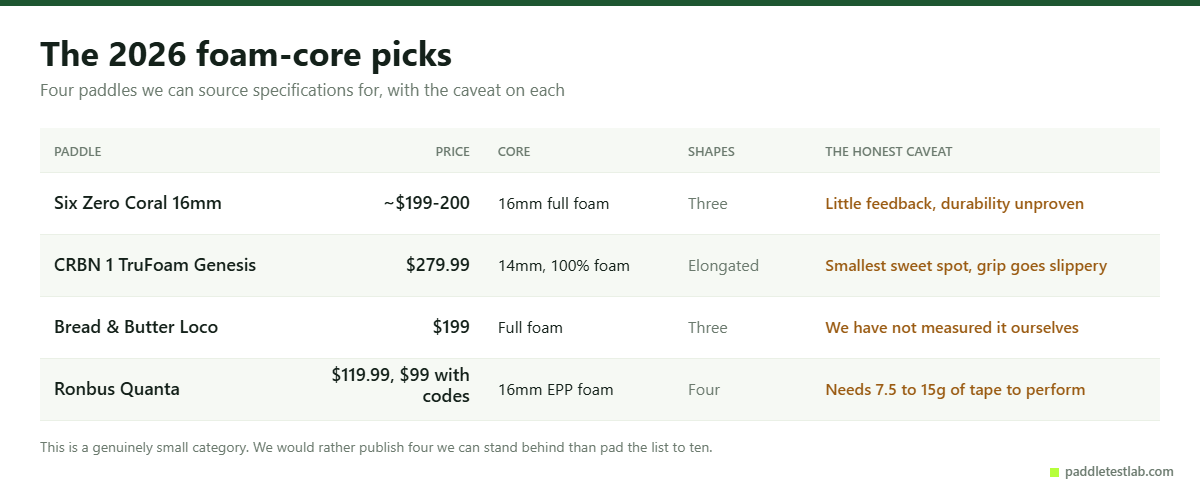
This is a genuinely small category. Four paddles below are full-foam or foam-cored builds we can source specifications for. We would rather publish four we can stand behind than pad the list to ten.
1. Six Zero Coral 16mm — best all-court foam paddle
A dense but soft full-foam core with minimal vibration and the strongest comfort scores of any paddle we track. At 7.9 to 8.2 ounces it is not unusually heavy for the category, and three shapes are offered.
Two caveats worth weighing. It gives little feedback — the muted feel that makes it comfortable also makes it hard to sense exactly where on the face you made contact. And long-term durability is genuinely unproven; the construction has not been in players’ hands long enough for a verdict. The grip is thick, which is a poor fit for small hands.
~$199–200 MSRP · 16mm full foam · elongated, hybrid or widebody · USAP approved.
2. CRBN 1 TruFoam Genesis — best foam paddle for spin and power

A 100% foam core behind a T700 raw carbon and fiberglass face, and the clearest demonstration of what long dwell time does: excellent spin and heavy drives. No core crush, by construction.
It asks a lot in return. The swing weight of 118 to 120 is the highest in this group, the sweet spot is the smallest in CRBN’s series, and owners report the stock grip going slippery. This is a 4.0-and-above paddle and it will frustrate a player still working on consistent contact.
$279.99 MSRP · 14mm, 100% foam · elongated · USAP approved.
3. Bread & Butter Loco — the value full-foam option
A full-foam core offered in all three shapes at $199, and one of the paddles Pickleball Studio currently lists at the top of its power rankings. On price alone it undercuts most of the Gen-4 field by fifty to eighty dollars.
We have not measured this paddle ourselves and there is less independent data on it than on the two above, so treat the listing as a pointer rather than a verdict. If you want full foam at under $200 in three shapes, it is the obvious candidate to research next.
$199 · full foam · widebody, hybrid or elongated.
4. Ronbus Quanta — cheapest way into a foam core

A Gen-4 EPP foam core at $119.99 MSRP, or around $99 with a code, in four shapes and at a very light 7.68 to 7.80 ounces. For anyone who wants foam durability without the Gen-4 price, this is the entry point.
The stock sweet spot is small and the paddle is designed to be weighted — 7.5 to 15 grams at 3 and 9 o’clock is what reviewers set it up with. Budget for tape and half an hour; see how to add weight to a paddle.
$119.99 MSRP, $99 with codes · 16mm EPP foam · four shapes · USAP approved, PBCoR .43.
The Durability Question Nobody Selling Foam Answers
The pitch for foam is durability, and on core crush specifically the pitch is true. There are no cells to collapse, so the failure mode that ruined thousands of thermoformed paddles between 2023 and 2025 simply does not apply.
What is not established is what foam does over two or three years. Foam can compress and take a set under repeated impact, and the Gen-4 paddles have not been in circulation long enough for anyone to say whether they do. Six Zero’s own Coral carries “long-term durability unproven” as a fair summary of the current evidence.
So the honest position is this: foam removes a known failure and replaces it with an unknown one. That is probably a good trade. It is not the settled fact the marketing implies, and anyone quoting you a lifespan for a foam core is guessing.
Two things remain unchanged by foam. Face grit still wears — usually within two to four months of heavy play on any textured carbon paddle. Edge guards still come loose. Neither is a core problem, and neither is solved by paying for foam.
Who Should Skip Foam Entirely
- Players under 3.5. The higher swing weight and smaller sweet spots of most full-foam paddles work against you. A forgiving $100 thermoformed paddle will improve your results more. Start with our beginner guide.
- Anyone with elbow or shoulder trouble buying on price. Foam is not automatically arm-friendly — the Coral is, the TruFoam Genesis is not. Comfort comes from swing weight and vibration damping, and you can get both cheaper. See our tennis elbow picks.
- Players who need fast hands at the kitchen. Dense cores swing heavier. If your game is speed-ups and counters, a lighter thermoformed hybrid is the better tool.
- Anyone on a noise-restricted court. Check the specific model’s approval before you spend $200 to $280.
Frequently Asked Questions
Is a foam core worth the extra money?
If you have previously killed a paddle through core crush, yes — you are buying out of a known failure. If you have not, the honest answer is that a good thermoformed paddle at half the price will play nearly as well for most players.
Are foam paddles quieter?
Not reliably. They sound different, and some are quieter, but it is model by model. Do not buy foam expecting to satisfy a noise rule without checking the specific paddle.
Do foam paddles delaminate?
Delamination is a bond failure between face and core, and it is possible on any construction. What foam eliminates is core crush, which is the collapse of honeycomb cells. The two get confused constantly — our guide to delamination signs explains how to tell them apart.
Is foam legal for tournament play?
Yes, where the specific model is approved — every paddle listed here is. Approval is per model, not per construction.
Foam wall or full foam?
Foam wall gives you a bigger sweet spot at a lower price and keeps a lighter swing. Full foam gives you dwell, spin and no core crush at a higher price and a heavier swing. For most players below 4.0, foam wall is the better value.
Specifications and prices are checked against each brand’s own store — Six Zero, CRBN and Ronbus — and were current in July 2026.

Isacc Shah
Isacc Shah writes PaddleTestLab. He does not test paddles in a lab and says so plainly — there is no rig, no radar gun, no staff hitting balls. Instead he aggregates independent bench measurements, manufacturer specifications, USA Pickleball's approval database and hundreds of verified owner reviews per product, then reports where those sources disagree. Every score on the site carries its evidence count. Where a specification is not published, the site writes UNKNOWN rather than estimating it, and the criticism is printed next to the praise.