

Choosing the best pickleball paddle for intermediate players is a different problem from choosing a first paddle. You know your playstyle now, you can feel the difference between a 14mm and 16mm core, and you’re deciding what to trade away: forgiveness for power, durability for spin, or money for comfort. This guide ranks the upgrade tier — roughly $180 to $280 — using aggregated verified owner reviews and published data, including the places where a brand’s own lineup contradicts its marketing.
The best pickleball paddle for intermediate players field is crowded this year, so we focused on verified data over hype.
Check the official source.
For more detail on how the best pickleball paddle for intermediate players compare, scroll to the scorecard at the end of this guide.
How We Rank Upgrade Paddles
We don’t claim court time with these paddles. We aggregate verified owner reviews at scale, cross-check them against manufacturer spec sheets and the official USA Pickleball approved list, and surface the repeated complaints a single glowing review won’t show you: grit that fades, cores that crush, edge guards that loosen. Where a spec isn’t published or a claim isn’t independently supported, we say “unconfirmed.” Read our full review process, or check any model against the Paddle Honesty Index.
At-a-Glance: Intermediate Upgrade Picks
| Pick | Paddle | Price | USAP |
|---|---|---|---|
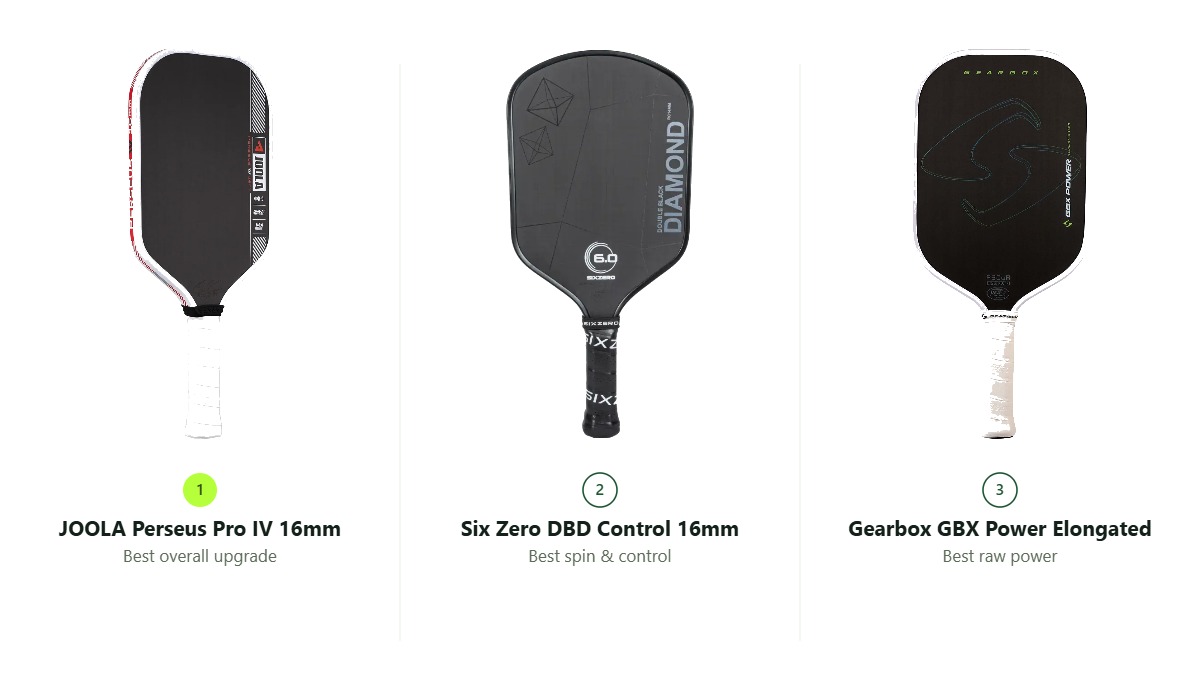
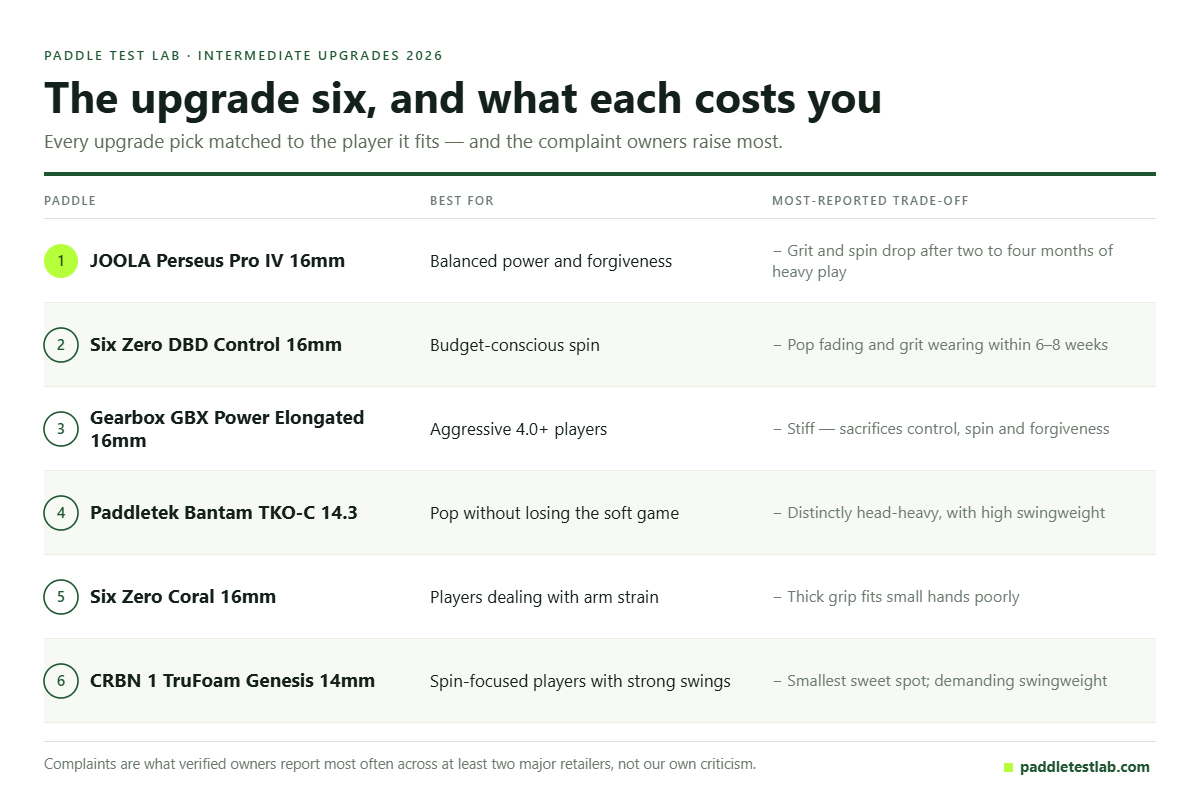
| Best Overall Upgrade | JOOLA Perseus Pro IV 16mm | $249.95 street ($279.99 MSRP) | Yes (USAP + UPA-A) |
| Best Spin & Control | Six Zero Double Black Diamond Control 16mm | $180.00 | Unconfirmed |
| Best Raw Power | Gearbox GBX Power Elongated 16mm | $179.99 | Yes (UPA-A + PBCoR) |
| Best Power with Control | Paddletek Bantam TKO-C 14.3 | $199.99 | Yes (since Feb 2024) |
| Best Arm-Friendly All-Court | Six Zero Coral 16mm | ~$199–200 | Yes |
| Best Foam-Core Spin (premium) | CRBN 1 TruFoam Genesis 14mm | $279.99 | Yes |
Compare how the best pickleball paddle for intermediate players rank by price, weight, and verified owner ratings before you decide. For most players the best pickleball paddle for intermediate players decision comes down to feel, price and durability – and this guide weighs all three from verified owner data.
The Upgrade-Tier Claim Check
The clearest finding in this tier isn’t about any single paddle — it’s that newer doesn’t mean better. JOOLA’s current flagship, the Perseus Pro V at $299.95, is widely called overpriced in reviews, with reviewers explicitly recommending the older Pro IV instead. That pattern — owner evidence contradicting a brand’s own lineup positioning — is exactly why we rank from owner data rather than release dates.
| Claim | What owners and published data show |
|---|---|
| “The Pro V is the refined new flagship” (JOOLA, $299.95) | Reviewers widely call it overpriced and recommend the older Pro IV at $249.95 instead |
| “Textured carbon = lasting spin” | Grit and spin on the Pro IV drop after 2–4 months of heavy play; the DBD Control’s pop and grit reportedly fade within 6–8 weeks |
| “No core crush” foam and cold-bond cores (CRBN, Gearbox) | Generally supported — foam-core and cold-bond designs show far fewer core-crush complaints than older polymer cores, including JOOLA’s own crush history |
JOOLA Perseus Pro IV 16mm — Best Overall Upgrade
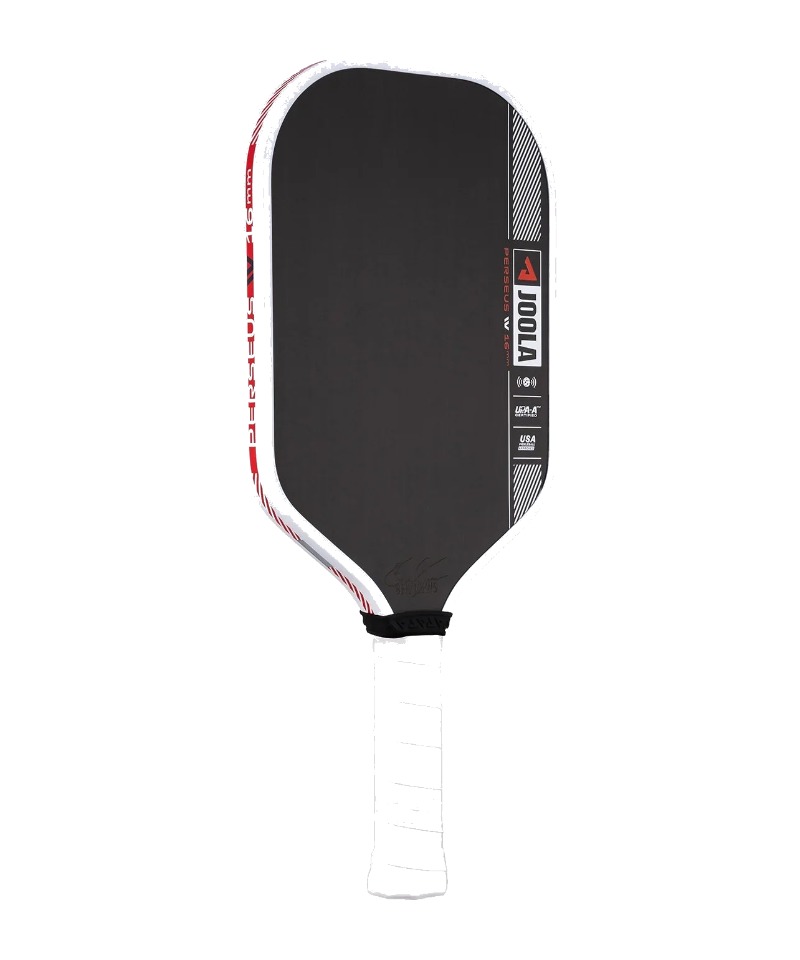
| Price | $249.95 street ($279.99 MSRP) |
| Weight | 7.9–8.1 oz |
| Core | 16mm (14mm also) |
| Face | Textured carbon fiber |
| Shape | Elongated |
| USAP | Yes (USAP + UPA-A) |
Praised: easy power, forgiving response, and a large sweet spot — the combination most intermediate players are upgrading to find. Owner reviews rank it above JOOLA’s own newer Pro V.
Criticized: grit and spin drop after 2–4 months of heavy play, and JOOLA cores carry a documented core-crush history. It’s officially superseded by the Pro V, so stock may tighten over time.
Six Zero Double Black Diamond Control 16mm — Best Spin & Control
| Price | $180.00 |
| Weight | 8.1 oz avg |
| Core | 16mm (14mm also) |
| Face | Toray 700K raw carbon |
| Shape | Hybrid |
| USAP | Unconfirmed |
Praised: a large sweet spot and strong topspin numbers, backed by a 4.6/5 average across 24 verified Pickleball Warehouse reviews.
Criticized: owners report pop fading and grit wearing within 6–8 weeks, the handle runs thin, and it scuffs balls more than rivals.
Gearbox GBX Power Elongated 16mm — Best Raw Power
| Price | $179.99 MSRP |
| Weight | 8.0 oz |
| Core | 16mm, cold-bond construction |
| Face | Raw unidirectional carbon |
| Shape | Elongated (hybrid also) |
| USAP | Yes (UPA-A + PBCoR) |
Praised: cold-bond build means no core crushing or degradation over time, and it delivers Gearbox’s third-generation power for about $100 less than the brand’s GX2 line.
Criticized: stiff, and it openly sacrifices control, spin, and forgiveness. Reviewers position it for 4.0+ power players specifically.
Paddletek Bantam TKO-C 14.3 — Best Power with Control
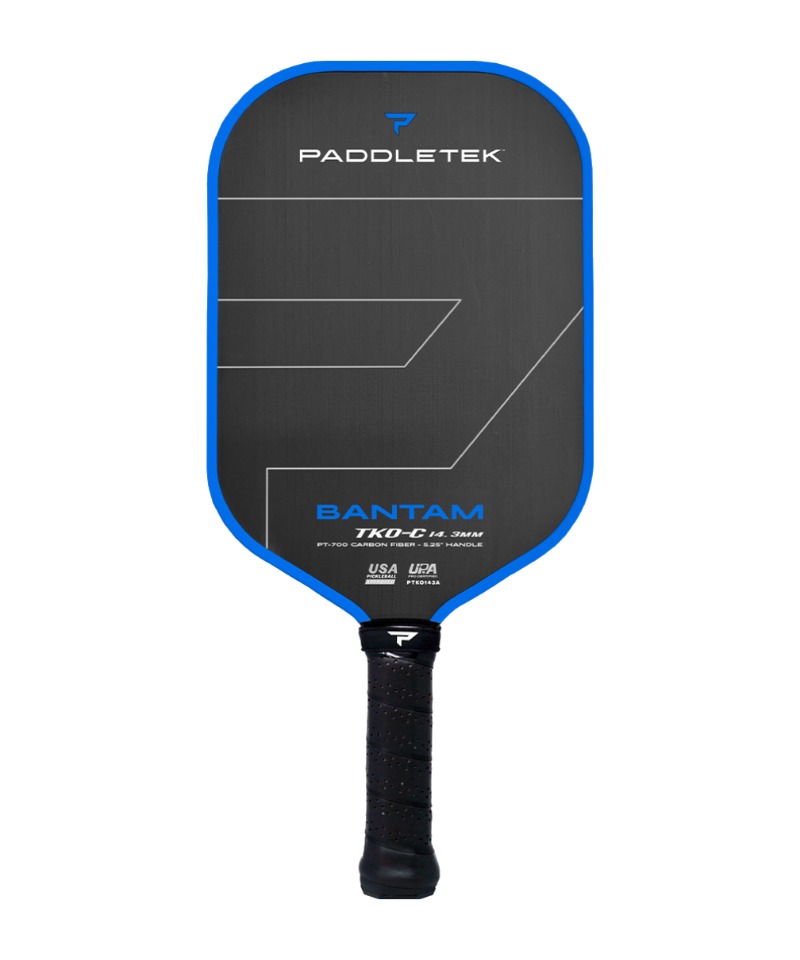
| Price | $199.99 MSRP |
| Weight | 7.7–8.1 oz (avg 7.9) |
| Core | 14.3mm |
| Face | PT-700 raw carbon |
| Shape | Elongated |
| USAP | Yes (since Feb 2024) |
Praised: big pop that still keeps control, made in the USA, and it’s the signature paddle of a touring pro (Christian Alshon).
Criticized: distinctly head-heavy (swingweight 116–117), the grip isn’t top-tier, it’s stiff on soft shots, and owners call it very loud.
Six Zero Coral 16mm — Best Arm-Friendly All-Court
| Price | ~$199–200 MSRP |
| Weight | 7.9–8.2 oz (avg 8.05) |
| Core | Dense full-foam |
| Face | Diamond Tough raw carbon |
| Shapes | Elongated / hybrid / widebody |
| USAP | Yes |
Praised: the dense, soft full-foam core produces minimal vibration and the top comfort scores in owner feedback — the standout choice if elbow strain is pushing your upgrade.
Criticized: muted feedback, long-term durability still unproven, and the thick grip fits small hands poorly.
CRBN 1 TruFoam Genesis 14mm — Best Foam-Core Spin (Premium)
| Price | $279.99 MSRP |
| Weight | 7.8–8.1 oz |
| Core | 100% foam (Gen4), 14mm |
| Face | T700 raw carbon + fiberglass |
| Shape | Elongated |
| USAP | Yes |
Praised: the all-foam core eliminates core crush, with excellent dwell time and spin — the technology bet that owner data so far supports.
Criticized: the grip goes slippery, it has the smallest sweet spot in its series, and a high 118–120 swingweight demands a stronger swing.
How to Pick Your Upgrade

Start from the weakness your current paddle exposes. If you’re outhitting a beginner paddle’s power ceiling, the Perseus Pro IV or Bantam TKO-C add pop without abandoning control; pure bangers can go GBX Power. If your kitchen game is your weapon, the DBD Control’s spin — while it lasts — or the Coral’s foam comfort make more sense. Core thickness still follows the usual rule: 14mm favors speed and power, 16mm favors control and softness — our 14mm vs 16mm guide covers the trade in detail. Coming from a starter paddle? Compare this tier against the beginner picks and the full 2026 rankings before you spend, and check spin claims against our paddle spin RPM data.
Upgrading From a Beginner Paddle: What Actually Changes
The upgrade from a starter paddle to a proper intermediate frame is the biggest single improvement available in this sport — bigger than any later step. Three things change, in this order of importance.
The face. Moving from a painted composite to a raw carbon surface transforms how much the ball grips. This is the change you feel immediately, and it is what lets you start shaping dinks rather than just placing them.
The core. A 16mm polymer core with foam-filled walls holds the ball longer and stays stable on off-centre contact. Starter paddles are usually thinner and hollower, which is why resets pop up.
Consistency. Better paddles vary less unit to unit, so the one you buy behaves like the one you tried. Cheap paddles vary meaningfully in weight and balance within the same model.
What does not change much: raw power. If you are upgrading expecting to hit harder, you will be disappointed — you are buying control and spin, not output. Our beginner paddle guide covers what you are moving on from, and carbon versus fiberglass covers the face change in detail.
Best pickleball paddle for 3.5 players
3.5 is the level where the soft game arrives, and the paddle should support that rather than fight it. The specs that matter: a 16mm core, a raw carbon face, and a standard or hybrid shape that keeps the sweet spot near your hand.
The most common 3.5 mistake is buying the paddle a 4.5 player recommends. Advanced frames run higher swing weights and stiffer faces, which reward grooved contact and punish everything else. At 3.5 your contact is improving but not yet repeatable, and a demanding paddle will cost you more points than it wins. Our advanced player guide covers what genuinely changes at 4.5 and above — and when it becomes worth having.
Intermediate Paddles Under $150
| Price band | What you get | Worth it at intermediate? |
|---|---|---|
| $60–$100 | Raw carbon face, 16mm polymer core, direct-to-consumer brands | Yes — the single biggest value step in the market |
| $100–$150 | Thermoformed build, foam perimeter, longer-lasting grit | Yes if you play three or more times a week |
| $150–$200 | Premium materials, tighter tolerances, longer warranty | Marginal — you are paying for durability and support |
| $200+ | Flagship frames, often pro-endorsed | No — specs built for grooved technique you have not yet grooved |
The honest recommendation for most intermediates is $80–$150. Below it you are still on starter construction; above it you are buying refinement you cannot yet exploit. Our under-$100 roundup covers the value band, and the main roundup covers what the premium tier actually adds.
FAQ
When should I upgrade my pickleball paddle?
Three signals, and none of them is time-based. First, your dinks and resets are technically sound but keep sitting up — that is a thin core returning more energy than you want. Second, you can brush the ball but it is not biting — that is a worn or painted face. Third, you have started losing to players you used to beat, and the difference is the shots that need touch.
Signals that are not reasons to upgrade: losing to better players, a paddle that looks scuffed, or a new model being released. Most players upgrade too early, buy too much paddle, and then blame the equipment for a technique gap. Our complete buying guide works through the specs so you can identify what you actually need.
What paddle is best for improving spin?
A raw carbon face, first and last. Core thickness has a small, indirect effect — a thicker core holds the ball slightly longer — but it is swamped by whether the surface is raw carbon or painted composite. A 14mm raw carbon paddle will out-spin a 16mm painted one every time.
Two things matter more than the model you choose. Grit wears, so a paddle that spins beautifully out of the box may not in six months — spin durability is the more useful buying metric than peak spin. And technique contributes more than equipment at intermediate level: a clean brushing contact on a mid-range paddle beats a flat swipe on a flagship. Our explainer on what actually drives paddle spin covers the mechanism, and who measures spin explains why published figures from different labs cannot be compared.
What is the best pickleball paddle for intermediate players in 2026?
Based on aggregated owner reviews, the JOOLA Perseus Pro IV is the strongest all-around upgrade: easy power, a large sweet spot, and owner preference over JOOLA’s own newer Pro V flagship at $50 more.
Is the JOOLA Perseus Pro V worth it over the Pro IV?
The evidence says no for most players. Reviewers widely describe the $299.95 Pro V as overpriced and recommend the $249.95 Pro IV instead. That’s the brand’s own lineup contradicting its marketing, and we rank accordingly.
How much should an intermediate player spend on a paddle?
The documented upgrade tier runs roughly $180 to $280. Below that you’re mostly re-buying beginner performance; above $300 the owner data shows diminishing returns and some documented defects, like edge-guard failures on premium power paddles.
Are 14mm paddles better for intermediate players?
Not universally. Thinner 14mm cores favor power and hand speed; 16mm cores favor control and comfort. Match it to the weakness you’re fixing, not to a blanket rule.
Do expensive paddles keep their spin longer?
Not reliably. Grit fade is documented across price tiers — within 6–8 weeks on the $180 DBD Control and 2–4 months on the $249.95 Perseus Pro IV. Foam-core designs like the TruFoam Genesis hold up better on core integrity, but face texture wears on nearly everything.
Reference: USA Pickleball — official rules, equipment standards, and the approved-paddle list.
Check our best pickleball paddle for intermediate players scorecard at the end for a side-by-side verdict. Whether you need the best pickleball paddle for intermediate players or a competing option, compare every spec before you commit.

Isacc Shah
Isacc Shah writes PaddleTestLab. He does not test paddles in a lab and says so plainly — there is no rig, no radar gun, no staff hitting balls. Instead he aggregates independent bench measurements, manufacturer specifications, USA Pickleball's approval database and hundreds of verified owner reviews per product, then reports where those sources disagree. Every score on the site carries its evidence count. Where a specification is not published, the site writes UNKNOWN rather than estimating it, and the criticism is printed next to the praise.