
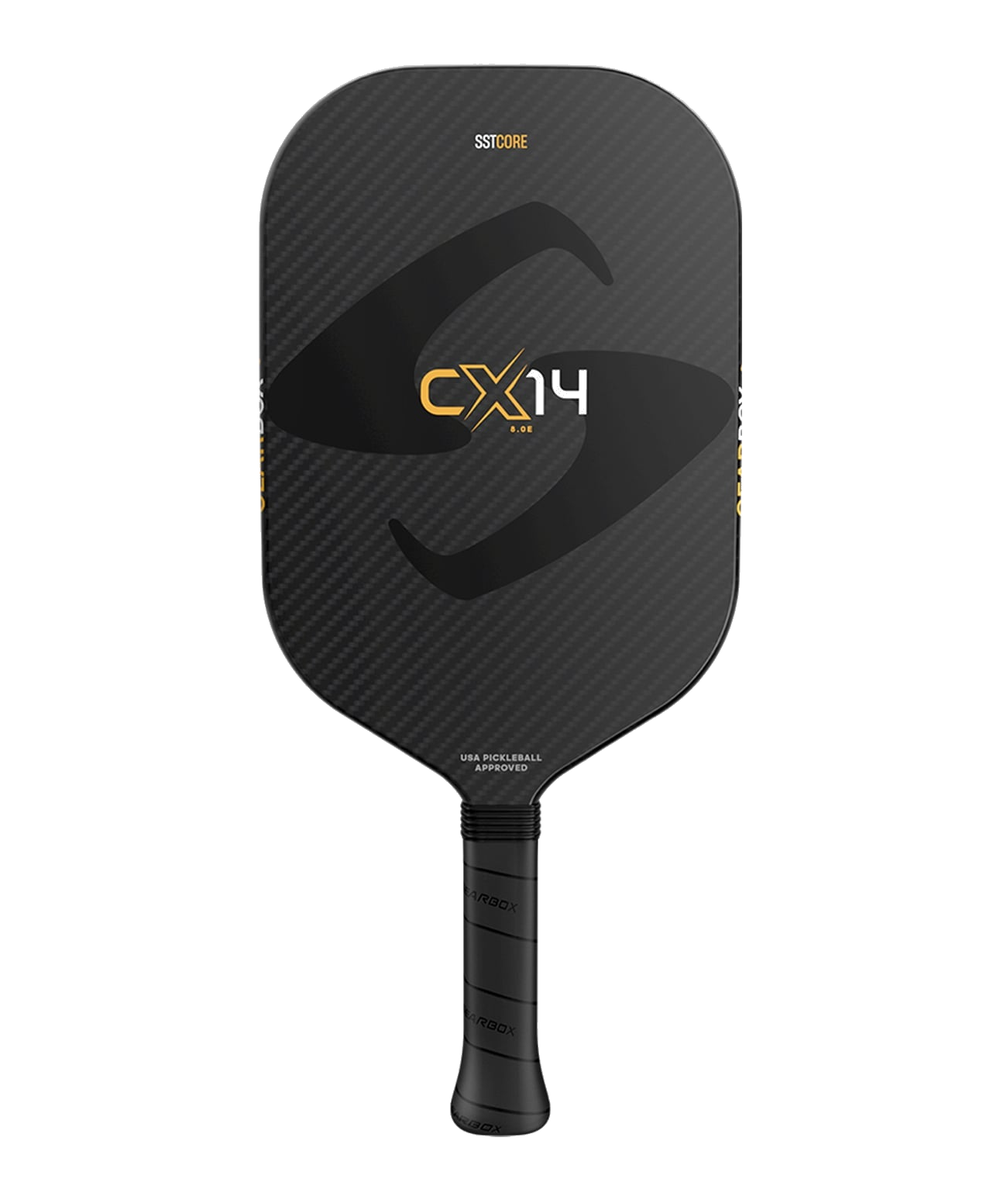
Gearbox built its reputation in racquetball before pickleball existed as a mainstream sport, and it carried that engineering-first identity straight into paddle design: instead of the polypropylene honeycomb core nearly every other brand uses, Gearbox builds around a proprietary carbon-fiber-tube core it calls SST. This Gearbox pickleball paddle review looks at what independent reviewers have actually measured on that core across the brand’s two current lines, and holds the durability claim in particular to real evidence rather than marketing copy.
Check the official source.
Who Gearbox Is, and What Makes Its Core Different
Gearbox’s SST core replaces the polymer honeycomb structure with vertically-aligned carbon fiber tubes. The pitch is durability: polymer cores are well known to compress and go “dead” over a season of play, while carbon fiber resists that kind of breakdown for years, according to reviewer testing cited below. That is a genuinely different construction, not a marketing rename of the same core everyone else uses, and it is the reason Gearbox commands premium pricing across both of its current lines.
The Gearbox Pickleball Paddle Lineup for 2026
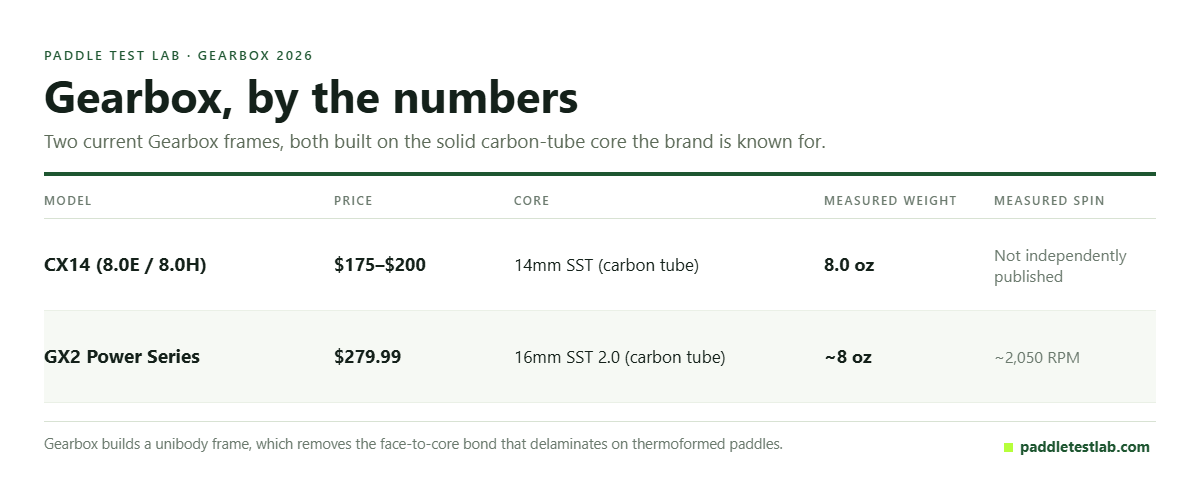
Every Gearbox pickleball paddle in the current catalog runs on some version of the SST carbon-tube core described above, split across two lines by thickness and price.
Compare how the gearbox pickleball paddle rank by price, weight, and verified owner ratings before you decide. For most players the gearbox pickleball paddle decision comes down to feel, price and durability – and this guide weighs all three from verified owner data.CX14 Series ($175–$200)
The CX14 is Gearbox’s control-oriented line, built on the original 14mm SST core. Independent testing from Pickleball Effect measured it at 8.0 oz across two shapes: the 8.0E (elongated, 16⅝” × 7⅛”) and the 8.0H (wider-body, 15⅞” × 8″). The same testing found strong forgiveness with minimal dead spots on mishits, a soft, controlled feel, and confirmed edge durability is a real weak point — the paddle “dinges easily” and reviewers recommend edge tape from day one.
GX2 Power Series ($279.99)
The GX2 moves to a thicker 16mm SST 2.0 core with a raw carbon, peel-ply-textured face, aimed at players who want power without giving up the SST core’s durability. Pickleball Effect’s testing measured a 113 swing weight on the hybrid shape (16.2″ × 7.8″) and 118 on the elongated shape (16.5″ × 7.5″), both around 8 oz static weight, with spin measured at roughly 2,050 RPM — a genuinely high number, in the same range as CRBN’s foam-core flagship we cover in our Pickleball Paddle Spin RPM Rankings.
| Model | Price | Core | Measured Weight | Independently Measured Spin |
|---|---|---|---|---|
| CX14 (8.0E / 8.0H) | $175–$200 | 14mm SST (carbon tube) | 8.0 oz | Not independently published |
| GX2 Power Series | $279.99 | 16mm SST 2.0 (carbon tube) | ~8 oz | ~2,050 RPM |
Compared to the polypropylene-honeycomb cores used by most competitors — including Franklin’s C45 and Signature Carbon lines — Gearbox’s carbon-tube approach is a genuinely different engineering bet, not just a different price point. That’s also part of why Gearbox paddles cost more than comparable polymer-core options: the SST core is a more expensive material and manufacturing process to produce at scale.
Claimed vs. Measured: The Durability Claim Holds Up, With One Caveat
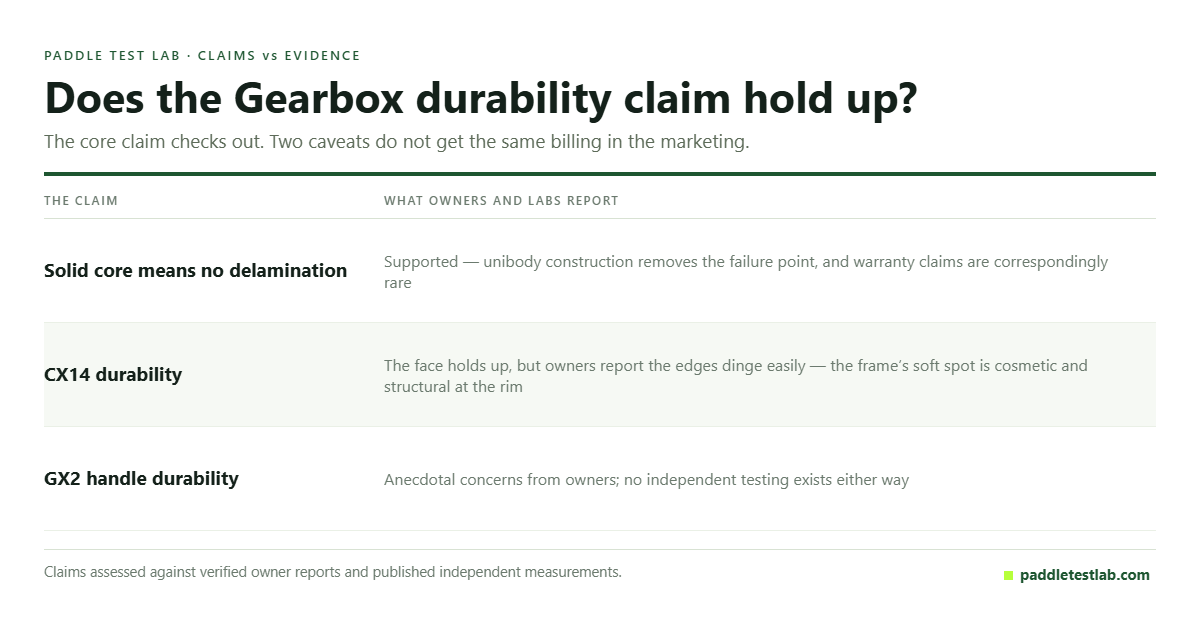
This Gearbox pickleball paddle’s central pitch — that a carbon-tube core resists the compression and “dead paddle” feel that polymer cores develop over time — is consistent with what independent reviewers reported: both the CX14 and GX2 were described as holding their performance over extended use rather than softening. We did not find independent, independently lab-tested longevity data (a controlled before/after test over a season), so we’re reporting reviewer-observed consistency, not a formal durability test — an honest distinction worth making.
Two real caveats did surface. First, CX14 owners and reviewers consistently flagged the edges as vulnerable to dinging, which is a cosmetic and eventually structural risk if left untaped. Second, scattered Reddit discussion referenced in reviewer coverage raised handle durability concerns on the GX2 — we’re flagging this as anecdotal owner chatter, not an independently measured failure rate, and would want to see a pattern across more sources before calling it a confirmed issue.
Who Should (and Shouldn’t) Buy Gearbox
Consider Gearbox if you:
- Have gone through polymer-core paddles that felt “dead” after a season and want a genuinely different core material.
- Want a control-first feel with strong forgiveness (CX14) or elite independently lab-tested spin with real dwell time (GX2).
- Are comfortable protecting the edges with tape as routine maintenance.
- Are not shopping on a tight budget — both lines sit at or above the market’s premium tier.
Look elsewhere if you:
- Want the lightest possible swing weight out of the box — the GX2 in particular runs 113–118, on the heavier side.
- Need a paddle that performs well immediately without an edge-guard habit.
- Are earlier in your budget range; see our Best Pickleball Paddles Under $100 guide instead.
Gearbox Solid Core Construction Explained
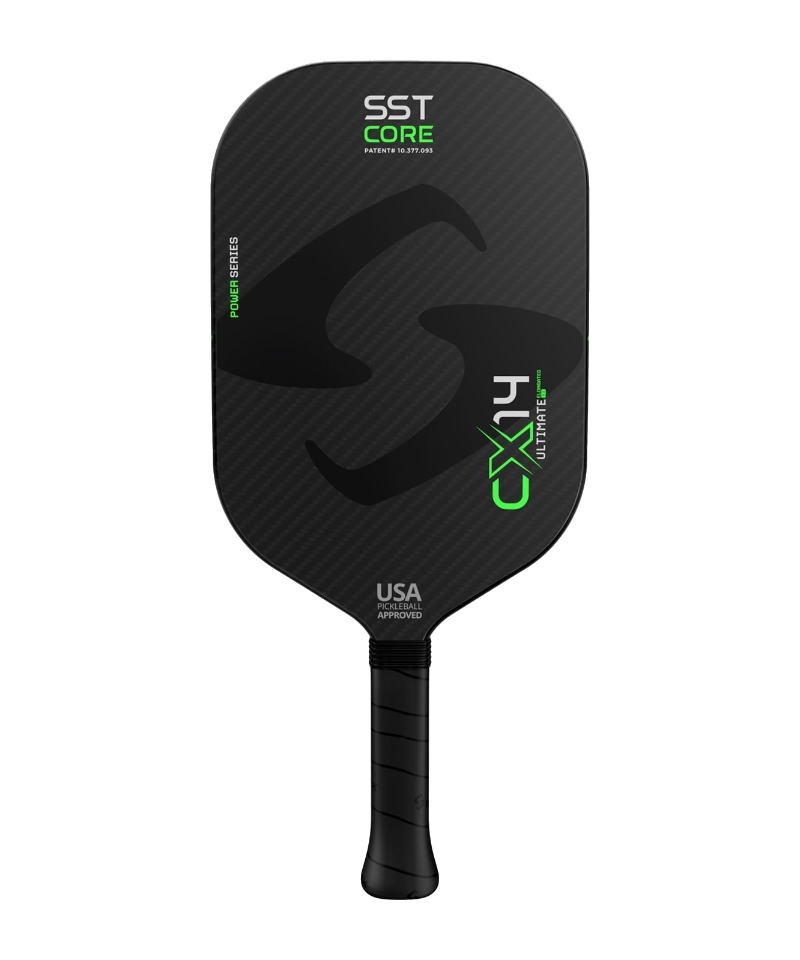
Gearbox is the one brand in this category doing something genuinely different, and understanding it explains both why people love the paddles and why others bounce off them hard.
Almost every pickleball paddle is built the same way: a polypropylene honeycomb core with a face bonded to each side, wrapped in a separate edge guard. Gearbox builds a unibody — the frame is a single continuous carbon structure with a dense solid core rather than a honeycomb, and there is no separate edge guard glued around the rim.
Two consequences follow. First, durability: there is no face-to-core bond to fail, which is the mechanism behind almost every delamination case in the sport, and no edge guard to peel off. Second, feel: a solid core does not trampoline the way a honeycomb does, so the response is muted and firm rather than springy. Players describe it as connected and precise, or as dead and unrewarding — and both descriptions are of the same paddle. Our guide to paddle core types covers how this compares to honeycomb, thermoformed and foam constructions.
Gearbox CX14 vs CX11: the number is the core thickness
The naming is refreshingly literal. CX14 is a 14mm core, CX11 is 11mm — and in a solid-core paddle that difference matters more than it would in a honeycomb frame, because there is no air pocket absorbing the difference.
The CX11 is the thinner, firmer, more direct option: less dwell, faster ball off the face, and noticeably less forgiving when you miss the middle. The CX14 adds enough material to widen the usable area and soften the impact, which is why it is the version most players should start with. Neither behaves like a 14mm or 16mm honeycomb paddle, so do not carry over assumptions from other brands — our guide to core thickness explains the standard relationship, and Gearbox is the exception to it.
Gearbox Pro Power vs Pro Control

| Pro Power | Pro Control | |
|---|---|---|
| Intent | Drives, put-aways, aggressive baseline play | Resets, dinks, kitchen-line exchanges |
| Feel | Firmer and more direct off the face | Longer dwell, more absorption |
| Shape options | Elongated and standard | Elongated and standard |
| Suits | Singles players and tennis converts with grooved strokes | Doubles players who live at the net |
| Watch out for | Punishes off-centre contact | May feel underpowered if you expect pop |
Both share the unibody build, so the durability advantage applies either way — the choice is purely about how you want the ball to leave the face. For where each sits against rivals, see our control paddle roundup.
FAQs
Are Gearbox paddles good for tennis elbow?
Opinion genuinely splits here, and it is worth understanding why rather than taking a single answer. The solid core transmits less vibration than a hollow honeycomb, which some players with arm sensitivity find noticeably more comfortable. But Gearbox frames are also stiff, and stiffness sends more shock into the arm on off-centre contact — so a player who mishits often may find them worse rather than better.
The practical guidance: if your contact is clean and you want less buzz, Gearbox is worth trying. If your elbow flares because you are catching the ball off the edge, a softer, more forgiving frame will serve you better. Our arm-friendly paddle guide covers the full set of factors, and paddle weight matters at least as much as construction.
How long is the handle on a Gearbox paddle?
Longer than most, and it is one of the main reasons people buy the brand. Gearbox handles typically run around 5.5″ and longer on the elongated frames, which suits two-handed backhands and players with larger hands who find standard handles cramped.
The trade-off is the usual one: handle length comes out of face length, so a longer handle means a slightly smaller hitting surface. If you play a two-handed backhand or your hand runs off the end of a standard grip, that is a trade worth making — our guide to paddles for large hands covers the other options, and grip sizing explains how to measure properly before you buy.
Is a Gearbox pickleball paddle worth the premium price?
If a “dead” polymer core is the specific problem you’re trying to solve, yes — the carbon-tube SST core is a genuinely different construction, not a marketing repackaging, and independent reviewer coverage backs the durability claim. If you’re simply looking for the cheapest control or power paddle, there are less expensive options that don’t require you to pay for that core material.
How long does a Gearbox pickleball paddle actually last?
We didn’t find an independent, independently lab-tested longevity study (a controlled before/after test across a full season), so we can’t publish a hard number. What we can report is that reviewer coverage described both the CX14 and GX2 holding their performance over extended use rather than softening — a reviewer-observed pattern, not a formal durability rating.
CX14 or GX2 — which Gearbox pickleball paddle should I buy?
The CX14 ($175–$200) is the control-first choice, with strong forgiveness on mishits at a lower price. The GX2 ($279.99) is the power upgrade, with a thicker 16mm core and the highest independently measured spin number in this review. Players prioritizing touch and budget should lean CX14; players who want the highest ceiling on spin and power, and can accept a heavier swing weight, should lean GX2.
Bottom Line
Gearbox is one of the few brands in this category building around a fundamentally different core material, and independent testing broadly backs the durability and spin claims that come with it — the GX2’s ~2,050 RPM spin number in particular holds up against the field’s best. The trade-offs are real too: premium pricing, heavier swing weights, and edges that need protecting. For where Gearbox sits against the wider field, see our Best Pickleball Paddles 2026 roundup.
Sources: Pickleball Effect — Gearbox CX14 Review; Pickleball Effect — Gearbox GX2 Power Series Review; Gearbox Sports — CX14 Collection.
Reference: USA Pickleball — official rules, equipment standards, and the approved-paddle list.

Isacc Shah
Isacc Shah writes PaddleTestLab. He does not test paddles in a lab and says so plainly — there is no rig, no radar gun, no staff hitting balls. Instead he aggregates independent bench measurements, manufacturer specifications, USA Pickleball's approval database and hundreds of verified owner reviews per product, then reports where those sources disagree. Every score on the site carries its evidence count. Where a specification is not published, the site writes UNKNOWN rather than estimating it, and the criticism is printed next to the praise.