
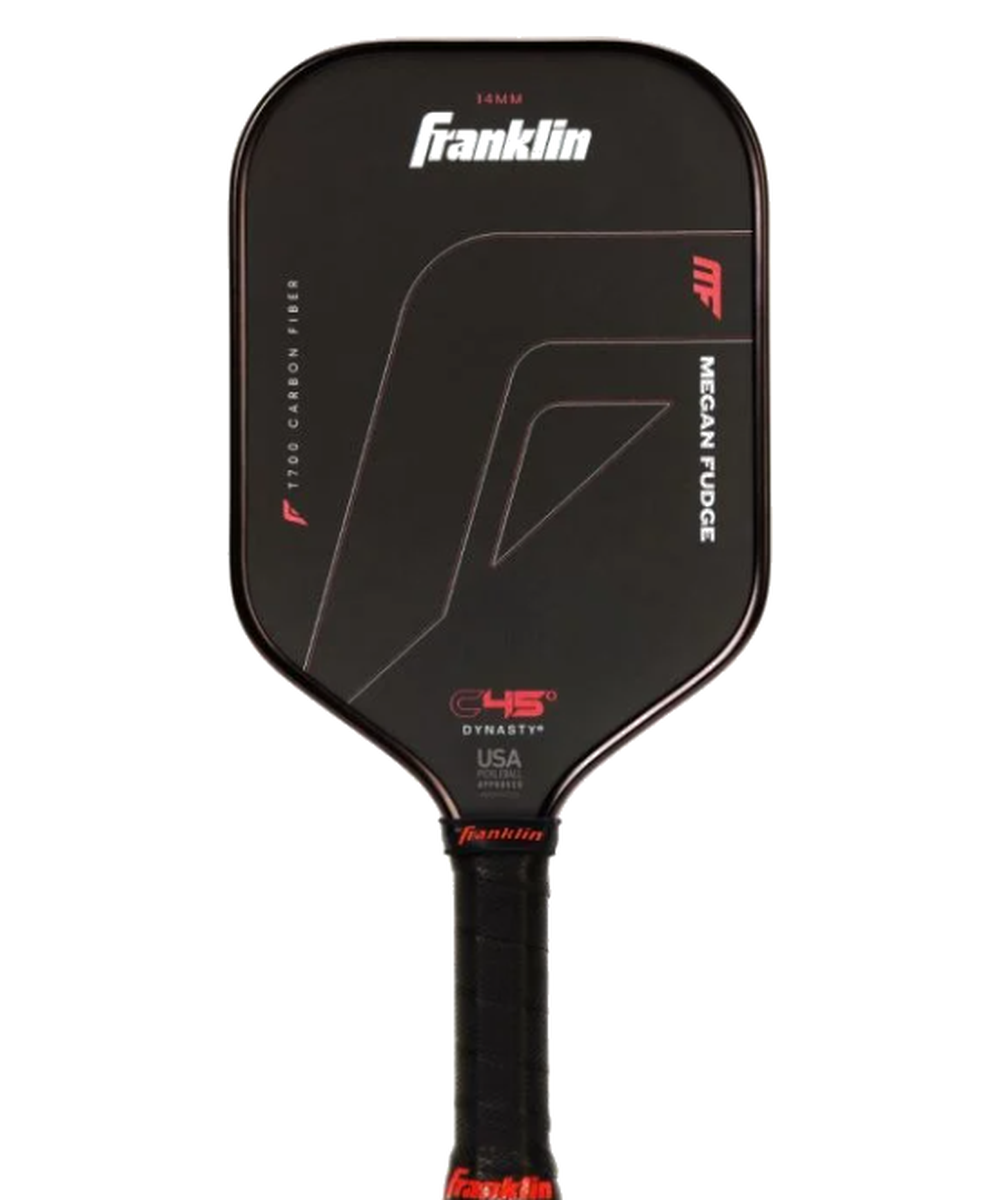
Franklin Sports built its name on backyard toy-aisle gear, and for years that reputation made serious players skip right past its pickleball paddles. That has changed. Franklin is now the official ball partner of USA Pickleball, and its paddle lineup has grown from beginner fiberglass sets into a full stack that tops out at $229.99 with pro-signature carbon models. This Franklin pickleball paddle review pulls together what independent reviewers and owners have actually measured and reported, and holds Franklin to the same standard as every other brand we cover: no invented numbers, no pretending a spec is “tested” when nobody credible has published it.
Check the official source.
Who Franklin Is, and an Honest Read on Its Positioning
Franklin’s advantage is distribution, not paddle heritage. It sells through Walmart, Dick’s Sporting Goods, and nearly every mainstream retailer, which means it reaches players who would never seek out a boutique carbon-fiber brand. That mainstream reach is real and valuable — but it also means Franklin’s lineup spans an unusually wide quality range, from $29.99 wood paddles to a $229.99 pro-endorsed carbon line, and a review of “Franklin” has to be honest about which tier it’s talking about at any given moment.
The Franklin Pickleball Paddle Lineup for 2026
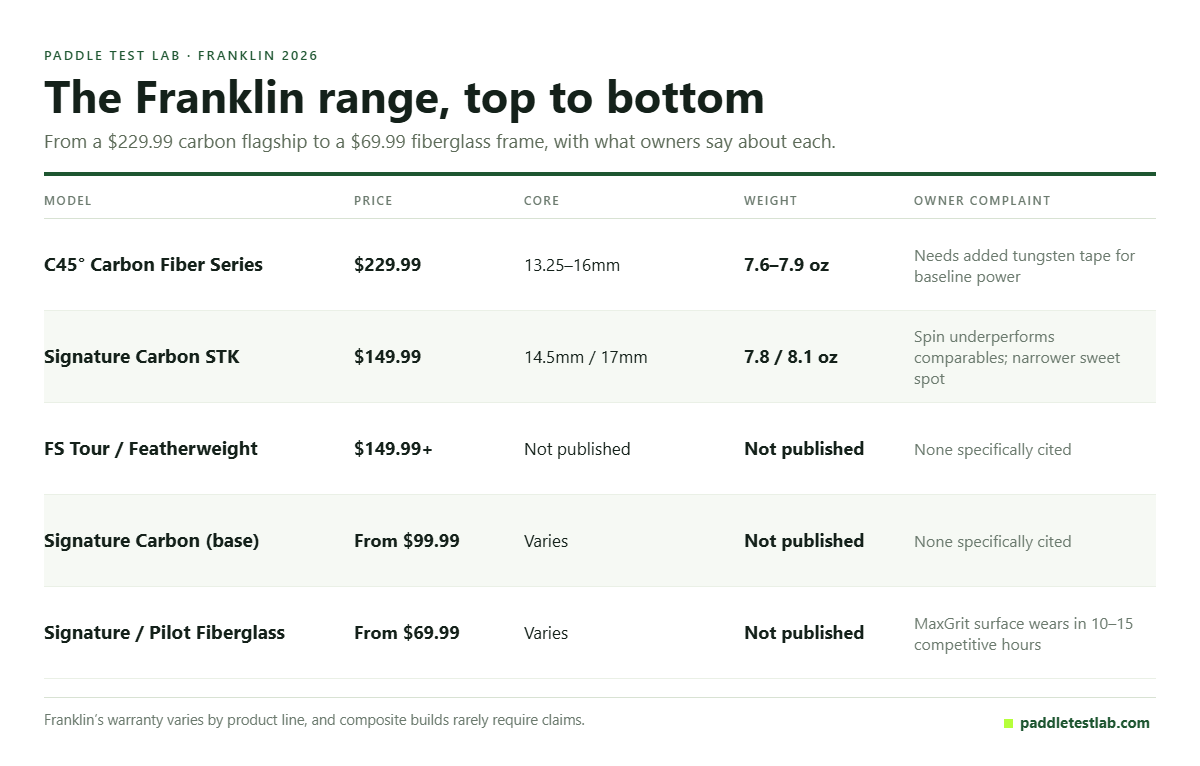
This Franklin pickleball paddle lineup splits into three clear tiers for 2026.
Compare how the franklin pickleball paddle rank by price, weight, and verified owner ratings before you decide. For most players the franklin pickleball paddle decision comes down to feel, price and durability – and this guide weighs all three from verified owner data.Premium: C45° Carbon Fiber Series ($229.99)
This is Franklin’s flagship line, including player-signature editions (Anna Leigh Waters, Parris Todd, Megan Fudge) and the Hayden elongated model. The C45 uses a Toray T700 carbon face over a PowerFlex polypropylene honeycomb core with a dual foam perimeter, in 13.25mm to 16mm thickness options depending on the specific model. Independent measurement from The Kitchen Pickle put a 14mm C45 at 7.6–7.9 oz with a notably low 104 swing weight — light and quick-handed by design, not a baseline power paddle.
Mid-Range: Signature Carbon & FS Tour ($99.99–$149.99)
The Signature Carbon Series starts at $99.99, and the FS Tour Featherweight and FS Tour lines start at $149.99. The Franklin Signature Carbon STK, independently reviewed by Pickleball Effect, weighed 7.8 oz (14.5mm core) or 8.1 oz (17mm core) at $149.99, with a nitro-infused carbon fiber face and an extended 5.6″ handle built for two-handed backhands.
Value: Fiberglass & Youth Lines ($29.99–$79.99)
The Signature Series Fiberglass and Pilot Series (both with a textured “MaxGrit” face) start at $69.99, alongside youth and wood paddles from $29.99. These are the paddles most likely to show up in a Walmart starter set, not a competitive bag.
| Line | Price | Core Thickness | Measured Weight |
|---|---|---|---|
| C45° Carbon Fiber Series | $229.99 | 13.25–16mm | 7.6–7.9 oz |
| Signature Carbon STK | $149.99 | 14.5mm / 17mm | 7.8 oz / 8.1 oz |
| FS Tour / FS Tour Featherweight | $149.99+ | Not independently published | Not independently published |
| Signature Carbon (base) | From $99.99 | Varies by model | Not independently published |
| Signature / Pilot Fiberglass (MaxGrit) | From $69.99 | Varies by model | Not independently published |
Owner Sentiment and Durability — What Reviews Actually Say
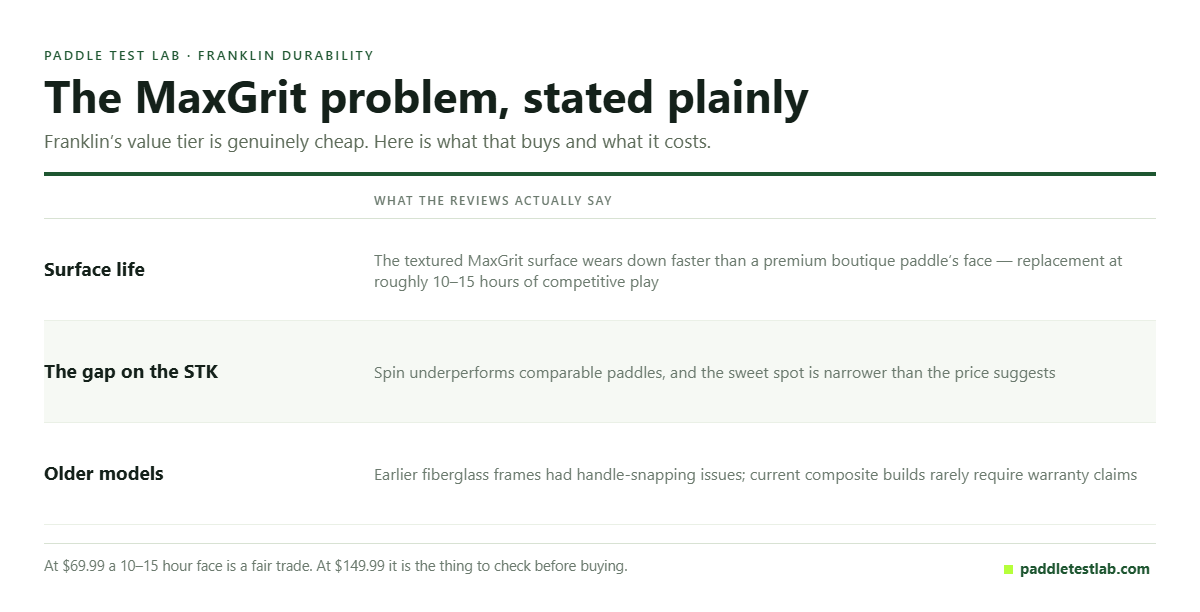
The most consistent theme across Franklin pickleball paddle owner and reviewer feedback is that Franklin’s textured “MaxGrit” surface — used across its fiberglass and older Signature carbon models — wears down faster than a premium boutique paddle’s face. Reporting from The Pickleball Gang put the window at roughly 10–15 hours of competitive play, or about 2–4 weeks of heavy use (3+ sessions a week), before the texture smooths out and spin potential drops, even though the paddle itself stays structurally sound. That same reporting also flagged that older, non-unibody Signature models had a history of handle-snapping issues, which Franklin’s newer C45 unibody construction was built to address.
Temperature sensitivity came up too: cold weather below 50°F was reported to make the polypropylene core feel brittle, and sustained heat can soften the epoxy bonds over time. None of this is unique to Franklin — polypropylene-core paddles from many brands share some version of these traits — but it’s a fair trade-off to know about before buying a paddle largely on price.
Claimed vs. Measured: A Real Gap on the STK

This is where our methodology usually earns its keep, and on the Signature Carbon STK it finds a real shortfall. Pickleball Effect’s independent testing measured the STK’s spin at roughly 1,250–1,300 RPM, against 1,500+ RPM from other raw-carbon paddles in a similar price bracket — a meaningful gap for a paddle marketed on pro-level technology. The same review also found the sweet spot narrower than expected and power output lagging for its 14.5mm thickness, and noted Pickleball Effect chose not to stock the model. That’s a specific, sourced finding, not a vibe — and it’s the kind of gap our Paddle Honesty Index exists to surface.
The C45, by contrast, earned more consistently positive marks in the reviews we found — praised for net-play “pop,” low swing weight, and vibration dampening, with the honest caveat that it needs added weight (via tungsten tape) to hold up on baseline drives and serves.
Who Should (and Shouldn’t) Buy Franklin
Consider Franklin if you:
- Want a widely available paddle you can buy at a big-box store without hunting a specialty retailer.
- Play primarily at the kitchen line and value a light, quick-handed paddle (the C45 in particular).
- Are buying a first paddle or a starter set and don’t want to commit $200+ before you know if you’ll stick with the sport.
- Want a paddle backed by a brand with an official USA Pickleball ball partnership and mainstream tournament sponsorships.
Look elsewhere if you:
- Want top-tier spin numbers at the $150 price point — independent testing found the STK meaningfully behind comparable raw-carbon paddles.
- Play 3+ times a week and want a textured face that holds its grip for a full season without fading.
- Need strong baseline power out of the box without adding weight yourself.
Bottom Line
This Franklin pickleball paddle lineup’s real strength in 2026 is accessibility, not lab-leading performance: its paddles are everywhere, its pricing spans every budget, and the C45 in particular is a genuinely well-regarded control paddle for net play. Its mid-tier Signature Carbon STK is the one model where independent testing found a real gap between price and performance. For how Franklin stacks up against the wider field, see our Best Pickleball Paddles 2026 roundup, and if budget is the deciding factor, our Best Pickleball Paddles Under $100 guide covers this exact price range.
Sources: Franklin Sports — official paddle lineup; The Kitchen Pickle — Franklin C45 Review; Pickleball Effect — Signature Carbon STK Review; The Pickleball Gang — Franklin Signature Durability; PR Newswire — Franklin/USA Pickleball partnership.
Reference: USA Pickleball — official rules, equipment standards, and the approved-paddle list.
Check our franklin pickleball paddle scorecard at the end for a side-by-side verdict. Whether you need the franklin pickleball paddle or a competing option, compare every spec before you commit.Franklin Model Comparison: C45, Signature and the Budget Range
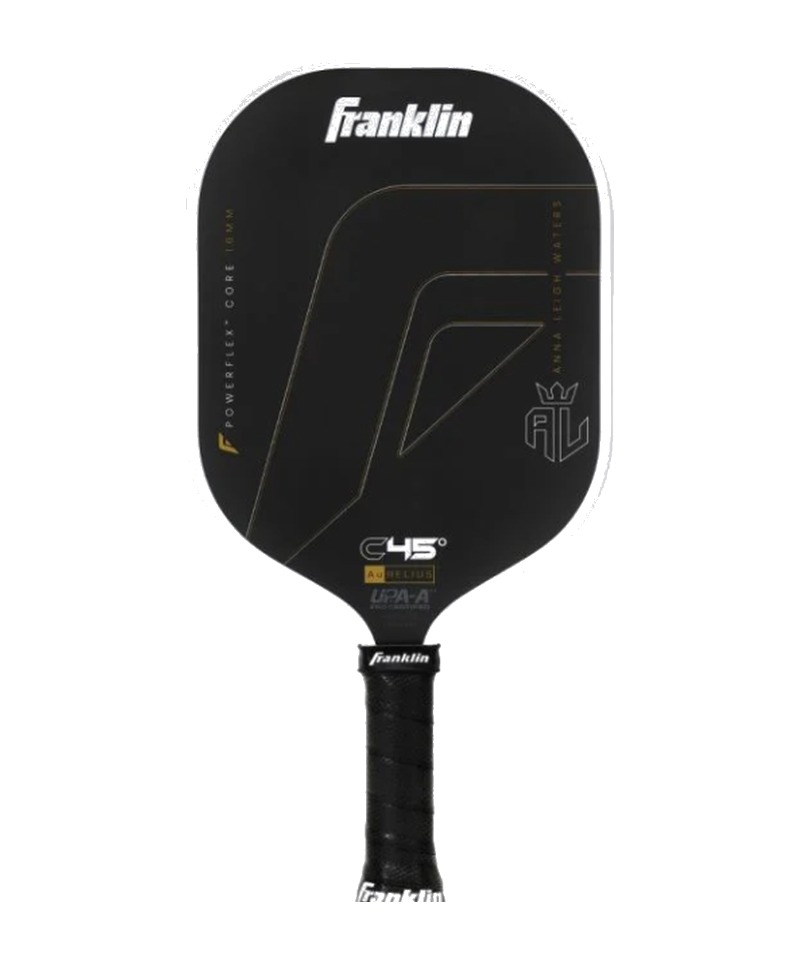
Franklin sits in a different part of the market to the direct-to-consumer brands, and comparing them on performance alone misses the point.
Franklin C45 vs Signature: what the money buys
The C45 is Franklin’s carbon-faced performance line and the closest the brand comes to competing with specialist paddle makers. The Signature range sits below it — composite or fiberglass faces, simpler cores, and prices that reflect it.
The gap is real and it is mostly surface. A carbon face grips the ball harder and holds its texture far longer than a painted composite one, which is the single biggest performance difference between the two lines. If you are choosing between them and spin matters to you at all, the C45 is the one worth having. If you are buying a paddle for occasional family play, the Signature range does the job and the extra money buys you nothing you will notice. Our guide to carbon fibre versus fiberglass faces covers exactly what changes, and the under-$100 roundup shows how the C45 compares to direct-to-consumer rivals at similar money.
Franklin pickleball paddles for beginners
Franklin is genuinely one of the better first-paddle choices, for a reason that has nothing to do with performance: availability. You can walk into a sporting goods store, hold three Franklin paddles, and buy one the same day. For someone who does not yet know whether they will still be playing in three months, that beats ordering a specialist paddle from overseas.
The trade-off is that you will outgrow it. Franklin’s entry paddles are built for accessibility rather than development, and once your soft game arrives you will want a thicker core and a carbon face. That is a normal upgrade path, not a mistake — our beginner paddle guide covers what to prioritise on a first paddle, and how to choose a paddle covers the specs to look at when you upgrade.
Franklin vs Onix: How the Two Mainstream Brands Compare
These are the two brands most likely to be side by side on a shop shelf, so the comparison comes up constantly.
| Franklin | Onix | |
|---|---|---|
| Retail presence | Very wide — most sporting goods stores | Wide, slightly more specialist |
| Best known for | The X-40 outdoor ball, official at many events | The Z5 composite paddle, a long-running bestseller |
| Entry range | Strong — genuinely usable starter paddles | Strong, with the Z5 as the default recommendation |
| Performance range | C45 carbon line | Evoke and Graphite lines |
| Where both fall short | Neither competes with specialist brands on spin or grit longevity at the same price |
The honest summary: both are good places to start and neither is where you finish. If you are buying at the lowest end, our under-$50 guide covers what is genuinely worth buying and what to walk past.
Frequently Asked Questions
Is Franklin a good pickleball brand?
For beginners and casual players, yes. Franklin is one of the largest names in the sport, makes the X-40 outdoor ball used at many sanctioned events, and its paddles are widely available and honestly priced. What it is not is a performance brand — a serious player comparing a Franklin against a specialist carbon paddle at the same price will find the specialist wins on spin and surface longevity. Buy Franklin for accessibility and value, not to compete. See where it sits against the field in our best pickleball paddles roundup.
Are Franklin paddles USA Pickleball approved?
Many are, but not all — Franklin’s range spans recreational sets through to tournament-legal frames, and the cheapest paddles in multi-packs are often not on the approved list because they were never submitted. That is fine for backyard play and a problem the first time you enter a sanctioned event. Check the specific model rather than assuming, using the method in our explainer on how USA Pickleball approval works.
How long does a Franklin paddle last?
Owner reports suggest the composite-faced models hold up well structurally — they are not prone to the delamination that affects thermoformed paddles — but the surface texture flattens faster than raw carbon, so spin drops off over a season of regular play. That is the expected trade-off at the price. If you notice a change in sound or feel, our guide to spotting paddle problems covers what to check.

Isacc Shah
Isacc Shah writes PaddleTestLab. He does not test paddles in a lab and says so plainly — there is no rig, no radar gun, no staff hitting balls. Instead he aggregates independent bench measurements, manufacturer specifications, USA Pickleball's approval database and hundreds of verified owner reviews per product, then reports where those sources disagree. Every score on the site carries its evidence count. Where a specification is not published, the site writes UNKNOWN rather than estimating it, and the criticism is printed next to the praise.