
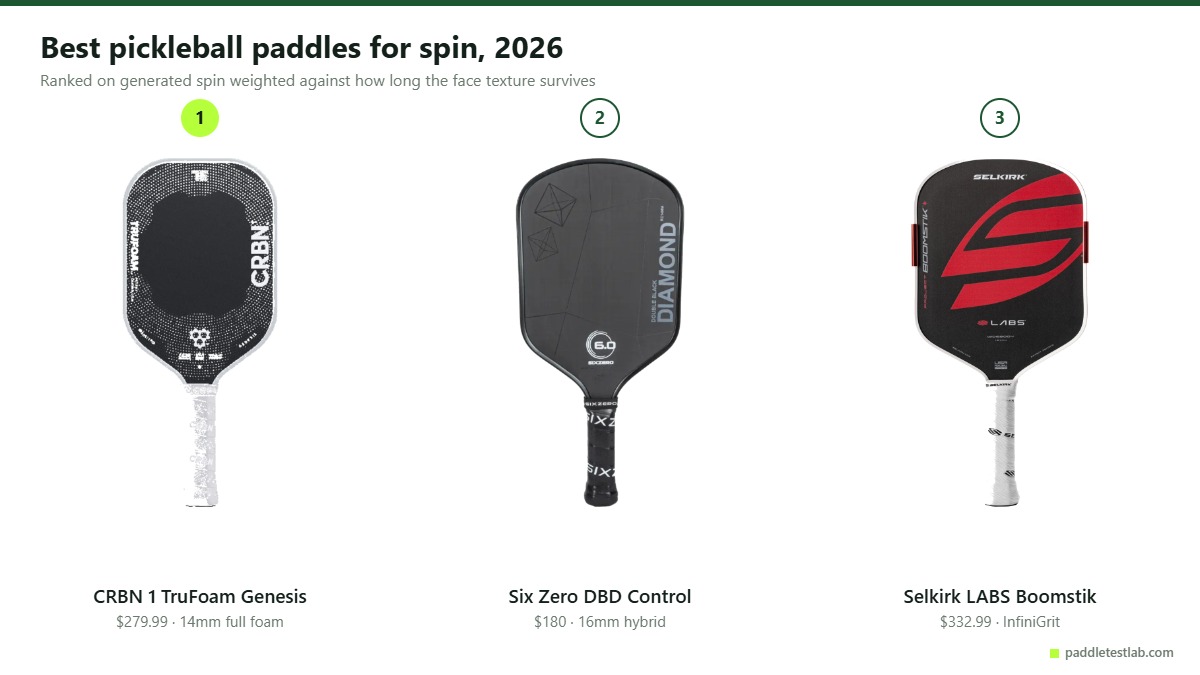
Short answer: the best pickleball paddles for spin in 2026 are the CRBN 1 TruFoam Genesis, the Six Zero Double Black Diamond Control and the Selkirk LABS Project Boomstik. The number that separates them is not how much spin they generate when new — it is how long the face keeps generating it.
Every paddle sold in 2026 claims spin. The face is raw carbon, the marketing copy says “aggressive grit,” and the product page quotes an RPM figure measured on a face that came out of the mould that morning. None of that tells you what the paddle will do in March after four months of league play.
That is the gap this ranking is built around. Below, paddles are judged on two things: how much spin the face generates when it is new, and how long it keeps generating it. Where a figure has been independently measured we say so and name the source. Where a brand quotes a number nobody has checked, we say that too.
How Pickleball Spin Is Actually Measured
Spin gets quoted in revolutions per minute, and the number comes out of a machine that fires a ball at a fixed paddle angle and speed, then films the return at high frame rate. The principle is sound. The problem is that no two testers use the same ball, the same impact speed, or the same paddle angle, so one lab’s 2,100 RPM and another’s 1,850 RPM can describe the same paddle behaving identically.
There are three things worth knowing before you read any spin number:
- The ball matters more than people expect. A fresh outdoor ball with sharp hole edges grips a rough face differently from a scuffed one. Testers who standardise on a new ball per run get higher, cleaner numbers than testers who do not.
- The number is measured on a virgin face. This is the single biggest problem with published spin data. A paddle is tested once, in week one, and that figure follows it around the internet for two years.
- Above a certain point, extra RPM stops mattering. The difference between 1,900 and 2,100 RPM is real on a machine and nearly invisible on a 3.5-level third-shot drop. The difference between 1,400 and 1,900 is not.
We cover the testing method and the current ceiling in more depth in our pickleball paddle spin RPM guide.
The Best Pickleball Paddles for Spin: 2026 Picks

Seven paddles, ranked on generated spin weighted against how long the texture survives. Prices are US street prices as of July 2026 and move constantly with discount codes.
1. CRBN 1 TruFoam Genesis — best spin overall

The TruFoam Genesis is a fully foam-cored paddle with a T700 raw carbon and fiberglass face, and the reason it tops a spin list is dwell time rather than surface roughness. The foam core lets the ball sit on the face fractionally longer, and a longer contact window is what actually converts a brushing swing into rotation. Reviewers consistently single it out for spin and for the feel that comes with it.
It is not a paddle without complaints. The swing weight sits around 118 to 120, which is high, and the series has the smallest sweet spot of CRBN’s current line. Several owners report the stock grip going slippery quickly, which on a spin paddle is not a trivial issue — you cannot brush the ball if the handle is moving in your hand. Budget for an overgrip on day one.
Price: $279.99 MSRP. Core: 14mm, 100% foam. Shape: elongated. Best for: 4.0+ players with a developed brushing stroke.
2. Six Zero Double Black Diamond Control 16mm — best spin under $200
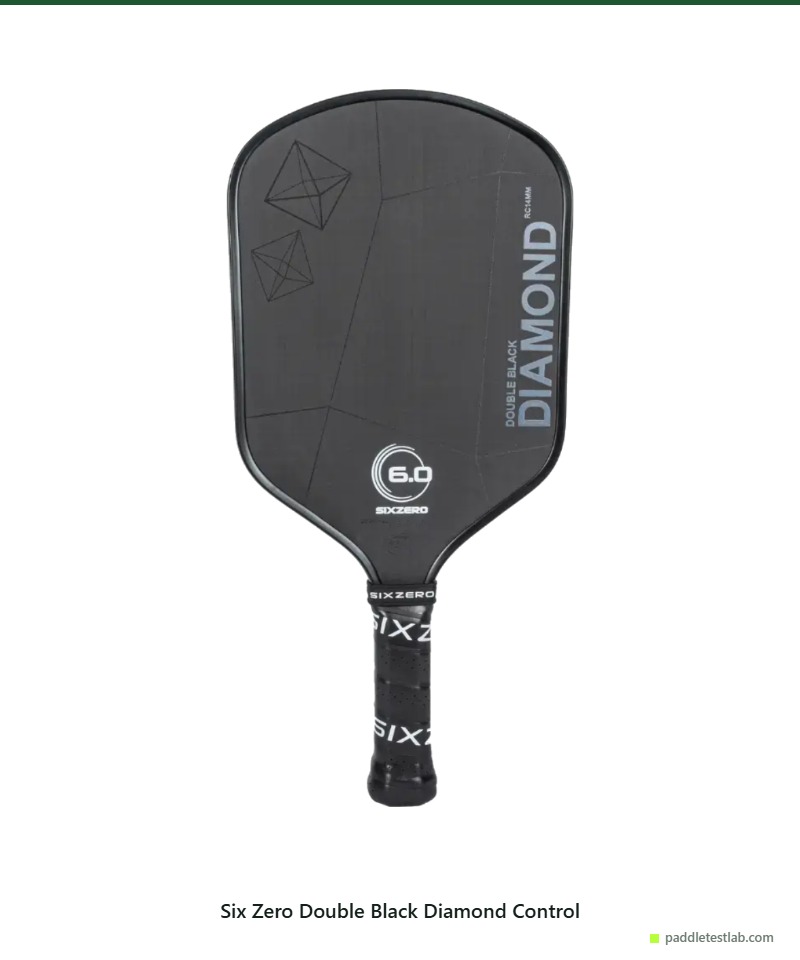
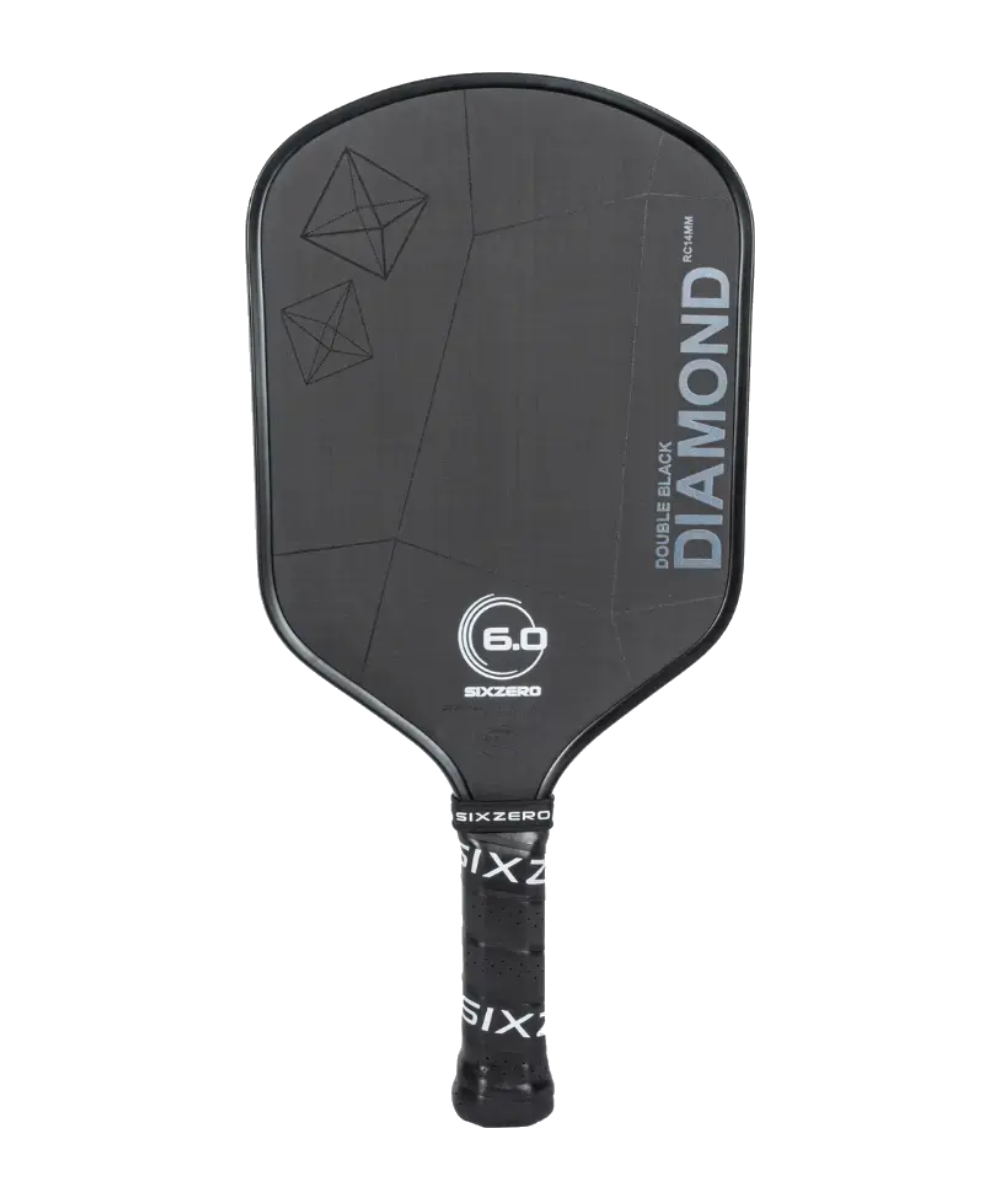
The DBD Control has the strongest topspin reputation of any paddle in the $150–200 band, and it is backed by volume of feedback rather than a single test: 4.6 out of 5 across 24 reviews at Pickleball Warehouse. The Toray 700K raw carbon face bites, the sweet spot is large, and the hybrid shape is more forgiving than the elongated paddles above it on this list.
The caveat is the one that runs through this whole category. Owners report the pop fading and the grit wearing inside six to eight weeks of regular play. Some also report the face scuffing balls badly enough to shorten ball life. If you play four times a week, treat this as a paddle you replace annually, and price it accordingly.
Price: $180. Core: 16mm (14mm also offered). Shape: hybrid. Best for: intermediate players who want spin without an elongated paddle’s penalty at the kitchen.
3. Selkirk LABS Project Boomstik — best spin durability
Selkirk’s InfiniGrit surface exists specifically to answer the durability problem, and it is the one face on this list marketed on how long it lasts rather than how rough it starts. That claim is supported by a limited lifetime warranty, which is the strongest consumer protection any brand on this page offers — and a warranty is a measurable commitment in a way a spin number is not.
Two honest problems. It is expensive, sitting $50 to $100 above comparable paddles, and there are a lot of reports of loose or failing edge guards. The edge guard is covered by the warranty, but a paddle you have to send back is a paddle you are not playing with.
Price: $332.99 MSRP. Core: 16mm Multistrata T700 with InfiniGrit. Shape: elongated, widebody also available. Best for: players who have already worn out one spin paddle and do not want to do it again.
4. JOOLA Perseus Pro IV 16mm — most spin per dollar at the premium end
The Pro IV is the paddle most reviewers still recommend over JOOLA’s own current flagship, and its textured carbon face generates easy spin off a forgiving, large sweet spot. It is the most approachable paddle in the top four here — the spin is available without a technically perfect stroke.
The wear pattern is documented and worth planning around: grit and spin drop off after two to four months of heavy play. JOOLA also carries a core-crush history across its range, which is worth knowing before you buy any JOOLA paddle at this price. Our JOOLA brand review covers that history in full.
Price: $249.95 street ($279.99 MSRP). Core: 16mm, 14mm also offered. Shape: elongated. Best for: players who want spin and power in the same paddle.
5. Ronbus Quanta — best spin on a budget, with a condition
The Quanta line runs $119.99 at MSRP and closer to $99 with codes, uses a Gen-4 EPP foam core that does not suffer core crush, and comes in four shapes. On paper it is the budget spin paddle of the year.
The condition is real and every reviewer mentions it: the stock sweet spot is small, and the paddle needs 7.5 to 15 grams added at the 3 and 9 o’clock positions to perform the way the reviews describe. That is a genuine extra step, not a tweak — if you are not willing to add lead tape, buy something else. Our guide to adding weight to a pickleball paddle covers the placement.
Price: $119.99 MSRP, $99 with codes. Core: 16mm EPP foam. Shape: elongated, widebody or hybrid. Best for: tinkerers on a budget.
6. Vatic Pro Prism — the honest budget caveat
The Prism is the benchmark $99 carbon paddle and it is genuinely good out of the box: raw Toray T700 face, plush forgiving feel, every shape offered. It generates real spin when new.
It also carries the most damning durability figure on this page. One tester measured roughly a 50% spin loss after two months of play. That is not grit “softening” — that is half the paddle’s defining property gone in a season. If you buy a Prism for spin specifically, buy it knowing you are buying two months of it. As a control paddle for a beginner it remains excellent value, which is why it sits on our under-$100 list.
Price: $99.99. Core: 16mm, 14mm also offered. Shape: hybrid, elongated or widebody. Best for: a first carbon paddle, not a spin investment.
7. SLK Halo XL Control — the one to skip if spin is the goal
This is on the list as a deliberate counter-example, because it is frequently recommended to beginners as a carbon spin paddle and it is not one. Independent testing puts the Halo XL at roughly 1,400 to 1,450 RPM, which is low for a T700 carbon face and noticeably below everything above it here.
It is a perfectly good control paddle at $99 street with Selkirk’s build quality behind it. It is just not a spin paddle, and the raw carbon face on the spec sheet does not make it one. The lesson generalises: “raw carbon” tells you what the face is made of, not how rough it was finished.
Price: $99.99 street (~$139.99 MSRP). Core: 16mm T700 Rev-Core. Shape: elongated. Best for: control, not spin.
Spin Durability: The Number Nobody Puts on the Box

Collect the durability reports from the seven paddles above and a pattern appears that no brand publishes:
- Two months — Vatic Pro Prism, roughly 50% measured spin loss.
- Six to eight weeks — Six Zero DBD Control, owner reports of grit wear and fading pop.
- Two to four months — JOOLA Perseus Pro IV, grit and spin drop under heavy play.
- Warranted for life — Selkirk InfiniGrit, the only surface with a durability commitment attached.
Three of the four highest-spin faces on this page lose a meaningful share of their bite inside a season. That is not a defect in any one paddle; it is what raw, peel-ply-textured carbon does. The grit is a surface treatment, and surface treatments abrade.
Two practical consequences. First, if you play more than three times a week, the real cost of a spin paddle is its price divided by about a year, not by three years. Second, a cheap paddle that loses its grit in two months and an expensive one that loses it in four are closer in value than the sticker prices suggest — and a warranted surface changes that calculation entirely.
What the UPA-A Spin-Rate Limit Changed
Regulators caught up with surface roughness, and paddles now have to pass a spin-rate test to be approved for sanctioned play. The practical effect is a ceiling: the arms race that ran from 2022 to 2024, where each generation of face was rougher than the last, has stopped at the top end.
For a recreational player this matters less than it sounds. Every paddle on this list is approved, and the ceiling sits well above what most players can exploit. Where it does matter is second-hand: a pre-rule paddle bought used may not be legal in a sanctioned tournament even though it feels wonderful in a rec game. We cover approval status and how to check a specific model in our guide to USA Pickleball approved paddles.
How Much Spin Comes From the Paddle, and How Much From You
Honest answer: less of it is the paddle than the marketing implies.
Spin is produced by the ball travelling across the face, and that happens because of swing path — low to high, brushing up the back of the ball — not because of the face material. A rough face converts a good brushing stroke into more rotation. It does not create rotation from a flat stroke.
This has a specific buying implication. If your topspin drive currently sits in the net, a rougher paddle will put it in the net with more spin on it. The paddle upgrades that actually change outcomes for players below 4.0 are usually about sweet spot size and swing weight, not surface texture — which is why our paddle buying guide puts those two variables first.
How to Actually Generate Topspin
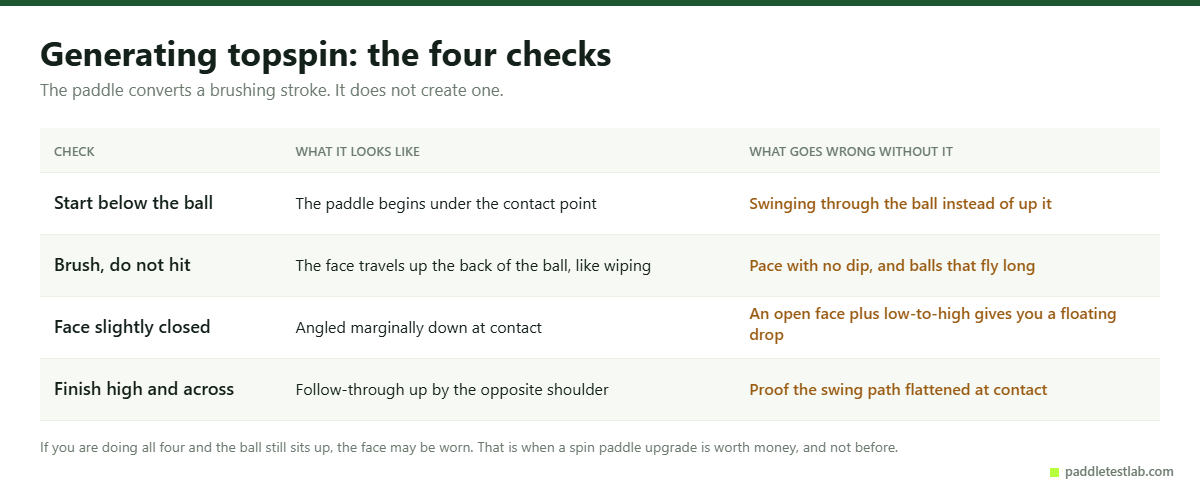
A rough face converts a brushing stroke into rotation. It does not create rotation from a flat one. Four things produce the stroke.
Start below the ball. Topspin comes from a low-to-high swing path, which means the paddle has to begin below the contact point. Players who cannot generate spin are almost always starting level with the ball and swinging through it rather than up the back of it.
Brush, do not hit. The paddle face travels up the back of the ball rather than into it. The sensation is closer to wiping than striking. You will lose some pace doing this, and gain a ball that dips.
Keep the face slightly closed. A face angled marginally downwards at contact keeps a topspin drive from flying long. An open face plus a low-to-high swing produces a floating ball with backspin, which is a drop, not a drive.
Finish high and across. The follow-through finishing up by the opposite shoulder is not decoration; it is evidence that the swing path was low to high all the way through contact rather than only at the start.
Then check the paddle. If you are doing all four and the ball still sits up, the face may be worn. That is the point at which a spin paddle upgrade is worth money — not before. If your topspin drive currently sits in the net, a rougher paddle will put it in the net with more spin on it. The upgrades that actually change outcomes below 4.0 are sweet spot size and swing weight, which is why our buying guide puts those two first.
Cleaning and Caring for a Textured Face
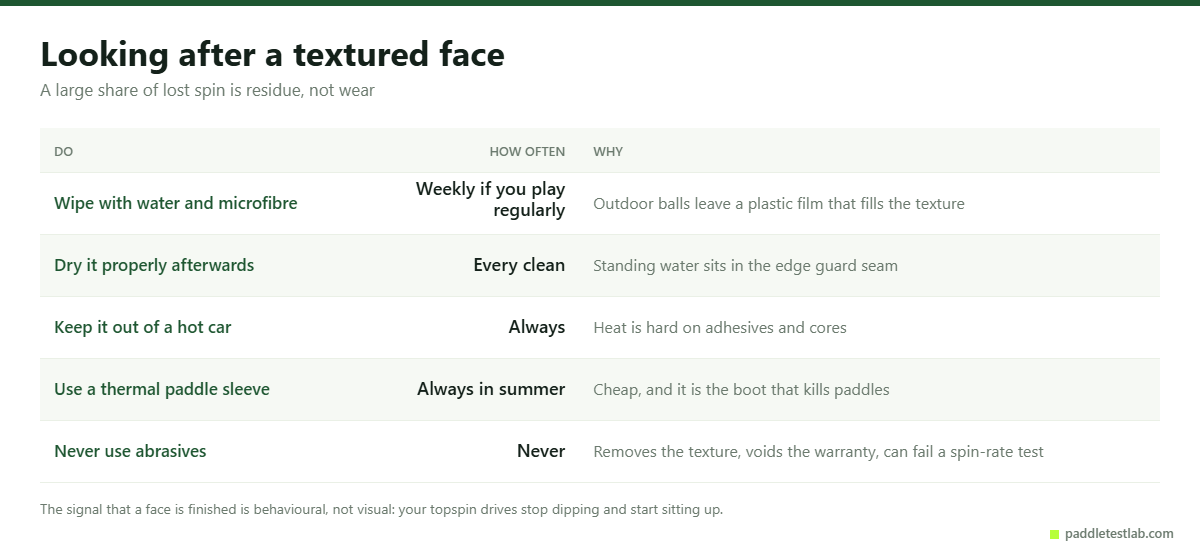
You cannot restore grit that has abraded away, but a large share of what feels like lost spin is ball residue rather than wear — and that comes off.
Clean the face weekly if you play regularly. Water and a microfibre cloth, wiped across the face, then dried. Outdoor balls leave a plastic film that fills the texture, and a clean face genuinely bites better than a dirty one. Do this before you decide your paddle is finished.
Never use abrasives. Sandpaper, scouring pads and abrasive cleaning blocks remove the textured layer itself. They will void any warranty, and a paddle roughened that way can fail a spin-rate test and be ineligible for sanctioned play. Our guide to approved paddles covers what the test checks.
Keep it out of a hot car. Heat is hard on adhesives and cores, and a boot in summer is one of the more reliable ways to shorten a paddle’s life. A thermal-lined paddle sleeve costs very little — see our paddle cover guide.
Know when it is actually done. The signal is behavioural, not visual: when your topspin drives stop dipping and start sitting up, the face has gone. At that point you are choosing a new paddle, and the durability column in the table above is the one to read.
Frequently Asked Questions
Can you restore grit on a worn carbon paddle?
Not meaningfully. Cleaning a face with water and a microfibre cloth removes ball residue and recovers some bite, and that is worth doing weekly. Abrasive pads and sandpaper remove the textured layer itself, will void any warranty, and can render a paddle non-compliant for sanctioned play.
Does a 14mm or 16mm core generate more spin?
Core thickness affects dwell time and control more than spin directly, and the effect is small next to face texture. A 16mm core generally offers a slightly longer contact window, which marginally helps. If you are choosing between thicknesses, choose on feel and control — our 14mm vs 16mm comparison lays out the trade-offs.
Is an elongated paddle better for spin?
It gives you more leverage and a longer swing arc, which helps generate racket-head speed, and racket-head speed does produce spin. The cost is a smaller sweet spot and slower hands at the kitchen. Four of the seven paddles here are elongated, which reflects a genuine tendency rather than a rule.
How often should a spin paddle be replaced?
Based on the durability reports above, plan on annually if you play three or more times a week, and every two years for casual play. Watch for the change rather than the calendar: when your topspin drives start sitting up instead of dipping, the face has gone.
Is a more expensive paddle always more spin?
No. The $99 Vatic Prism out-spins the $99 SLK Halo XL by a wide margin when both are new, and the $180 Six Zero DBD competes with paddles at twice the price. Price correlates with build quality, warranty and durability far more reliably than with initial spin.
Specifications and prices are checked against each brand’s own store — CRBN, Six Zero and Selkirk — and were current in July 2026.

Isacc Shah
Isacc Shah writes PaddleTestLab. He does not test paddles in a lab and says so plainly — there is no rig, no radar gun, no staff hitting balls. Instead he aggregates independent bench measurements, manufacturer specifications, USA Pickleball's approval database and hundreds of verified owner reviews per product, then reports where those sources disagree. Every score on the site carries its evidence count. Where a specification is not published, the site writes UNKNOWN rather than estimating it, and the criticism is printed next to the praise.