
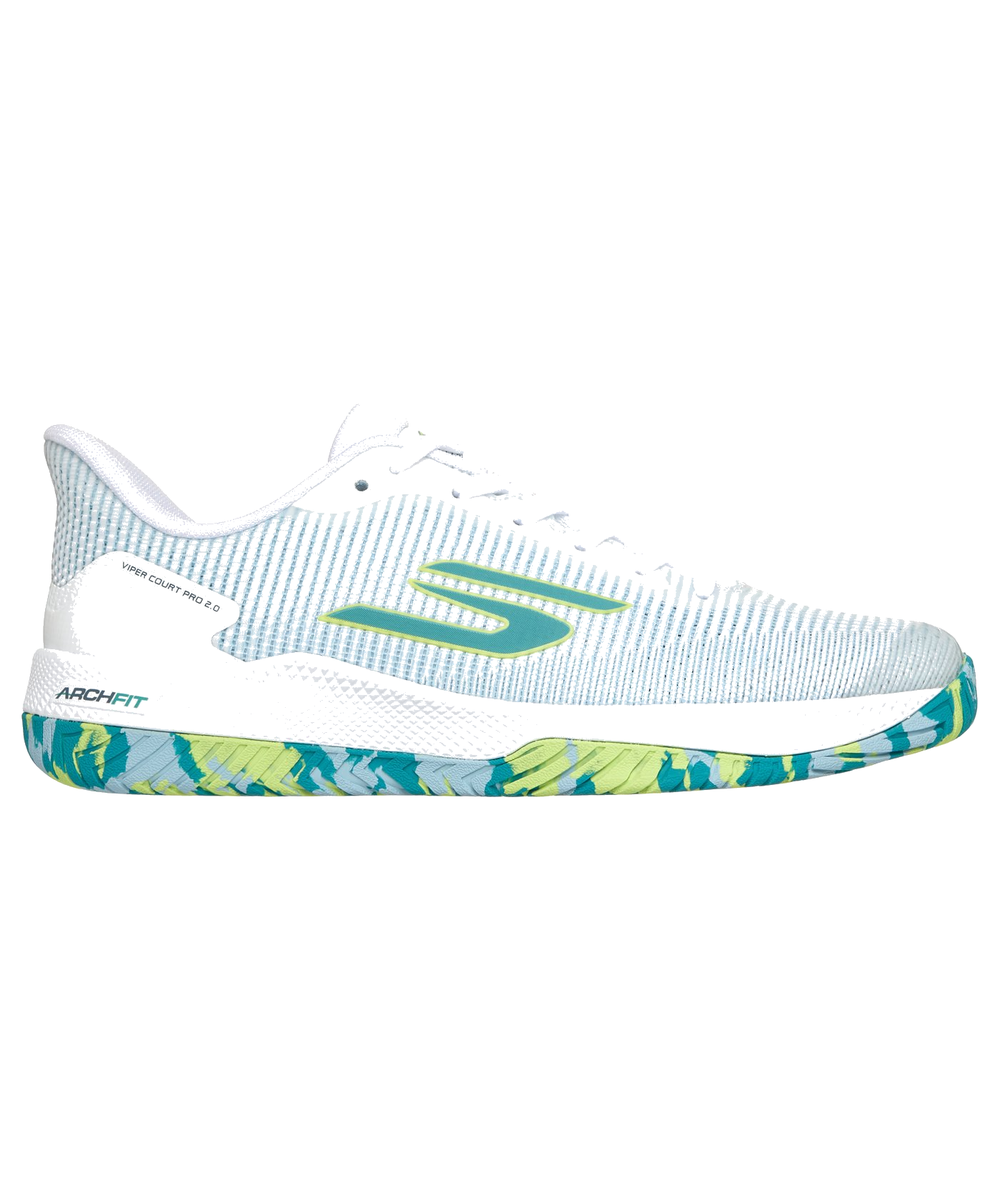
Skechers pickleball shoes have quietly become one of the more debated categories in court footwear. They’re not the first brand players think of, but the Viper Court lineup has built a real following among owners who care more about comfort and width options than chasing every ounce of stability a $160 shoe promises. This review pulls from verified owner reviews and published specs to figure out where Skechers pickleball shoes actually earn their price tag, and where they fall short.
See our related buying guide. Check the official source.
What Skechers Offers in Pickleball Footwear
Court shoe lineup overview
Skechers splits its pickleball offering into four tiers. The Viper Court Pro 2.0 is the current flagship, positioned as the all-around performance shoe. Above it sits the Viper Court Elite family (Elite, Elite 2.0, VC Elite Control), aimed at lighter, faster players. Below the Pro 2.0 is the Slip-ins Relaxed Fit: Viper Court Reload, built for comfort and hands-free entry. At the bottom is the budget-tier Relaxed Fit: Viper Court Smash, which is currently showing up in closeout listings.
Where these shoes fit in the market
Compared to ASICS, Babolat, K-Swiss, and SQAIRZ, Skechers pickleball shoes tend to undercut on price while leaning hard into comfort features — Arch Fit insoles, wide and extra-wide sizing, and slip-in designs. Owners consistently frame Skechers as the comfort-and-value option rather than the performance-first choice: a shoe you reach for when all-day wearability and a roomy toe box matter more than the last few percent of lockdown a dedicated tournament shoe delivers.
Compare how the skechers pickleball shoes rank by price, weight, and verified owner ratings before you decide. For most players the skechers pickleball shoes decision comes down to feel, price and durability – and this guide weighs all three from verified owner data.
Specs at a Glance
Street prices move around, so treat these as approximate ranges rather than fixed figures. Where Skechers does not publish a spec, we mark it UNKNOWN rather than guess.
| Model | Tier | Approx. street price | Width options | Best for |
|---|---|---|---|---|
| Viper Court Pro 2.0 | Flagship | $120–$130 | Standard, Wide | All-around play |
| Viper Court Elite / Elite 2.0 | Performance | $140–$155 | Standard | Faster, lighter players |
| Viper Court Reload (Slip-ins) | Comfort | $85–$95 | Standard, Wide | Comfort & easy entry |
| Viper Court Smash | Budget | $55–$70 | Standard, Wide | Casual / occasional play |
Published weights across the line sit in the mid-range for court shoes, but Skechers does not list a consistent measured weight for every SKU, so exact per-model figures are UNKNOWN without independent scale testing.
Manufacturer Claims vs Owner Evidence
Comfort and cushioning
Skechers leans hard on its Arch Fit contoured insole and lightweight midsole cushioning. This is the one claim owners back almost unanimously: comfort straight out of the box is the single most repeated positive across reviews, with many players noting little to no break-in period. For anyone coming from stiff, tennis-derived court shoes, the difference in day-one comfort is the headline reason they switched.
Traction and outsole
Skechers markets a durable rubber court outsole with a herringbone-style pattern for multidirectional grip. Owner reports are mixed-positive: grip on clean indoor courts and dry outdoor surfaces is rated well, but a minority report the outsole wearing faster on rough outdoor concrete than premium tennis-lineage shoes hold up.
Stability and lateral support
This is where the claim and the owner evidence diverge most. Skechers positions the Viper Court line as genuinely court-ready, yet competitive 4.0+ players repeatedly note that the same plush, wide platform that makes the shoe so comfortable also allows more foot roll during hard lateral cuts. It is a real trade-off, not a defect: comfort and a roomy fit come at some cost to the locked-down feel aggressive players want.
Durability
Owners generally report solid upper durability, with variable outsole life depending on surface. Independent lab abrasion data is UNKNOWN, so durability here reflects owner sentiment rather than measured wear testing.
What Owners Praise
- Out-of-the-box comfort and minimal break-in — the most-cited positive by far.
- Genuine wide and extra-wide availability, a gap most court-shoe brands ignore.
- Strong value: comfort-focused features at prices well under premium court shoes.
- Slip-in convenience on the Reload for players who want hands-free entry.
- True-to-size fit for most owners, with the roomy toe box a recurring favourite.
What Owners Criticize
- Lateral stability under aggressive, quick-cut play — the top complaint from higher-level players.
- Outsole wear on rough outdoor concrete for some owners.
- Less lockdown for narrow feet, since the fit is tuned toward roomier sizing.
- Some find them bulkier or heavier-feeling than sleek tennis-style court shoes.
Who These Shoes Are Best For
Skechers pickleball shoes are an easy recommendation for recreational to roughly 3.5-level players, anyone with wide or extra-wide feet, and comfort-first players who value all-day wearability over maximum lockdown. If you play mostly for fun and fitness and want a shoe that feels good from the first game, this is one of the best value picks in the category.
Look elsewhere if you are a 4.0+ player who makes hard lateral cuts, if you have narrow feet needing maximum lockdown, or if you play primarily on rough outdoor concrete. In those cases, compare the options in our best pickleball shoes for men guide or our ASICS pickleball shoes review.
Final Verdict
At 7.6, Skechers pickleball shoes earn their place as the comfort-and-value choice rather than the performance-first one. For the player they fit — comfort-focused, wide-footed, recreational to intermediate — they are one of the simplest recommendations in the category. For the aggressive competitor chasing every degree of lateral stability, they are a compromise. See how we reach these scores on our review process page, and if you are still choosing gear, start with our best pickleball paddles guide.
Reference: USA Pickleball — official rules, equipment standards, and the approved-paddle list.

Isacc Shah
Isacc Shah writes PaddleTestLab. He does not test paddles in a lab and says so plainly — there is no rig, no radar gun, no staff hitting balls. Instead he aggregates independent bench measurements, manufacturer specifications, USA Pickleball's approval database and hundreds of verified owner reviews per product, then reports where those sources disagree. Every score on the site carries its evidence count. Where a specification is not published, the site writes UNKNOWN rather than estimating it, and the criticism is printed next to the praise.