
Looking for carbon fiber pickleball paddles? We ranked the field from verified owner reviews and independent data — no marketing fluff.
See our related buying guide. Check the official source.
For more detail on how the carbon fiber pickleball paddles compare, scroll to the scorecard at the end of this guide.
Why Carbon Fiber Face Material Matters
A carbon fiber pickleball paddle isn’t automatically better than a fiberglass one, no matter what the marketing copy says. The face material changes how a paddle feels, spins, and holds up over months of play, and owners across price tiers report very different experiences depending on which carbon layup and core they end up with. Before recommending specific models, it’s worth defining what “carbon fiber” actually buys you on court.
Carbon fiber vs fiberglass vs composite
Carbon fiber faces tend to be stiffer than fiberglass, which generally means a firmer, more controlled response and — according to owner feedback across multiple models in this guide — better spin potential when the surface texture is raw or gritty. Fiberglass faces flex more, which often produces more pop on soft shots but less bite on spin. Composite paddles blend materials to land somewhere in between. None of this is universal law; it’s a pattern that shows up again and again in verified owner reviews, and paddle-to-paddle variation (core, texture, weight) matters as much as the face material itself.
Compare how the carbon fiber pickleball paddles rank by price, weight, and verified owner ratings before you decide. For most players the carbon fiber pickleball paddles decision comes down to feel, price and durability – and this guide weighs all three from verified owner data.
How core thickness and weight affect feel
Most carbon fiber paddles in this guide use a 14mm or 16mm polymer honeycomb core. Thinner 14mm cores generally favor players chasing more pop and a louder, crisper sound; 16mm cores tend to dampen vibration and soften the feel on contact, which matters a lot to anyone managing elbow or wrist sensitivity. Paddle weight in this category mostly runs 7.6-8.3 oz, and even small differences here change swingweight and how head-heavy a paddle feels in a fast exchange. Owners rarely separate “core” from “weight” in their reviews — they talk about “feel,” and feel is really both of these specs working together.
How We Picked These Paddles
This guide doesn’t claim any on-court testing. We don’t have a lab, a radar gun, or a private stash of demo paddles we swung ourselves. What we do have is a lot of aggregated data.
Our data sources: owner reviews, USAP list, published specs
Every pick below is built from three sources: verified purchaser reviews collected across major retailers, the current USA Pickleball approved paddle list, and manufacturer-published spec sheets for weight, core thickness, and face material. Where a paddle’s approval status or specs were unclear or conflicting across sources, we say so rather than guess.
What we do not do: no in-house testing claims
We don’t run our own demo days, and we’re not going to pretend we do. Instead, we look for recurring patterns — the same praise or the same complaint showing up across 8-10+ independent verified owner reviews per paddle — and we flag when a marketing claim (spin rate, “pro-level” durability) doesn’t match what owners actually report after weeks or months of use.
At-a-Glance: Best Carbon Fiber Paddles for 2026
Award summary table
| Award | Paddle | Price | Core/Weight |
|---|---|---|---|
| Best Overall | JOOLA Perseus Pro IV 16mm | $249.95 street | 16mm / 7.9-8.1 oz |
| Best Budget | Vatic Pro Prism | $99.99 | 16mm / 7.7-8.2 oz |
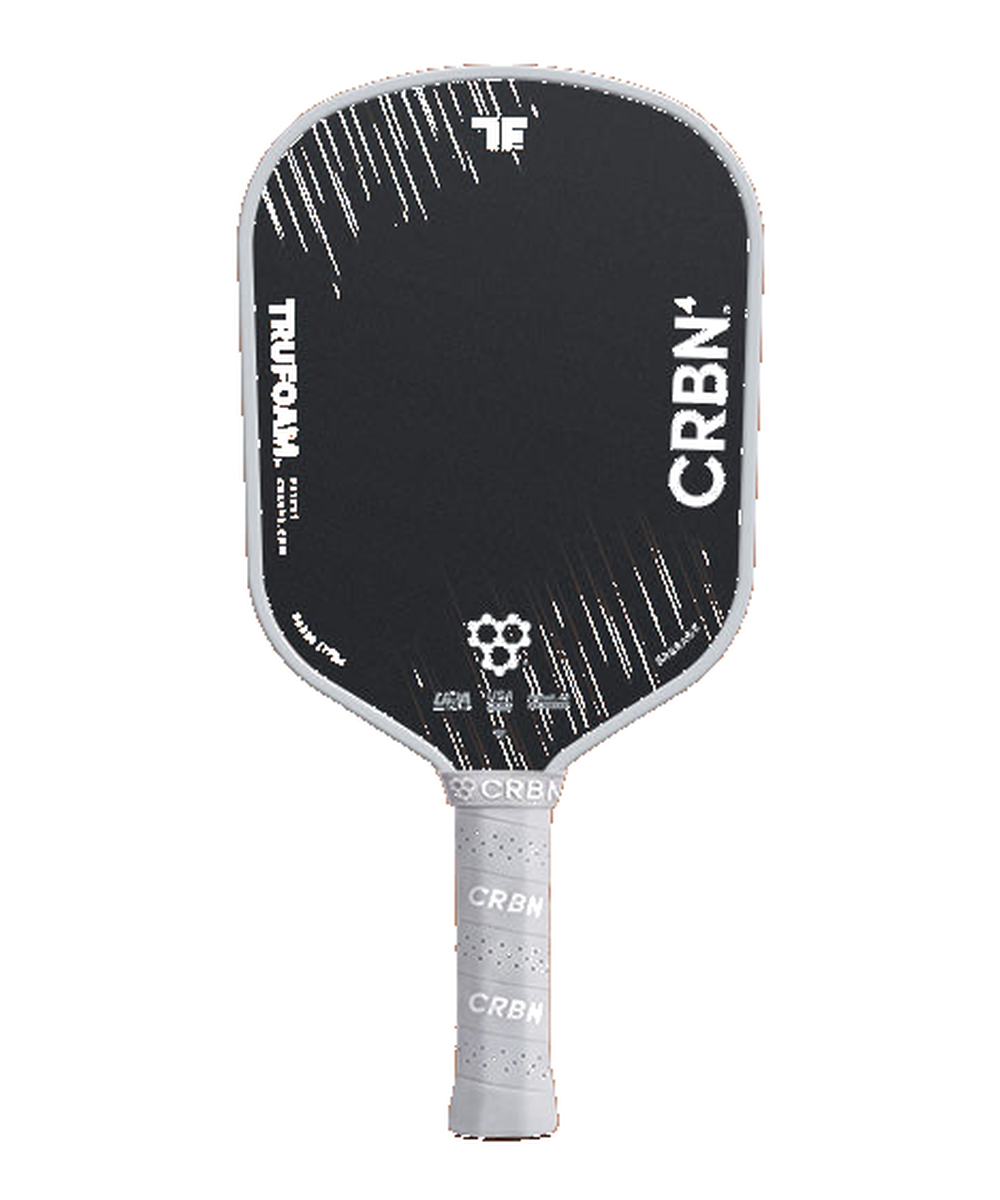
| Best for Spin | CRBN 1 TruFoam Genesis | $279.99 MSRP | 14mm / 7.8-8.1 oz |
| Best for Beginners | Selkirk SLK Halo XL Control | $99.99 street | 16mm / 7.6-8.2 oz |
| Best Arm-Friendly | Six Zero Coral 16mm | ~$199-200 MSRP | 16mm / 7.9-8.2 oz |
| Best Wide Body/Wide Feet | Vatic Pro Saga 16mm | $99.99 | 16mm / 8.03-8.32 oz |
Full Reviews by Award Category
Best Overall: JOOLA Perseus Pro IV 16mm
JOOLA released a Perseus Pro V flagship in early 2026, but the data still points to the Pro IV as the smarter buy. It’s textured carbon fiber, 16mm (a 14mm version exists too), 7.9-8.1 oz, and USAP approved under USAP+UPA-A. Owners consistently praise the easy power, forgiving sweet spot, and all-around feel. The recurring complaint: grit and spin noticeably fade after 2-4 months of heavy play, and JOOLA cores have a documented history of core-crush issues. It’s discounted from its $279.99 MSRP to around $249.95 street, largely because it’s been superseded on paper — reviewers, including pickleballstudio.com’s own comparison, still say buy the Pro IV over the pricier Pro V.
| Price | $249.95 street ($279.99 MSRP) |
| Weight | 7.9-8.1 oz |
| Core | 16mm (14mm also available) |
| Face | Textured carbon fiber |
| USAP | Yes (USAP+UPA-A) |
Best Budget: Vatic Pro Prism
At $99.99, the Vatic Pro Prism is treated by multiple review sources as the benchmark budget carbon fiber pickleball paddle. It uses a raw Toray T700 carbon face over a 16mm core (14mm variant also sold), weighs 7.7-8.2 oz depending on the specific model, and carries USAP approval. Owners describe a plush, forgiving feel that punches well above its price point, plus grip inserts marketed to cut down on shock. The catch: one tester measured roughly 50% spin loss after just two months, a criticism echoed in the surrounding owner chatter about grit wearing fast. It also runs slightly head-heavy.
| Price | $99.99 |
| Weight | 7.7-8.2 oz |
| Core | 16mm (14mm also) |
| Face | Raw Toray T700 carbon |
| USAP | Yes |
Best for Spin: CRBN 1 TruFoam Genesis (TFG1)
CRBN’s TruFoam Genesis line uses a genuinely 100% foam core (the Gen4 version), which owners repeatedly credit with eliminating core-crush concerns and delivering excellent dwell time and spin. It’s a 14mm core paired with a T700 raw carbon and fiberglass face, running 7.8-8.1 oz, USAP approved, priced at $279.99 MSRP. The tradeoffs owners flag: the grip tends to go slippery over time, the sweet spot is the smallest in the CRBN series, and swingweight sits high at 118-120, which can tire out arms during long sessions.
| Price | $279.99 MSRP |
| Weight | 7.8-8.1 oz |
| Core | 14mm |
| Face | T700 raw carbon + fiberglass |
| USAP | Yes |
Best for Beginners: Selkirk SLK Halo XL Control
Selkirk’s beginner-to-intermediate SLK line puts real T700 raw carbon on a paddle that street-prices around $99.99 (MSRP nearer $139.99). It’s a 16mm core, 7.6-8.2 oz average around 7.9 oz, and it earns consistent praise for strong control at an entry price. Owner-reported spin numbers land only around 1,400-1,450 RPM, low for a carbon face, and reviewers note it doesn’t have enough pop for aggressive players. The grip also runs thick, which several reviews say fits poorly for many women’s hands. USAP approval status wasn’t confirmed in available sources — check the current list before buying if tournament legality matters to you.
| Price | $99.99 street |
| Weight | 7.6-8.2 oz |
| Core | 16mm |
| Face | T700 raw carbon (Rev-Core) |
| USAP | Unconfirmed — verify before purchase |
Best Arm-Friendly: Six Zero Coral 16mm
Six Zero’s Coral uses a dense, soft full-foam core under a Diamond Tough raw carbon face, at 16mm and 7.9-8.2 oz (averaging 8.05 oz). It’s priced around $199-200 MSRP and holds USAP approval. Owners and reviewers give it top comfort scores, citing minimal vibration transfer — the exact quality anyone managing tennis elbow or wrist strain should look for in any paddle, carbon fiber or otherwise. For a deeper dive into joint-friendly options generally, see our guide to paddles for tennis elbow. The honest caveat: there’s relatively little owner feedback yet, so long-term durability is unproven, and the grip runs thick — a poor fit for smaller hands.
| Price | ~$199-200 MSRP |
| Weight | 7.9-8.2 oz (avg 8.05) |
| Core | 16mm |
| Face | Diamond Tough raw carbon |
| USAP | Yes |
Best Wide Body/Wide Feet: Vatic Pro Saga 16mm
The Vatic Pro Saga is offered in widebody, hybrid, and elongated shapes, all at the same $99.99 price point, running 8.03-8.32 oz on a 16mm core (14mm also available) with a raw carbon face. It’s called out as the best-priced true all-court paddle in its category, using a polymer core that hasn’t shown the long-term issues seen in some rivals. The tradeoff is consistency of identity: reviewers describe it as a jack-of-all-trades that won’t generate offense on its own — you have to bring the power.
| Price | $99.99 |
| Weight | 8.03-8.32 oz |
| Core | 16mm (14mm also) |
| Face | Raw carbon |
| USAP | Unknown — not published |
Manufacturer Claims vs. Owner Evidence
Spin claims checked against owner feedback
Carbon fiber marketing loves the word “spin,” but owner data tells a more mixed story. Raw, textured carbon faces do generally out-spin smooth fiberglass early in a paddle’s life, and that pattern shows up across multiple models here. What manufacturers rarely advertise up front is how fast that grit wears off. The Vatic Pro Prism’s roughly 50% independently measured spin loss after two months and the Six Zero Double Black Diamond Control’s reports of pop fading and grit wearing within 6-8 weeks are the clearest examples in this data set.
Durability and ‘pro-level’ marketing checked against complaint patterns
“Pro-level” and “no core crush” claims deserve scrutiny too. Selkirk’s LABS Project Boomstik advertises no core crush and backs it with a limited lifetime warranty, but owner reviews flag a different weak point — loose or failing edge guards, reported often enough to be a pattern rather than a fluke. JOOLA’s Perseus line, meanwhile, has a documented core-crush history across owner reports even as newer versions claim improvements. The lesson from the data: check the specific failure mode owners report, not just the marketing headline.
| Claim | Owner/Independent Finding |
|---|---|
| JOOLA Perseus Pro IV: “easy power, forgiving” | Confirmed by owners — but grit/spin fades noticeably after 2-4 months |
| Selkirk Boomstik: “no core crush, InfiniGrit spin durability” | Core durability holds up; edge guards are a recurring failure point instead |
| Vatic Pro Prism: “grip inserts reduce shock” | Comfort praised, but spin-producing grit wears fast per tester measurement |
| Selkirk SLK Halo XL: “strong control” carbon paddle | Confirmed for control; spin RPM measured low (1,400-1,450) for a carbon face |
Who Should Buy Which Paddle
By skill level
Beginners are best served by the Selkirk SLK Halo XL Control or the Vatic Pro Saga — both prioritize control and forgiveness over raw power, which is exactly what a new carbon fiber pickleball paddle owner needs while learning shot placement. Intermediate and advanced players chasing spin should look at the CRBN 1 TruFoam Genesis, accepting its smaller sweet spot and higher swingweight as the tradeoff.
By arm/joint sensitivity
Owners managing elbow or wrist issues consistently gravitate toward paddles with heavier, softer cores and reduced vibration transfer — the Six Zero Coral is the standout example in this guide’s data. If joint comfort is your main filter, it’s worth reading our full best paddles for tennis elbow guide before committing.
By budget
Under $100, the Vatic Pro Prism and Vatic Pro Saga both deliver real carbon fiber performance, with the understanding that grit longevity is the weak point at this price. Between $180-280, the JOOLA Perseus Pro IV and CRBN 1 TruFoam Genesis represent where most of the meaningful upgrades in feel and spin retention show up in owner reviews.
Verdict: Our Top Carbon Fiber Pick for 2026
Across the data, the JOOLA Perseus Pro IV earns Best Overall because it balances power, forgiveness, and price better than its own newer flagship, according to the reviewers who’ve compared both directly. It’s not without flaws — grit fade and JOOLA’s core-crush history are real, documented concerns — but no rival paddle in this data set matched its combination of praise volume and price positioning. Budget shoppers should default to the Vatic Pro Prism, and anyone managing joint sensitivity should start with the Six Zero Coral rather than assuming any carbon face will feel the same in hand.
Raw Carbon vs T700: What the Marketing Terms Actually Mean
Carbon paddle listings are full of terminology that sounds technical and mostly is not. Three terms do the heavy lifting.
Raw carbon means the carbon weave is left unpainted and unsealed. That exposed texture is what grips the ball, and it is the single biggest reason carbon paddles out-spin painted composite ones. A painted carbon paddle is, for spin purposes, closer to a composite.
T700 is a Toray carbon fibre grade — a real specification, not a marketing invention, describing the tensile strength of the fibre. Higher grades exist (T800, T1100) and appear on some premium frames. In practice the grade matters less to spin than whether the surface is raw, and less to feel than what sits behind it.
The weave and the core do more than the grade. A T700 raw carbon face over a 16mm foam-walled core plays entirely differently from the same face over a thin honeycomb. If you are comparing two paddles and one lists a higher carbon grade, that alone tells you very little — our guide to paddle core types covers what is actually driving the difference, and carbon versus fiberglass covers the face comparison that does matter.
How long does carbon fibre paddle grit last?
Less time than buyers expect, and this is the honest limitation of the whole category.
Owner reports converge on a consistent pattern: the surface is at its most aggressive out of the box, drops noticeably over the first weeks of heavy play, then stabilises at a lower level for a long period. Players hitting four or more sessions a week notice it within a season; twice-a-week players often never register it. One independent tester recorded roughly a 50% spin loss on a budget carbon paddle after two months of heavy use.
Two practical consequences. First, spin durability matters more than peak spin for anyone playing regularly — a paddle that reads high when new and dulls in six weeks is worse than one that starts lower and holds. Second, cleaning helps: ball residue and court dust fill the texture, and a damp cloth restores more grip than most players realise. Our explainer on what actually drives paddle spin covers the mechanism, and who measures spin and why their numbers disagree explains why you should never compare a figure from one lab against another.
Best Budget Carbon Fibre Paddles
| Price band | What you get | Worth it? |
|---|---|---|
| Under $60 | Usually painted or hybrid faces described loosely as carbon | Check for “raw” — without it you are buying the look, not the grip |
| $60–$100 | Genuine raw carbon over a 16mm polymer core, direct-to-consumer brands | Yes — the biggest value step in the market |
| $100–$180 | Thermoformed builds, foam perimeters, longer-lasting grit | Yes if you play 3+ times a week |
| $180+ | Premium grades, tighter tolerances, longer warranties | Diminishing returns unless you compete |
The direct-to-consumer brands are what changed this market — construction that cost $200 three years ago now lands under $100 because there is no retail markup in between. Our under-$100 roundup covers which of those are genuinely worth buying.
Frequently Asked Questions
Are carbon fibre pickleball paddles worth it?
For anyone who uses spin, yes — and the step from a painted composite face to a raw carbon one is the single most noticeable equipment upgrade available in the sport. It changes how much the ball grips, how much shape you can put on a dink, and how long the surface stays useful.
Where it is not worth it: complete beginners who have not yet developed the brushing contact that generates spin, and casual players who play twice a month. They would notice the price more than the paddle. Our comparison of carbon fibre versus fiberglass covers exactly what changes and for whom.
What spin rating do carbon fibre paddles have?
There is no single number, and be suspicious of anyone who gives you one. Independent testers measure spin on genuinely different rigs — a radar gun reading off a human swing produces figures on a completely different scale from a clamped ball-cannon test — so a paddle can read in the hundreds under one protocol and the low thousands under another. Both are correct.
The rules that follow: only compare within a single tester’s dataset, treat any brand’s own spin claim as marketing until an independent lab confirms it, and remember that a worn face costs you more spin than any spec choice made at purchase. Our page on who measures pickleball spin names the labs doing serious work and explains their methods.
Is carbon fiber better than fiberglass?
Not universally. Carbon fiber faces tend to be stiffer, offering more control and, when raw or textured, better initial spin. Fiberglass flexes more and often feels softer and more forgiving on touch shots. Which is “better” depends on your game and how much you value control over pop.
Do carbon fiber paddles need to be USAP approved?
Only if you plan to play sanctioned tournament pickleball. For casual and league play, approval status matters less, though many players still prefer buying from the approved list for resale value and rule certainty. Always check the current USA Pickleball approved paddle list before a purchase, since status can change.
What is the best carbon fiber pickleball paddle for 2026?
Based on aggregated owner reviews and published specs, the JOOLA Perseus Pro IV is the strongest all-around pick, with the Vatic Pro Prism leading the budget tier and the CRBN 1 TruFoam Genesis leading for spin-focused players.
Are carbon fiber pickleball paddles good for tennis elbow?
Some are, some aren’t — it depends far more on core thickness and weight distribution than on the face material alone. The Six Zero Coral’s full-foam 16mm core draws specific praise for comfort and low vibration in owner reviews, making it a reasonable starting point for elbow-sensitive players.
Which carbon fiber paddles are USA Pickleball approved?
Among the paddles in this guide, the JOOLA Perseus Pro IV, Selkirk LABS Project Boomstik, CRBN 1 TruFoam Genesis, Six Zero Coral, Paddletek Bantam TKO-C 14.3, Gearbox GBX Power Elongated, Ronbus Quanta, and Vatic Pro Prism all carry confirmed USAP approval. Status for the Selkirk SLK Halo XL, Six Zero Double Black Diamond Control, Vatic Pro Saga, and 11SIX24 models was unconfirmed in available sources, so check the live list before buying.
Do carbon fiber paddles really generate more spin?
Raw, gritty carbon surfaces do tend to produce higher spin early in their life, but owner reports across multiple models show that grit — and the spin it creates — wears down over weeks or months of play. Marketing claims about spin should be read as a starting point, not a permanent feature.
What is the most affordable carbon fiber paddle worth buying?
At $99.99, the Vatic Pro Prism is treated by multiple sources as the benchmark budget carbon fiber pickleball paddle, offering real T700 carbon performance with the tradeoff of faster-than-average grit wear.
Reference: USA Pickleball — official rules, equipment standards, and the approved-paddle list.
Check our carbon fiber pickleball paddles scorecard at the end for a side-by-side verdict. Whether you need the carbon fiber pickleball paddles or a competing option, compare every spec before you commit.
How long does a carbon fiber paddle surface last?
Owners report texture holding up several months longer than fiberglass under regular play.

Isacc Shah
Isacc Shah writes PaddleTestLab. He does not test paddles in a lab and says so plainly — there is no rig, no radar gun, no staff hitting balls. Instead he aggregates independent bench measurements, manufacturer specifications, USA Pickleball's approval database and hundreds of verified owner reviews per product, then reports where those sources disagree. Every score on the site carries its evidence count. Where a specification is not published, the site writes UNKNOWN rather than estimating it, and the criticism is printed next to the praise.