
Short answer: the best pickleball paddles for seniors are not the lightest ones. A paddle under about 7.5 ounces twists on off-centre hits and sends that jolt straight into the wrist and shoulder. The picks below are chosen on static weight, swing weight, twist weight and grip fit together.
Search for a senior pickleball paddle and almost every result gives the same advice: buy the lightest one you can find. That advice is wrong often enough to be worth correcting properly.
A very light paddle twists in the hand on off-centre contact, and that twisting jolt is transmitted straight into the wrist, elbow and shoulder. For a player managing arthritis, a rotator cuff or a history of tennis elbow, a paddle that is too light can be harder on the body than one half an ounce heavier with the mass in the right place.
Here is what to shop on instead, and the seven paddles that actually meet it.
Why “Lightest” Is the Wrong First Filter
Static weight — the number on the scale, usually 7.6 to 8.3 ounces — tells you how heavy the paddle feels sitting in your hand. It does not tell you how it behaves at contact.
Two other numbers do:
Swing weight describes how the mass is distributed. A low swing weight is genuinely easier to move at the kitchen line and less tiring over two hours. Our guide to swing weight covers the measurement.
Twist weight describes resistance to rotation when you hit off-centre. This is the comfort number. High twist weight means the paddle stays square when you catch one near the edge, and the shock that reaches your arm is smaller and cleaner. Widebody shapes have it. Very light, narrow paddles do not.
The combination most senior players are best served by: moderate static weight around 7.9 to 8.1 ounces, low to moderate swing weight, and twist weight as high as you can get. That is a specific paddle profile, and it is rarely the lightest one on the shelf.
The Three Numbers That Matter After 60
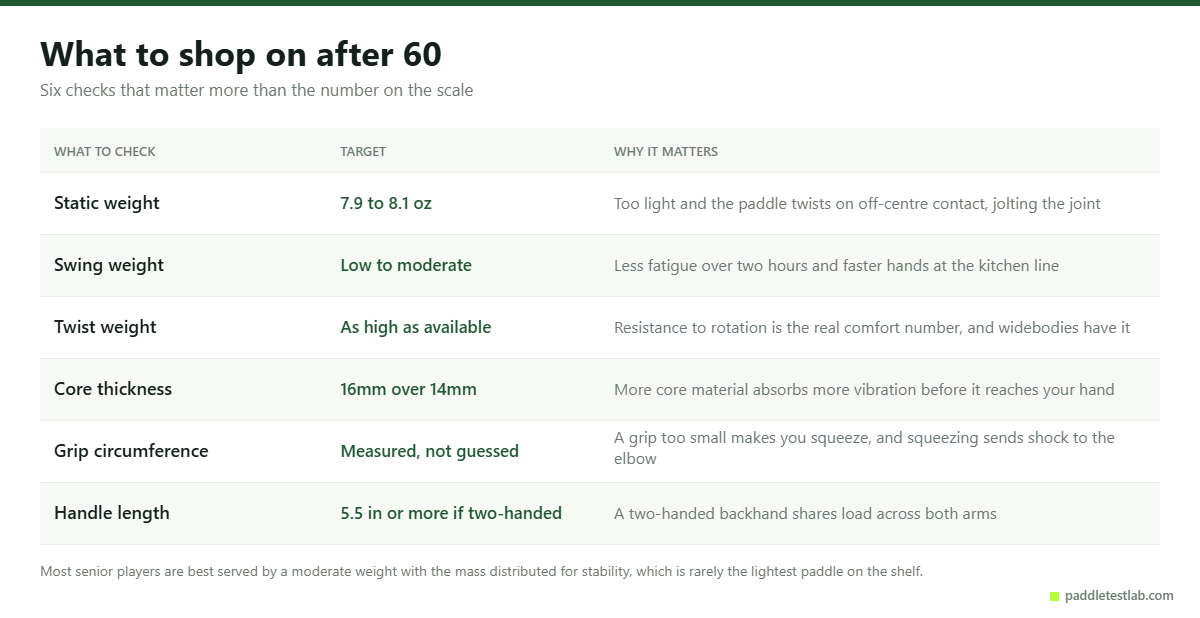
- Core thickness. Take 16mm over 14mm. A thicker core absorbs more vibration before it reaches your hand, and gives you longer on the ball. See our 14mm vs 16mm comparison.
- Grip circumference. Too small and you squeeze, and squeezing is what turns paddle vibration into elbow pain. Too large and you lose wrist mobility. Measure before you buy — our grip size guide has the method.
- Handle length. Shorter handles suit one-handed players; 5.5 inches and up matters if you use a two-handed backhand, which many players adopt to take load off a single shoulder.
The Best Pickleball Paddles for Seniors: 2026 Picks
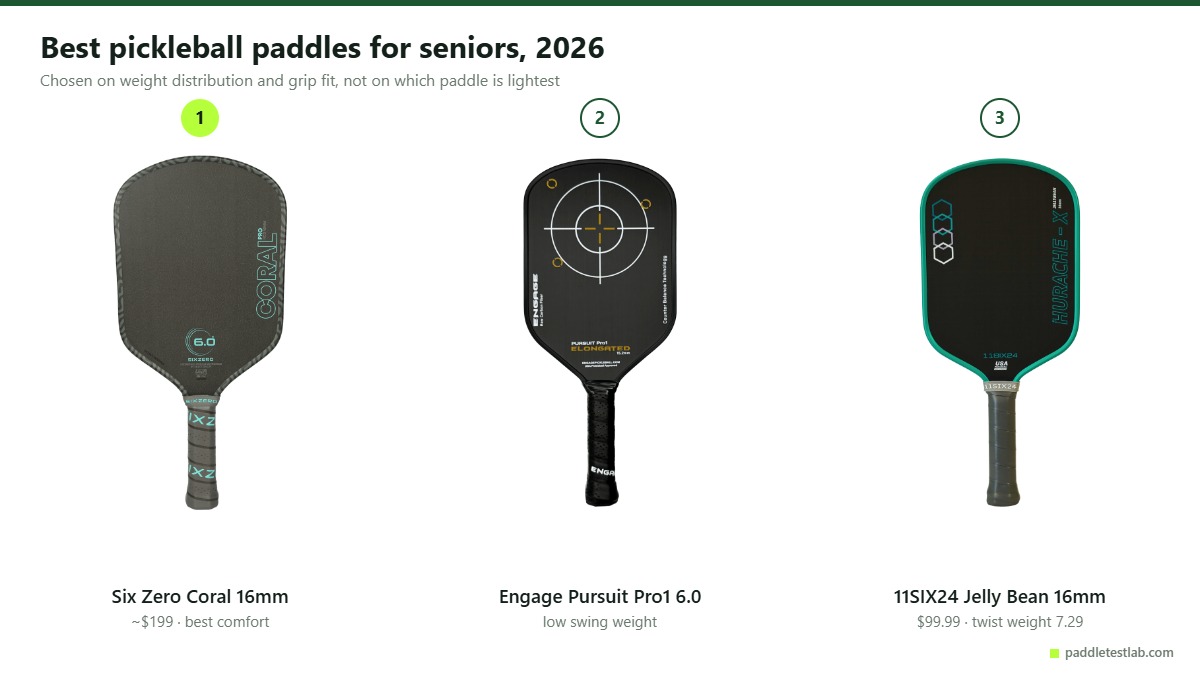
1. Six Zero Coral 16mm — best overall for comfort
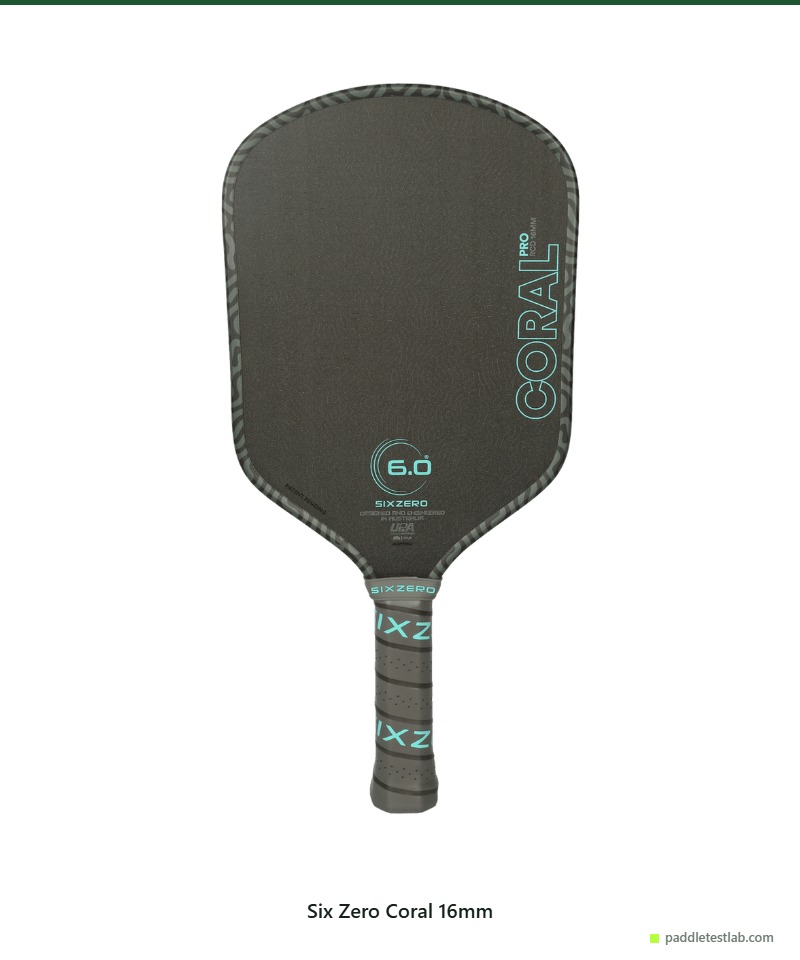
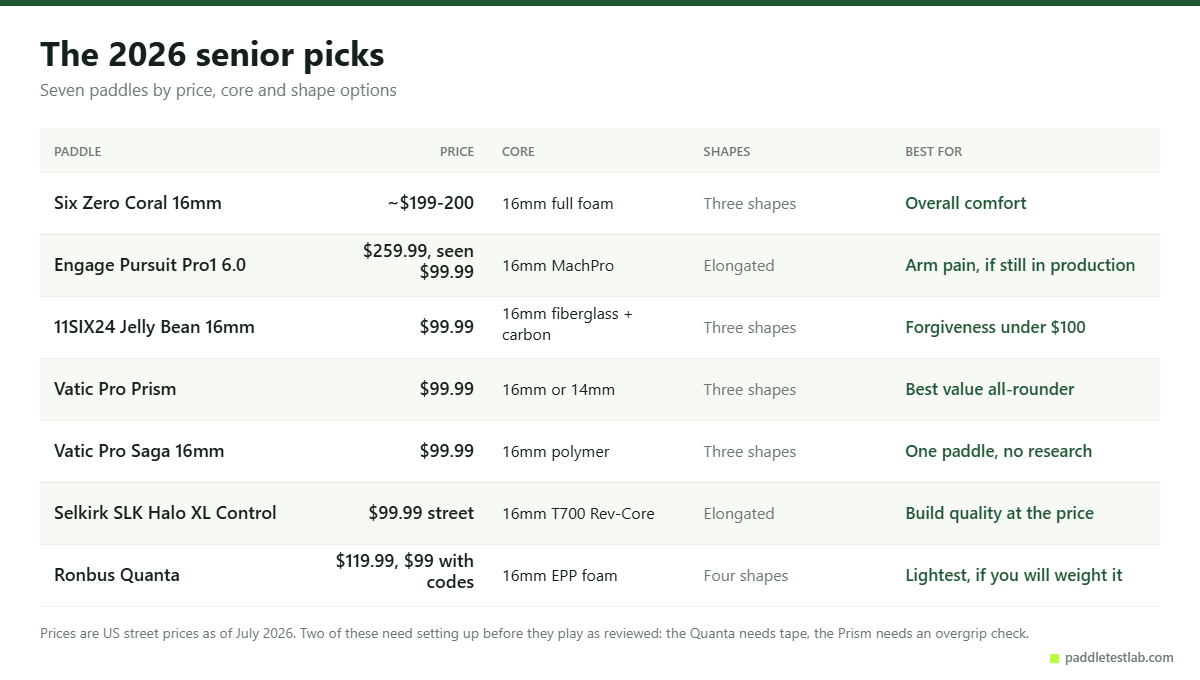
A dense, soft full-foam core with minimal vibration and the highest comfort scores of any paddle we track. At 7.9 to 8.2 ounces it sits in the right static-weight band, and the full-foam construction means no core crush over time.
Two honest caveats. It gives little feedback — some players find that soothing and others find it numb, and you will know which you are within a game. Long-term durability is unproven simply because the construction is new. The grip is also thick, which is a problem for small hands; see the SLK note below for the same issue.
~$199–200 MSRP · 16mm full foam · elongated, hybrid or widebody · USAP approved.
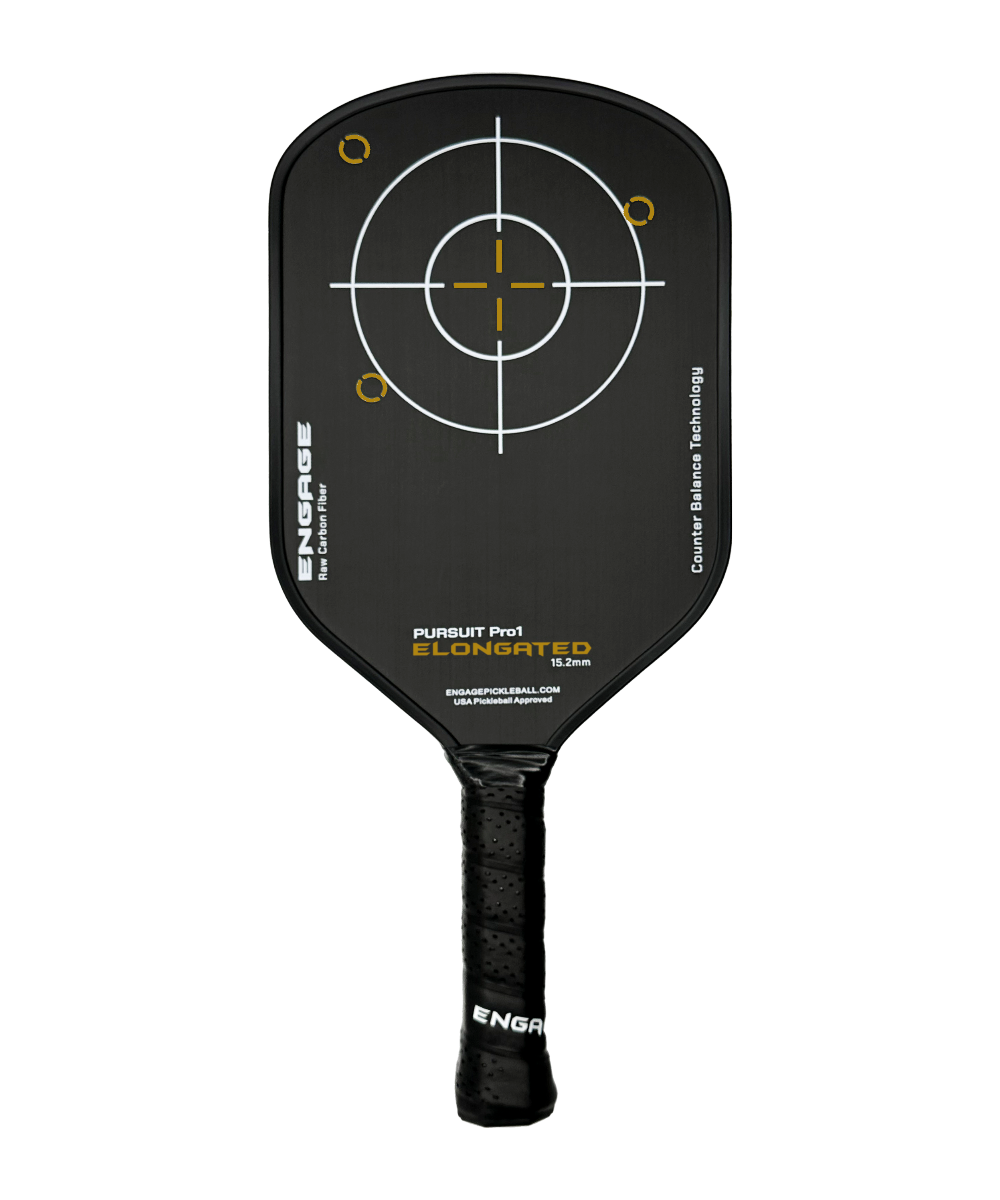
2. Engage Pursuit Pro1 6.0 Elongated — the arm-pain standard, with a caveat
This is the paddle most often recommended for players with elbow trouble, and for good reason: built-in vibration dampening, a very low swing weight, and US manufacturing. If your priority is finishing a session without your forearm aching, this is the shortlist.
The caveat is commercial rather than technical. It carries a $259.99 MSRP but has been seen at $99.99 street, and steep discounting like that usually means clearance. There is also no independent 2026 durability data on it. Check it is still in production before you buy, and if you find one at the discounted price, that is a genuine bargain rather than a red flag on the paddle itself.
$259.99 MSRP, seen at $99.99 · 16mm MachPro core · elongated · USAP approved.
3. 11SIX24 Pegasus / Vapor / Hurache-X Jelly Bean 16mm — best forgiveness under $100
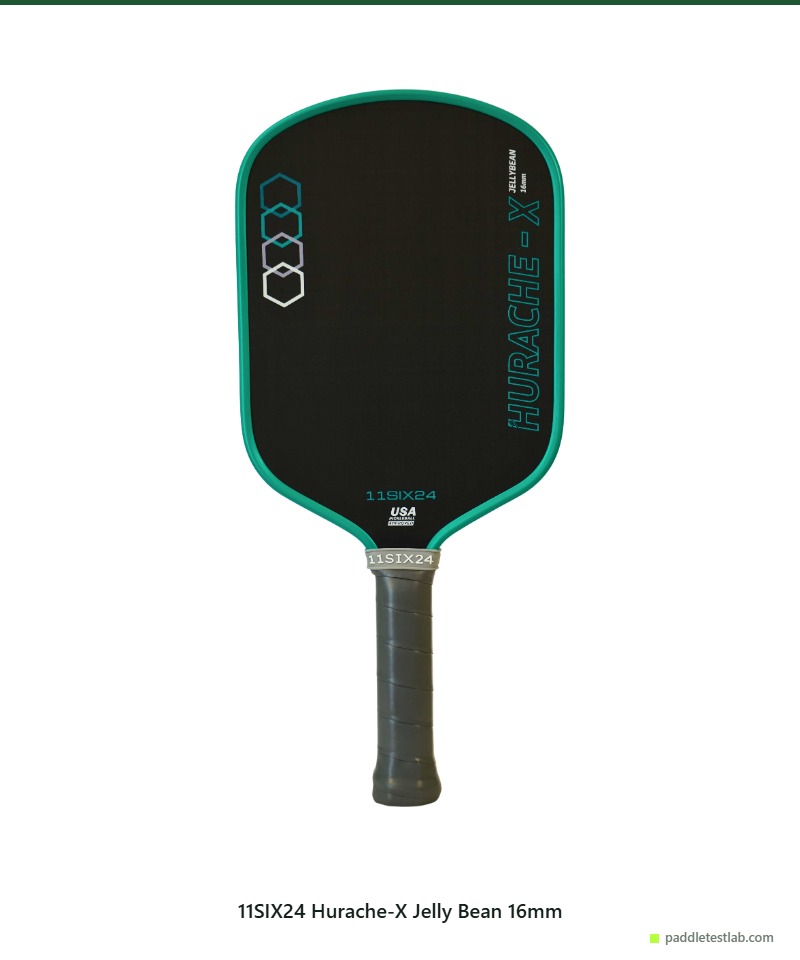
The standout number here is twist weight at 7.29, which is high, and it is exactly the property that makes off-centre hits stop hurting. Excellent forgiveness, a fiberglass and raw carbon face, and three shapes so you can pick a widebody for maximum stability.
It will not put balls away for you, and the sweet spot is smaller than the foam-core paddles above. For a player whose game is placement and consistency rather than winners, neither is a real cost. It is a 2024-generation design, which shows up in pace, not in comfort.
$99.99 · 16mm · widebody, hybrid or elongated.
4. Vatic Pro Prism — best value all-rounder
The benchmark $99 carbon paddle: plush, forgiving feel, raw Toray T700 face, and grip inserts marketed specifically to reduce shock. It comes in every shape, so a widebody Prism is an easy, cheap way into a high-stability paddle.
Two things to know. The grit wears fast — one tester measured roughly 50% spin loss after two months — which matters less for a control-oriented senior game than for a spin player. And it is slightly head-heavy, so try the widebody rather than the elongated if your shoulder is the concern.
$99.99 · 16mm or 14mm · three shapes · USAP approved.
5. Vatic Pro Saga 16mm — best if you do not want to think about it
The best-priced true all-court paddle we track, with a polymer core that has no long-term crushing issues and every shape on offer. It is a jack of all trades and does not pretend otherwise — it will not generate offence for you.
For a player who wants one paddle, wants it to last, and does not want to research construction, this is the least risky $100 in the category.
$99.99 · 16mm or 14mm · widebody, hybrid or elongated.
6. Selkirk SLK Halo XL Control — best build quality at the price
Selkirk’s entry-to-intermediate line, with a T700 raw carbon face at $99 street and the brand’s build standards behind it. Strong control, and a sensible pick for a player stepping up from a starter paddle.
Two limits, stated plainly. Spin sits at roughly 1,400 to 1,450 RPM, which is low for carbon — fine for a control game, disappointing if you want to add topspin later. And the grip is thick, which many women and small-handed players find a poor fit. Try before buying if you can.
$99.99 street (~$139.99 MSRP) · 16mm · elongated.
7. Ronbus Quanta — lightest option, for players who will set it up
At 7.68 to 7.80 ounces this is the lightest paddle here, with a Gen-4 EPP foam core that will not crush. If your limiting factor is shoulder fatigue over a long session rather than impact shock, it is the most manoeuvrable choice.
It needs 7.5 to 15 grams of tape at 3 and 9 o’clock to reach its rated performance and to bring the twist weight up. That is a small job, but it is a job — see how to add weight to a paddle. Without it, the sweet spot is small.
$119.99 MSRP, $99 with codes · 16mm EPP foam · four shapes · USAP approved.
Paddles to Avoid, and Why
- Anything under 7.5 ounces. Low mass plus low twist weight is the combination that puts shock into the joint.
- Stiff 14mm power paddles. Fast off the face and unforgiving into the arm. If you want more pace, add weight to a comfortable paddle instead.
- Long, narrow elongated shapes as a first upgrade. Great leverage, small sweet spot. Start widebody or hybrid and move up only if you want to.
- Anything you cannot try or return. Grip fit is individual and no spec sheet substitutes for holding it.
Grip Size, Overgrips and Arthritis
Grip is where most comfort problems are actually solved, and it costs under ten dollars to experiment.
A grip slightly too small forces you to squeeze to keep control, and grip tension is the main route by which paddle vibration reaches the elbow. If you find yourself gripping hard, add an overgrip and re-test — one layer typically adds about 1/16 inch of circumference. Our guide to adding an overgrip walks through the wrap, and the overgrip comparison covers cushioned options that absorb more shock.
For hands with arthritis, a slightly larger circumference and a softer, tackier grip reduce how hard you have to hold on. Replace overgrips well before they go slick.
Setting Up a Paddle for a Sore Arm
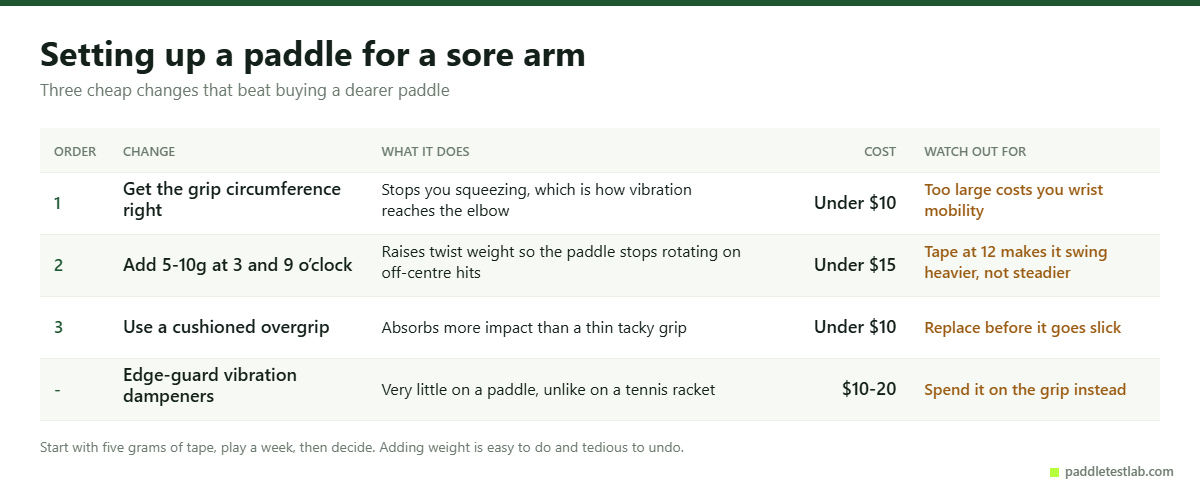
A paddle out of the box is rarely set up for the player holding it, and three cheap adjustments do more for a sore elbow or shoulder than upgrading to a dearer paddle does.
Get the grip circumference right first. This is the single highest-value change and it costs under ten dollars. A grip that is slightly too small makes you squeeze, and grip tension is the main route by which paddle vibration travels into the forearm. One layer of overgrip typically adds about 1/16 inch of circumference. If you find your hand aching before your arm does, add a layer and re-test. Our grip size guide has the measuring method and the overgrip guide covers the wrap.
Then add weight at 3 and 9 o’clock, not at 12. Five to ten grams of lead or tungsten tape at the sides of the paddle face raises twist weight, which is the property that stops the paddle rotating on off-centre hits. That rotation is the jolt you feel. Tape at 12 o’clock raises power instead and makes the paddle swing heavier, which is the opposite of what a sore shoulder wants. Start with five grams, play a week, then decide. Our guide to adding weight to a paddle covers placement.
Choose a cushioned overgrip, not a tacky one. Tacky grips help you hold on with less pressure, which is good, but a cushioned grip absorbs more of the impact before it reaches your hand. For an arthritic hand, a slightly thicker cushioned grip usually beats a thin tacky one. Replace it well before it goes slick — a slippery grip makes you squeeze harder, which undoes everything above. The overgrip comparison covers the cushioned options.
What not to bother with. Vibration dampeners that clip to the edge guard do very little on a paddle, unlike on a tennis racket — the frequencies involved are different. Spend the money on the grip instead.
Shoes, Balls and the Rest of the Kit That Affects Your Joints
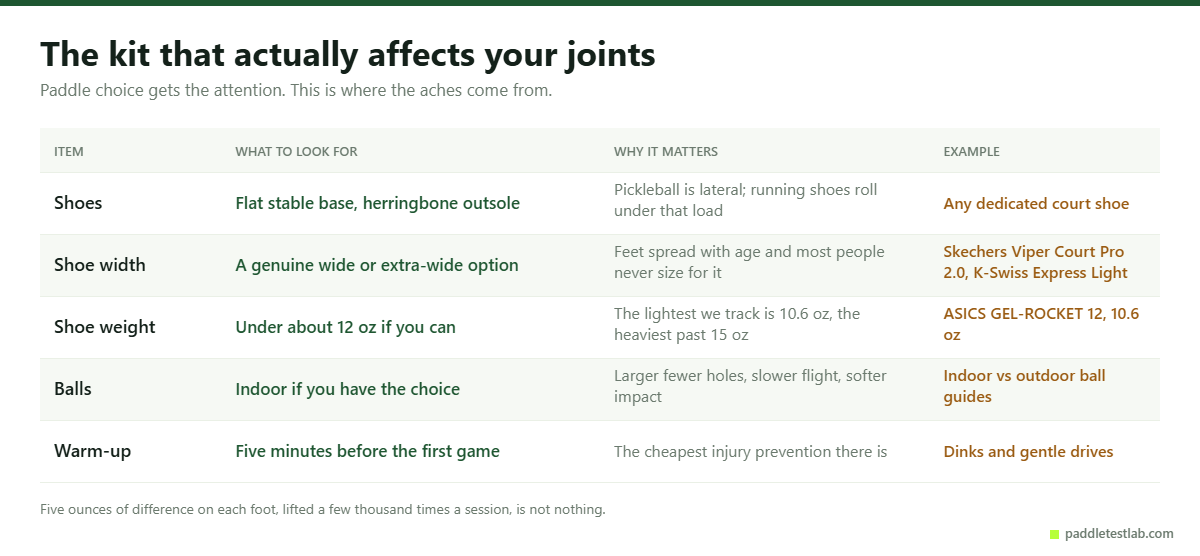
Paddle choice gets all the attention, and it is not where most senior players’ aches come from.
Shoes matter more than the paddle for knees, ankles and hips. Running shoes are built to move forward and have soft, tall midsoles that roll under lateral load. Pickleball is almost entirely lateral. A court shoe with a flat, stable base and a herringbone outsole is the single most protective piece of kit you can buy.
Width is available, and most people do not know it. Several current models come in genuinely wide fits: the Skechers Viper Court Pro 2.0 offers an extra-wide men’s option, the K-Swiss Express Light comes in a 2E width, the ASICS GEL-ROCKET 12 has a wide version, and FitVille builds wide and extra-wide as standard. If your feet have spread with age — and most do — a correctly wide shoe removes a whole category of foot pain. Our guides to pickleball shoes, men’s shoes and women’s shoes cover the fits.
Weight matters on your feet too. The ASICS GEL-ROCKET 12 is the lightest shoe we track at 10.6 oz; the heaviest court shoes run past 15 oz. Nearly five ounces on each foot, lifted a few thousand times a session, is not nothing.
Balls change the impact. Indoor balls have larger, fewer holes, fly slower and hit the paddle softer than outdoor balls, which are harder and faster. If you have a choice of venue and a sensitive arm, indoor play is easier on it. See our indoor ball guide.
Warm up before the first game, not during it. Five minutes of dinking and gentle drives before you start is the cheapest injury prevention available, and it is the thing rec players skip most.
When the Paddle Is Not the Problem
Equipment can reduce the load on a joint. It cannot fix a cause that is not equipment, and it is worth being honest about which you are dealing with.
Volume. The most common pattern behind pickleball elbow is not a bad paddle, it is going from two sessions a week to five in a month. Load tolerance builds slowly. If the pain arrived shortly after the frequency went up, the frequency is the variable to change first.
Technique. Hitting with a stiff, locked wrist and an arm-only swing puts far more shock through the elbow than using the shoulder and trunk. This is genuinely worth one lesson, and one lesson is cheaper than most of the paddles on this page.
Grip pressure. Holding the paddle tightly all the time, rather than only at contact, is the habit that turns normal vibration into pain. The fix is a correctly sized grip and conscious relaxation between shots.
Old injuries. A shoulder or wrist that already had a problem will find pickleball, and no paddle in this roundup will change that.
If pain persists for more than a couple of weeks, does not settle with rest, or wakes you at night, that is a conversation for a physiotherapist or doctor rather than a shopping decision. We write about equipment; we are not clinicians, and buying a different paddle is not a treatment plan.
Frequently Asked Questions
What weight paddle should a senior player use?
Most players are best served between 7.9 and 8.1 ounces with the mass distributed for a high twist weight. Go lighter only if shoulder fatigue over a long session is your limiting factor, and expect to give up stability when you do.
Will a different paddle fix my tennis elbow?
It can reduce the load meaningfully, but it is one of several factors alongside grip size, grip tension, technique and how much you play. Our tennis elbow paddle guide covers the full picture.
Is a thicker 16mm core always better for comfort?
For most players managing joint pain, yes — more core material absorbs more vibration before it reaches the handle. The cost is a little pace, which is rarely the priority here.
Do I need a two-handed backhand paddle?
Only if you use one. If you do, or you are considering it to share load across both arms, look for a handle of at least 5.5 inches.
How often should I replace a paddle?
Face texture fades within months of regular play; cores last far longer. Replace when the paddle stops doing what it used to — dead spots, a duller sound, or drives that no longer dip. Our guide to delamination signs covers what a failing core feels like.
Specifications and prices are checked against each brand’s own store — Six Zero, Engage and Vatic Pro — and were current in July 2026.

Isacc Shah
Isacc Shah writes PaddleTestLab. He does not test paddles in a lab and says so plainly — there is no rig, no radar gun, no staff hitting balls. Instead he aggregates independent bench measurements, manufacturer specifications, USA Pickleball's approval database and hundreds of verified owner reviews per product, then reports where those sources disagree. Every score on the site carries its evidence count. Where a specification is not published, the site writes UNKNOWN rather than estimating it, and the criticism is printed next to the praise.