
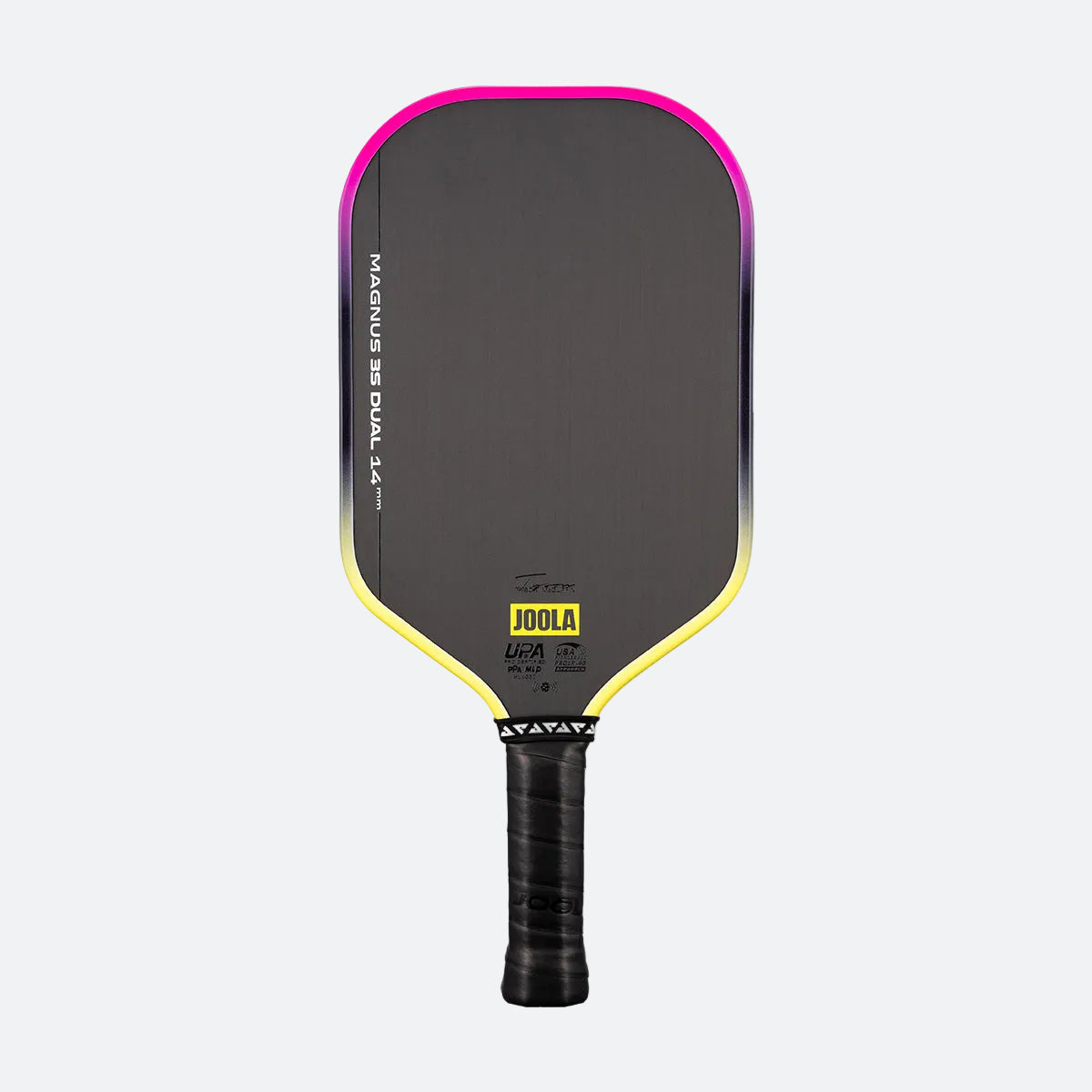
Spin sells paddles. Almost every product page now advertises an RPM figure — the revolutions per minute a ball picks up off the face — and bigger is presented as better. The problem is that a spin RPM number only means something when you know who measured it and how. Swing speed, ball type, shot angle, robot-arm calibration and even paddle age all move the result. A brand’s single hero figure tells you almost nothing on its own. This article explains what actually drives pickleball paddle spin RPM, why measured ranges differ so much between independent labs, what genuinely counts as high, and it ends with an honest ranked table of paddles whose spin was measured by a named tester.
The pickleball paddle spin field is crowded this year, so we focused on verified data over hype.
This piece is a companion to our Paddle Honesty Index, where we track the gap between what brands claim and what independent labs actually record. If you want the shortlist of paddles that survive that scrutiny, start with Best Pickleball Paddles 2026.
For more detail on how the pickleball paddle spin compare, scroll to the scorecard at the end of this guide.
What actually creates spin
Spin is friction. When the ball skids across the paddle face at contact, surface texture grabs it and sets it rotating. That texture is the single biggest lever a manufacturer controls, and it comes in two broad forms:
Compare how the pickleball paddle spin rank by price, weight, and verified owner ratings before you decide. For most players the pickleball paddle spin decision comes down to feel, price and durability – and this guide weighs all three from verified owner data.
- Raw carbon-fiber grit — a lightly abrasive peel-ply weave left exposed on the face. This is the current standard on high-spin paddles.
- Applied or sprayed grit coatings — a gritty layer added on top of the surface. These can post big early numbers but tend to smooth out with play, so spin fades.
Two things follow from this. First, “high spin” is mostly a surface story, not a marketing story — a textured raw face on a $120 paddle can out-grip a slick premium one. Second, spin is not permanent. A face that measures well when new may drop noticeably after 20 to 30 hours of play as the grit wears down, which is why durability matters as much as the peak number.
The player still supplies most of the spin through brush-up swing mechanics; the paddle only sets a ceiling. Two other specs shape how usable that ceiling is — a heavier, higher-swing-weight paddle can drive more spin at the cost of maneuverability, which we cover in What Is Swing Weight in Pickleball?
Why measured RPM ranges differ between labs
Here is the part the marketing figures skip. There is no single industry-standard spin test. Each independent reviewer builds their own rig and protocol, so the same paddle can post very different numbers depending on who tested it:
- Swing speed and mechanism. A robot arm or a human tester swinging faster imparts more spin. Small differences in contact speed move RPM a lot.
- Ball and contact angle. Ball model, temperature and the brush angle across the face all change the friction captured.
- Measurement method. Some labs film with high-speed cameras and count rotation; others use sensors. The scales are not interchangeable.
- Paddle condition. A fresh face reads higher than a broken-in one.
The clearest illustration is the Six Zero Double Black Diamond 16mm, one of the most-tested paddles on the market. Depending on the lab and the sample, it has been measured anywhere from roughly 1,675 to 1,880 RPM across Pickleball Studio and Pickleball Effect testing. That is a swing of over 200 RPM on the exact same paddle — larger than the gap between many “high” and “medium” paddles in a single lab’s own list. The lesson: never compare a number from one tester against a number from another. Compare within one lab’s system, and always cite the source.
What counts as genuinely high?
Because scales differ, “high spin” has to be defined per lab. As a rough rule of thumb on the human-and-robot testing scales used by Pickleball Studio, Pickleball Effect and Matt’s Pickleball, the picture in 2026 looks like this:
- Roughly 2,000+ RPM (independent lab): genuinely high. Only a subset of raw-carbon paddles reach this on these scales.
- Roughly 1,700–1,950 RPM: solid, competitive spin for most players.
- Below ~1,600 RPM: more of a control or touch surface than a spin weapon.
Note that JustPaddles’ Paddle Lab reports on a different, much lower numeric scale, so a reading there is not comparable to a “2,000 RPM” reading elsewhere — same reason you cannot cross-compare labs.
Measured RPM rankings (2026)
Every figure below is attributable to a named independent tester and reflects that lab’s own protocol. Where a paddle has been measured across a range, we report the range rather than cherry-picking the highest single number. This is a grouping of well-measured high-spin paddles, not a claim that one is objectively “the best” — because the scales are not interchangeable.
| Paddle | Measured spin RPM | Lab source |
|---|---|---|
| CRBN TruFoam Genesis (wide) | ~2,172 | Pickleball Studio |
| CRBN TruFoam Genesis (elongated) | ~2,151 | Pickleball Studio |
| CRBN TruFoam Genesis (hybrid) | ~2,132 | Pickleball Studio |
| Six Zero DBD Infinity 16mm | ~2,080 | Pickleball Effect |
| Vatic Pro Prism Flash 16mm | ~2,059 | Matt’s Pickleball |
| Six Zero Double Black Diamond 16mm | ~1,675–1,880 (varies by lab) | Pickleball Studio / Pickleball Effect |
A few honest caveats about that table:
- These figures come from different labs. The CRBN Genesis numbers (Pickleball Studio) and the Vatic Prism Flash (Matt’s Pickleball) sit near the top of their respective scales, but they were not measured side by side, so treat them as “all elite,” not precise rankings across labs.
- Ranges are shown where they exist. The DBD 16mm entry is deliberately a range — it is the single best reminder in this table that a lone marketing RPM figure is unreliable.
- “Not published” beats a guess. Any paddle whose spin we could not attribute to a named lab was left off entirely rather than estimated.
How to read spin claims without getting fooled
- Demand a named source. A big RPM number on a brand page with no independent tester attached is a marketing figure, not a measurement.
- Compare within one lab. Rank paddles using a single tester’s list; never mix scales.
- Look for a range, not a peak. If a paddle has been tested more than once, the spread tells you how reliable the number is.
- Weigh durability. Peak spin on a fresh raw face means little if it smooths out in a month.
- Remember the ceiling. Any of the 2,000+ RPM paddles above has more spin potential than the vast majority of players can currently use. Technique closes that gap faster than a new paddle.
Spin RPM is a useful spec — but only when it is honest about who measured it and under what conditions. Report ranges, cite the tester, and compare like with like. For the wider claimed-versus-measured picture across every spec, see our Paddle Honesty Index.
Sources: Pickleball Studio, Pickleball Effect, Matt’s Pickleball.
Reference: USA Pickleball — official rules, equipment standards, and the approved-paddle list.
Check our pickleball paddle spin scorecard at the end for a side-by-side verdict. Whether you need the pickleball paddle spin or a competing option, compare every spec before you commit.
The pickleball paddle spin rankings above come from verified owner data, not the manufacturers’ marketing lines.
Looking for the raw numbers? Our Spin-RPM Benchmark lays out independently measured spin data on 20 current paddles side by side in one table.
How to Generate More Spin in Pickleball
Equipment sets your ceiling; technique determines how close you get to it. Most players chasing spin are leaving more on the table in their swing than in their paddle.
Brush, do not hit. Spin comes from the ball rolling across the face rather than compressing into it. That means a low-to-high swing path with the face travelling across the ball, not through it. If your contact feels solid and loud, you are hitting flat.
Accelerate through contact. Face angle creates direction; racket-head speed creates revolutions. A slow brushing swing produces a slow spinning ball that sits up. Speed matters more than force.
Keep the face clean. Ball residue, court dust and skin oil fill the surface texture and kill grip. Wiping the face with a damp cloth between games restores more spin than most players expect — and it costs nothing.
Use a fresh ball. A scuffed, worn outdoor ball takes far less spin than a new one, regardless of your paddle. If you are testing whether a paddle spins, do not test it with a ball that has been on court for three weeks.
Equipment-wise, the single biggest lever is a raw carbon face — the exposed weave grips in a way painted composite surfaces cannot. Our carbon fibre paddle roundup covers what that buys at each price, and carbon versus fiberglass covers the comparison.
Does paddle grit wear off?
Yes, and faster than most buyers expect. This is the honest limitation of every textured paddle in the sport.
Owner reports converge on a consistent pattern: the surface is at its most aggressive out of the box, drops noticeably over the first weeks of heavy play, then stabilises at a lower level for a long period. Players hitting four or more sessions a week notice it within a season; twice-a-week players often never register it. One independent tester recorded roughly a 50% spin loss on a budget carbon paddle after two months of heavy use.
Two practical consequences. First, spin durability matters more than peak spin for anyone playing regularly — a paddle that reads high when new and dulls in six weeks is worse than one that starts lower and holds. Johnkew is the only tester publishing durability tiers based on an accelerated wear test, and it is the more useful metric. Second, a worn face is not a defect and is not covered by warranty — unlike delamination, which is a genuine failure. Knowing the difference saves you a rejected claim.
The USA Pickleball Spin Rate Limit
| Rule | Detail |
|---|---|
| Spin rate limit | USA Pickleball has adopted a 2,100 RPM ceiling, aligning with the UPA-A standard |
| Why it exists | Surface texture had escalated to the point where spin was distorting the professional game |
| What is tested | Surface roughness and spin generation under controlled conditions |
| Can a paddle lose approval? | Yes — models have been decertified after launch for exceeding roughness limits |
| Does it affect recreational play? | Not directly, but decertified paddles remain on sale and become unusable in sanctioned events |
| Does a worn face help or hurt? | Wear reduces spin, so an old paddle drifts further inside the limit, not outside it |
The practical implication for buyers: a paddle marketed as being at the very top of any spin chart is, by definition, close to the regulatory ceiling — and closer to the risk of decertification. Our explainer on how USA Pickleball approval works covers what gets tested and how to check a specific model.
Frequently Asked Questions
What is a good spin RPM for pickleball?
There is no single number, and any site that gives you one without naming a lab and a method is guessing.
Independent testers use genuinely different rigs. Pickleball Studio records spin with a radar gun off a real human swing. Johnkew uses a ball cannon with the paddle clamped and the player removed entirely. Those two approaches produce figures on completely different scales — the same paddle can read in the hundreds under one protocol and the low thousands under another. Both are correct measurements of different events.
The rules that follow: only compare within one tester’s dataset, and treat any brand’s own spin claim as marketing until an independent lab confirms it. The one number with real meaning across the sport is the 2,100 RPM regulatory ceiling, because it is defined by the governing body rather than by a testing house. Our page on who measures pickleball spin and why their figures disagree names the labs and explains their methods.
Which paddle has the highest spin?
We do not publish a ranking, because we do not run a spin rig and we will not reprint someone else’s leaderboard as though it were ours.
What we can tell you is what the top of every independent chart has in common: a raw, unpainted carbon face with aggressive surface texture, usually on a thermoformed or foam-core frame. Beyond that, the ordering changes between testers and between production batches of the same model.
The more useful question than “which spins most” is “which still spins in six months” — and that is a durability question, not a peak-spin one. For current measured rankings, go to the source: our spin measurement explainer links to the three labs doing serious work, and comparing within one of their datasets will tell you more than any figure we could publish.

Isacc Shah
Isacc Shah writes PaddleTestLab. He does not test paddles in a lab and says so plainly — there is no rig, no radar gun, no staff hitting balls. Instead he aggregates independent bench measurements, manufacturer specifications, USA Pickleball's approval database and hundreds of verified owner reviews per product, then reports where those sources disagree. Every score on the site carries its evidence count. Where a specification is not published, the site writes UNKNOWN rather than estimating it, and the criticism is printed next to the praise.