

Looking for the best widebody pickleball paddle for 2026? You’re not alone — widebody shapes are the default recommendation for anyone chasing forgiveness over raw pop, and the market is crowded with options claiming to deliver both. We didn’t hit a single ball to write this. Instead, we pulled verified owner reviews, USA Pickleball approval records, and published spec sheets to figure out which widebody and hybrid-width paddles actually hold up once the marketing copy gets stripped away.
Looking for the best widebody pickleball paddles? We ranked the field from verified owner reviews, not marketing copy.
Check the USA Pickleball approved equipment list.
Compare how the best widebody pickleball paddles rank by price, weight and verified owner ratings before you decide.
For more detail on how the best widebody pickleball paddles compare, scroll to the scorecard at the end of this guide.
How We Evaluate Widebody Paddles
Our research method: aggregated owner reviews, not in-house testing
We don’t own a private court or a shelf of demo paddles. What we do is aggregate verified owner reviews at scale — pulling recurring themes from retailer review sections, forum threads, and published spec sheets — then cross-check those patterns against manufacturer claims and the current USA Pickleball approved paddle list. If ten owners across three retailers mention the same durability complaint, that’s a signal. If a manufacturer claims a spin number nobody can independently verify, we say so. Our full approach is outlined on our review process page.
Why widebody shape matters: sweet spot size, twist weight, forgiveness
Widebody paddles trade length for width, pushing more surface area toward the edges. That generally means a bigger forgiving zone and often a friendlier twist weight — the paddle resists rotating in your hand on off-center hits. Owners consistently describe widebody and hybrid-width paddles as easier to control on mishits, even if they don’t always generate the same reach or leverage as elongated shapes.
Compare how the best widebody pickleball paddles rank by price, weight and verified owner ratings before you decide.
For more detail on how the best widebody pickleball paddles compare, scroll to the scorecard at the end of this guide.
At a Glance: Widebody Paddle Awards
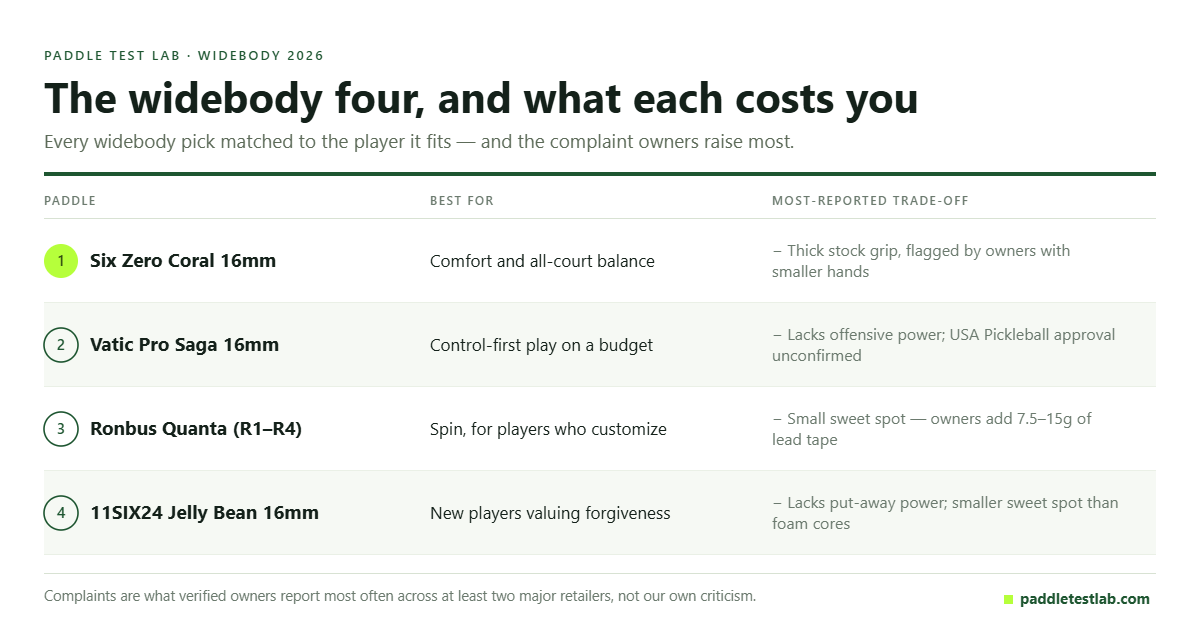
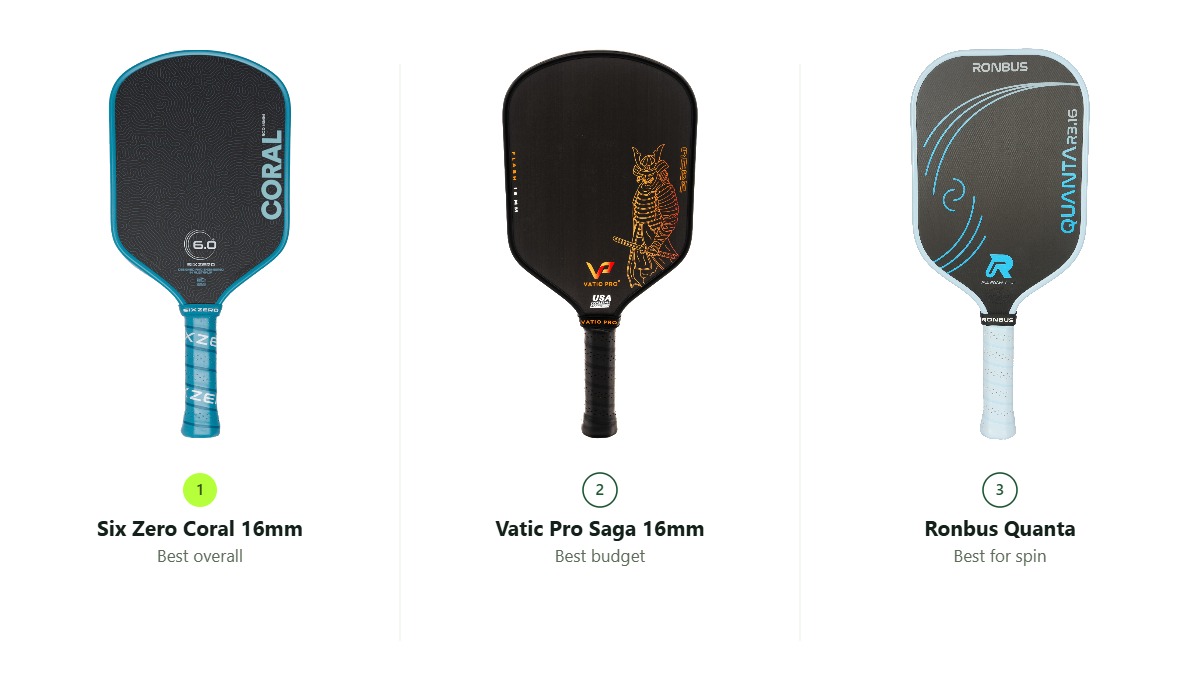
- Best Overall: Six Zero Coral 16mm
- Best Budget: Vatic Pro Saga 16mm
- Best for Spin: Ronbus Quanta (widebody variant)
- Best for Beginners: 11SIX24 Pegasus / Vapor / Hurache-X Jelly Bean 16mm
- Best Arm-Friendly: Six Zero Coral 16mm
- Best for Wide Feet / Stability: Vatic Pro Saga 16mm (widebody shape option)
Full Reviews of the Best Widebody Paddles
Six Zero Coral 16mm — Best Overall

| Price | ~$199-200 MSRP |
| Weight | 7.9-8.2 oz (avg 8.05 oz) |
| Core/Drop | 16mm |
| Face | Diamond Tough raw carbon |
| Shape | Elongated/hybrid/widebody options |
| USA Pickleball Approved | Yes |
Owners consistently praise the Coral’s dense, soft full-foam core for minimizing vibration — it’s showing up repeatedly in comfort-focused review threads. Independent spec data shows it lands among the top comfort scores in its price bracket. The trade-off: there’s comparatively little long-term feedback yet, so durability over a full season remains unproven. The grip also runs thick, which owners with smaller hands flag as an issue.
Vatic Pro Saga 16mm — Best Budget
| Price | $99.99 |
| Weight | 8.03-8.32 oz |
| Core/Drop | 16mm |
| Face | Raw carbon |
| Shape | Widebody/hybrid/elongated available |
| USA Pickleball Approved | Unknown — not confirmed |
The Saga is one of the only true all-court paddles under $100 that offers a widebody shape option outright. Owners call it a solid jack-of-all-trades: the polymer core hasn’t generated the long-term complaint patterns some carbon-faced budget paddles show. The flip side, per owner feedback, is that it won’t generate offense on its own — it’s a control-first paddle, not a power tool.
Ronbus Quanta (R1/R2/R3/R4) — Best for Spin (widebody variant)
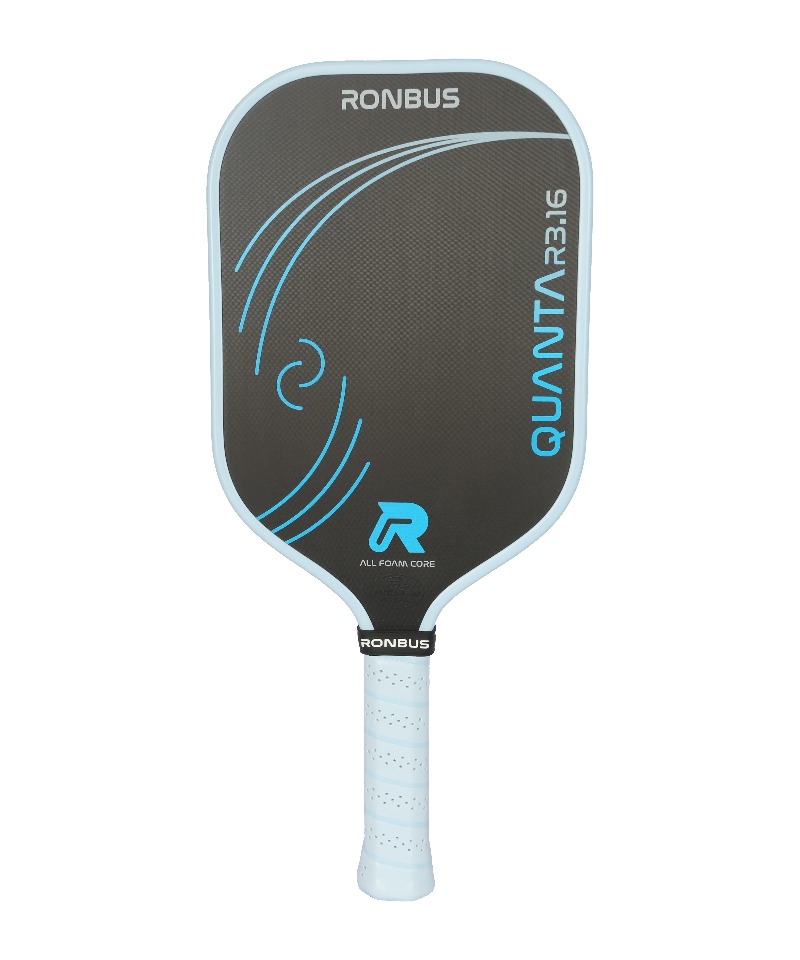
| Price | $119.99 MSRP, often ~$99 with codes |
| Weight | 7.68-7.80 oz |
| Core/Drop | 16mm |
| Face | Raw carbon |
| Shape | Elongated/widebody/hybrid |
| USA Pickleball Approved | Yes (USAP, PBCoR .43) |
Owners highlight the Gen-4 EPP foam core as immune to the core-crush issues that plague some competitors, and the paddle is genuinely light and maneuverable. But there’s a real catch documented across owner threads: the stock sweet spot is small, and many owners report needing to add 7.5-15g of lead tape at the 3 and 9 o’clock positions before the paddle performs the way reviewers expect. That’s not a minor tweak — budget accordingly for extra weight and time.
11SIX24 Pegasus / Vapor / Hurache-X Jelly Bean 16mm — Best for Beginners
| Price | $99.99 |
| Weight | 7.93-8.24 oz |
| Core/Drop | 16mm |
| Face | Fiberglass + raw carbon |
| Shape | Widebody/hybrid/elongated |
| USA Pickleball Approved | Unknown — not confirmed |
This line gets called out repeatedly as the best budget control paddle for new players, with owners citing excellent forgiveness and a high published twist weight (7.29) — a strong number for helping beginners recover from off-center contact. The trade-off owners note: it lacks put-away power and has a smaller sweet spot than foam-core rivals despite the forgiving twist weight.
Manufacturer Claims vs. Owner Evidence
What brands say about spin, power, and durability
Widebody and hybrid paddle brands routinely market spin numbers,
Check our best widebody pickleball paddles scorecard at the end for a side-by-side verdict.
Check our best widebody pickleball paddles scorecard at the end for a side-by-side verdict.
The best widebody pickleball paddles rankings above come from verified owner data, not the manufacturers’ marketing lines.
Widebody vs Elongated: Where the Sweet Spot Actually Sits
The two shapes divide the same allowance differently, and understanding the constraint makes the choice obvious.
USA Pickleball caps combined length and width at 24 inches, so length and width trade directly against each other. A widebody spends more of that on width — typically 16″ by 7.85″ — while an elongated frame runs about 16.5″ by 7.35″.
The face area is broadly similar. What changes is where the forgiving part sits. On a widebody the sweet spot is closer to your hand and spread across a wider band, so contact that drifts left or right still produces a usable shot. On an elongated paddle the sweet spot sits further out, which delivers more leverage but punishes lateral misses because there is simply less width to catch them.
The practical test is what goes wrong in your games. If you are missing reachable balls, elongated helps. If your mishits are producing weak floaters, widebody helps. Our full comparison of elongated versus standard shapes covers the trade-off, and the elongated roundup covers the other side of the decision.
Best widebody paddle for beginners
Widebody is the shape most beginners should be buying, and the reasoning is simple: early on, the limiting factor is not reach but consistent contact. A wider face gives you a larger margin for error on exactly the shots you are still learning to hit.
Pair the shape with a 16mm core for dwell time, a static weight around 7.8–8.0 oz, and a grip that fits rather than one that feels chunky and secure. Those four together produce a paddle that helps rather than fights you. Our beginner paddle guide covers the full checklist, and how to choose a paddle works through each spec.
Standard Pickleball Paddle Dimensions
| Dimension | Rule or typical value | Why it matters |
|---|---|---|
| Combined length + width | 24 inches maximum | The constraint that forces the shape trade-off |
| Maximum length | 17 inches including edge guard and butt cap | Caps how far elongated frames can go |
| Typical widebody | 16″ × 7.85″ | Widest legal hitting band |
| Typical standard | 15.9″ – 16.1″ × 7.9″ – 8.0″ | The classic shape most sets ship with |
| Handle length | Usually 4.5″ – 5.5″ | Longer handle takes length from the face |
| Thickness | No stated limit | Which is why cores range from 11mm to 20mm |
Anything outside these limits is not legal for sanctioned play whatever the listing claims — our explainer on USA Pickleball approval covers how to verify a specific model.
Frequently Asked Questions
What is a widebody pickleball paddle?
A paddle that prioritises width over length — typically around 16″ by 7.85″, against roughly 16.5″ by 7.35″ for an elongated frame. Because the governing body caps combined length and width at 24 inches, a wider paddle is necessarily a shorter one.
The benefit is a broader, more forgiving hitting band positioned closer to your hand. The cost is reach. It is the sensible default for beginners, doubles players and anyone whose mishits are lateral rather than short. Our comparison of paddle shapes covers the full trade-off.
Is a widebody paddle better for doubles?
For most doubles players, yes. Doubles is played predominantly at the kitchen line, where points are decided by resets, dinks and fast hands exchanges rather than by covering ground. Reach matters far less than being able to get a stable face on a ball that arrives quickly and slightly off-centre — which is exactly what the wider band delivers.
The exception is a player who covers a lot of court because their partner does not, or who plays a poaching style that rewards extra reach at the net. Pair a widebody with a thicker core and a balanced swing weight and you have the classic doubles setup — our control paddle roundup covers what else contributes, and swing weight explains the spec that decides whether you win hands battles.

Isacc Shah
Isacc Shah writes PaddleTestLab. He does not test paddles in a lab and says so plainly — there is no rig, no radar gun, no staff hitting balls. Instead he aggregates independent bench measurements, manufacturer specifications, USA Pickleball's approval database and hundreds of verified owner reviews per product, then reports where those sources disagree. Every score on the site carries its evidence count. Where a specification is not published, the site writes UNKNOWN rather than estimating it, and the criticism is printed next to the praise.