
Short answer: the padel rules that matter most are these — you serve underarm after a bounce, the ball must bounce on the floor before it touches a wall, and after that the walls are yours to play off. Scoring is tennis scoring, and it is almost always doubles.
Padel is the fastest-growing racket sport in the United States, and almost every rules explanation available is written by a European brand or federation for an audience that grew up with the sport.
This one is written for the reader America actually sends to a padel court: someone arriving from tennis or pickleball, who knows how to hit a ball and has no idea what the walls are for.
Padel Rules in Ninety Seconds
Padel is played on an enclosed court, almost always in doubles, with solid stringless rackets and a ball slightly softer than a tennis ball. You serve underarm. The walls are in play. Scoring is tennis scoring.
The single idea that makes the sport click: the ball must bounce on the floor before it touches a wall. After that bounce, the walls are yours to use — you can let the ball come off the glass behind you and hit it back. That one rule is what turns padel from “tennis in a box” into its own game, because points last far longer than they would with nothing behind you.
The Court, the Glass and the Cage

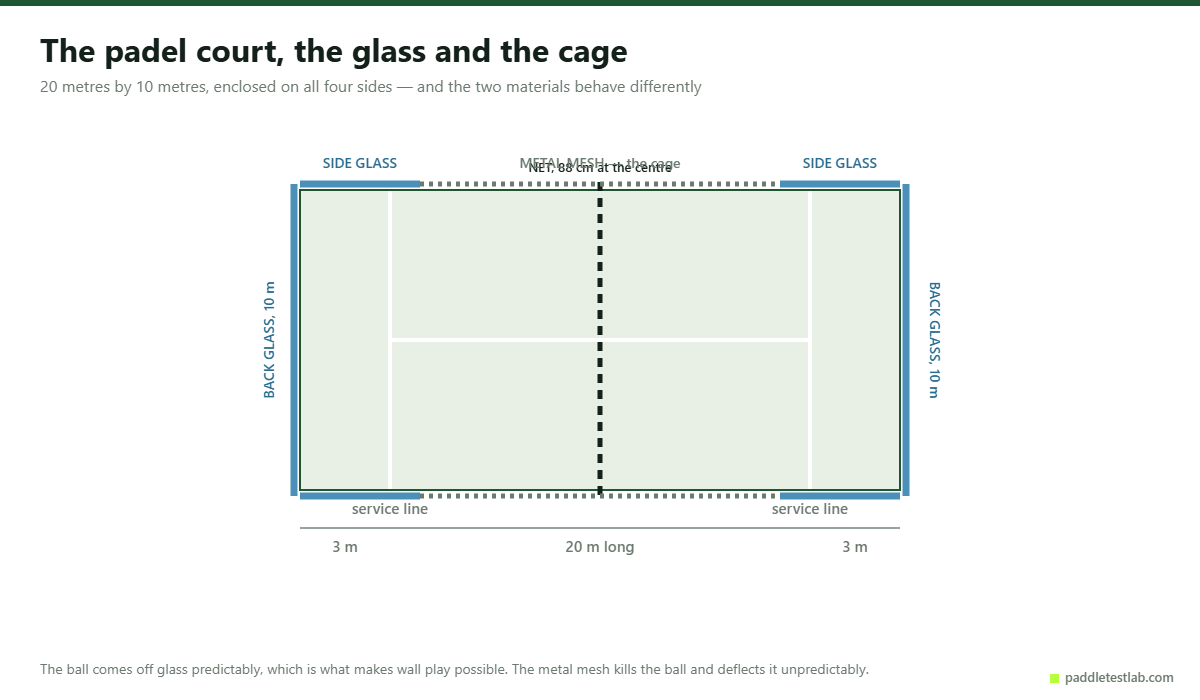
A padel court is 20 metres long by 10 metres wide, enclosed on all sides. Two materials make up the enclosure and they behave differently:
- Glass at the back and part of the sides. The ball comes off glass predictably, which is what makes wall play possible.
- Metal mesh — the cage or fence — along the rest of the sides. It kills the ball and deflects it unpredictably.
The net sits at roughly 88 centimetres in the middle, rising slightly towards the posts. Most courts have openings in the side walls; on courts that have them, you are allowed to go out through the opening and play the ball back from outside the court, which is the sport’s most spectacular legal shot.
For scale: a padel court is roughly two and a half times the footprint of a pickleball court, and about a third the area of a tennis court. Our padel vs pickleball comparison puts the two side by side.
Serving: Underarm, Below the Waist, After a Bounce
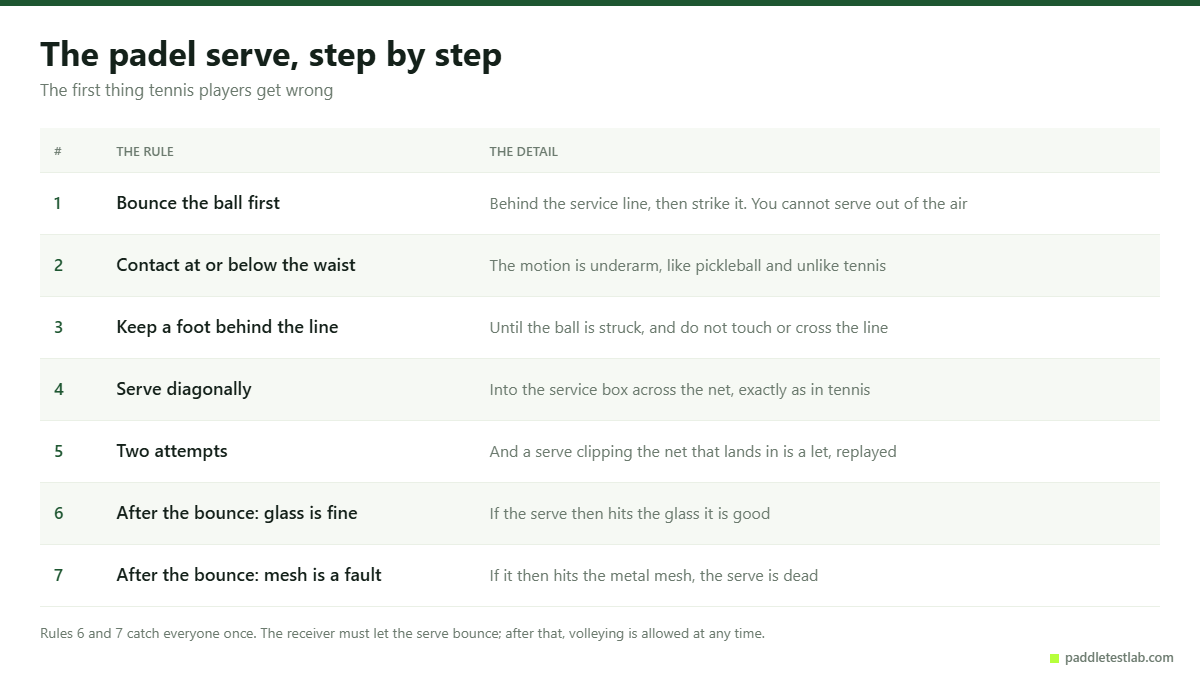
The serve is the most rule-bound moment in padel and the first thing tennis players get wrong.
- Bounce the ball on the ground first, behind the service line, then strike it. You cannot serve out of the air.
- Contact at or below waist height. The motion is underarm.
- One foot stays behind the service line until the ball is struck, and you must not touch or cross the line.
- Serve diagonally, into the service box across the net, exactly as in tennis.
You get two serve attempts, like tennis. A serve that clips the net and lands in the correct box is a let and is replayed — padel kept the let, unlike pickleball, which abolished it.
Then the padel-specific part. After the serve bounces in the correct service box:
- If it then hits the glass, the serve is good and play continues.
- If it then hits the metal mesh, it is a fault.
That distinction catches everyone once. The receiver must let the serve bounce before returning it; after that, volleying is allowed at any time.
Playing the Walls: What Is Legal and What Is Not
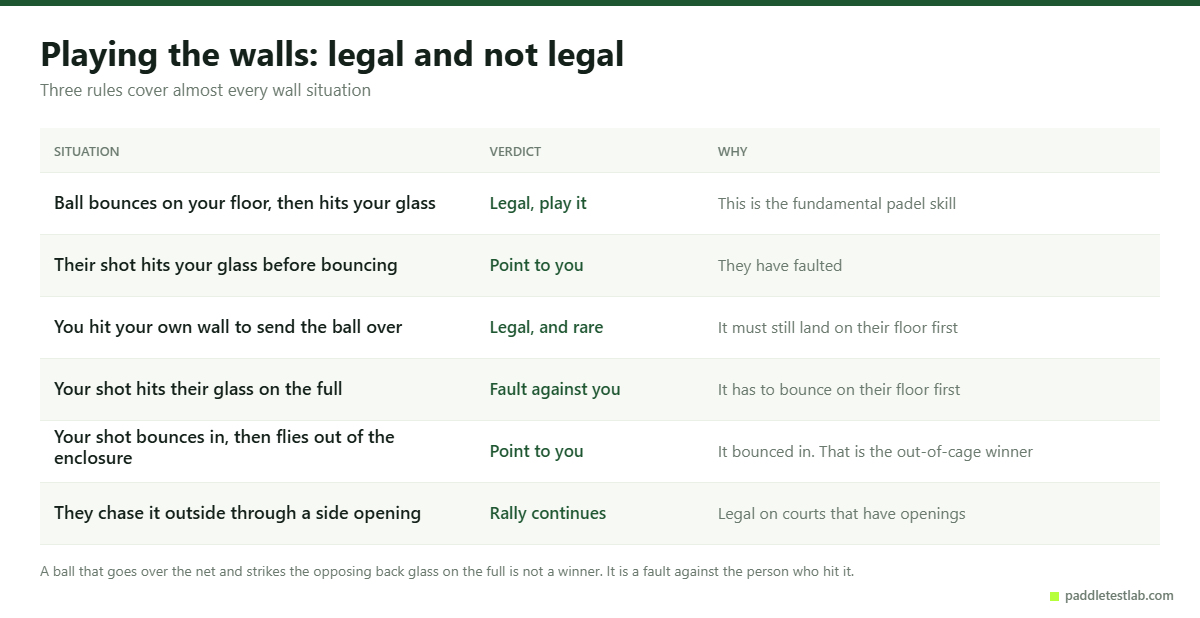
Three rules cover almost every wall situation.
1. The ball must bounce on your floor before it touches your walls. If your opponent’s shot flies over the net and hits your back glass without bouncing first, the point is yours — they have faulted.
2. Once it has bounced, your walls are yours to use. Let the ball pass you, come off the back glass, and hit it on the way out. This is the fundamental padel skill and the one tennis players take longest to trust.
3. Your shot must clear the net and land in the opponent’s court on the floor first. You may hit the ball into your own wall to send it over — legal, rare, and worth knowing about — but it must still land on their floor before touching anything of theirs.
The corollary is the shot that ends most beginner rallies: a ball that goes over the net and strikes the opposing back glass on the full is not a winner. It is a fault against the person who hit it.
Faults, Lets and the Out-of-Cage Winner
You lose the point if:
- The ball bounces twice on your side before you return it.
- Your shot hits the net and fails to cross, or lands outside the opponent’s court.
- Your shot hits the opponent’s wall or fence before bouncing on their floor.
- The ball touches you or your partner.
- You touch the net, the posts or the opponent’s side of the court while the ball is live.
- You hit the ball twice, or you and your partner both touch it.
The out-of-cage winner. If your shot bounces correctly in the opponent’s court and then flies out of the enclosure over the fence, the point is yours — it bounced in. On courts with side openings your opponent may chase it outside and play it back, and if they do, the rally continues. That is legal, and it is the shot that fills every padel highlight reel.
Coming From Tennis
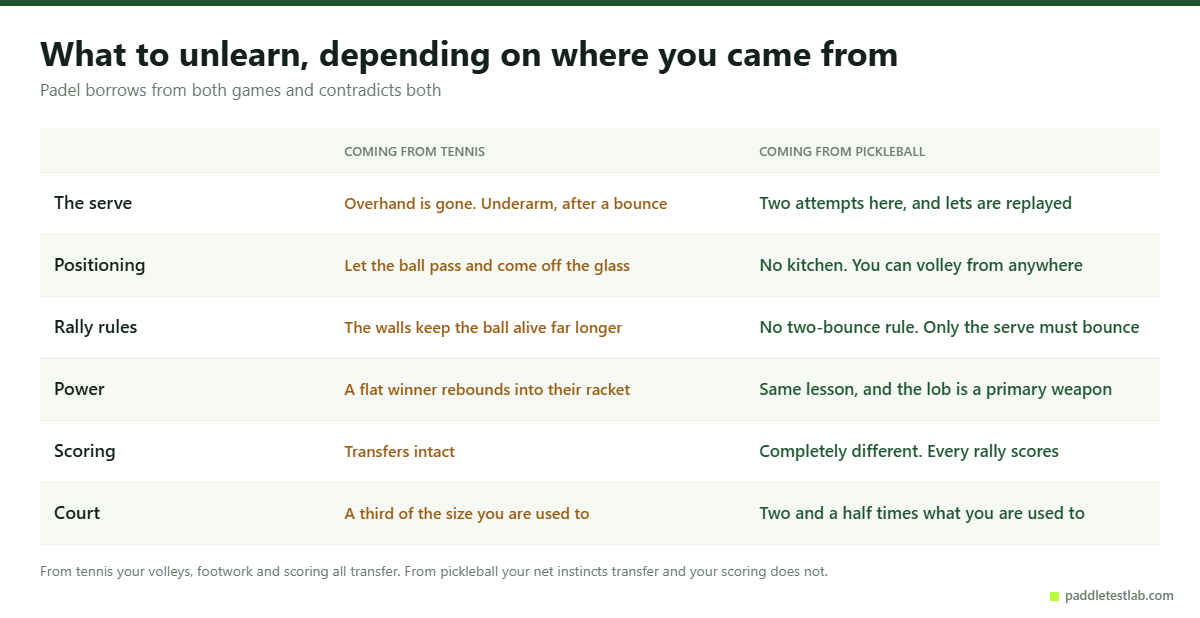
Three habits to unlearn:
- The overhead serve. Gone. Underarm, below the waist, after a bounce.
- Chasing every ball. Let it go past you and come off the glass. Standing still is often the correct play.
- Power. A flat winner that clears your opponent just rebounds off the back glass into their racket. Padel rewards placement, angles and patience; the lob is a primary weapon, not a defensive last resort.
The good news: your volleys, your footwork and the scoring system all transfer intact.
Coming From Pickleball
Different set of adjustments:
- There is no kitchen. You can volley from anywhere, including right at the net. The net position you fight for in pickleball is even more valuable here.
- There is no two-bounce rule. Only the serve has to bounce. After that, volley whenever you like.
- You get two serves, and lets are replayed.
- The scoring is completely different — tennis scoring, and points are won on every rally regardless of who served. Our padel scoring guide covers it in full.
- The court is much bigger, and you will cover far more ground than a pickleball court asks of you.
The Shots That Only Exist in Padel
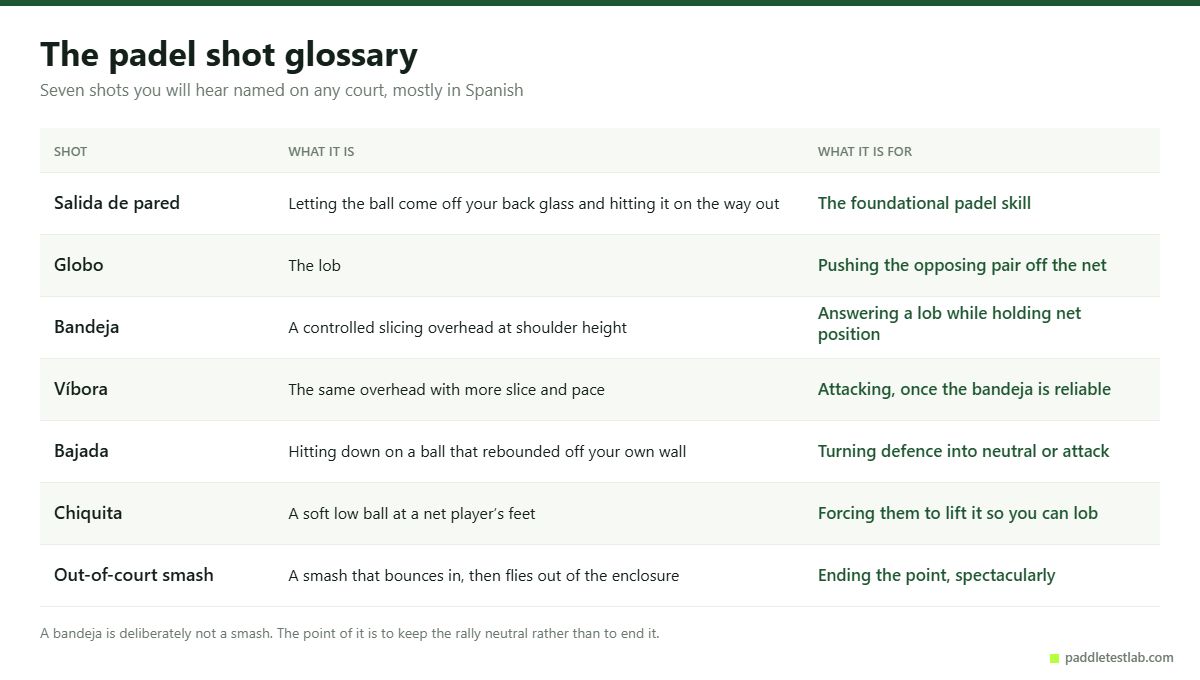
Padel has its own vocabulary, mostly Spanish, and the words describe shots that tennis and pickleball simply do not have. You will hear these on any court.
Salida de pared — the wall exit. Letting the ball pass you, come off the back glass, and hitting it on the way out. This is the foundational padel skill and the one tennis players take longest to trust. Until it is comfortable, you will chase balls you should have let go.
Globo — the lob. In padel the lob is an attacking weapon, not a last resort. A good lob pushes the opposing pair off the net and lets your pair move forward, and net position is where padel points are won. Expect to hit far more lobs here than in any other racket sport.
Bandeja — the tray. A controlled overhead played at around shoulder height with a slicing, flattish motion. It is deliberately not a smash: the point of a bandeja is to answer a lob, keep the rally neutral and hold your net position rather than try to end the point. It is the most useful shot in club padel.
Víbora — the viper. The bandeja’s aggressive cousin: the same overhead position, but hit with more slice and more pace so the ball kicks sideways off the glass. Harder, riskier, and what you graduate to once the bandeja is reliable.
Bajada — coming down on it. A shot played after the ball has rebounded off your own back wall, where you hit down and through it. It turns a defensive position into a neutral or attacking one.
Chiquita — the little one. A soft, low ball played at the feet of an opponent at the net, forcing them to lift it and give you the lob you want. It is the main tool for getting out of a defensive position without risking a passing shot.
The out-of-court smash. A smash hit hard enough that the ball bounces in and then flies out over the enclosure. On courts with side openings the opponent may chase it and play it back, which is why it fills every padel highlight reel.
Your First Session: Kit, Etiquette and What to Expect
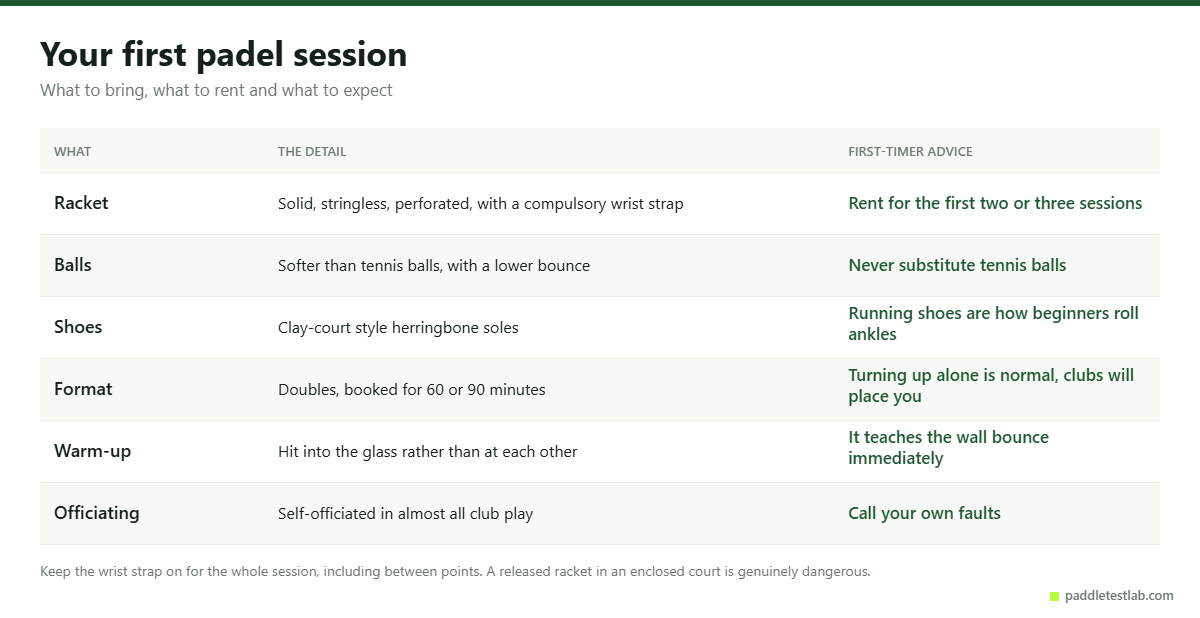
Kit. You need a padel racket — solid, stringless, perforated, with a wrist strap that is compulsory, because a released racket in an enclosed court is genuinely dangerous. Most clubs rent rackets, and renting for the first two or three sessions is sensible before you learn which shape suits you. Our guide to choosing a padel racket and the beginner racket roundup cover the choice when you are ready.
Balls. Padel balls look like tennis balls and are slightly softer with a little less pressure, so they bounce lower. Do not substitute tennis balls: the higher bounce ruins wall play, which is the whole game. See our padel ball guide.
Shoes. Padel involves more lateral movement and short slides than tennis, and clay-court style herringbone soles are the norm. Running shoes are the wrong tool and the most common cause of rolled ankles among beginners. Our padel shoe guide covers the outsoles.
Format and time. Courts are booked as doubles, usually for 60 or 90 minutes, and you play with the same three people for the session. Turning up alone is normal — most clubs run open sessions and will place you.
Etiquette worth knowing. Warm up by hitting into the glass rather than at each other. Call your own faults, since almost all club padel is self-officiated. If a ball from the next court comes into yours, the point is replayed. And keep the racket strap on your wrist for the whole session, including between points.
Why the Rules Make It Easy to Start
Padel is the fastest-growing racket sport in the United States, and the rules above explain most of why.
The serve is underarm, which removes the single hardest skill in tennis. A complete beginner can put a legal serve in play in their first ten minutes, and that alone is why first sessions are enjoyable rather than demoralising.
The walls keep the ball alive, so rallies last. A shot that would be a clean winner in tennis rebounds off the glass and comes back, which means beginners get more touches per point and mismatched pairs still have competitive games.
The court is enclosed and small, so you cover less ground than in tennis and there is no ball-chasing between points.
It is always doubles, which makes it social by design and makes booking a court a group activity rather than a duel.
The flip side, worth knowing before you get attached: courts are expensive to build and there are still far fewer of them than there are pickleball courts, so availability rather than interest is usually the limiting factor. If you are weighing the two sports up, our padel vs pickleball comparison sets them side by side on cost, court access and learning curve.
Frequently Asked Questions
Can you play padel singles?
It exists, on a narrower court, but it is rare. Padel is designed as a doubles game and almost every club court is set up for it.
Can you go outside the court?
On courts with side openings, yes — you may exit and return the ball from outside, provided you get it back into the opponent’s court legally. Courts without openings do not allow it.
Is the ball the same as a tennis ball?
It looks the same and is slightly softer, with a little less internal pressure, so it bounces lower. Do not substitute tennis balls; the bounce ruins wall play.
What racket do I need?
A solid, stringless, perforated racket with a wrist strap, which is compulsory. Shape and weight matter a great deal to how it plays — our guide to choosing a padel racket and racket shape guide cover the choice, and the beginner racket roundup has the shortlist.
Do I need special shoes?
Padel involves more lateral movement and sliding than tennis, and clay-court style herringbone soles are the norm. See our padel shoe guide.
How long does a match last?
Best of three sets, typically 60 to 90 minutes. Points last longer than in tennis because the walls keep the ball alive.
Rules in this guide follow the current International Padel Federation regulations. Last reviewed 15 September 2026.

Isacc Shah
Isacc Shah writes PaddleTestLab. He does not test paddles in a lab and says so plainly — there is no rig, no radar gun, no staff hitting balls. Instead he aggregates independent bench measurements, manufacturer specifications, USA Pickleball's approval database and hundreds of verified owner reviews per product, then reports where those sources disagree. Every score on the site carries its evidence count. Where a specification is not published, the site writes UNKNOWN rather than estimating it, and the criticism is printed next to the praise.