
Short answer: the pickleball kitchen rules come down to one sentence — you may not volley the ball while standing in the non-volley zone or touching its line. You may stand in the kitchen whenever you like. Everything below is the exceptions, and the exceptions are where every argument starts.
The kitchen rule is one sentence long. Almost every argument about it comes from the exceptions, and from a widespread belief that you are not allowed in the kitchen at all — which is wrong.
This page gives the rule, then catalogues every way to fault in the non-volley zone, then covers the two shots that look illegal and are not.
The Pickleball Kitchen Rules in One Sentence
You may not volley the ball while standing in the non-volley zone, or while touching any part of its line.
That is it. Note what it does not say. It does not say you cannot be in the kitchen — you may stand in it all day if you like. It only prohibits volleying from it.
A volley is a ball hit out of the air, before it bounces. A ball that has bounced can be hit from anywhere on the court, kitchen included. That is what a dink off the bounce is, and it is entirely legal.
The Zone Itself
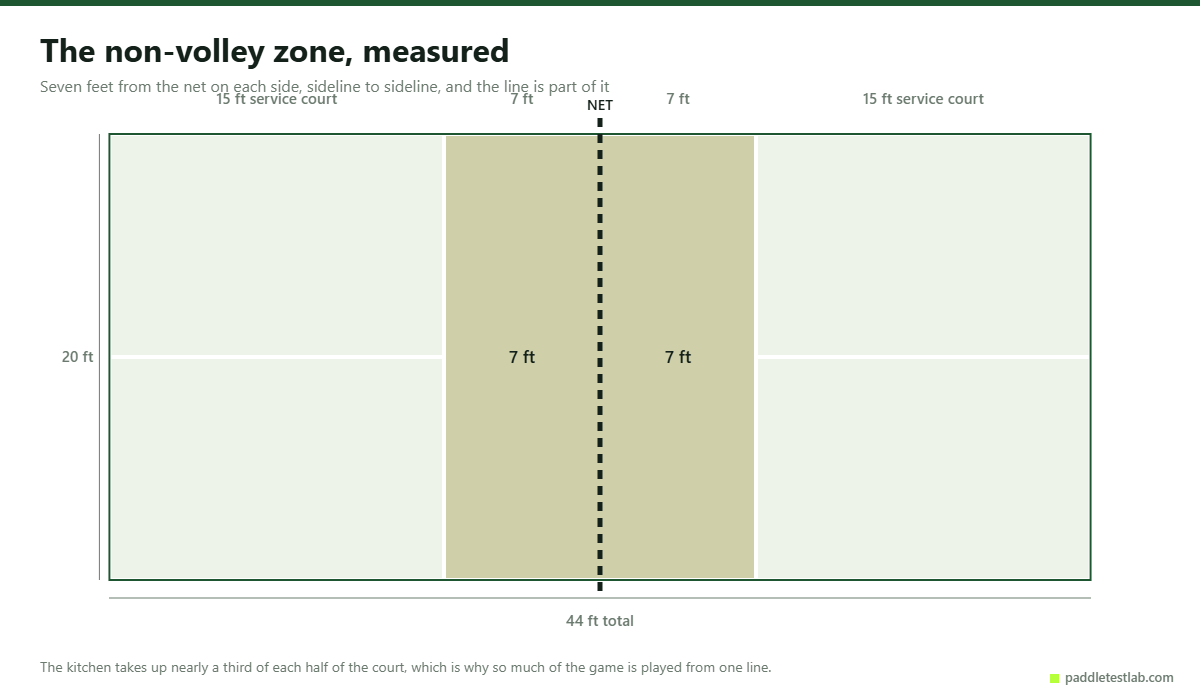
- Seven feet from the net on each side, measured from the net to the back edge of the non-volley line.
- Sideline to sideline — the full 20-foot width of the court.
- The lines are part of the zone. Touching the non-volley line counts as being in the kitchen. This catches more people than anything else on this page.
Full court measurements, including where the line sits relative to everything else, are in our pickleball court dimensions guide.
Every Way to Fault in the Kitchen
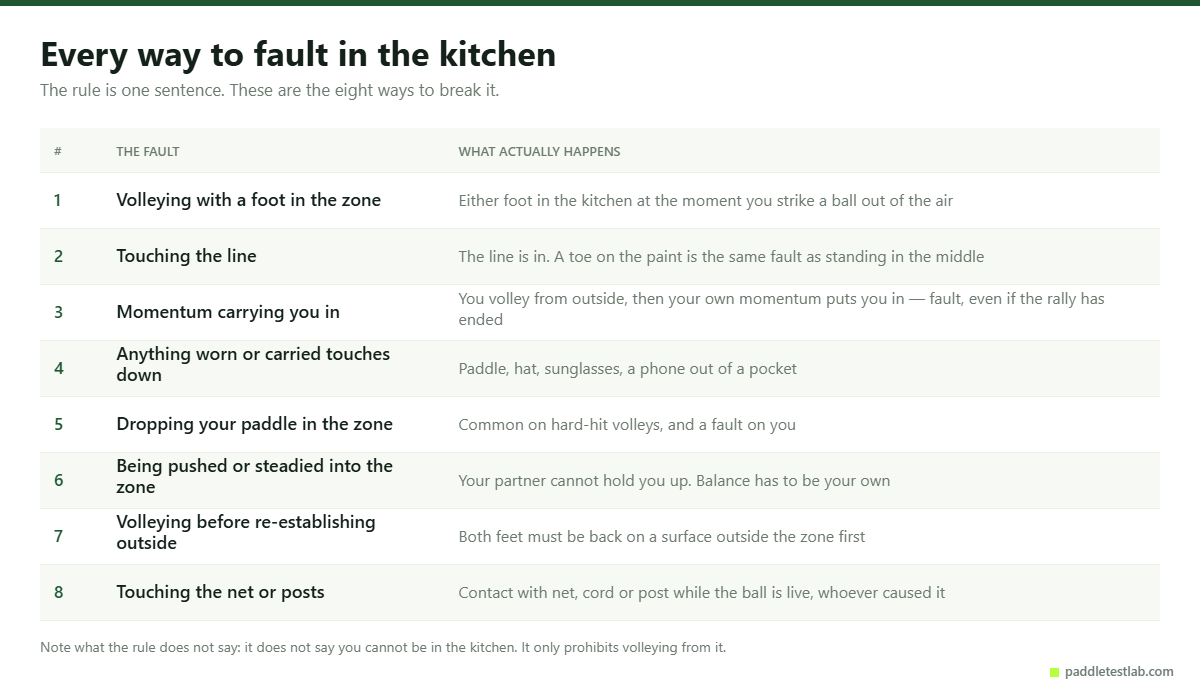
1. Volleying with a foot in the zone
The basic case. Either foot touching the kitchen or its line at the moment you strike a ball out of the air is a fault.
2. Touching the line
The line is in. A toe on the paint while volleying is the same fault as standing in the middle of the zone. Referees look at feet at contact, and most self-officiated faults happen here.
3. Momentum carrying you in
This is the rule people get wrong most often. If you volley from outside the kitchen and your momentum from that shot then carries you into the zone or onto the line, it is a fault — even though the ball is already gone, and even if the rally has ended.
The fault is not about interfering with play. It is about whether the act of volleying put you in the zone. You must come to a stop outside the kitchen before anything about you touches it.
4. Anything you are wearing or carrying touches down
Your paddle, a hat that falls off, sunglasses, a phone out of a pocket. If it touches the kitchen during the volley or during the momentum that follows it, it is a fault on you.
5. Dropping your paddle in the zone
A specific case of the above and a common one on hard-hit volleys. If the paddle leaves your hand and lands in the kitchen as part of the volley, you have faulted.
6. Being pushed or steadied into the zone
Your partner cannot hold you up to keep you out of the kitchen after a volley, and if partner contact results in you touching the zone, it is a fault. Balance has to be your own.
7. Volleying before re-establishing outside
If you have been in the kitchen — legitimately, hitting a bounced ball — you must get both feet back onto a surface outside the zone before you may volley again. A single foot out is not enough, and leaning back while one toe is still on the line is a fault.
8. Touching the net or net posts
Not strictly a kitchen rule, but it lives in the same moment. Contact with the net, the net cord or the posts while the ball is live is a fault, whoever caused it.
What You Are Allowed to Do in the Kitchen
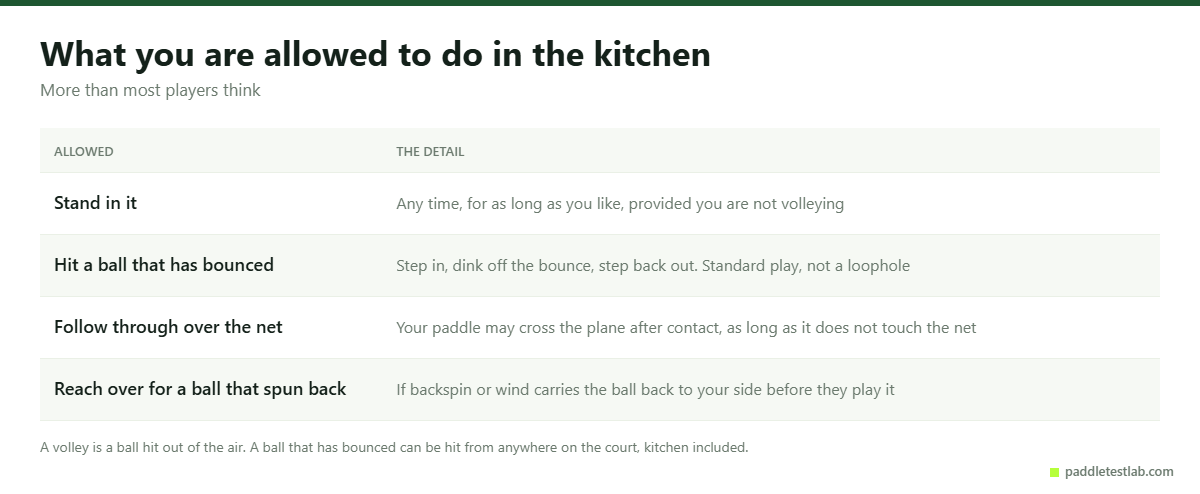
- Stand in it. Any time, for as long as you like, provided you are not volleying.
- Hit a ball that has bounced. Step in, dink off the bounce, and step back out. This is standard play, not a loophole.
- Follow through over the net. Your paddle may cross the plane of the net after contact, as long as it does not touch the net.
- Reach over the net for a ball that has spun back. If backspin or wind carries the ball back over to your opponent’s side before they play it, you may reach across to hit it — without touching the net or stepping into their court.
The Erne and the ATP — Legal, and Why
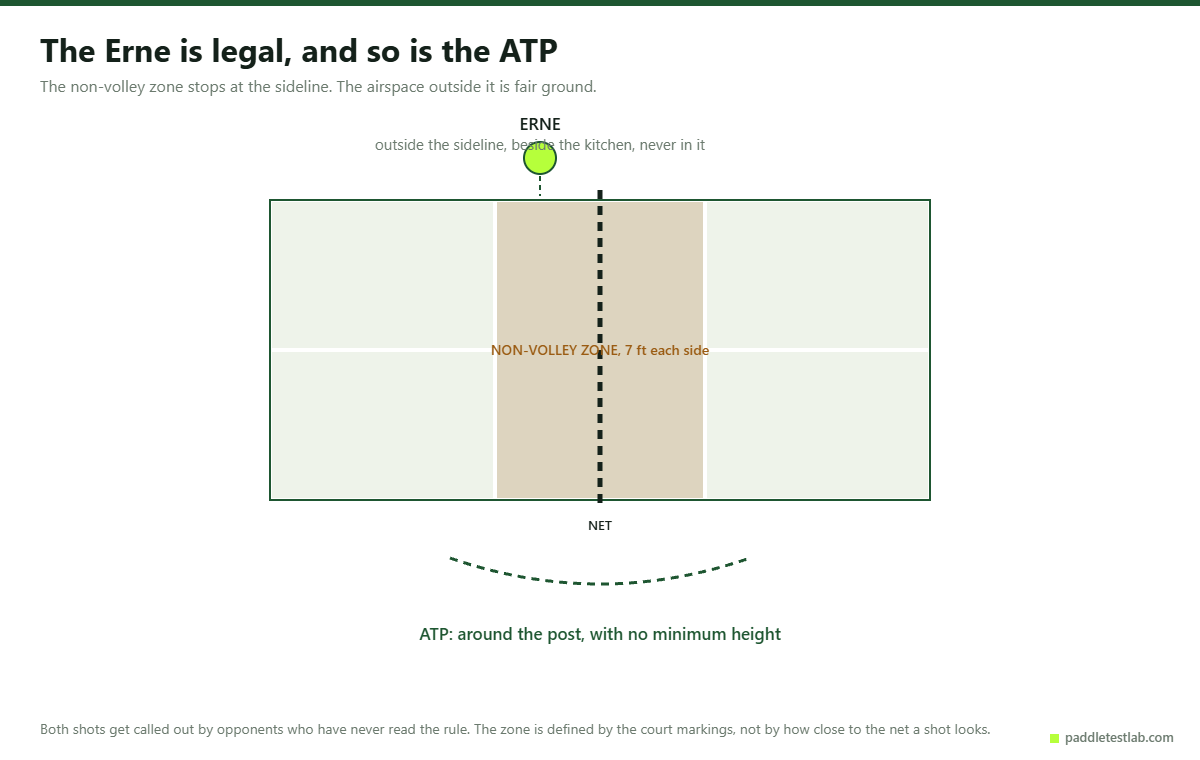
The Erne. A player jumps from outside the sideline, beside the kitchen rather than in it, and volleys the ball in mid-air close to the net. It looks illegal and it is not: the non-volley zone stops at the sideline, so the airspace outside it is fair ground. The player must not touch the kitchen or the net, and must land outside the zone. Done cleanly, an Erne is a legal volley taken from a place the rule simply does not cover.
The ATP — around the post. A ball wide enough can be hit around the outside of the net post rather than over the net, and there is no minimum height. The shot can travel below net level and land in. It surprises people every time, and it is legal.
Both shots are frequently called out by opponents who have never read the rule. The zone is defined by the court markings, not by how close to the net a shot looks.
How to Call It Fairly Without a Referee
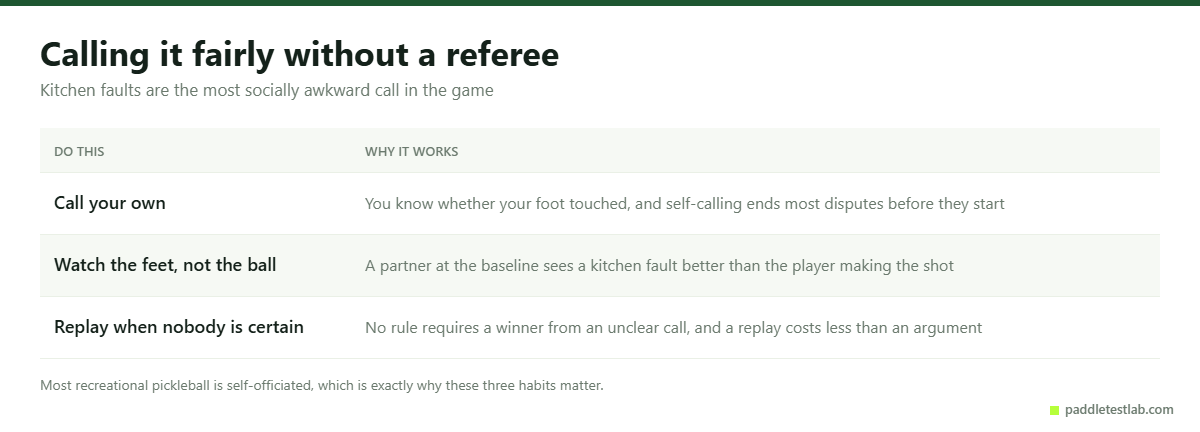
Most recreational pickleball is self-officiated, which makes kitchen faults the most socially awkward call in the game. Three things keep it clean:
- Call your own. You know whether your foot touched. Calling your own faults ends almost every dispute before it starts.
- Watch the feet, not the ball. A partner at the baseline is better placed to see a kitchen fault than the player making the shot.
- If nobody is certain, replay the point. There is no rule requiring a winner from an unclear call, and a replay costs less than an argument.
Where to Stand at the Kitchen Line
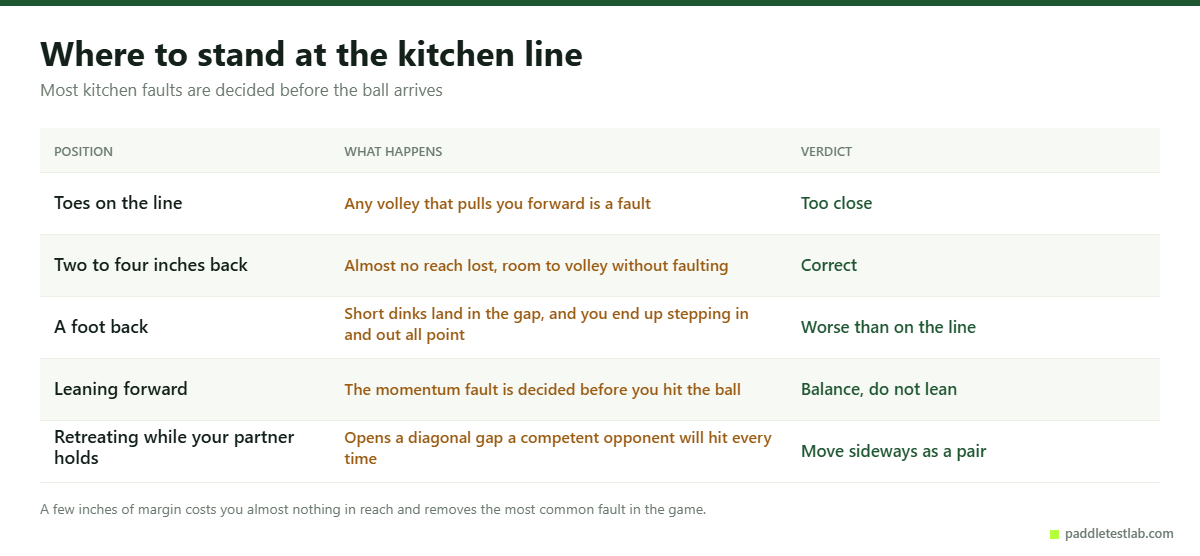
Almost every kitchen fault happens because of where a player was standing before the ball arrived, not because of what they did when it did. Position is the fix.
Stand with your toes two to four inches behind the line, not on it. On the line leaves you nothing: any volley that pulls you forward is a fault, and you will be pulled forward by every ball at your feet. A few inches back costs you almost no reach and gives you the room to volley without your momentum carrying you in.
Do not stand a foot back either. That is worse. It opens the gap in front of you where a dink lands short and forces you to step in and hit a ball that has bounced — which is legal, but it means you are now inside the zone and must get both feet back out before you can volley again. Players who camp a foot back spend the whole point moving in and out of the kitchen.
Split step as the ball leaves their paddle, with your weight balanced rather than leaning forward. Leaning is what turns a volley into a momentum fault. If you finish a volley already falling towards the net, the fault was decided before you hit the ball.
Move sideways along the line, not in and out. Your partner and you should hold the line together and shift as a pair. A player who retreats leaves a diagonal gap that a competent opponent will hit every time.
Watch your paddle on low volleys. A dropped paddle that lands in the zone is a fault, and it happens most on hard-hit balls at the ankles. Grip pressure matters more here than anywhere else on court, which is one reason a worn overgrip is worth replacing — see our overgrip guide.
Drills That Stop You Faulting
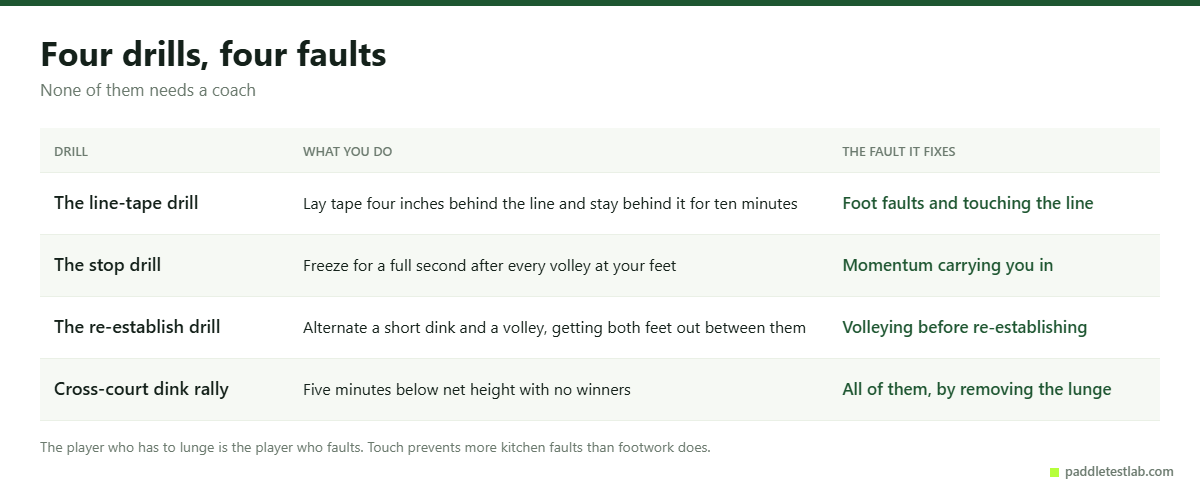
Four drills, none of which needs a coach, and all of which target a specific fault from the catalogue above.
The line-tape drill — for foot faults. Lay a strip of tape four inches behind the non-volley line and stand behind the tape instead. Play ten minutes of dinks and volleys without crossing it. The tape gives you a margin you can feel, and after a few sessions the margin stays even when the tape is gone.
The stop drill — for momentum. Have a partner feed you volleys at your feet. After every single volley, freeze completely for a full second before doing anything else. You will discover quickly whether you were balanced or falling in. This is the only drill that fixes momentum faults, because momentum is a balance problem rather than a footwork problem.
The re-establish drill — for volleying too early. Have your partner alternate a short dink that bounces in the kitchen with a ball you can volley. Step in for the dink, get both feet out, then volley. Do it slowly at first. The habit you are building is the two-footed exit, not the step-in.
The cross-court dink rally — for everything. The single most useful pickleball drill there is. Rally cross-court dinks with a partner for five minutes without a winner, aiming to keep every ball below net height. It builds the touch that keeps you out of the kitchen in the first place, because the player who has to lunge is the player who faults.
If you want a wider set of solo and partner drills, our drills guide covers the full range.
What Changes in Refereed Play
In a refereed match the kitchen rule is the same rule, but two things about it change.
Somebody else is watching your feet. A referee stands where they can see the non-volley line, and they are looking at feet at the moment of contact and at everything that happens immediately afterwards. Faults that go uncalled in a rec game — a toe brushing the line, a paddle grazing the zone on the follow-through — get called.
You stop calling your own. The referee’s call stands, and the correct response to one you disagree with is to ask for an explanation between rallies rather than to argue during one. Players may not overrule a referee on a non-volley-zone call.
The practical implication for anyone stepping up from recreational play into a sanctioned tournament: the margin you have been getting away with is about to disappear. The line-tape drill above is the cheapest way to find out how much margin you actually have, and it is worth doing a fortnight before your first refereed match rather than the morning of it.
Frequently Asked Questions
Can you stand in the kitchen?
Yes. There is no rule against occupying the non-volley zone. You may not volley from it, which is a different thing.
Is it a fault if I fall into the kitchen after the point ends?
If the fall is the momentum from your volley, yes — the rally being over does not save you. If you volley, come to a complete stop outside the zone, and then step in, that is legal.
What if my partner is in the kitchen when I volley?
Their position is irrelevant. Only the player striking the ball has to be outside the zone.
Does the kitchen line count as in or out?
The line is part of the non-volley zone. Touching it while volleying is a fault.
Why is it called the kitchen?
Nobody has a documented origin. The commonly repeated explanation borrows from shuffleboard, where “the kitchen” is a penalty area. Treat it as folklore rather than fact.
Where do the rest of the rules live?
Our scoring guide covers the three-number call and the double-bounce sequence, and the serving rules guide covers what makes a serve legal.
Rules in this guide follow the current USA Pickleball rulebook. Last reviewed 15 September 2026.

Isacc Shah
Isacc Shah writes PaddleTestLab. He does not test paddles in a lab and says so plainly — there is no rig, no radar gun, no staff hitting balls. Instead he aggregates independent bench measurements, manufacturer specifications, USA Pickleball's approval database and hundreds of verified owner reviews per product, then reports where those sources disagree. Every score on the site carries its evidence count. Where a specification is not published, the site writes UNKNOWN rather than estimating it, and the criticism is printed next to the praise.