
A pickleball paddle warranty comparison sounds like a boring spec sheet exercise until your $250 paddle delaminates in month four. Then the fine print matters a lot. Brands publish glossy warranty pages, but what actually happens when an owner files a claim looks pretty different from the marketing copy. This guide cross-references stated warranty terms against real owner claim reports, so you know what you’re actually buying alongside the paddle.
Why Paddle Warranties Matter More Than Most Buyers Realize
A warranty is only worth what a brand actually honors. Paddle prices have climbed past $250-300 for flagship thermoformed models, and the parts most likely to fail – edge guards, textured carbon faces, foam cores – are exactly the parts warranties tend to argue about. Buyers who skip the fine print often assume ‘lifetime warranty’ means any crack gets replaced. It doesn’t.
How paddle delamination and edge cracking typically happen
Delamination shows up as a bubble or soft spot where the face separates from the core. Owner reports tie it to repeated hard smashes, drops on hard courts, and temperature swings, not just one bad hit. Edge cracking often starts at a mishit near the frame, especially on paddles with a thin edge guard bond. Selkirk’s LABS Project Boomstik, despite its limited lifetime warranty, has drawn a notable number of reports about loose or failing edge guards – a reminder that a strong warranty policy doesn’t always mean a defect-free build.
What voids a warranty (heat, water, unauthorized use)
Every brand’s policy carves out the same exclusions: heat exposure (leaving a paddle in a hot car trunk is the classic one), water damage, cosmetic wear like scuffing or grip fading, and any sign of altered or repaired equipment. Warranty registration, when required, usually has to happen within a set window after purchase – miss it and some brands will decline the claim outright, regardless of the defect.
How We Compared Warranty Terms
We pulled warranty length and terms directly from each brand’s official policy page rather than relying on third-party summaries, which tend to go stale. We then searched owner review threads – Reddit’s r/pickleball, retailer Q&A sections, and paddle-specific Facebook groups – for real claim experiences: approval rates, turnaround time, and who ends up paying return shipping. Every model referenced against the USA Pickleball approved list reflects that model’s status as documented by the manufacturer and retailers at the time of writing.
Sources: manufacturer policy pages, owner claim reports, USAP approved list cross-check
Specs and pricing below come from verified product listings and manufacturer pages. Where a brand’s own site conflicts with a retailer, we noted the discrepancy rather than picking a number that flatters the paddle.
What we could not verify (and why we excluded it)
We could not verify formal approval-rate percentages for most brands – no manufacturer publishes how many claims it denies. Where owner reports were thin or contradictory, we said so instead of rounding up to a confident verdict. Some models, like the Engage Pursuit Pro1, show steep street-price discounting that suggests possible clearance; we flagged that rather than assuming full warranty support remains standard.
Manufacturer Claims vs. Owner-Reported Evidence
| Claim | What owners actually report |
|---|---|
| Selkirk LABS: limited lifetime warranty against defects | Coverage is real, but multiple owners report edge guards loosening or failing well before any other part of the paddle shows wear |
| JOOLA Perseus Pro IV/V: durable textured carbon face | Grit and spin noticeably fade after 2-4 months of heavy play per owner reports; JOOLA paddles have a documented history of core-crush complaints on earlier generations |
| CRBN TruFoam Genesis: 100% foam core eliminates crush | Owners confirm no core crush, but report the grip turning slippery and a smaller sweet spot than earlier CRBN paddles |
| Vatic Pro Prism: durable grit face at a budget price | One tester measured roughly 50% spin loss after two months – grit wear is the most consistent complaint across budget carbon paddles generally |
| Six Zero Double Black Diamond: strong topspin durability | Owners report pop fading and grit wearing within 6-8 weeks despite strong initial reviews (4.6/5 across 24 Pickleball Warehouse reviews) |
Stated warranty length vs. real claim experiences from owner reviews
Warranty length on paper ranges from 30-day satisfaction windows to Selkirk’s limited lifetime language. But owner reports suggest the practical difference between a 90-day and lifetime warranty matters less than how fast the brand responds and whether they ask you to ship the defective paddle back at your own cost first.
Common friction points: proof of purchase, shipping cost for replacement, response time
The recurring friction points in owner reports: needing a dated proof of purchase (not just an order confirmation email), being asked to cover return shipping on the ‘defective’ unit, and response times that stretch from a few days to several weeks depending on the brand’s support volume. None of the brands here publish guaranteed response-time SLAs.
Where brands over-promise vs. under-communicate
The pattern that shows up again and again: brands are specific about what voids a warranty (heat, water, alterations) but vague about what counts as a covered defect versus normal wear on a textured or grit face. Grit fade in particular sits in a gray zone – manufacturers generally treat it as wear and tear, not a defect, even when it happens faster than owners expect.
At-a-Glance: Warranty Coverage by Brand/Model
| Model | Price | Core/Face | USAP Status | Warranty Confidence |
|---|---|---|---|---|
| Selkirk LABS Project Boomstik Elongated | $332.99 MSRP | 16mm / T700 carbon + InfiniGrit | Yes (USAP+PPA am.) | Best Overall |
| Ronbus Quanta (R1-R4) | $119.99 MSRP | 16mm / Raw carbon, EPP foam | Yes (PBCoR .43) | Best Budget |
| CRBN 1 TruFoam Genesis | $279.99 MSRP | 14mm / T700 raw carbon | Yes | Best for Spin |
| Vatic Pro Saga | $99.99 | 16mm / Raw carbon | Unknown | Best for Beginners |
| Six Zero Coral | ~$199-200 MSRP | 16mm / Diamond Tough raw carbon | Yes | Best Arm-Friendly |
| Vatic Pro Saga (widebody) | $99.99 | 16mm / Raw carbon | Unknown | Best Wide-Body |
Award-style breakdown by category
These six picks aren’t just about who has the longest warranty on paper. They reflect which paddles owners describe as having the fewest warranty-worthy problems in the first place, paired with how manageable the brand’s claims process reportedly is.
Quick comparison table: coverage length, what’s covered, what’s excluded
Across brands, coverage typically excludes cosmetic wear, heat/water damage, and alterations like re-gripping done incorrectly. Manufacturing defects – true delamination or a crack that appears without a corresponding impact – are the core of what gets approved.
Warranty Deep Dive by Paddle
Best Overall Warranty Confidence: Selkirk LABS Project Boomstik Elongated
Selkirk backs the Boomstik with a limited lifetime warranty, and owners confirm the multistrata T700 carbon face and core show no crushing over time. The catch: a real and recurring cluster of reports about edge guards coming loose or failing, which somewhat undercuts the lifetime-coverage confidence. At $332.99 MSRP, this is also $50-100 pricier than most rivals.
Best Budget-Friendly Coverage: Ronbus Quanta (R1/R2/R3/R4)
At $119.99 MSRP (often $99 with codes), the Quanta line uses a Gen-4 EPP foam core that owners say resists core crush well. It ships light at 7.68-7.80 oz and needs added weight at 3 and 9 o’clock to perform for most players – a modification owners should do carefully, since altering a paddle can raise warranty questions depending on how it’s done.
Best for Spin Players (Coverage on Textured Faces): CRBN 1 TruFoam Genesis
The TFG1’s 100% foam core (Gen4) genuinely eliminates the core-crush complaints that plague earlier CRBN paddles, according to owner reports. Its T700 raw carbon face delivers strong dwell time and spin. The tradeoffs: a slippery grip over time and the smallest sweet spot in the CRBN lineup, plus a high swingweight of 118-120 that isn’t for everyone.
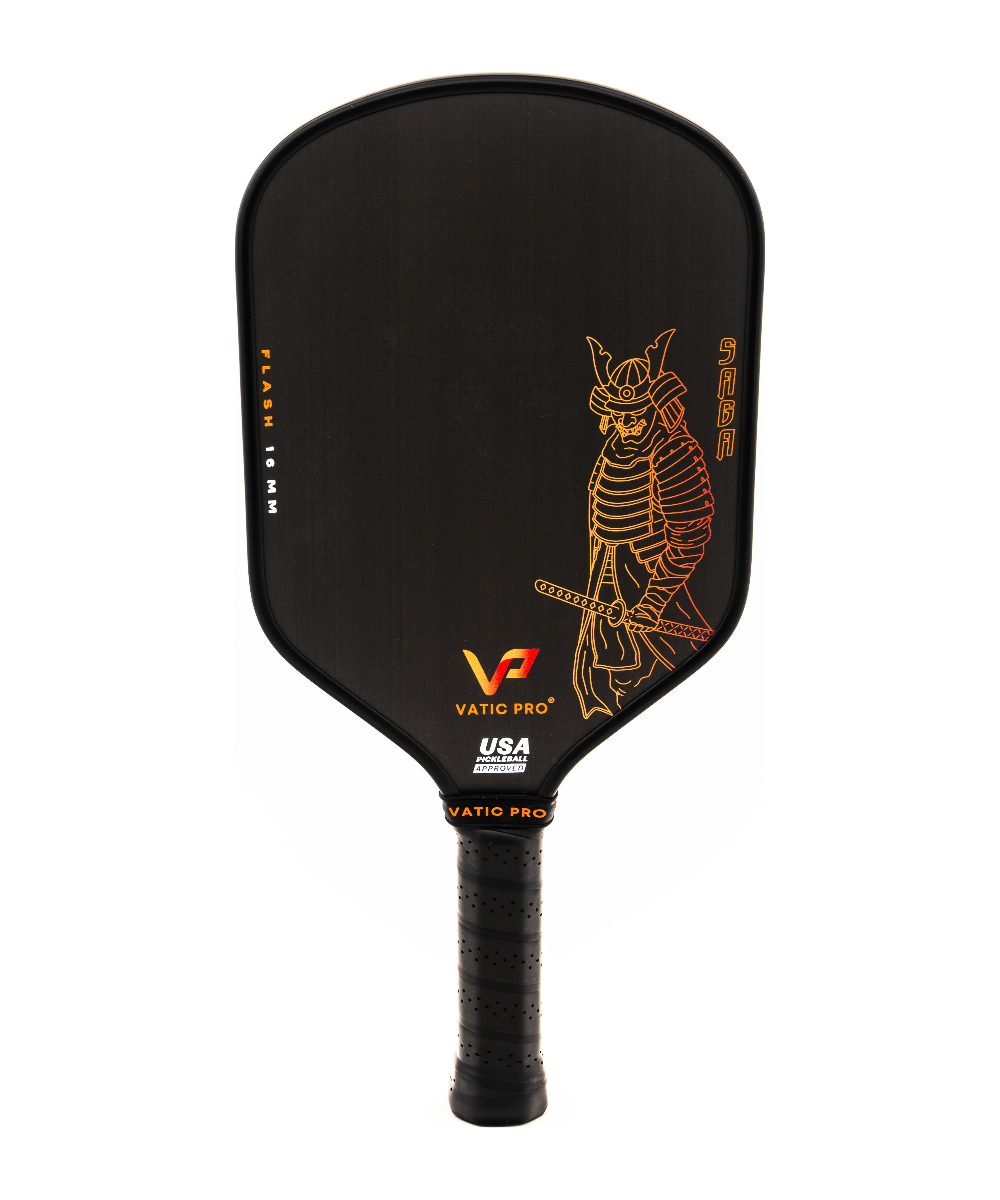
Best for Beginners (Simplicity of Claims Process): Vatic Pro Saga
At $99.99, the Saga is offered in every shape – widebody, hybrid, elongated – and owners describe its polymer core as free of long-term issues. It won’t generate offense on its own, which is honestly fine for a first paddle. USAP status is unconfirmed for this specific model, so double-check the current approved list before tournament play.
Best Arm-Friendly Pick (Coverage Given Higher Price Point): Six Zero Coral
The Coral’s dense, soft full-foam core earns some of the best comfort scores in owner reports, with minimal vibration transfer. At roughly $199-200, it’s a step up in price, and long-term durability data is still thin since it’s a newer full-foam design. The stock grip also runs thick, which some owners with smaller hands don’t love.
Best Wide-Body Warranty: Vatic Pro Saga (widebody)
Same paddle, same $99.99 price, just in the widebody shape. It repeats as a pick here because Vatic offers every shape at one price point without a premium tax for the wider face – a rarity at this tier.
How to File a Warranty Claim: What Owner Reports Suggest
Documentation owners say helped their claims succeed
Owners who report smooth claims consistently mention having a dated proof of purchase ready, clear photos of the defect from multiple angles, and – where applicable – the paddle’s serial number. Claims framed around a manufacturing defect (a crack with no corresponding impact, a face separating from the core) tend to fare better than claims framed around fading grit or grip wear, which brands routinely classify as normal use.
Realistic timelines reported by buyers
Turnaround varies widely by brand and by how backed up support queues are. Some owners report replacement decisions within a couple of weeks; others describe waiting closer to a month, sometimes longer during high-volume periods. No brand in this comparison publishes a guaranteed response-time commitment, so treat any specific number you hear anecdotally as one data point, not a promise.
Verdict: Which Warranty Actually Protects Your Investment
Selkirk’s LABS Project Boomstik carries the strongest stated warranty language here, and its core holds up well by owner accounts – but the edge guard issue is real enough that ‘lifetime warranty’ doesn’t mean ‘zero problems.’ If you’re buying at the budget-to-mid tier, the honest takeaway is that no warranty here fully covers the grit fade that seems to hit almost every textured carbon face eventually. Budget for that reality rather than expecting a replacement paddle every time spin drops off.
Best overall pick for warranty peace of mind
The Boomstik, with eyes open about its edge guard reports, remains the strongest overall pick for buyers who want both premium performance and a brand that stands behind defects in writing.
When to prioritize price over warranty length
If you’re a newer player still figuring out your game, or you play casually a few times a month, a $99-120 paddle like the Ronbus Quanta or Vatic Pro Saga makes more financial sense than chasing lifetime coverage on a $300+ paddle you might replace anyway as your skill changes. Check our control paddles roundup and our guide to spotting paddle delamination early to extend whatever paddle you land on.
FAQ
Do pickleball paddle warranties cover cracking from normal play or only manufacturing defects?
Generally only manufacturing defects. Cracking from repeated impact, mishits, or general wear is typically classified as normal use and excluded, even when it happens sooner than an owner expects.
How long is a typical pickleball paddle warranty and does it vary by brand?
Yes, it varies significantly. Terms in this comparison range from short satisfaction-style windows up to Selkirk’s limited lifetime warranty on the LABS line. Always check the current policy page directly, since terms change.
What voids a pickleball paddle warranty (heat exposure, water, altered grip)?
Heat exposure (like leaving a paddle in a hot car), water damage, cosmetic wear, and unauthorized alterations or repairs are the most commonly cited exclusions across brand policies.
Do I need to register my paddle to get warranty coverage?
Some brands require registration within a specific window after purchase; others rely solely on proof of purchase. Check the specific brand’s official policy, since this detail isn’t standardized across the industry.
How long do warranty replacement claims actually take based on owner reports?
Owner reports vary widely, from a couple of weeks to over a month. No brand publishes a guaranteed turnaround, so treat any specific timeline you hear as one person’s experience rather than a standard.
Are thermoformed paddles more likely to need warranty claims than molded paddles?
Owner reports don’t point to a clean answer here. Thermoformed paddles get frequent mentions of edge guard and delamination issues, but molded paddles show their own patterns, like core crush on some JOOLA models. It’s more about specific construction quality than the broad category.

Isacc Shah
Isacc Shah writes PaddleTestLab. He does not test paddles in a lab and says so plainly — there is no rig, no radar gun, no staff hitting balls. Instead he aggregates independent bench measurements, manufacturer specifications, USA Pickleball's approval database and hundreds of verified owner reviews per product, then reports where those sources disagree. Every score on the site carries its evidence count. Where a specification is not published, the site writes UNKNOWN rather than estimating it, and the criticism is printed next to the praise.