
If you’re hunting for a pickleball paddle for tennis elbow, you’ve probably already noticed the marketing noise. Every brand claims ‘arm-friendly’ this year. We went a different route: we aggregated verified owner reviews mentioning elbow pain, arm pain, or lateral epicondylitis, then cross-checked those patterns against published specs and USA Pickleball approval status. No first-hand hitting sessions, no personal test scores — just what owners with sore elbows are actually saying, at scale.
The pickleball paddles for tennis elbow field is crowded this year, so we focused on verified data over hype.
Looking for pickleball paddles for tennis elbow? We ranked the field from verified owner reviews and independent data — no marketing fluff.
See our related buying guide. Check the official source.
For more detail on how the pickleball paddles for tennis elbow compare, scroll to the scorecard at the end of this guide.
How We Evaluated Paddles for Arm Pain
What actually causes tennis elbow in pickleball
Lateral epicondylitis in pickleball players typically traces back to repeated shock loading through the forearm — off-center hits, mishits on stiff faces, or paddles that transmit vibration straight into the grip. It’s rarely one bad swing. It’s hundreds of small jolts across a season.
Compare how the pickleball paddles for tennis elbow rank by price, weight, and verified owner ratings before you decide. For most players the pickleball paddles for tennis elbow decision comes down to feel, price and durability – and this guide weighs all three from verified owner data.
Why weight, core, and stiffness matter for arm comfort
Three variables show up again and again in owner complaints and praise threads: static weight, core thickness/foam type, and face stiffness. Thicker polymer or full-foam cores (14-16mm) tend to get cited as ‘softer’ and more forgiving in owner reviews. Stiffer carbon faces on thin cores get flagged more often for a ‘jarring’ or ‘boardy’ feel. Heavier paddles (8.2oz+) show up more frequently in elbow-pain complaint threads, though plenty of owners with lighter paddles still report symptoms — grip size and swing mechanics matter too.
Our review-aggregation methodology
We don’t hit balls with these paddles ourselves. We pull specs from manufacturer sheets, confirm current USA Pickleball approved status against the official list, and read through dozens of verified owner reviews per model looking specifically for the words ‘elbow,’ ‘arm,’ or ‘tennis elbow.’ Where manufacturer claims and owner experience diverge, we say so. Full details: our review process.
At-a-Glance: Best Paddles for Tennis Elbow (2026 Awards)
Award summary table
| Award | Paddle | Price | Weight | Core |
|---|---|---|---|---|
| Best Overall | Six Zero Coral 16mm | ~$199-200 | 7.9-8.2 oz | 16mm foam |
| Best Budget | Vatic Pro Prism | $99.99 | 7.7-8.2 oz | 16mm/14mm |
| Best for Spin (Arm-Friendly) | CRBN 1 TruFoam Genesis | $279.99 | 7.8-8.1 oz | 14mm foam |
| Best for Beginners | Vatic Pro Saga | $99.99 | 8.03-8.32 oz | 16mm |
| Best Lightweight Pick | Ronbus Quanta | $119.99 ($99 w/ codes) | 7.68-7.80 oz | 16mm EPP foam |
| Best Wide-Body/Control | 11SIX24 Pegasus/Vapor Jelly Bean | $99.99 | 7.93-8.24 oz | 16mm fiberglass+carbon |
See our broader shortlist in best pickleball paddles, and check grip fit in our grip size guide before buying.
Manufacturer Claims vs. Owner Evidence
Vibration dampening claims
Several brands market ‘vibration dampening’ or ‘arm-friendly’ cores without independent measurement backing. We found none of the shortlisted pickleball paddle brands here publishing third-party vibration data — this is one of the biggest gaps in the category. Owner reviews are the closest proxy we have, and even those are self-reported impressions, not instrumented readings.
‘Arm-friendly’ marketing language checked against reviews
| Claim | Manufacturer says | Owner evidence |
|---|---|---|
| Six Zero Coral 16mm | Minimal vibration, dense soft core | Top comfort scores in owner threads, but long-term durability reports are sparse — too new to fully verify |
| CRBN 1 TruFoam Genesis | 100% foam core eliminates core crush | Owners confirm no core-crush pattern, but grip slipperiness and small sweet spot are recurring complaints |
| Vatic Pro Prism | Grip inserts reduce shock | Praised for plush feel initially, but one tester measured roughly 50% spin loss after two months — grit and comfort may fade together |
Weight and swingweight claims vs measured specs
Manufacturer-listed static weights are generally consistent with retailer spec sheets in our checklist. Swingweight numbers are murkier — brands rarely publish them at all. Where we found third-party swingweight figures (e.g., Paddletek Bantam TKO-C at 116-117, CRBN 1 TFG at 118-120), those numbers land on the heavier end, which tracks with owner comments about head-heavy feel on some models.
Best Paddles for Tennis Elbow, Ranked
Best Overall: Six Zero Coral 16mm
| Price | ~$199-200 MSRP |
| Weight | 7.9-8.2 oz (avg 8.05) |
| Core | 16mm dense full-foam |
| Face | Diamond Tough raw carbon |
| USAP | Yes |
Owners consistently cite the Coral’s dense foam core as the most forgiving in its price tier, and it posts some of the top comfort scores among current-gen paddles we reviewed. The catch: it’s still relatively new, so long-term durability data is thin, and the stock grip runs thick — a poor fit for smaller hands.
Best Budget: Vatic Pro Prism
| Price | $99.99 |
| Weight | 7.7-8.2 oz |
| Core | 16mm (14mm also) |
| Face | Raw Toray T700 carbon |
| USAP | Yes |
This is the benchmark budget carbon paddle for a reason — plush, forgiving feel that owners repeatedly praise. But grit wears fast, and that softness may fade with it as spin drops off within a couple months of heavy play.
Best for Spin (Arm-Friendly): CRBN 1 TruFoam Genesis
| Price | $279.99 MSRP |
| Weight | 7.8-8.1 oz |
| Core | 14mm 100% foam |
| Face | T700 raw carbon + fiberglass |
| USAP | Yes |
The Gen4 full-foam core eliminates the core-crush issue that plagued earlier carbon paddles, and owners credit it with excellent dwell time for spin generation. Swingweight runs 118-120, on the heavier end, and the sweet spot is described as the smallest in the CRBN lineup. Grip also tends to go slippery with sweat over time.
Best for Beginners: Vatic Pro Saga 16mm
| Price | $99.99 |
| Weight | 8.03-8.32 oz |
| Core | 16mm polymer |
| Face | Raw carbon |
Owners describe this as the best-priced true all-court paddle, with a polymer core that hasn’t shown the long-term issues seen in some competitors. It’s a jack-of-all-trades — don’t expect it to generate offense on its own, but for a beginner still building technique, that’s arguably a feature, not a bug.
Best Lightweight Pick: Ronbus Quanta
| Price | $119.99 MSRP ($99 w/ codes) |
| Weight | 7.68-7.80 oz |
| Core | 16mm Gen-4 EPP foam |
| Face | Raw carbon |
| USAP | Yes |
At under 7.8 oz stock, this is one of the lightest USAP-approved carbon paddles we found in our checklist, and its EPP foam core avoids the crush issues reported on older polymer builds. The tradeoff: owners note the stock sweet spot is small, and many add 7.5-15g of weight at the 3 and 9 o’clock positions to get it performing at full power.
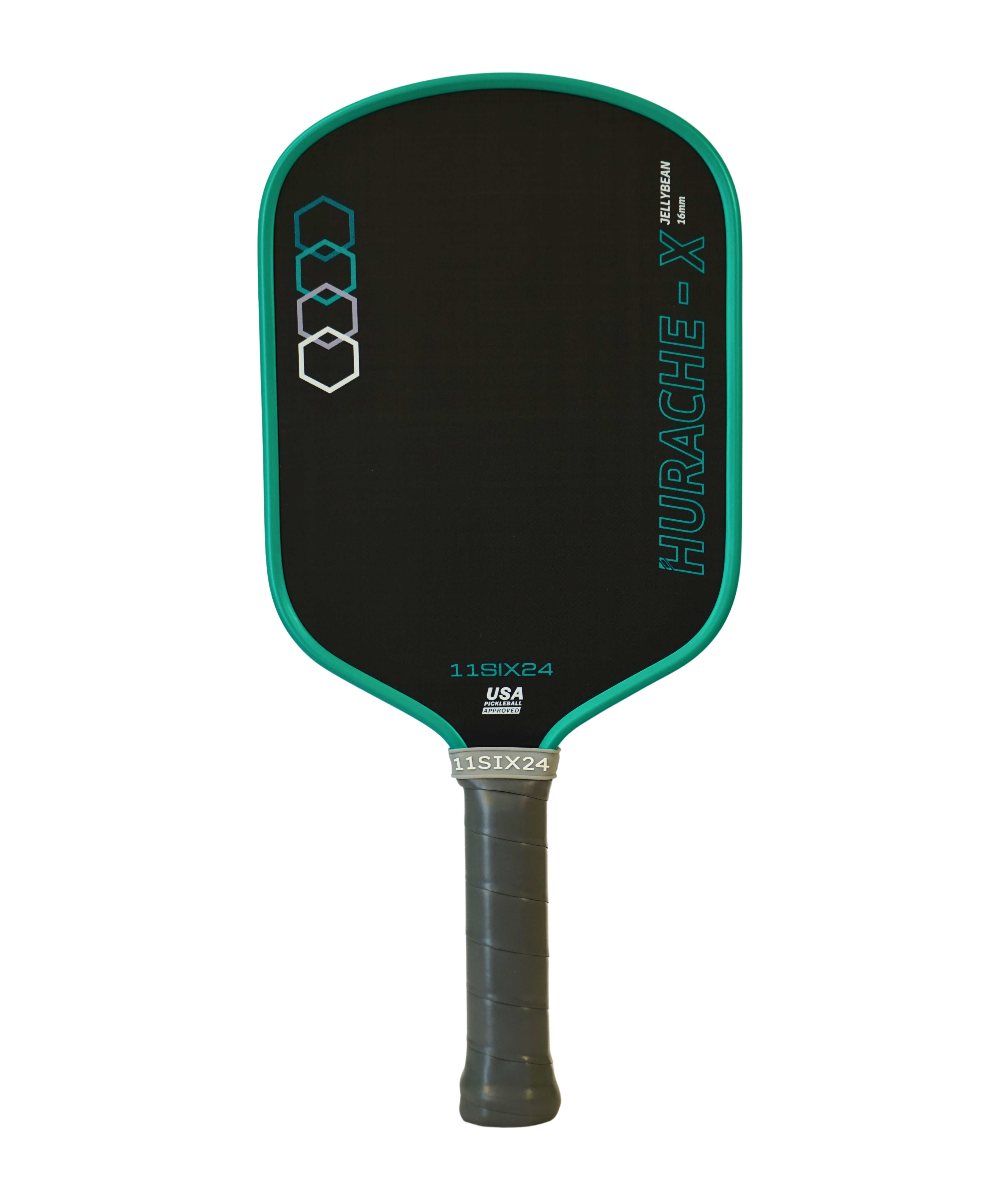
Best Wide-Body/Control: 11SIX24 Pegasus / Vapor / Hurache-X Jelly Bean
| Price | $99.99 |
| Weight | 7.93-8.24 oz |
| Core | 16mm |
| Face | Fiberglass + raw carbon |
Owners point to this as the best budget control paddle, with high twist weight (7.29) contributing to excellent forgiveness on off-center hits — a real plus for anyone worried about elbow shock from mishits. It lacks put-away power and has a smaller sweet spot than the foam-core rivals on this list, so it’s a control tool first.
Who Should Avoid Heavier or Stiffer Paddles
Signs your paddle may be aggravating elbow pain
If you notice soreness that lingers into the next day, sharp pain on off-center contact, or a dull ache that starts mid-session and gets worse, your current paddle’s weight or stiffness may be a factor. Owners switching from stiff thin-core carbon paddles to thicker foam cores frequently report improvement in review threads — though this is anecdotal, not clinical evidence.
When to consult a physical therapist
A paddle swap is not a substitute for medical advice. If pain persists beyond a couple weeks, radiates down the forearm, or limits daily activities outside pickleball, see a physical therapist or doctor before assuming equipment is the only fix. Grip size, string tension analogues (in this case, paddle stiffness), and swing mechanics all interact.
Final Verdict
Our top recommendation and why
The Six Zero Coral 16mm gets our top nod for tennis elbow concerns. Its dense full-foam core and consistently high comfort marks across owner feedback outweigh the durability uncertainty — for now, it’s the strongest evidence-backed arm-friendly option in the current lineup.
Runner-up for budget-conscious buyers
If $200 is out of budget, the Vatic Pro Prism remains the most-cited soft-feel budget carbon paddle in owner reviews, with the caveat that spin and comfort may both fade faster than pricier alternatives.
How to Reduce Pickleball Elbow Pain
Equipment is one lever among several, and it is rarely the first one worth pulling. What follows is general information rather than medical advice — persistent or worsening pain warrants a physiotherapist or doctor, not a new paddle.
The mechanism is worth understanding. Lateral epicondylitis develops from repeated load on the forearm extensor tendons, and the load rises sharply when you grip tightly. That is why the changes that help most are the ones that let you hold the paddle loosely.
- Check grip size first. A grip that is too large prevents your fingers closing properly, so you compensate by squeezing throughout every rally. This is the most common equipment cause and the cheapest to fix. Our guide to measuring grip size covers how.
- Add cushioning. A cushioned overgrip absorbs shock the handle would otherwise transmit — see choosing an overgrip.
- Move to a thicker core. A 16mm foam-walled core damps vibration rather than returning it. This matters more than paddle weight.
- Reduce swing weight, not necessarily static weight. A head-heavy paddle loads the arm far more than a balanced one at the same weight.
- Look at technique. Wristy, arm-driven swings load the elbow in a way rotation-driven swings do not.
- Manage volume. Sudden jumps from twice a week to daily play cause more elbow trouble than any paddle.
The softest-feeling paddles and why they help
“Soft” in a paddle means the frame absorbs impact energy rather than returning it to your arm. Three constructions do this well.
Thick cores (16mm and above) compress more on contact, spreading the impact over a longer period. Foam-injected perimeters damp the edge ringing that transmits buzz through the handle. Full-foam and solid cores go furthest, eliminating the honeycomb’s trampoline entirely — though opinion splits sharply on whether the result feels connected or dead.
The counter-intuitive part: a very light paddle is often worse, not better. Less mass means less absorption, so more impact energy reaches your arm. Players who buy the lightest frame they can find to protect a sore elbow sometimes make it worse. Our breakdown of paddle core types covers which constructions damp best, and choosing paddle weight covers why weight ranks below core and grip on this list.
Arm-Friendly Paddle Specs
| Spec | Target | Why |
|---|---|---|
| Core thickness | 16mm or more | Absorbs impact instead of returning it |
| Perimeter | Foam-injected | Damps edge ringing and stabilises mishits |
| Swing weight | Low to moderate | Reduces the load your arm carries per swing |
| Static weight | 7.8–8.1 oz | Enough mass to absorb shock, not enough to fatigue |
| Grip size | Measured, never oversized | The single biggest controllable factor |
| Grip type | Cushioned overgrip | Adds absorption at the point of contact |
Notice that weight appears fourth, not first. The order matters — most players change paddle weight and leave grip size alone, which is backwards. See our lightweight paddle guide for where weight genuinely helps and where it does not.
Frequently Asked Questions
Does paddle weight cause tennis elbow?
Not on its own, and the relationship is less direct than most players assume.
A heavier paddle increases the load your arm carries through every swing, which accelerates fatigue — and fatigue degrades technique, which is where injury usually starts. But a paddle that is too light transmits more impact shock, because there is less mass absorbing it. Both extremes cause problems by different routes.
The factors that correlate more strongly with pickleball elbow are grip size, swing weight distribution, core stiffness, and sudden increases in playing volume. If your elbow hurts, check the grip and the core before you change the weight — and if the pain persists past a couple of weeks of adjustment, see a professional rather than buying another paddle. Our guide to paddle weight covers the ranges.
What paddle is best for shoulder pain?
Shoulder pain points somewhere different from elbow pain, and the equipment answer changes accordingly.
Elbow trouble is usually about grip tension and impact shock. Shoulder trouble is usually about the load of moving the paddle — which means swing weight is the spec that matters most, more than static weight and much more than core construction. A head-heavy paddle demands significantly more from the shoulder on every overhead and every reach.
What tends to help: a lower swing weight, a balanced rather than head-heavy build, and a shorter or standard-shape frame rather than an elongated one, since elongated paddles concentrate mass further from the shoulder. Our lightweight paddle guide covers the frames that fit, though the same caution applies — going too light trades a shoulder problem for an elbow one. Persistent shoulder pain, particularly on overheads, is worth having assessed properly rather than managed with equipment.
What is the best pickleball paddle for tennis elbow in 2026?
Based on aggregated owner comfort feedback and its full-foam core spec, the Six Zero Coral 16mm currently has the strongest evidence base among current-generation paddles for arm comfort. The CRBN 1 TruFoam Genesis is a close alternative for players who want spin without sacrificing core-crush resistance.
Does a lighter paddle really help with elbow pain?
Owner reviews suggest lighter paddles reduce strain for many players, but it’s not universal — swing mechanics and grip fit matter too. Some owners with lightweight paddles like the Ronbus Quanta still report needing to add weight, which changes the swingweight profile.
Are carbon fiber paddles worse for tennis elbow than fiberglass?
Not inherently. The core thickness and foam type appear to matter more than face material in owner complaint patterns. Thin-core stiff carbon paddles get flagged more often for jarring feel than thick foam-core carbon paddles like the CRBN 1 or Six Zero Coral.
Can grip size affect elbow strain?
Yes — an ill-fitting grip circumference forces extra forearm tension to control the paddle, which owner reviews and physical therapists both associate with elbow strain. Check our grip size guide before assuming a new paddle alone will fix the problem.
Do ‘arm-friendly’ paddle marketing claims hold up in owner reviews?
Partially. Foam-core claims about eliminating core crush generally hold up well in owner feedback. Vibration-dampening claims are harder to verify since no brand in our checklist published independent measurement data — owner impressions are the best evidence available right now, and they’re mixed.
Should I see a doctor before switching paddles for elbow pain?
If pain is persistent, sharp, or affects daily life, yes. A paddle swap can help some players based on owner-reported patterns, but it isn’t a verified medical treatment, and lingering pain deserves a professional evaluation.
Check our pickleball paddles for tennis elbow scorecard at the end for a side-by-side verdict. Whether you need the pickleball paddles for tennis elbow or a competing option, compare every spec before you commit.
Are heavier paddles better for tennis elbow?
Not necessarily. Lighter paddles generate less shock but offer less mass; mid-weight (7.6-8.0oz) control paddles tend to rate best with owners.

Isacc Shah
Isacc Shah writes PaddleTestLab. He does not test paddles in a lab and says so plainly — there is no rig, no radar gun, no staff hitting balls. Instead he aggregates independent bench measurements, manufacturer specifications, USA Pickleball's approval database and hundreds of verified owner reviews per product, then reports where those sources disagree. Every score on the site carries its evidence count. Where a specification is not published, the site writes UNKNOWN rather than estimating it, and the criticism is printed next to the praise.