
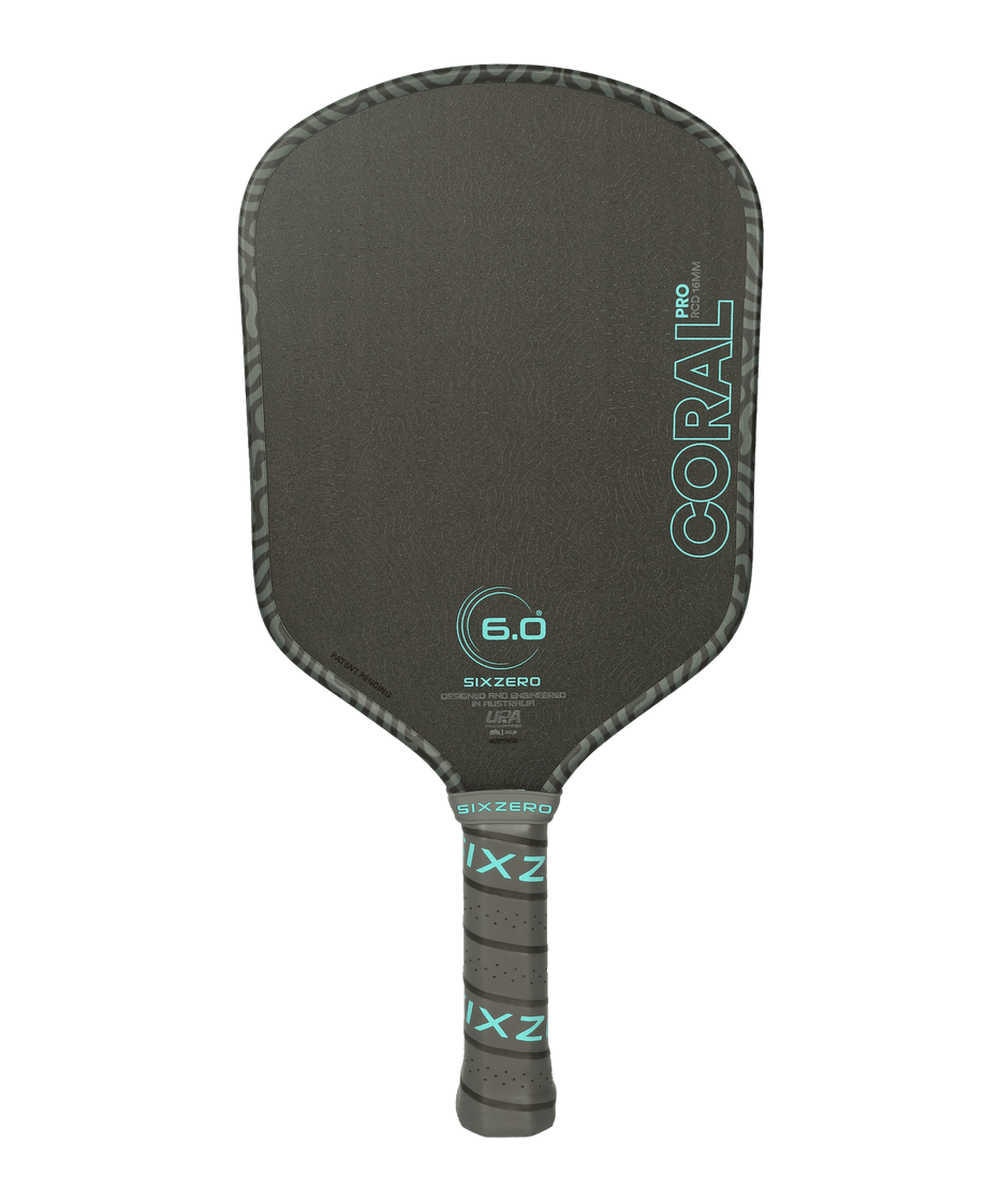
Finding the best pickleball paddle for large hands comes down to two numbers most shoppers never check: grip circumference and handle length. Get those wrong and you’ll fight your paddle instead of your opponent. We aggregated verified owner reviews and manufacturer spec sheets to see which paddles actually deliver a comfortable fit for bigger hands, and which ones just market the idea.
Compare how the best pickleball paddle for large hands rank by price, weight and verified owner ratings before you decide.
For more detail on how the best pickleball paddle for large hands compare, scroll to the scorecard at the end of this guide.

Why Grip Size and Handle Length Matter for Large Hands
A paddle that’s too small forces your fingers to overlap or clench, which drives up grip pressure and speeds up forearm fatigue. Owners with larger hands consistently report the same pattern in reviews: a grip that feels fine in the store starts to hurt after 45 minutes of real play. That’s not a durability issue – it’s a fit issue that shows up as tendon strain, not broken equipment.
How grip circumference is measured
Manufacturers measure grip circumference around the handle, typically listed in inches (commonly 4 inches to 4.5 inches across the market). Paddle brands don’t always publish this number clearly, and where our research checklist could not confirm a manufacturer-listed circumference for a specific model, we say so rather than guess.
Standard vs elongated handles
Handle length is a separate spec from grip circumference, and it matters most for players using a two-handed backhand. Elongated paddle shapes – like the JOOLA Perseus line, CRBN TruFoam Genesis, and Selkirk LABS Project Boomstik – shift length from the paddle face into the handle, giving two-handed players more room for a second hand without changing the total paddle length limit.
Signs your current paddle is too small
Owner reviews mentioning “hand fatigue” or “grip size” tend to cluster around a few recurring complaints: fingers wrapping past the butt cap, the paddle twisting in the hand on off-center hits, and needing to re-grip mid-rally. If any of that sounds familiar, the fix is rarely a stronger grip – it’s usually a bigger one.
Compare how the best pickleball paddle for large hands rank by price, weight and verified owner ratings before you decide.
For more detail on how the best pickleball paddle for large hands compare, scroll to the scorecard at the end of this guide.
At-a-Glance: Top Picks for Large Hands
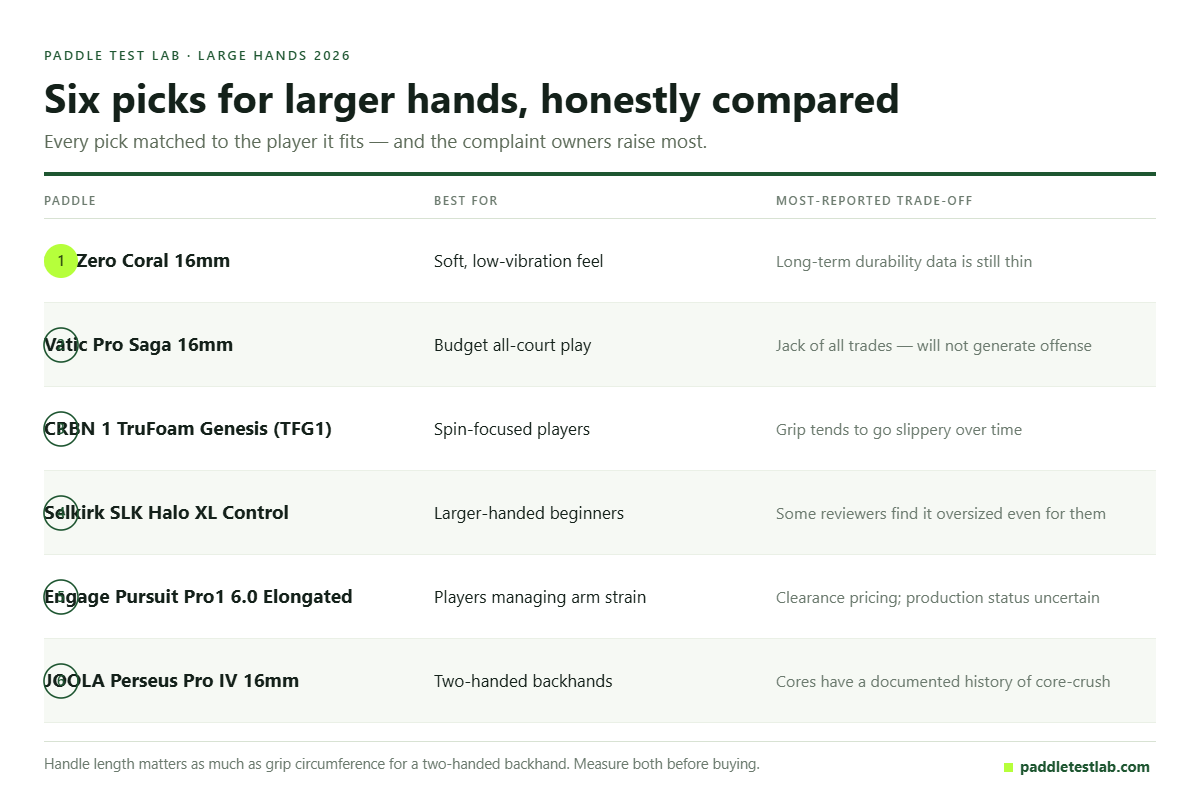
Award summary table
| Award | Paddle | Price | Weight | Shape |
|---|---|---|---|---|
| Best Overall | Six Zero Coral 16mm | ~$199-200 MSRP | 7.9-8.2 oz | Elongated/hybrid/widebody |
| Best Budget | Vatic Pro Saga 16mm | $99.99 | 8.03-8.32 oz | Widebody/hybrid/elongated |
| Best for Spin | CRBN 1 TruFoam Genesis (TFG1) | $279.99 MSRP | 7.8-8.1 oz | Elongated |
| Best for Beginners | Selkirk SLK Halo XL Control | $99.99 street | 7.6-8.2 oz | Elongated |
| Best Arm-Friendly | Engage Pursuit Pro1 6.0 Elongated | $259.99 MSRP | 8.0-8.3 oz | Elongated |
| Best for Two-Handed Backhand | JOOLA Perseus Pro IV 16mm | $249.95 street | 7.9-8.1 oz | Elongated |
Manufacturer Claims vs Evidence
Grip size claims vs owner-measured circumference
Most brands publish a single grip circumference per model rather than offering multiple sizes, which is a real limitation for large-handed shoppers. Owner reviews for the Six Zero Coral repeatedly describe the grip as noticeably thicker than rivals – flagged in the data as “poor for small hands,” which is effectively a positive signal if your hands run large. The Selkirk SLK Halo XL, by contrast, draws similar “thick grip” comments, but from women reviewers reporting it as too big, not too small – proof that a single spec cuts both ways depending on who’s holding it.
‘Extended handle = better for two-handed backhand’ claims checked against reviews
Elongated shape is marketed almost universally as friendlier for two-handed backhands, and the general logic holds – more handle room genuinely helps. But it’s worth noting: none of the paddles in our research checklist had review data specifically isolating two-handed backhand comfort as a standalone theme. The claim is directionally reasonable, and elongated models like the JOOLA Perseus Pro IV and CRBN TruFoam Genesis are the logical picks, but we’re extrapolating from shape and length specs rather than a dedicated two-handed-backhand review pattern.
Comfort/anti-fatigue marketing vs documented owner complaints
This is where the gap between marketing and reality shows up most. The CRBN TruFoam Genesis markets itself on dwell time and control, but owner reviews document the grip going slippery over time – a comfort issue that isn’t advertised anywhere. The Engage Pursuit Pro1 is the one paddle in this database with a genuine documented reputation for reducing arm strain, built around vibration dampening rather than grip size alone. That’s a meaningfully different, and better-supported, comfort claim than most of the field.
Detailed Picks by Award Category

Best Overall for Large Hands: Six Zero Coral 16mm
Owners consistently report minimal vibration and a full-foam core that feels dense but forgiving, with a thicker stock handle that draws praise from bigger-handed players and complaints from smaller-handed ones. That split is exactly the signal we’re looking for in this category. Long-term durability data is still thin since it’s a newer paddle, so treat the comfort verdict as strong and the longevity verdict as unproven.
| Price | ~$199-200 MSRP |
| Weight | 7.9-8.2 oz (avg 8.05) |
| Core | 16mm full foam |
| Face | Diamond Tough raw carbon |
| USAP status | Approved |
Best Budget: Vatic Pro Saga 16mm
At $99.99, the Saga is the best-priced true all-court option with every shape available, including elongated for players wanting more handle. Owners describe the polymer core as reliable without the long-term core-crush issues reported on some pricier carbon paddles. The tradeoff, per reviews: it’s a jack-of-all-trades paddle that won’t generate offense on its own.
| Price | $99.99 |
| Weight | 8.03-8.32 oz |
| Core | 16mm (14mm also available) |
| Face | Raw carbon |
| USAP status | Unknown – not confirmed in research |
Best for Spin: CRBN 1 TruFoam Genesis (TFG1)
The Gen4 100% foam core is the headline feature here – owners and independent sources agree it eliminates the core-crush problem that plagues some rival paddles, while delivering strong dwell time and spin. The catch, documented repeatedly in owner reviews: the grip tends to go slippery over time, and the sweet spot is the smallest in the CRBN lineup. Swingweight also runs high (118-120), which matters for anyone already managing arm fatigue.
| Price | $279.99 MSRP |
| Weight | 7.8-8.1 oz |
| Core | 14mm foam |
| Face | T700 raw carbon + fiberglass |
| Swingweight | 118-120 |
Best for Beginners: Selkirk SLK Halo XL Control
At $99.99 street, this brings Selkirk’s T700 raw carbon face to an entry price point, and reviewers praise the control it offers newer players. Spin numbers land only around 1400-1450 RPM by independent measurement standards for carbon paddles – modest for the category – and it lacks the power for aggressive players. The grip runs thick, which large-handed beginners will likely appreciate, though some reviewers (particularly women) report it’s oversized for their hands.
Best Arm-Friendly: Engage Pursuit Pro1 6.0 Elongated
This is the paddle most consistently named in owner reviews as the go-to pick for players managing tennis elbow or general arm strain. It’s built around vibration dampening rather than a bigger grip alone, and owners describe the swingweight as unusually low for an elongated paddle. One flag from our research: pricing has been seen discounted heavily (down to $99.99 from a $259.99 MSRP), which can indicate clearance activity – worth confirming current production status before buying.
Best for Two-Handed Backhand Players: JOOLA Perseus Pro IV 16mm
The Pro IV has technically been superseded by the Perseus Pro V, but reviewers repeatedly say they prefer the Pro IV’s feel and forgiveness at a lower price ($249.95 street versus $299.95 for the Pro V). Its elongated shape gives two-handed backhand players more handle room, and owners praise the large sweet spot. The known weakness: JOOLA’s cores have a documented history of core-crush issues, and grip/spin performance tends to fade after 2-4 months of heavy play.
How to Choose: Sizing Guide for Your Hand
Measuring your grip size at home
Measure from the middle crease of your palm to the tip of your ring finger. That length in inches roughly corresponds to a comfortable grip circumference, though this varies by individual hand shape – treat it as a starting point, not a guarantee.
Overgrip and building up a handle
Adding an overgrip is the cheapest way to increase circumference slightly, and plenty of owners in the review data mention doing exactly this rather than buying a new paddle. It won’t fix a handle that’s fundamentally too short, and stacking multiple overgrips changes swingweight and feel more than most players expect.
When to size up vs choose a longer handle
If your complaint is fingers wrapping too far around the paddle, you need a larger grip circumference – overgrips can help here. If your complaint is running out of handle room on two-handed shots, you need a longer handle, which usually means an elongated shape – overgrips won’t solve that.
Our Verdict
Who should buy which paddle
Players with genuinely large hands and no specific power or spin priority should start with the Six Zero Coral. Budget-conscious buyers do well with the Vatic Pro Saga. Spin-focused players should weigh the CRBN TruFoam Genesis against its grip-durability complaints. Beginners with bigger hands get real value from the Selkirk SLK Halo XL. Anyone managing arm pain should prioritize the Engage Pursuit Pro1, pending confirmation it’s still being manufactured. Two-handed backhand players get the most handle room from the JOOLA Perseus Pro IV.
Final recommendation summary
No paddle in this data set has a manufacturer-published “large hand” grip size option – the market simply doesn’t segment that way yet. The workaround is picking a paddle with a naturally thicker stock grip (Coral, Halo XL) or building up a standard grip with an overgrip. Owner reviews are the most reliable signal available until brands start publishing grip circumference more consistently across their lineups.
Paddles for a 4 5/8 Grip and Above
If you measure at the top of the range, the honest position is that almost nothing ships that large. Pickleball grips top out around 4 1/2″ from the factory, and 4 5/8″ is effectively a build-up rather than a purchase.
That is not the problem it sounds like, because building up is easy and building down is not. Start with a paddle at 4 1/4″ or 4 1/2″ and add wraps until it fits. Each overgrip adds roughly 1/16″, so two takes a 4 1/2″ handle to about 4 5/8″, and you get better cushioning than a thicker factory handle would give you.
What to prioritise instead of chasing a large stated grip: a longer handle (5.5″ or more), which matters more for large hands than circumference does — a short handle leaves your hand running off the end regardless of thickness. Gearbox and elongated frames generally run longest. Our Gearbox review covers a brand built around long handles.
How to build up a paddle grip properly
Three methods, roughly in order of how much they add:
- Overgrips. About 1/16″ per wrap, reversible, cheap, and they improve tackiness at the same time. Two is comfortable, three is the practical ceiling before the handle loses its bevels. Our guide to wrapping an overgrip covers the technique.
- A thicker replacement grip. Strip the factory grip and fit a cushioned replacement, then overgrip on top. Adds more than an overgrip alone and keeps a cleaner handle shape.
- Heat-shrink sleeve. Slides over the bare handle and shrinks to fit, adding thickness while preserving the bevel shape better than tape. More work, best result for a large increase.
What to avoid: stacking four or more overgrips. Past three the handle loses its bevels, so you lose the tactile reference that tells you where the face is pointing, and the outer layers start moving independently of the inner ones. Our guide to measuring grip size covers finding your actual number first.
Longest-Handle Paddles

| Handle length | Suits | Trade-off |
|---|---|---|
| 4.5″ – 5.0″ | Standard one-handed play, average hands | Cramped for large hands and two-handed backhands |
| 5.3″ – 5.5″ | The practical range for large hands | Slightly shorter face than the same frame with a short handle |
| 5.5″ + | Two-handed backhands, tennis converts, largest hands | Noticeably less hitting surface; usually elongated frames |
The trade-off is fixed by geometry: handle length comes out of face length, because the governing body caps total paddle length at 17 inches. A 5.5″ handle on a 16.5″ frame leaves less face than a 5.0″ handle on the same frame. If you need the handle, that is a fair exchange — our elongated paddle roundup covers the frames that make it, and shape trade-offs covers what you give up elsewhere.
FAQs
What grip size do I need for large hands?
Measure rather than assume. From the middle crease of your palm to the tip of your ring finger: around 4 3/8″ to 4 1/2″ puts you at the large end, and above that you are into build-up territory.
The counter-intuitive advice: buy at 4 1/4″ or 4 1/2″ and build up, rather than hunting for the largest handle you can find. A grip that is too large is worse than one slightly too small — it prevents your fingers closing properly, forces constant squeezing, restricts wrist action, and is a documented contributor to tennis elbow. A slightly small grip with two overgrips gives you the size you want plus cushioning, and it is adjustable if you get it wrong. Our guide to measuring grip size covers both methods, and the arm-friendly guide covers why oversizing causes problems.
What is the best paddle for a two-handed backhand?
Handle length is the spec that decides this, not face shape. You need room for both hands, which means 5.5″ or longer — and a paddle with a beautiful shape and a 4.75″ handle is useless to you regardless of its other qualities.
Elongated frames are the usual answer because the extra overall length leaves room for a longer handle, and the shape suits the fuller swing a two-handed backhand produces. Tennis converts land here for the same reason. The trade-off is a narrower face with the sweet spot further from your hand, so mishits are punished harder — acceptable if your contact is already grooved from another racket sport, less so if it is not. Our elongated roundup covers the frames, and swing weight covers why long-handled paddles often feel lighter than their stated weight.
What grip size should I use if I have large hands?
There’s no universal number, since most paddles ship in a single grip circumference. Measure your palm-to-fingertip length as a rough guide, then lean toward paddles owners describe as having a thicker stock grip, like the Six Zero Coral, and add an overgrip if needed.
Do longer paddle handles help with two-handed backhands?
Generally, yes – elongated shapes like the JOOLA Perseus Pro IV or CRBN TruFoam Genesis shift more length into the handle. That said, our research didn’t turn up dedicated owner-review data isolating two-handed backhand comfort specifically, so treat this as a reasonable inference rather than a confirmed pattern.
Can I just add overgrips instead of buying a paddle with a bigger grip?
Often, yes, and many owners do exactly this. It’s a good fix for slightly-too-small grips but won’t solve a handle that’s too short overall, and it will add some weight and change swingweight.
What is the average pickleball paddle grip circumference?
Commonly it falls somewhere around 4 to 4.5 inches across the market, though exact published circumference wasn’t confirmed for every model in our research and owner-reported comfort varies by individual hand size.
Are elongated paddles harder to control for beginners?
Owner reviews suggest elongated shapes can feel less forgiving on off-center hits compared to wider or hybrid shapes. Beginner-friendly picks like the Selkirk SLK Halo XL or Vatic Pro Saga tend to favor control-oriented shapes for exactly this reason.
Does a bigger grip affect paddle swingweight or maneuverability?
Yes – adding grip material, whether stock or via overgrip, shifts weight toward the handle end and can change how head-heavy or head-light a paddle feels. Reviewers on head-heavy paddles like the Paddletek Bantam TKO-C already note added weight compounds that effect, so it’s worth checking published swingweight where available.
For more comparisons, see our best pickleball paddles 2026 roundup and our dedicated paddle grip size guide. Always confirm any model’s current status against the USA Pickleball approved paddle list before buying, since approval status and specs can change between production runs.
Check our best pickleball paddle for large hands scorecard at the end for a side-by-side verdict.
Check our best pickleball paddle for large hands scorecard at the end for a side-by-side verdict.
The best pickleball paddle for large hands rankings above come from verified owner data, not the manufacturers’ marketing lines.

Isacc Shah
Isacc Shah writes PaddleTestLab. He does not test paddles in a lab and says so plainly — there is no rig, no radar gun, no staff hitting balls. Instead he aggregates independent bench measurements, manufacturer specifications, USA Pickleball's approval database and hundreds of verified owner reviews per product, then reports where those sources disagree. Every score on the site carries its evidence count. Where a specification is not published, the site writes UNKNOWN rather than estimating it, and the criticism is printed next to the praise.