
Looking for pickleball paddle grip size? We ranked the field from verified owner reviews and independent data — no marketing fluff.
Grip size is the pickleball paddle spec buyers most often overlook, and the one they most often regret. Two paddles with identical cores and faces can feel completely different in your hand purely because of grip circumference, and the wrong size quietly works against your control, your spin, and in some owner reports, your elbow. This guide covers what the two grip measurements actually mean, how to measure yourself at home, and how to choose when you are stuck between sizes.
For more detail on how the pickleball paddle grip size compare, scroll to the scorecard at the end of this guide.
The Two Grip Measurements That Actually Matter
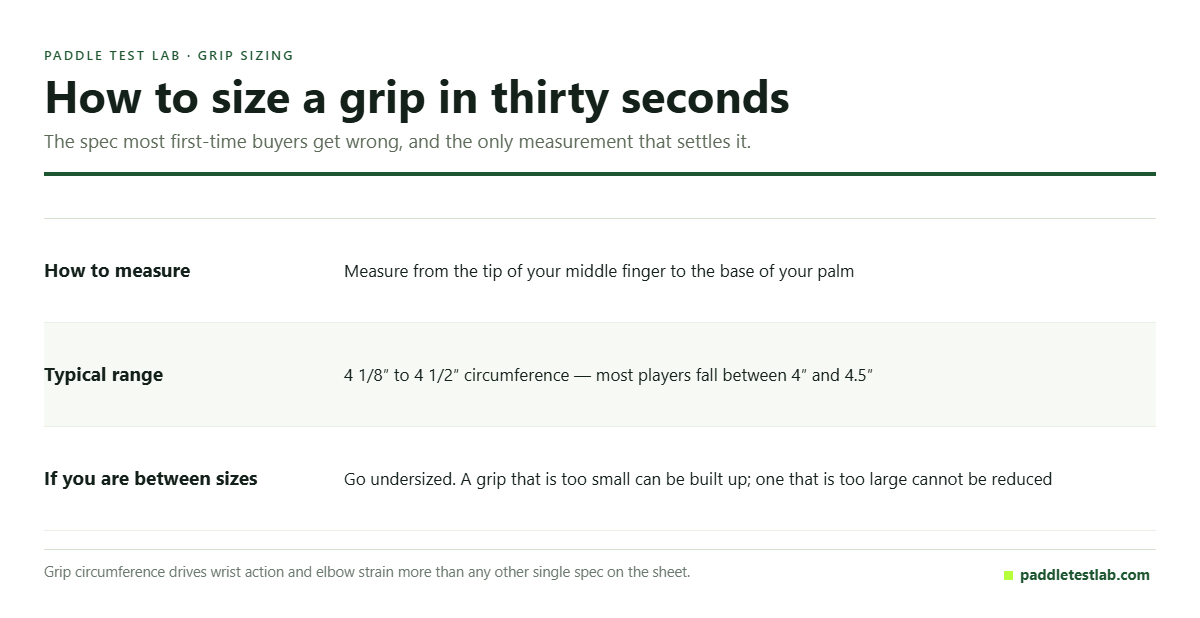
People say “grip size” as if it is one number, but there are two, and they do different jobs. Grip circumference is the distance around the handle, usually between 4 inches and 4‑1/2 inches on pickleball paddles. It controls how the handle fills your palm. Handle length is a separate spec entirely; longer handles suit two-handed backhands and players coming from tennis, while shorter handles free up face area on the paddle. This guide is about circumference, because that is the number tied most directly to comfort and strain.
Compare how the pickleball paddle grip size rank by price, weight, and verified owner ratings before you decide. For most players the pickleball paddle grip size decision comes down to feel, price and durability – and this guide weighs all three from verified owner data.
How to Measure Your Pickleball Grip Size at Home
There are two quick methods owners rely on, and they usually agree within an eighth of an inch.
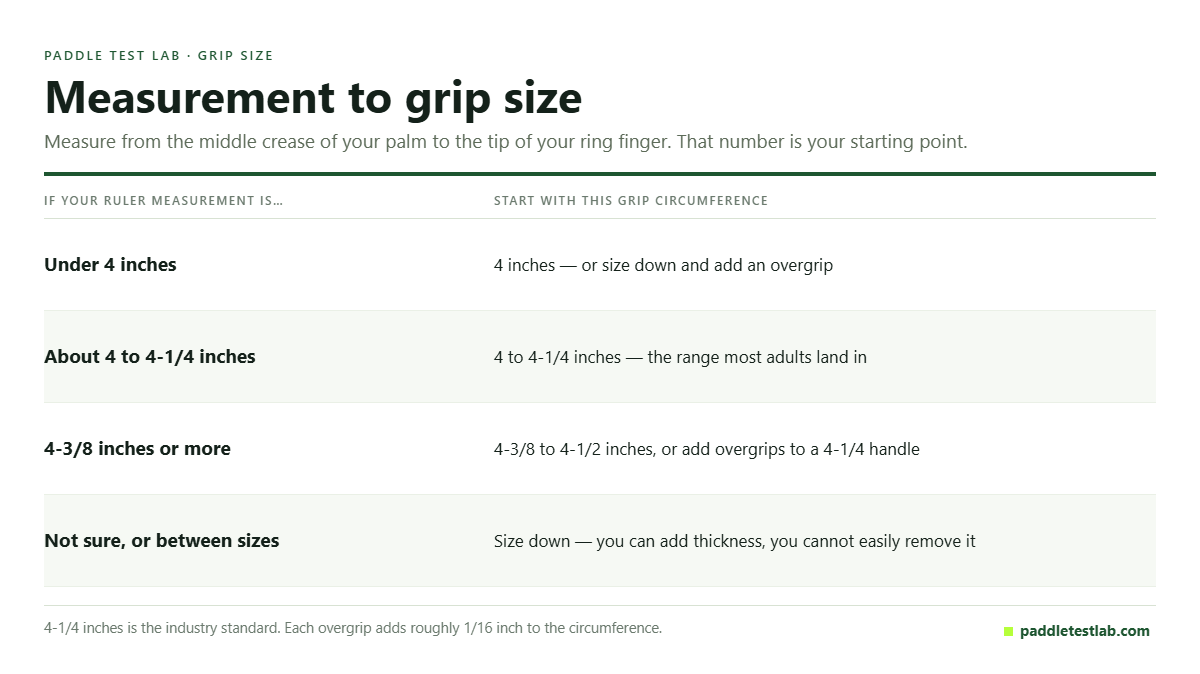
The ruler test: open your dominant hand and measure from the middle horizontal crease of your palm to the tip of your ring finger. That measurement in inches is a good estimate of your ideal circumference. Most adults land between 4 and 4‑1/2 inches.
The finger test: hold a paddle with a normal grip, then slide the index finger of your other hand into the gap between your fingertips and the base of your thumb. If your index finger fits snugly, the grip is about right. No room means it is too small; a loose gap means it is too big.
| If your ruler measurement is… | Start with this grip circumference |
|---|---|
| Under 4 inches | 4 inches (or size down and add an overgrip) |
| About 4 to 4‑1/4 inches | 4 to 4‑1/4 inches — the range most adults land in |
| 4‑3/8 inches or more | 4‑3/8 to 4‑1/2 inches, or add overgrips to a 4‑1/4 handle |
| Not sure / between sizes | Size down — you can add thickness, you cannot easily remove it |
Signs Your Grip Is the Wrong Size
A grip that is too small forces you to squeeze harder to keep the paddle from twisting on off-center hits. That constant over-gripping is tiring and can transmit more shock into the wrist and forearm. A grip that is too big is the one owners flag more often in comfort complaints: it stops you from getting a full, relaxed wrap around the handle, reduces wrist mobility for spin and dinks, and is frequently mentioned in reviews alongside hand fatigue and elbow soreness. If your hand cramps late in a session, grip size is one of the first things worth checking.
Why “Just Add Overgrips” Only Works in One Direction
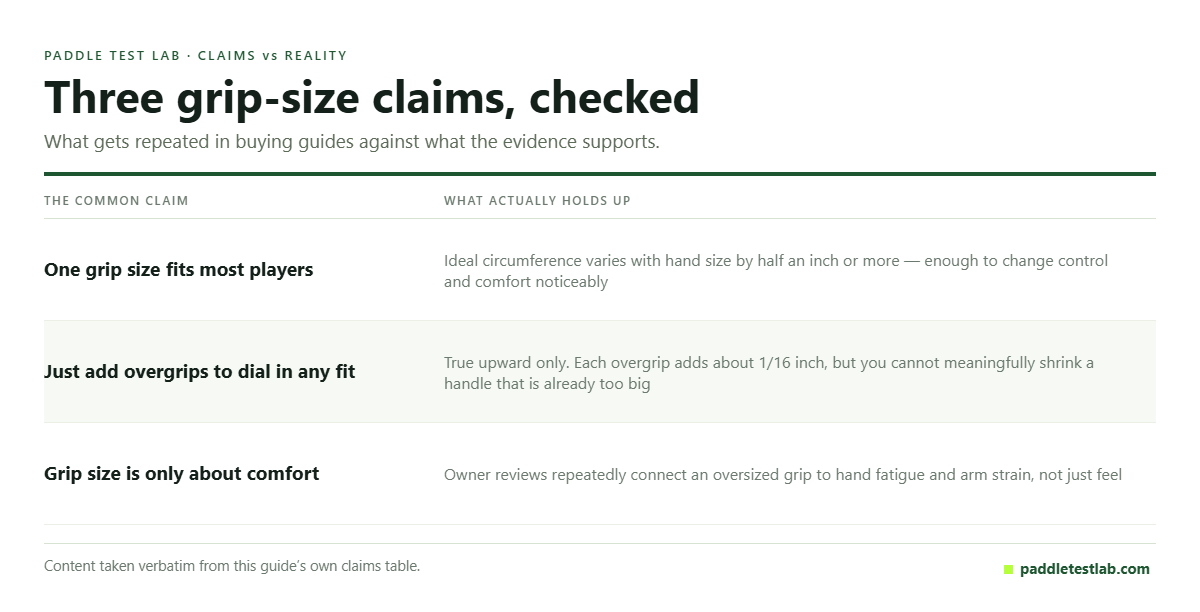
Paddle marketing tends to wave grip size away with “just add an overgrip to customize the fit.” That is true, but only upward. Each overgrip adds roughly 1/16 inch to the circumference, so you can take a 4‑1/4 inch handle up toward 4‑3/8 or 4‑1/2 easily. Going the other way is the problem: shrinking a too-big handle means removing the stock grip and shaving the underlying material, which most players will not do and manufacturers do not recommend. That asymmetry is the whole reason the standard advice is to buy slightly small.
| The common claim | What actually holds up |
|---|---|
| “One grip size fits most players” | Ideal circumference varies with hand size by half an inch or more — enough to change control and comfort noticeably |
| “Just add overgrips to dial in any fit” | True upward only; each overgrip adds about 1/16 inch, but you cannot meaningfully shrink a handle that is already too big |
| “Grip size is only about comfort” | Owner reviews repeatedly connect an oversized grip to hand fatigue and arm strain, not just feel |
Grip Size, Comfort, and Your Arm
If you already deal with elbow or wrist pain, grip size belongs on the same checklist as paddle weight and swingweight. A handle that forces a tighter hold adds forearm tension on every swing, which is why several owners managing joint issues specifically call out grips that run thick. We cover the paddle side of this in our guides to arm-friendly pickleball paddles and the best paddles for tennis elbow. Grip is one more variable in the same equation, and often the cheapest one to fix.
How to Measure Your Pickleball Grip Size
Two methods, both take under a minute, and they usually agree.
The ruler method. Open your hitting hand flat, palm up. Measure from the middle crease of your palm to the tip of your ring finger. That measurement in inches is approximately your grip size — around 4″ suggests a 4.125″ grip, roughly 4.25″ suggests standard, 4.5″ or more suggests you need a larger handle or to build one up.
The index finger test. Take your normal grip on a paddle. You should be able to slide the index finger of your other hand into the gap between your fingertips and the base of your thumb. No gap means the grip is too small; more than a finger’s width means it is too large.
If the two methods disagree, go with the smaller size. Building a grip up takes two minutes with an overgrip; shrinking one means stripping the handle, which most people never get round to. Our guide to paddles for larger hands covers the options if you measure at the top of the range and standard handles feel cramped.
How to reduce a grip that is too large
This is the harder direction, which is why buying small is the safer error.
The only real method is to strip the factory grip and replace it with a thin overgrip. Peel the original off, remove any adhesive residue, and wrap a single overgrip directly onto the bare handle. That typically takes about 1/8″ off the circumference — enough to move you down roughly one size.
What does not work: squeezing harder to compensate, which restricts wrist action and causes exactly the arm problems you are trying to avoid. If stripping the handle still leaves it too large, the paddle is genuinely the wrong one for your hand and no amount of adjustment will fix it. Our guide to wrapping an overgrip covers the technique for a bare handle.
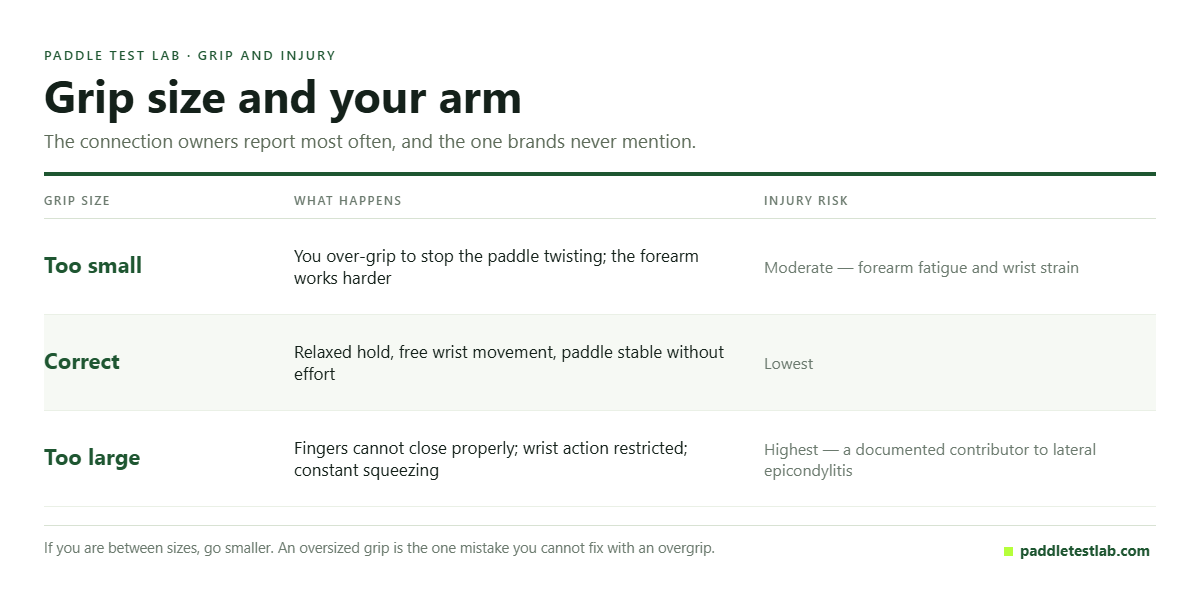
Grip Size and Arm Injury
| Grip size | What happens | Injury risk |
|---|---|---|
| Too small | You over-grip to stop the paddle twisting; forearm works harder | Moderate — forearm fatigue and wrist strain |
| Correct | Relaxed hold, free wrist movement, paddle stable without effort | Lowest |
| Too large | Fingers cannot close properly; wrist action restricted; constant squeezing | Highest — a documented contributor to lateral epicondylitis |
The mechanism worth understanding: a grip that is too large prevents your fingers from wrapping the handle, so you compensate by gripping harder throughout the rally. Sustained tension in the forearm extensors is the pathway to tennis elbow, and it is why grip sizing appears in almost every discussion of pickleball arm pain. If your elbow is sore, check grip size before you change paddles — our arm-friendly paddle guide covers the full set of contributing factors, of which the paddle itself is only one.
Frequently Asked Questions
Is a 4 1/4 or 4 1/2 grip better?
Neither in the abstract — it depends on your hand, and 4.25″ is simply the more common shipping size.
4 1/4″ suits most adult players and is the default for good reason. It allows a relaxed hold with free wrist movement for the majority of hand sizes. 4 1/2″ suits players with genuinely large hands or those coming from tennis who are used to a fuller handle.
If you measure between the two, take 4 1/4″ and add an overgrip — each wrap adds roughly 1/16″, so two takes you close to 4 3/8″ with better cushioning than the larger factory handle would give you. The reverse is not available: a 4 1/2″ handle cannot be meaningfully reduced without stripping it. Our guide for players with smaller hands covers the options below 4 1/4″.
What is the standard pickleball grip circumference?
4 1/4 inches is the industry standard and what the majority of paddles ship with. The usual range runs from about 4 inches at the small end to 4 1/2 inches at the large, with 4 1/8″ and 4 3/8″ appearing as intermediate options on some lines.
Two things worth knowing. First, pickleball grips run smaller than tennis grips — converts frequently buy too large because they choose by the number they are used to. Second, manufacturers measure inconsistently, so a 4.25″ handle from one brand can feel noticeably different from another’s, particularly once you account for the factory grip’s thickness. Treat the printed number as a starting point rather than a specification, and adjust with an overgrip once the paddle is in your hand.
What is the most common pickleball paddle grip size?
Most adult paddles ship in a 4‑1/8 to 4‑1/4 inch circumference, and that range fits the majority of players. Smaller hands often prefer 4 inches; larger hands go to 4‑3/8 or 4‑1/2, frequently by adding overgrips.
Should I size up or size down if I am between grips?
Size down. You can add thickness with an overgrip in about a minute, but you cannot easily remove material from a handle that is already too big.
Does a smaller grip help with spin?
A slightly smaller grip allows more wrist mobility, which many players find helps with spin and touch shots. The tradeoff is that too small a grip makes the paddle twist on off-center contact, so there is a limit before control suffers.
How much does an overgrip change the size?
Roughly 1/16 inch of circumference per overgrip. Two overgrips take a 4‑1/4 inch handle to about 4‑3/8, while also refreshing tackiness and cushioning.
Is grip size the same as handle length?
No. Grip size is the circumference around the handle; handle length is how long the handle is. Longer handles suit two-handed backhands and tennis converts, and are covered separately from circumference. See our explainer on swing weight for how handle choices interact with balance.
Related: new to buying? Start with our best paddles for beginners and the 14mm vs 16mm core guide, or see the full best pickleball paddles roundup.
Check our pickleball paddle grip size scorecard at the end for a side-by-side verdict. Whether you need the pickleball paddle grip size or a competing option, compare every spec before you commit.
Related guides

Isacc Shah
Isacc Shah writes PaddleTestLab. He does not test paddles in a lab and says so plainly — there is no rig, no radar gun, no staff hitting balls. Instead he aggregates independent bench measurements, manufacturer specifications, USA Pickleball's approval database and hundreds of verified owner reviews per product, then reports where those sources disagree. Every score on the site carries its evidence count. Where a specification is not published, the site writes UNKNOWN rather than estimating it, and the criticism is printed next to the praise.