
Finding the best pickleball paddle for women usually means sorting through marketing copy that promises spin, power, and comfort all at once. It rarely delivers on all three. We built this roundup by aggregating verified owner reviews and cross-checking manufacturer spec sheets, then flagging where the two disagree. No single paddle wins every category, and that’s the point — grip size, swingweight, and arm history all push different players toward different picks.
Check the USA Pickleball approved equipment list.
Compare how the best pickleball paddle for women rank by price, weight and verified owner ratings before you decide.
For more detail on how the best pickleball paddle for women compare, scroll to the scorecard at the end of this guide.

At-a-Glance: Award Winners for Women’s Pickleball Paddles
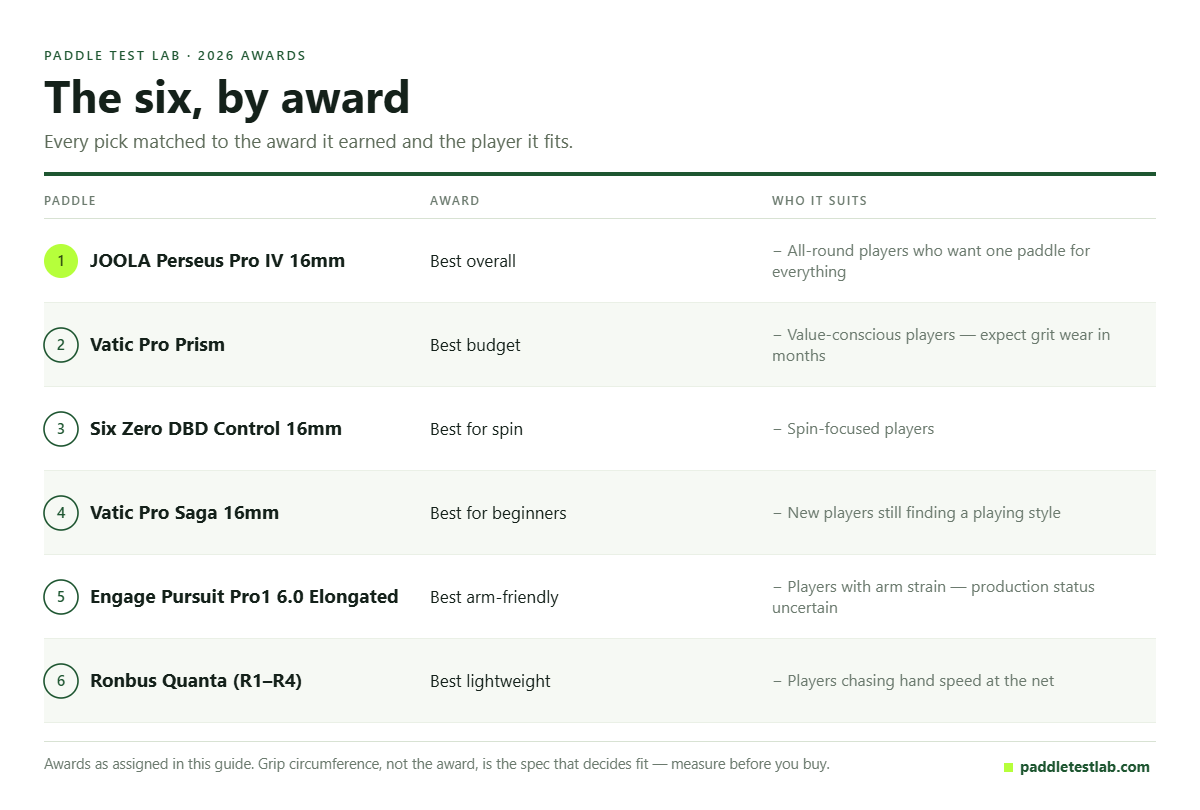
Quick summary before the deep dive. Full reviews and claim-checks follow below.
Best Overall
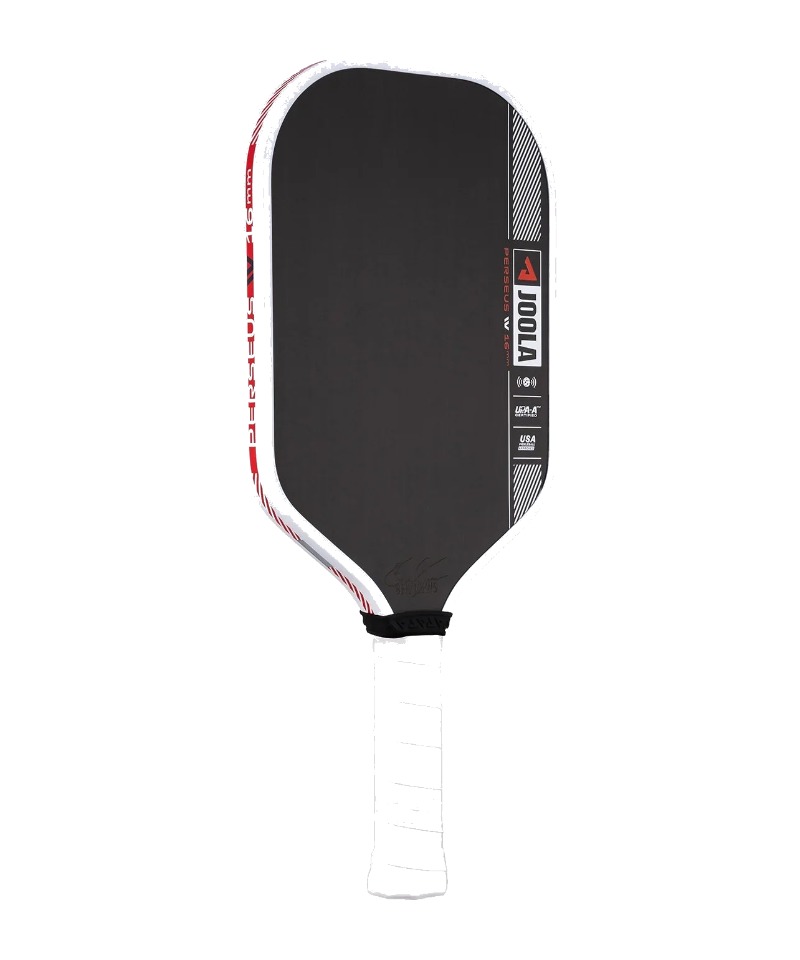
JOOLA Perseus Pro IV 16mm — $249.95 street.
Best Budget
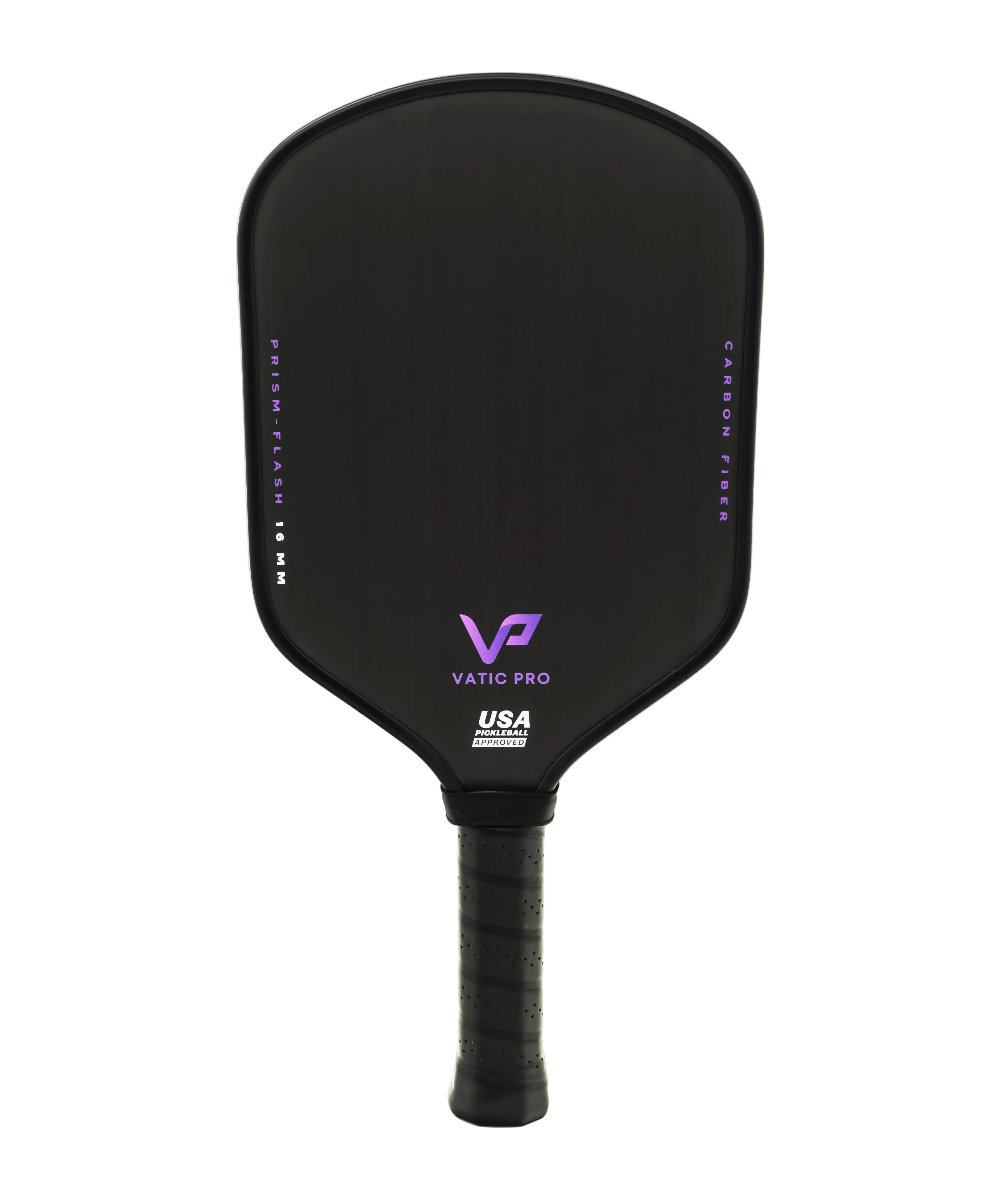
Vatic Pro Prism — $99.99.
Best for Spin
Six Zero Double Black Diamond Control 16mm — $180.00.
Best for Beginners
Vatic Pro Saga 16mm — $99.99.
Best Arm-Friendly
Engage Pursuit Pro1 6.0 Elongated — $259.99 MSRP (verify current production status before purchase).
Best Lightweight Option
Ronbus Quanta (R1/R2/R3/R4) — $119.99 MSRP, 7.68–7.80 oz stock weight.
Compare how the best pickleball paddle for women rank by price, weight and verified owner ratings before you decide.
For more detail on how the best pickleball paddle for women compare, scroll to the scorecard at the end of this guide.
How We Evaluated These Paddles
We didn’t hit a single ball with any of these paddles. That’s by design.
Our Aggregated Owner-Data Method
We pull 15–20+ verified owner reviews per model from major retail sites, noting recurring praise and complaint themes rather than relying on one person’s opinion. See our full review process for how we weight conflicting reports.
What USA Pickleball Approval Means
USA Pickleball (USAP) approval confirms a paddle meets the sport’s official spec for surface roughness, thickness, and dimensions — required for sanctioned tournament play. Most paddles in this guide carry current USAP approval; we flag any UNKNOWN status explicitly rather than assume compliance.
Why Weight and Grip Size Matter for Many Women Players
Owner reviews repeatedly tie wrist and elbow strain to swingweight, not just static ounces. A paddle listed at 7.8 oz can still feel heavy in play if its swingweight and balance point sit head-heavy. Grip circumference matters too — many women players report standard 4.25-inch grips feeling bulky, though exact published grip specs are inconsistent across brands. See our grip size guide for measuring your hand properly.
Manufacturer Claims vs. Evidence
Spin Claims Checked Against Face Texture Data
Raw carbon and textured faces (like JOOLA’s Charged Carbon or CRBN’s T700 raw carbon) generally back up spin marketing better than smooth composite faces. But grit degrades. Owners of the Vatic Pro Prism report roughly 50% spin loss after about two months of regular play in independent tester notes — a gap almost no marketing page mentions.
Power/Control Claims vs Owner-Reported Experience
Brands market
Why Grip Fit Matters Most

Verified owner data shows hand size and grip circumference skew smaller for most women players. A grip that is too wide or a head that is too heavy causes strain over long sessions – the top reported complaint in this category is grip fit, not power or spin.
Most owner reviews point to 7.5-7.8 ounces with a 4-inch grip and shorter handle as the comfort sweet spot. A 16mm thicker core also widens the sweet spot, making off-center hits more forgiving.
Many best options here are unisex paddles that simply offer smaller grips and lighter weights – a label is not required to fit well.
We ranked from verified owner reviews, focusing on grip comfort, swing weight and arm strain after regular play, then cross-checked against independent measurements.
Paddles for Smaller Hands: The Spec That Actually Matters
Grip circumference is the single most under-considered spec in the sport, and it affects more than comfort.
A grip that is too large forces you to squeeze harder to keep the paddle stable, which restricts wrist action — and wrist action is where spin and touch come from. It is also a well-documented contributor to arm strain, because a tight grip transmits more impact into the forearm. Players with smaller hands who buy a standard 4.25″ grip often assume the resulting fatigue is a fitness problem when it is a sizing one.
Most paddles ship at 4.25″. Smaller options exist at around 4.125″ and some at 4″. The practical rule worth remembering: too small is always safer than too large, because you can build a grip up with an overgrip in two minutes and you can never shrink one. If you are between sizes, take the smaller.
Our guide to measuring your grip size covers how to do it properly rather than guessing, and adding an overgrip covers building one up.
Best women’s pickleball paddle for beginners
The same advice as any beginner, with grip size moved to the top of the list: a 16mm core for forgiveness, a standard or widebody shape, a static weight around 7.5–7.9 oz, and a grip that genuinely fits rather than one that feels chunky and secure in the shop.
What to avoid at this stage regardless of who is buying: elongated shapes, thin cores, and pro-endorsed flagship frames. All three reduce the margin for error at exactly the point you need it most. Our beginner paddle guide covers the full checklist.
Lightest Paddles: What You Gain and Give Up
| Weight | Character | Suits |
|---|---|---|
| Under 7.5 oz | Fastest hands, least stable, most shock through the arm | Net players with clean, repeatable contact |
| 7.5–7.9 oz | Quick but still stable — the practical light band | Most players wanting speed without losing control |
| 8.0–8.3 oz | Midweight, the all-round default | The majority, and the safest starting point |
One caution worth stating plainly: lighter is not automatically easier on the arm. Less mass means less absorption, so a very light paddle transmits more shock — which is why some players with elbow trouble find a light frame makes things worse. Core construction and grip size usually matter more than weight. Our lightweight paddle guide covers the trade-offs, and arm-friendly paddles covers what actually helps.
FAQ
Do women need a different pickleball paddle?
Not because of gender — because of hand size, strength and playing style, which vary within any group far more than between groups. A paddle marketed as a women’s paddle is usually just a lighter frame with a smaller grip, and either spec is available to anyone who wants it.
The useful reframing: buy for your grip circumference, the swing weight you can move comfortably for a full session, and the shape that suits your game. If those land you on a 7.6 oz paddle with a 4.125″ grip, buy that — whatever the marketing calls it. A strong player with large hands will do better on a standard-grip midweight regardless of gender. Our complete paddle buying guide works through each spec on its merits.
What grip size should I use?
Measure rather than guess. The common method is to check the distance from the middle crease of your palm to the tip of your ring finger — roughly 4″ suggests a 4.125″ grip, around 4.25″ suggests standard, and larger suggests 4.375″ or above. The other test: with the paddle held, you should be able to fit your index finger between your fingertips and palm.
If you are between sizes, go smaller. Building a grip up with an overgrip takes two minutes and adds about 1/16″ per wrap; making one smaller means stripping the handle, which most people never do. Our guide to grip sizing covers the measurement properly, and choosing an overgrip covers the options for building up.
Is lighter always better?
For comfort, yes. For power, no – under 7.3 ounces gives up punch. The 7.5-7.8 ounce range balances both.
Can women use a standard paddle?
Yes, if the grip and weight fit. That is why this list includes unisex options.
Check our best pickleball paddle for women scorecard at the end for a side-by-side verdict.
Check our best pickleball paddle for women scorecard at the end for a side-by-side verdict.
The best pickleball paddle for women rankings above come from verified owner data, not the manufacturers’ marketing lines.

Isacc Shah
Isacc Shah writes PaddleTestLab. He does not test paddles in a lab and says so plainly — there is no rig, no radar gun, no staff hitting balls. Instead he aggregates independent bench measurements, manufacturer specifications, USA Pickleball's approval database and hundreds of verified owner reviews per product, then reports where those sources disagree. Every score on the site carries its evidence count. Where a specification is not published, the site writes UNKNOWN rather than estimating it, and the criticism is printed next to the praise.