
Learning how to choose pickleball paddle weight saves you from the most common first-paddle regret in owner threads. Weight changes how a paddle swings, how stable it feels against hard drives, and how your arm feels after two hours. Here’s the honest breakdown, built from aggregated owner experiences rather than a marketing chart.
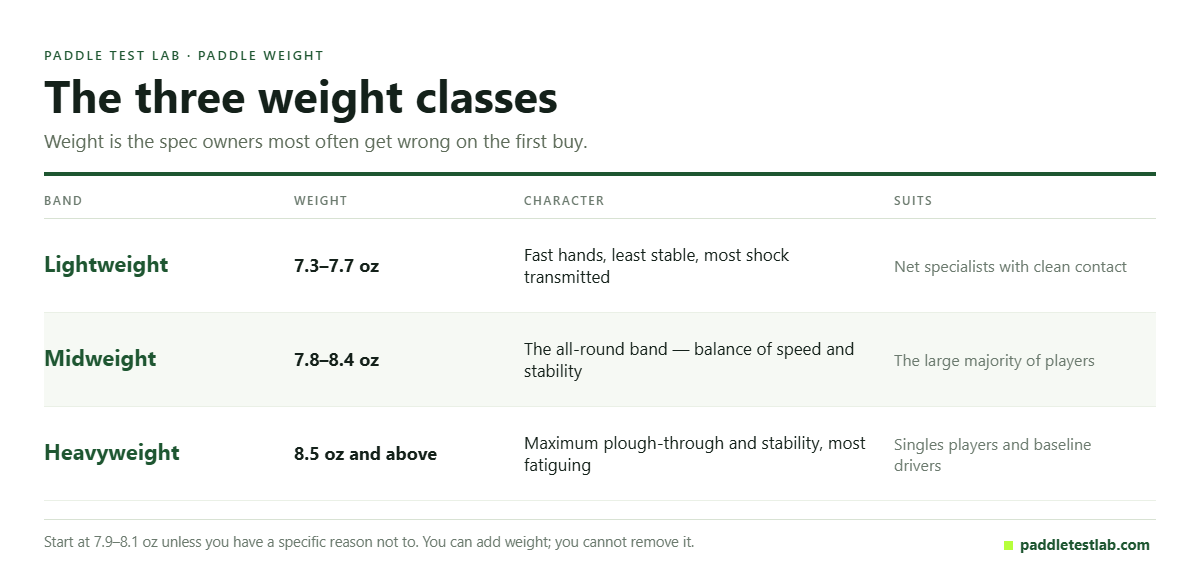
How to Choose Pickleball Paddle Weight: The Three Classes
Most paddles fall into three broad bands: lightweight (roughly under 7.5 oz), mid-weight (roughly 7.5–8.2 oz), and heavy (above 8.2 oz). Manufacturing tolerances mean two copies of the same paddle can differ, so treat listed weights as a range, not a promise — a detail owners discover when their paddle arrives heavier than the spec sheet said.
What owners say about lightweight paddles
Praise: fast hands at the kitchen, easy maneuvering in fast exchanges, less fatigue in long sessions. Complaints: getting pushed around by hard drives, a jittery unstable feel on blocks, and having to supply all the power yourself. Lightweight builds show up most in our lightweight paddle roundup, where the same praise-and-complaint pattern repeats across models.
What owners say about mid-weight paddles
Mid-weight is where most owners land and stay. Reviews describe it as the balance point: enough mass to stay stable on blocks and add pace, light enough for quick hands. When a review thread asks ‘what weight should I get?’, the most-upvoted answer is almost always mid-weight.
What owners say about heavy paddles
Praise: effortless drive pace, rock-solid stability, plowing through the ball. Complaints: slower hand speed at the net, and — the big one — arm fatigue and elbow soreness that builds over weeks, not minutes. Heavy paddles feature prominently in tennis-elbow threads, usually in the ‘what I switched away from’ role.
Static Weight vs Swing Weight
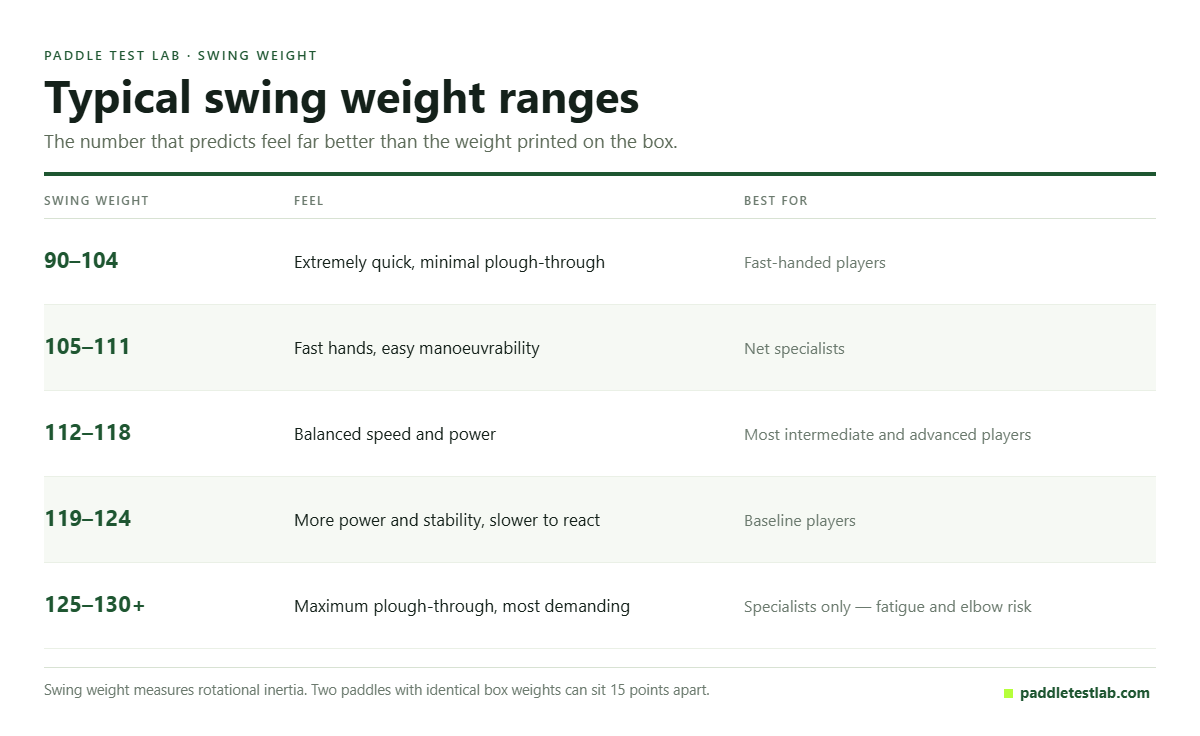
Two paddles at identical scale weight can swing completely differently. Weight concentrated toward the head swings heavy; weight in the handle swings light. Owners often describe this as a paddle ‘playing heavier than it weighs’. Published swing-weight numbers exist for some paddles, but where they don’t, owner descriptions — ‘head-heavy’, ‘balanced’, ‘handle-weighted’ — are the best available signal.
A Simple Decision Path
Start mid-weight unless you have a specific reason not to. Go lighter if you have existing wrist or shoulder issues, prize hand speed above all, or play fast doubles at a high level. Go heavier only if you already know your mechanics are sound, you want more drive pace, and your arm has no complaint history. And remember you can tune upward: adding lead tape to a lighter paddle is easy and reversible — our guide on adding weight to a paddle walks through it. Removing weight from a heavy paddle is impossible.
Weight also interacts with grip and arm comfort — a too-small grip makes any weight feel worse. Check our grip size guide alongside this one.
Is an 8 oz Pickleball Paddle Too Heavy?
No — 8 oz sits squarely in the midweight band and is close to the most common weight in the sport. If an 8 oz paddle feels heavy to you, the weight is usually not the reason.
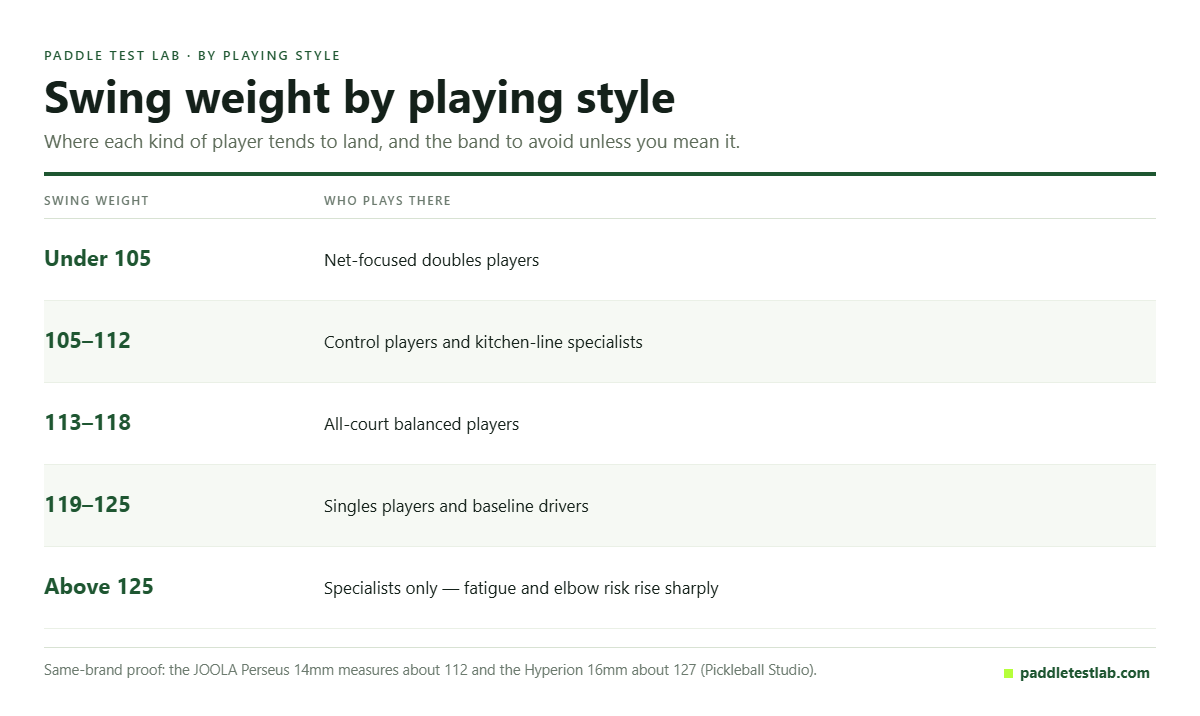
What is far more likely is where the mass sits. An 8.0 oz paddle with weight concentrated toward the head will feel considerably heavier in play than an 8.2 oz paddle balanced toward the handle, because you are fighting leverage rather than mass. This is measured as swing weight, and it is the number that actually determines whether a paddle feels manageable.
Two other culprits worth ruling out before you blame the weight. Grip size: a grip that is too large forces you to squeeze harder, which fatigues the forearm fast and makes everything feel heavier. And handle length: a short handle on a long face concentrates the load awkwardly, particularly for two-handed players.
If a paddle feels heavy despite a normal spec, check the balance point before buying lighter. Our guide to swing weight covers how to measure balance at home, and grip sizing covers the spec most players get wrong.
Paddle weight for seniors and players managing joint pain
The instinct is to go as light as possible, and it is only half right.
Lower mass genuinely reduces the load your shoulder and elbow carry across a long session, which matters. But a lighter paddle also absorbs less shock, so more impact energy travels into your arm — which is why some players with existing elbow trouble find a very light paddle makes symptoms worse rather than better.
What tends to help more, in order: a thicker core that damps rather than returns vibration, a foam-filled perimeter, a correctly sized grip so you are not gripping tightly, and a moderate swing weight you can move without straining. Weight itself comes fifth. A 7.9 oz paddle with a 16mm foam-walled core will usually be kinder than a 7.4 oz thin-core frame. Our arm-friendly paddle guide works through the full set, and core construction covers which builds damp best.
Midweight and the Full Weight Range
| Band | Weight | Character | Suits |
|---|---|---|---|
| Lightweight | 7.3–7.7 oz | Fast hands, least stable, most shock transmitted | Net specialists with clean contact |
| Midweight | 7.8–8.4 oz | The all-round band — balance of speed and stability | The large majority of players |
| Heavyweight | 8.5 oz and above | Maximum plough-through and stability, most fatiguing | Singles players and baseline drivers |
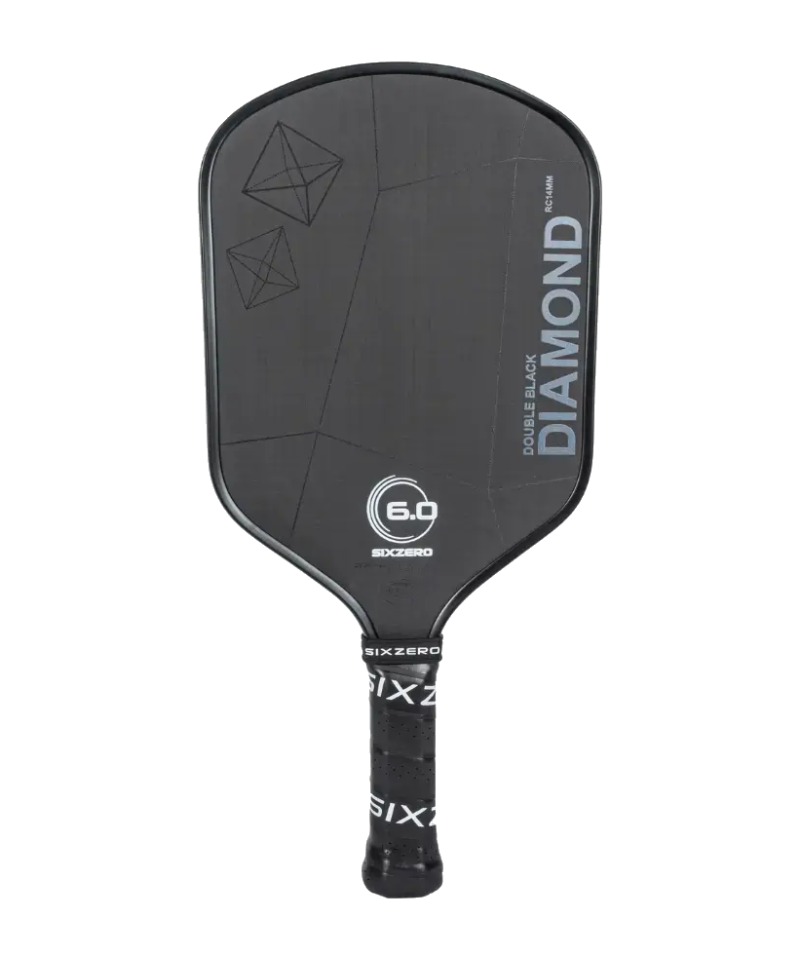
Midweight is where most players should start, and 7.9–8.1 oz is the safest opening position. Adjust based on what actually goes wrong: losing hands battles points lighter, getting pushed around on blocks points heavier.
One practical asymmetry worth remembering: you can always add mass, never remove it. If you are between bands, buy the lighter paddle and tune it up with lead tape — that also lets you choose where the weight sits rather than accepting the factory distribution.
Frequently Asked Questions
What weight pickleball paddle should I use?
Start at 7.9–8.1 oz unless you have a specific reason not to. That is the middle of the midweight band, and it is where the great majority of players end up after experimenting.
Then adjust based on evidence from your own games rather than theory. If you are consistently late in hands exchanges at the kitchen line, go lighter. If blocks and counters are getting pushed back weakly, go heavier. If your arm aches, look at core construction and grip size before touching weight. And check swing weight — two paddles at the same static weight can feel entirely different, and that number explains more than the one printed on the box. Our lightweight paddle guide covers the lighter end if you decide to go that way.
Does a heavier paddle mean more power?
All else equal, yes — more mass behind the ball transfers more energy, which is why heavier paddles drive better and hold their line against pace. But “all else equal” is doing a lot of work in that sentence.
Power in practice comes from mass and head speed, and a paddle heavy enough to slow your swing can produce less at the ball than a lighter one you can accelerate properly. It also fatigues you, and a tired arm produces weaker shots in the third game regardless of the spec.
The more precise answer is that where the weight sits matters as much as how much there is. Adding a few grams at the top of the face raises power meaningfully; the same mass in the handle adds almost none but improves manoeuvrability. Our guide to adding lead tape covers placement, which is the part most players get wrong.
What weight pickleball paddle should a beginner use?
Mid-weight, per the overwhelming pattern in owner threads. It’s stable enough to learn blocks and drives on, light enough not to build bad habits or sore elbows. Buy light and tune up with lead tape if needed.
Does a heavier paddle really cause tennis elbow?
No single spec causes it, but heavy paddles — especially head-heavy ones — appear constantly in owner accounts of elbow pain. Weight, grip size, core stiffness, and technique all contribute. If your arm already complains, go lighter and softer.
Why does my paddle weigh more than the listed spec?
Manufacturing tolerance. Most brands list a target weight or range, and individual units vary. Owners who care about exact weight report weighing paddles on arrival — within-range variation is normal, not a defect.
Is it better to buy light and add weight, or buy heavy?
Owner consensus is clear: buy light and add. Lead tape is cheap, adjustable, and reversible, letting you find your exact preference. A paddle that’s too heavy out of the box can’t be lightened.

Isacc Shah
Isacc Shah writes PaddleTestLab. He does not test paddles in a lab and says so plainly — there is no rig, no radar gun, no staff hitting balls. Instead he aggregates independent bench measurements, manufacturer specifications, USA Pickleball's approval database and hundreds of verified owner reviews per product, then reports where those sources disagree. Every score on the site carries its evidence count. Where a specification is not published, the site writes UNKNOWN rather than estimating it, and the criticism is printed next to the praise.