
The elongated vs standard pickleball paddles decision shapes how a paddle plays more than most buyers expect. Brands market elongated shapes with words like ‘power’ and ‘reach’ and standard shapes with ‘forgiveness’ — and for once, aggregated owner reports mostly agree with the marketing. The nuance is in who actually benefits.
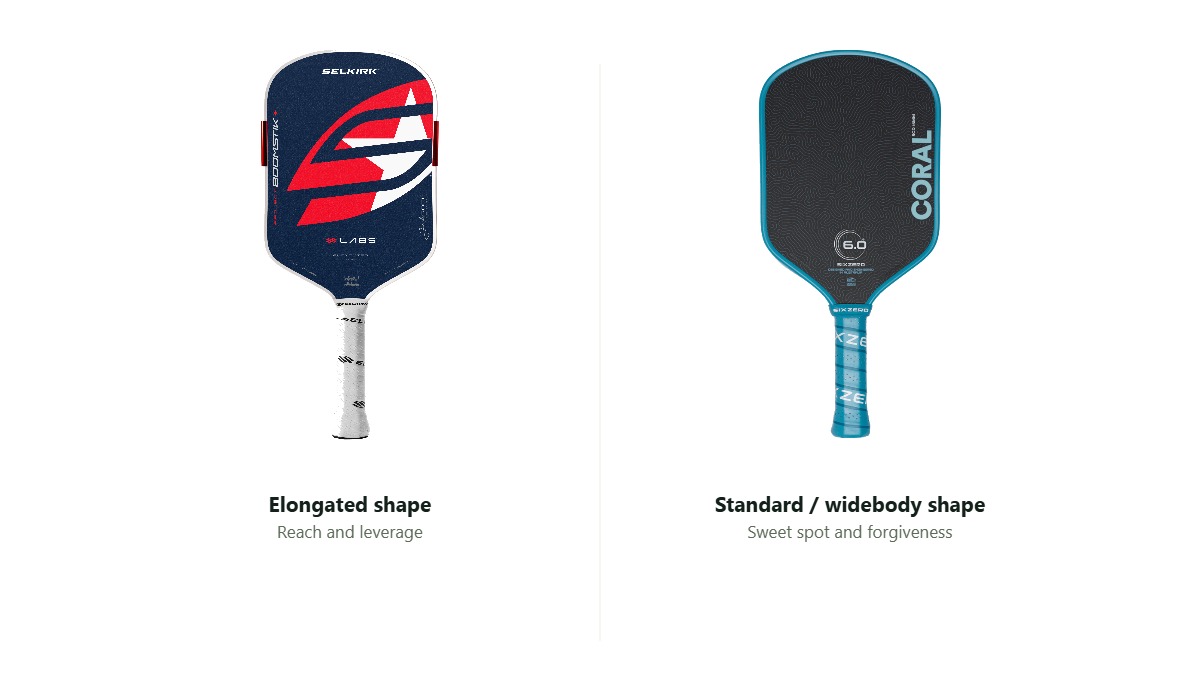
Elongated vs Standard Pickleball Paddles: The Core Difference
Paddle rules cap combined length plus width, so shape is a zero-sum choice. An elongated paddle stretches longer and narrower; a standard or widebody paddle stays shorter and wider. Same total real estate, distributed differently.
What owners report about elongated shapes
Three things come up again and again in reviews of elongated paddles: extra reach matters at the kitchen line and on stretch volleys, the longer lever adds easy pace on drives and overheads, and off-center hits low on the face feel noticeably dead. That last one is the tax. The sweet spot sits higher and runs narrower, so mishits punish harder — exactly the pattern that fills the complaint sections of elongated paddle reviews. Singles players and former tennis players tolerate the tax best.
What owners report about standard and widebody shapes
Reviews of standard-shape paddles read calmer: fewer dead-spot complaints, more praise for consistency on blocks and resets, and a paddle that feels stable when the ball doesn’t hit dead center. Widebody variants push this further — the widest legal face, the biggest margin for error, and the shape most often recommended to new players. The recurring criticism is the flip side: less reach, less leverage, and a ceiling on easy power.
Which Shape Fits Which Player

Choose elongated if
You play singles or aggressive doubles, you already make consistent centered contact, you want overhead and drive leverage, and you’ll trade forgiveness to get it. Our elongated paddle roundup covers the models owners rate highest in this shape.
Choose standard or widebody if
You’re still developing consistency, you play mostly doubles at the kitchen, or you simply want the paddle to bail you out on imperfect contact. The widebody roundup collects the strongest options at the forgiving end.
The hybrid middle
Many current paddles ship in a hybrid shape — slightly longer than standard, slightly wider than elongated. Owner sentiment on hybrids is generally positive for exactly the reason you’d expect: a milder version of both trade-offs. If you can’t decide, a hybrid is the low-regret pick.
What Shape Doesn’t Change
Owners switching shapes sometimes expect a new paddle personality and report back surprised: spin still comes from the face texture, softness still comes from the core thickness, and swing feel still comes mostly from weight and balance. Shape redistributes the hitting area — it doesn’t rewrite the paddle’s character.
Standard vs Hybrid: The Shape Most People Should Buy

The shape conversation is usually framed as elongated versus widebody, which skips the option that suits most players.
Standard frames run about 16″ by 7.9″ — the classic proportions most sets ship with. The sweet spot sits centrally, close to the hand, and the shape is the most forgiving of the three.
Hybrid shapes split the difference, typically around 16.3″ by 7.6″. You get slightly more reach than a standard frame without the narrow face and distant sweet spot of a full elongated. In practice this is where a large share of modern paddles have landed, because it is the shape that costs you least in either direction.
The honest recommendation: if you are not sure, buy hybrid. It is the shape least likely to be actively wrong for your game, and it is the one most competitive doubles players converge on. Reach for a full elongated only if you play singles or have a grooved two-handed backhand, and reach for a widebody if your mishits are lateral rather than short. Our widebody roundup and elongated roundup cover each extreme.
The best paddle shape for doubles
Standard or hybrid, in almost every case — and the reasoning is about where doubles points are actually decided.
Doubles is played predominantly at the kitchen line. Points turn on resets, dinks and fast hands exchanges, not on covering ground. What you need is a stable face you can get into position quickly when a ball arrives fast and slightly off-centre. That is precisely what a centrally-positioned, wider sweet spot delivers.
Reach is worth much less than it sounds in doubles, because your partner covers half the court. The exception is a poaching style, or playing with a partner who does not move well — in both cases the extra inch has a real use. Our control paddle roundup covers what else contributes to a doubles setup.
Which Shape for Which Player
| Player | Shape | Why |
|---|---|---|
| Complete beginner | Standard or widebody | Largest margin for error while contact is inconsistent |
| Improving doubles player | Hybrid | Slight reach gain with most of the forgiveness kept |
| Kitchen-line specialist | Standard | Fastest hands, sweet spot closest to the hand |
| Singles player | Elongated | Reach and leverage cover the whole court alone |
| Two-handed backhand | Elongated with a long handle | Handle length matters more than face shape here |
| Tennis convert | Elongated or hybrid | Suits a longer, grooved swing path |
If you are buying a first paddle, start at the top of this table rather than the bottom — our beginner paddle guide covers why the forgiving shapes accelerate development.
Frequently Asked Questions
Does paddle shape affect reach?
Yes, but less than players expect — and the gain costs more than they expect.
An elongated paddle is typically about half an inch longer than a standard one. That extra reach is real and occasionally decisive on a stretch volley. But because the governing body caps combined length and width at 24 inches, that half-inch of length comes directly out of width — so the face is narrower and the sweet spot sits further from your hand, which means off-centre contact produces more twist.
The trade is worth it in singles, where you cover the whole court alone. It is usually not worth it in doubles, where a wider, closer sweet spot wins more points than half an inch of reach. Our elongated paddle guide covers the shape class and the length rules in detail.
What is a hybrid pickleball paddle shape?
A frame sitting between standard and elongated — usually around 16.3″ long by 7.6″ wide, against roughly 16″ by 7.9″ for standard and 16.5″ by 7.35″ for elongated.
The point of a hybrid is that it gives up little in either direction. You get modest extra reach and leverage without the narrow face that makes elongated frames punishing, and the sweet spot moves only slightly outward rather than sitting up near the tip. It has quietly become the default shape for a large share of modern paddles for exactly that reason. If you do not have a pronounced singles or kitchen-line style pulling you toward one extreme, hybrid is the safe answer — see our main paddle roundup for the frames that use it.
Are elongated pickleball paddles better for power?
They add leverage, which owners consistently describe as easier pace on drives and overheads. But total power also depends on core thickness, weight, and your mechanics — an elongated shape alone doesn’t make a power paddle.
Is an elongated paddle harder for beginners to use?
Generally yes, per owner reports. The smaller, higher sweet spot punishes the off-center contact that’s normal while learning. Most beginner-focused guidance — including our paddle buying guide — steers new players toward standard, widebody, or hybrid shapes first.
Do elongated paddles help short players?
Reach is reach — the extra length helps anyone covering more court, and owners who mention height often say the elongated shape narrows the gap on stretch balls. The forgiveness trade-off still applies equally.
Can I switch shapes without relearning my game?
Expect an adjustment period. Owners switching to elongated report a few weeks of mishits while their contact point adapts to the higher sweet spot; switching back to standard is usually described as easier.

Isacc Shah
Isacc Shah writes PaddleTestLab. He does not test paddles in a lab and says so plainly — there is no rig, no radar gun, no staff hitting balls. Instead he aggregates independent bench measurements, manufacturer specifications, USA Pickleball's approval database and hundreds of verified owner reviews per product, then reports where those sources disagree. Every score on the site carries its evidence count. Where a specification is not published, the site writes UNKNOWN rather than estimating it, and the criticism is printed next to the praise.