

Short answer: in Paddletek vs Selkirk, Paddletek is the better value at the top of the range and Selkirk owns the entry tier. Both are US manufacturers now competing on consistency, warranty and support rather than on raw performance.
Paddletek and Selkirk were making pickleball paddles before most of today’s brands existed, both manufacture in the United States, and both are now competing against direct-to-consumer companies that undercut them on price and out-spec them on construction.
That context matters, because the honest comparison between these two is not about who has the fastest paddle. Neither does. It is about what you get instead.
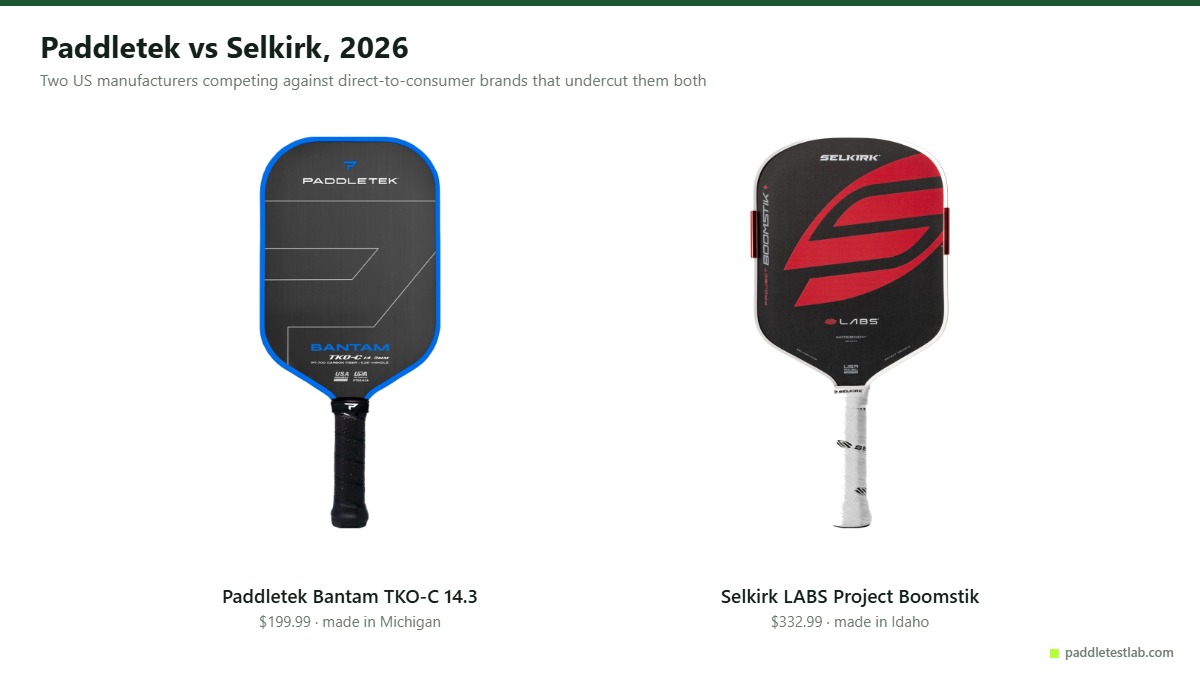
Two Brands That Predate the Paddle Arms Race
Paddletek is a Michigan manufacturer with a long history in the sport and a reputation built on the Bantam and Tempest lines. Its current flagship direction is the Bantam TKO series, and it carries player signatures without building the whole brand around them.
Selkirk is an Idaho family business, also US-manufactured, running a two-tier structure: LABS at the top for experimental high-performance builds, SLK at the bottom for accessible carbon paddles. Its distinguishing feature is a limited lifetime warranty.
Both are the kind of company you can phone. In a market full of brands that exist only as a Shopify storefront, that is worth something — and it is most of what separates these two from cheaper rivals.
Current Ranges and Price
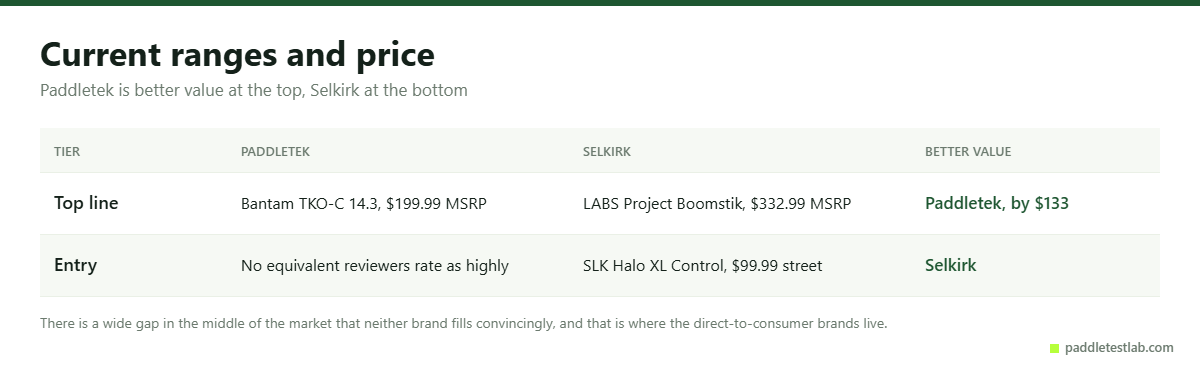
Premium. Selkirk’s LABS Project Boomstik sits at $332.99 MSRP, which is $50 to $100 above comparable paddles and the most expensive paddle in this comparison by a distance. Paddletek’s Bantam TKO-C 14.3 sits at $199.99 — a full $130 less, and squarely in the mid-tier by price even though it is a top-line paddle.
Entry. Selkirk owns this. The SLK Halo XL Control at $99.99 street (against a $139.99 MSRP) brings T700 raw carbon and Selkirk build quality to a first-paddle budget. Paddletek does not have an equivalent that reviewers rate as highly at the same price.
So the shape of it: Paddletek is better value at the top, Selkirk is better value at the bottom, and there is a wide gap in the middle that neither fills convincingly.
Paddletek vs Selkirk, Spec for Spec
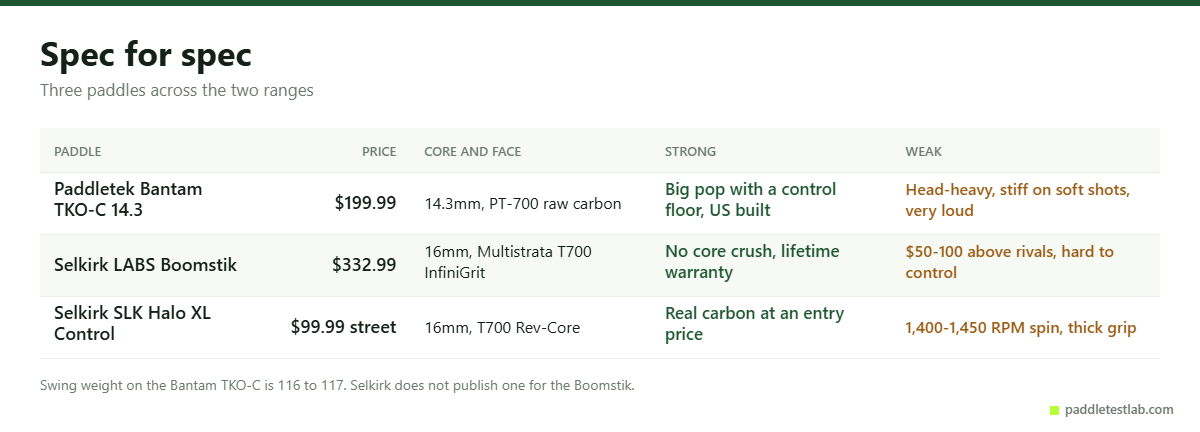
Paddletek Bantam TKO-C 14.3
$199.99 MSRP · 14.3mm core · PT-700 raw carbon face · elongated · 7.7–8.1 oz (avg 7.9) · swing weight 116–117 · USAP approved since February 2024.
Strong: big pop that keeps a usable control floor, made in the USA, an unusual 14.3mm core thickness that genuinely works.
Weak: head-heavy, stock grip is not top tier, stiff on soft shots so drops and dinks demand attention, and very loud.
Selkirk LABS Project Boomstik Elongated 16mm
$332.99 MSRP · 16mm core · Multistrata T700 carbon with InfiniGrit · elongated (widebody also offered) · 8.0–8.3 oz · USAP and PPA amateur approved.
Strong: explosive durable power, no reported core crush, InfiniGrit for spin durability, limited lifetime warranty.
Weak: $50 to $100 above rivals, genuinely hard to control, and many reports of loose or failing edge guards.
Selkirk SLK Halo XL Control
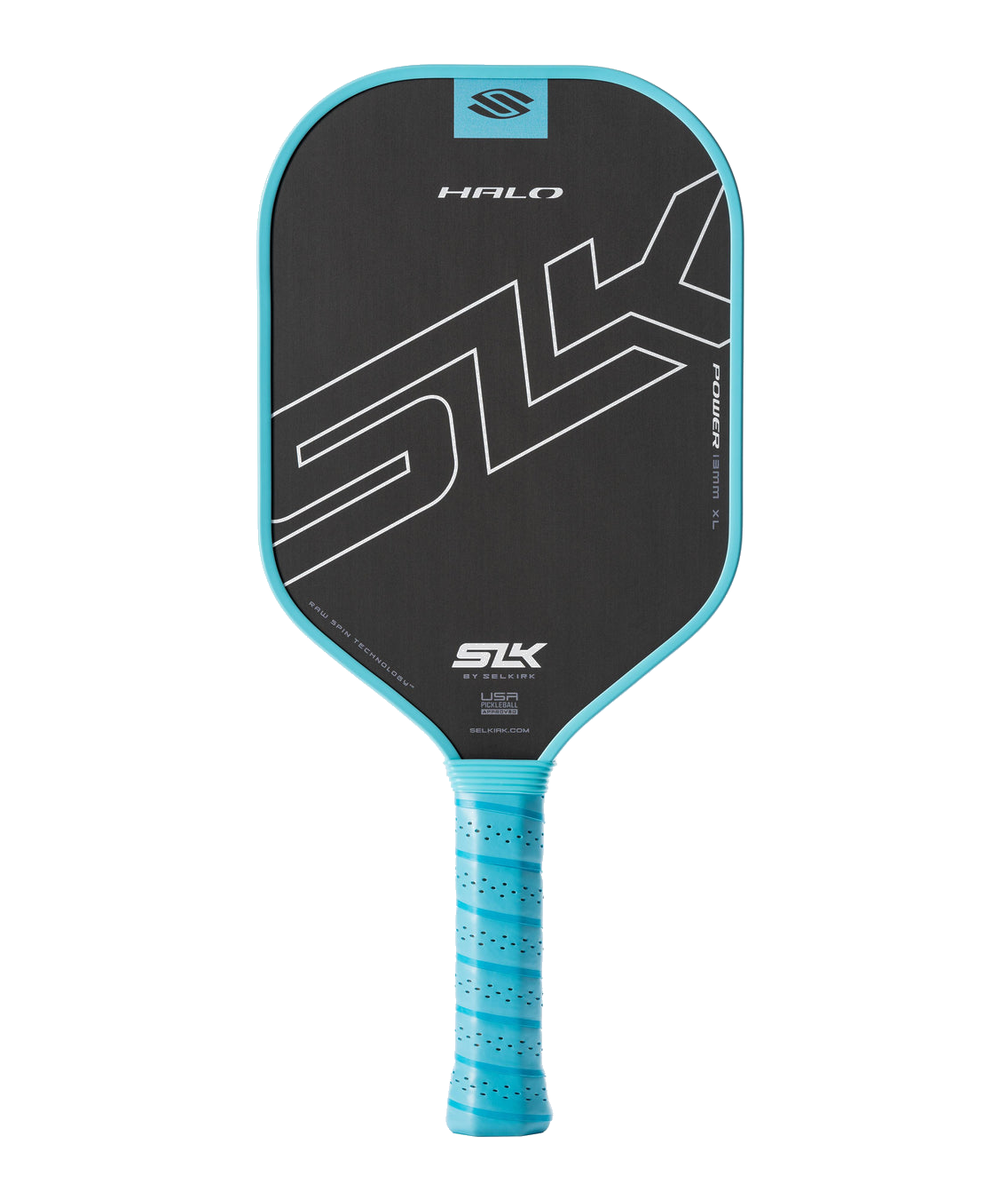
$99.99 street (~$139.99 MSRP) · 16mm T700 Rev-Core · elongated · 7.6–8.2 oz (avg 7.9).
Strong: real carbon at an entry price with Selkirk’s manufacturing behind it, strong control.
Weak: spin of roughly 1,400 to 1,450 RPM, low for a carbon face; not enough power for aggressive players; thick grip that many women and small-handed players find a poor fit.
Build Quality and Consistency
This is where both brands earn their price against cheaper competition, and it is the least glamorous thing on the page.
US manufacturing means tighter unit-to-unit consistency. Two paddles of the same model from either brand will weigh and balance closer together than two units of a $99 overseas-made paddle. If you ever replace a paddle you love, that consistency is the difference between getting the same paddle back and getting something that plays subtly wrong.
Neither brand is perfect. Selkirk’s edge-guard failures on the Boomstik are a genuine quality issue, and Paddletek’s stock grip is repeatedly criticised. But both failures are in accessories rather than in the core structure, and both are fixable — one by warranty, one by a $10 overgrip. See our overgrip guide for the Paddletek fix.
Warranty and Customer Service
Selkirk’s limited lifetime warranty on the LABS line is the strongest consumer protection either brand offers and the strongest we track anywhere. On a paddle with a known edge-guard problem, it is the reason the Boomstik remains recommendable.
Paddletek runs a limited warranty from purchase, covering manufacturing defects. That is the market norm and it is not a criticism — but it does mean that at $199.99 you are buying a paddle, whereas at $332.99 Selkirk is selling you a paddle plus a long-term promise.
Our warranty comparison has the current terms for both, including what each brand classifies as normal wear.
Where Both Have Fallen Behind
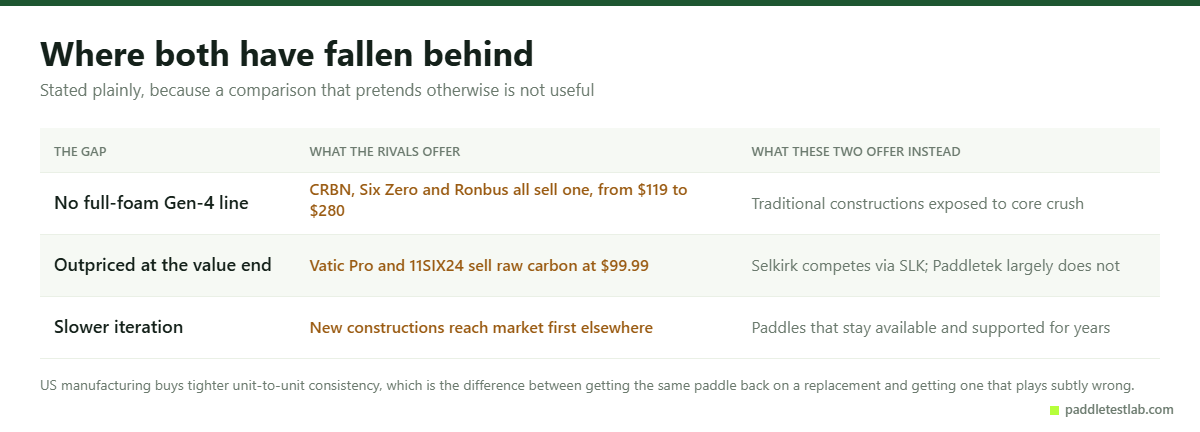
Stated plainly, because a comparison that pretends otherwise is not useful.
Neither has a full-foam Gen-4 paddle in its main line. CRBN, Six Zero and Ronbus all do, at prices from $119 to $280. Foam eliminates core crush outright, and that is the failure mode both these brands’ traditional constructions are exposed to. See our foam core guide for what that field looks like.
Both are outpriced at the value end. Vatic Pro and 11SIX24 deliver raw carbon paddles at $99.99 that reviewers rate against paddles twice the price. Selkirk’s SLK competes there; Paddletek largely does not.
Iteration is slower. That is a feature if you want a paddle that stays available and supported for years. It is a drawback if you want the newest construction.
Frequently Asked Questions
Are Paddletek and Selkirk still worth buying in 2026?
Yes, for specific reasons: US manufacturing, unit consistency, real customer service and — for Selkirk — a lifetime warranty. If your priority is the highest spec per dollar, newer direct-to-consumer brands will beat both.
Which is the better paddle for power?
The Boomstik hits harder. The Bantam TKO-C is more usable, costs $130 less, and keeps more control. For most players the Paddletek is the better power buy; for a 4.5-plus player who wants the ceiling, the Selkirk.
Which is quieter?
Not the Bantam TKO-C — it is very loud, and that matters on noise-restricted courts. If you have a decibel limit to meet, start with our quiet paddle guide rather than either brand’s catalogue.
Which is better for a beginner?
Selkirk, via the SLK line at $99 street. Neither brand’s flagship is a beginner paddle. Our beginner guide has the wider shortlist.
What is the best single model from each?
Paddletek: the Bantam TKO-C 14.3, on value. Selkirk: the SLK Halo XL at entry level, or the Boomstik if the warranty is what you are buying. Our full Selkirk brand review covers the rest of that range.
Ranges, warranty terms and prices are checked against Paddletek and Selkirk directly, and were current in July 2026.

Isacc Shah
Isacc Shah writes PaddleTestLab. He does not test paddles in a lab and says so plainly — there is no rig, no radar gun, no staff hitting balls. Instead he aggregates independent bench measurements, manufacturer specifications, USA Pickleball's approval database and hundreds of verified owner reviews per product, then reports where those sources disagree. Every score on the site carries its evidence count. Where a specification is not published, the site writes UNKNOWN rather than estimating it, and the criticism is printed next to the praise.