
If you’re shopping for a new frame, the padel racket shape guide question comes before brand, before price, before color. Shape decides where the sweet spot sits, how the racket swings, and whether your elbow thanks you or punishes you after two hours on court. This guide pulls from verified owner reviews and manufacturer spec sheets across dozens of current-production models to show what actually holds up.
Why Padel Racket Shape Matters More Than Brand
Two rackets from the same brand, same price tier, can feel completely different because of shape alone. Shape changes where the mass sits relative to the handle, and that single variable affects sweet spot size, swingweight, and how forgiving a frame feels on off-center hits. Owners who switch shapes — say, from a round beginner frame to a diamond — consistently report the adjustment period feels bigger than any brand-to-brand jump within the same shape.
How shape affects sweet spot, balance, and swingweight
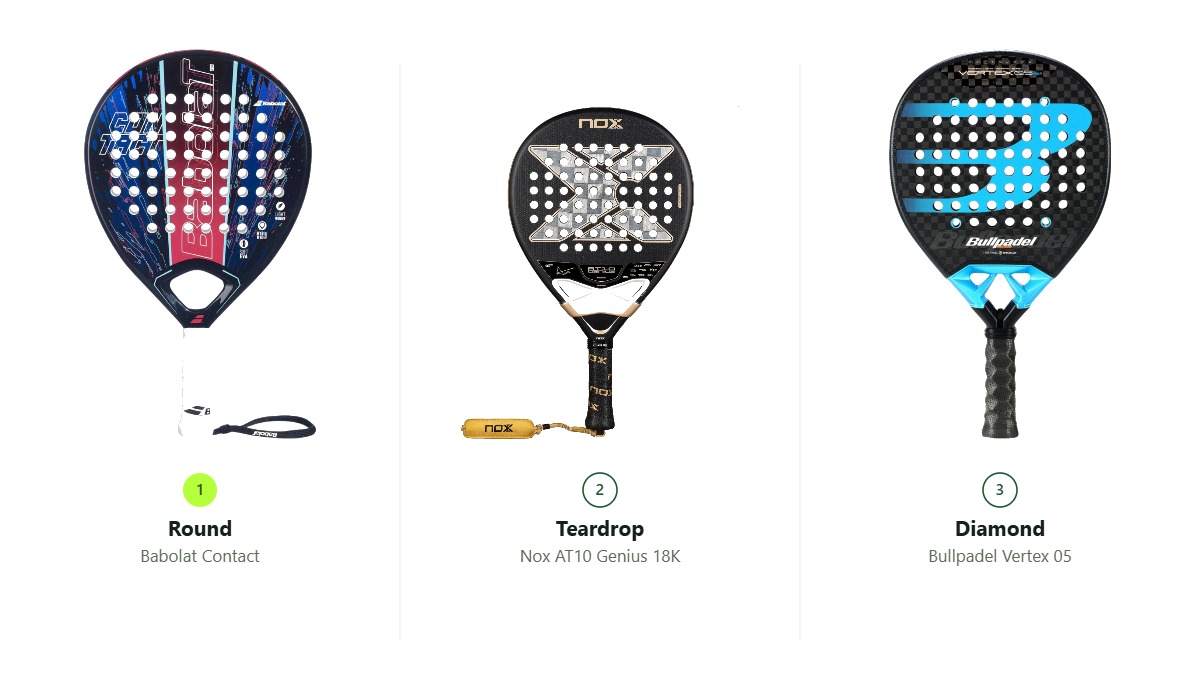
Round shapes place the widest part of the head lower, closer to the handle, which keeps the balance point low and the sweet spot large and centered. Diamond shapes push mass toward the tip, shrinking the usable sweet spot but multiplying leverage on clean contact. Teardrop sits in between, structurally and in feel. Across the models we reviewed, weight ranges cluster tightly — most entry and mid-tier padel rackets sit around 340g to 375g regardless of shape — which tells us shape, not raw weight, is doing most of the work in how a racket plays.
Shape vs weight vs core: what actually changes your game
Core material matters too. Soft EVA foam cores, common in entry rackets like the Babolat Contact and Head Evo Speed, add comfort regardless of shape. Denser, higher-density EVA blends in premium diamond frames like the Bullpadel Vertex 05 and Head Coello Pro amplify the power a diamond shape already concentrates. Shape sets the ceiling and floor; core density and face material fine-tune where you land inside that range. Owners rarely separate these variables cleanly in reviews, but patterns emerge when you read enough of them — soft-core round rackets get praised for comfort far more often than hard-core diamond rackets do, and that’s not a coincidence.
Round Shape Explained
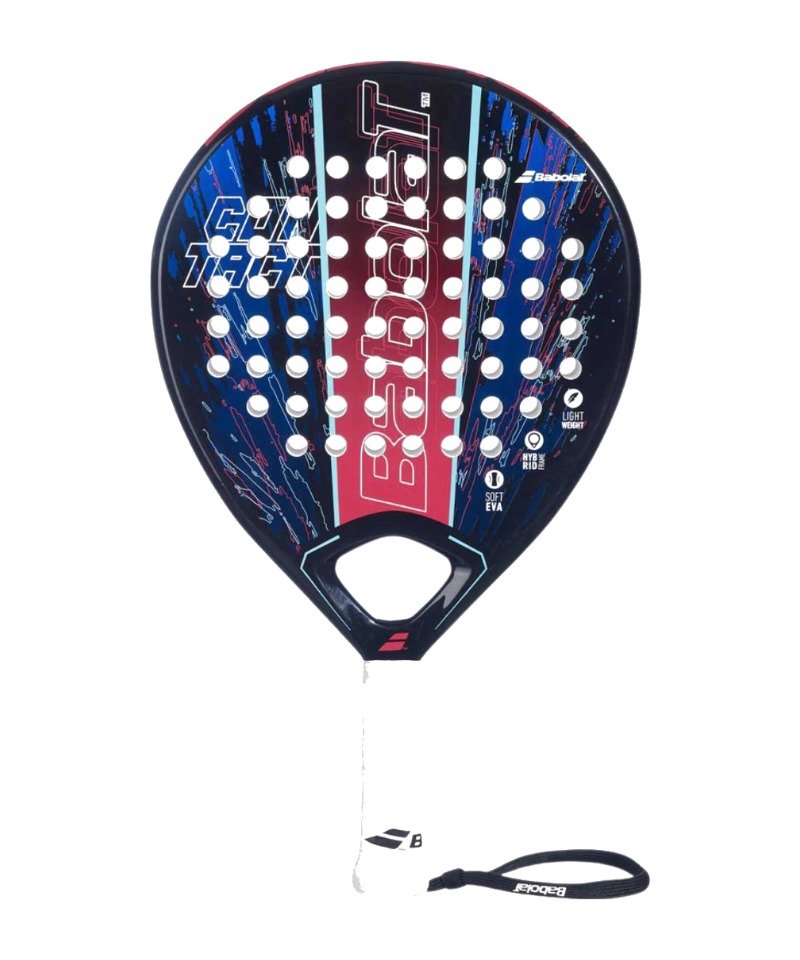
Round-shaped padel rackets keep the head’s widest point low, near the throat, producing a head-light balance and the largest practical sweet spot in the padel category. That translates to more forgiveness on mishits and less shock transferred to the arm.
Who round rackets suit best
Beginners and players prioritizing control over firepower gravitate toward round shapes. Owner reviews of the Babolat Contact consistently flag it as one of the most arm-friendly rackets recommended at any price point, with the Vibrasorb system getting repeated praise for killing vibration on mishits. Reviewers also point out its ceiling: there’s no meaningful power to grow into, so it’s explicitly framed as an entry frame rather than a long-term racket for anyone chasing pace.
Typical balance point and control tradeoffs
The Nox ML10 Pro Cup, a round-shaped mid-tier racket, gets cited with a rough internal control-vs-power split of roughly 95 out of 100 for control against 85 for power — numbers that come from the manufacturer’s own positioning rather than independent lab testing, but that align with what owners report: a massive sweet spot, high maneuverability, and comfort, at the cost of finishing power on smashes. It’s one of the best-selling padel rackets in the category for a reason, and reviewers repeatedly describe it as forgiving rather than explosive.
Teardrop (Hybrid) Shape Explained
Teardrop-shaped rackets — sometimes labeled hybrid — sit structurally between round and diamond, with the widest point of the head positioned roughly mid-frame. This is the shape most searched by players moving past their first racket, and for good reason: it’s the compromise pick.
Balance of control and power
The Head Evo Speed and Head Evo Extreme, both teardrop-classified entry rackets, get consistent praise as the frame coaches quietly hand to brand-new players — big central sweet spots that swallow mishits, light enough for a full two-hour clinic. But reviewers are candid that these are transitional rackets: owners are told plainly they’ll outgrow them before moving to a diamond. At the mid tier, the Nox AT10 Pro Cup Soft stands out for arm comfort specifically — its Nox Custom Grip was tested by an independent lab, Testea Padel, and reported to cut vibration transfer to the hand by 29% compared to a standard grip, while the Pulse System is designed to filter frame vibration without killing attacking pop.
Who should choose teardrop over round or diamond
Intermediate players who’ve outgrown a pure round beginner racket but aren’t ready for a diamond’s demands are the core teardrop audience. The premium Nox AT10 Genius, a teardrop/hybrid inverted shape, pulls a notably strong owner rating — reviewers score it around 4.8 out of 5 in aggregated buyer feedback, praising wide sweet spot, agility, and control alongside power. One recurring criticism: it can lack a bit of punch on flat smashes, and the fast rebound off its face can work against you in quick exchanges if your reflexes aren’t sharp.
Diamond Shape Explained
Diamond-shaped rackets push the widest point of the head toward the tip, concentrating mass far from the handle. That’s what gives diamond frames their reputation for hard-hitting smashes — and their reputation for punishing bad technique.
Power concentration and sweet spot location
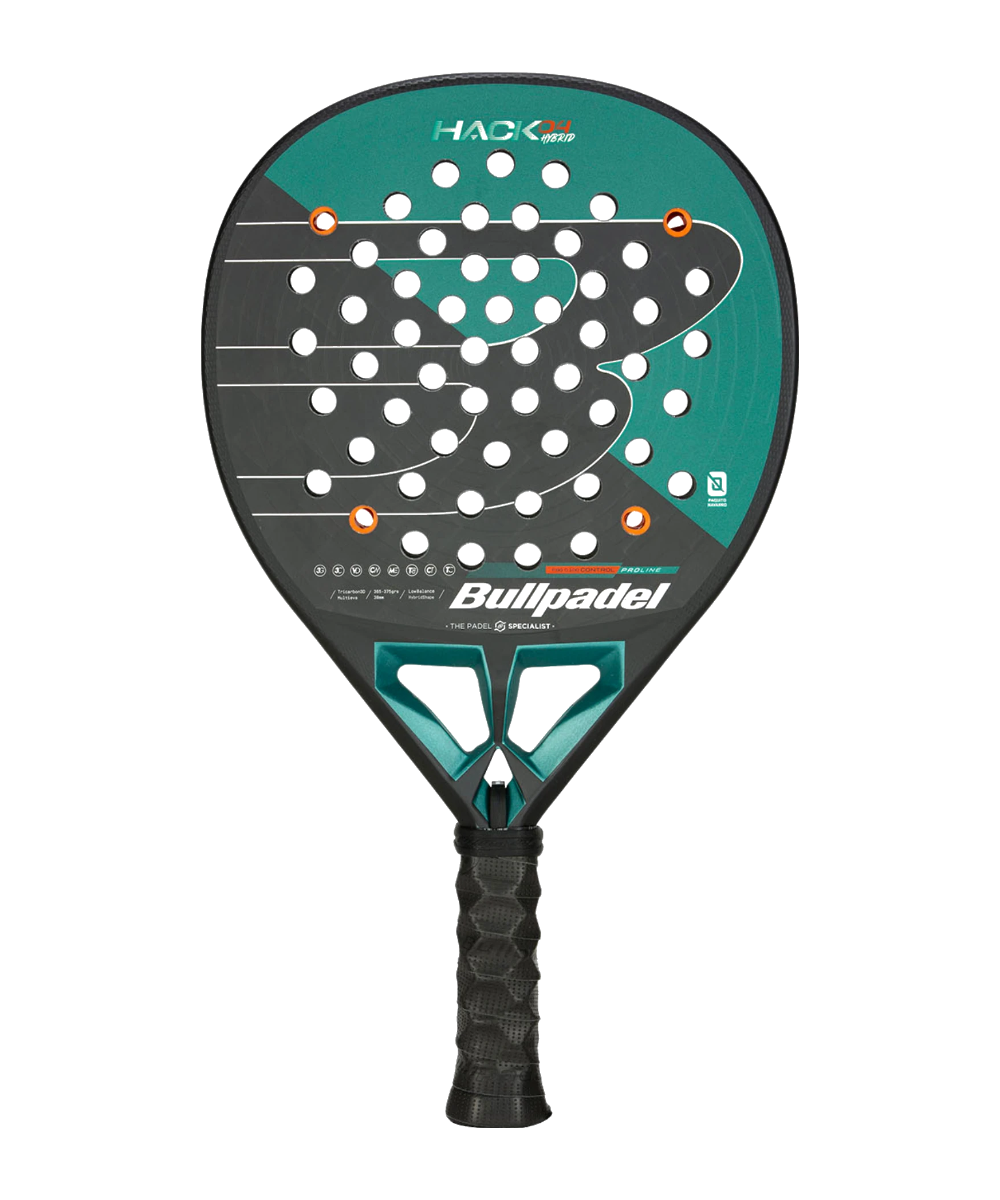
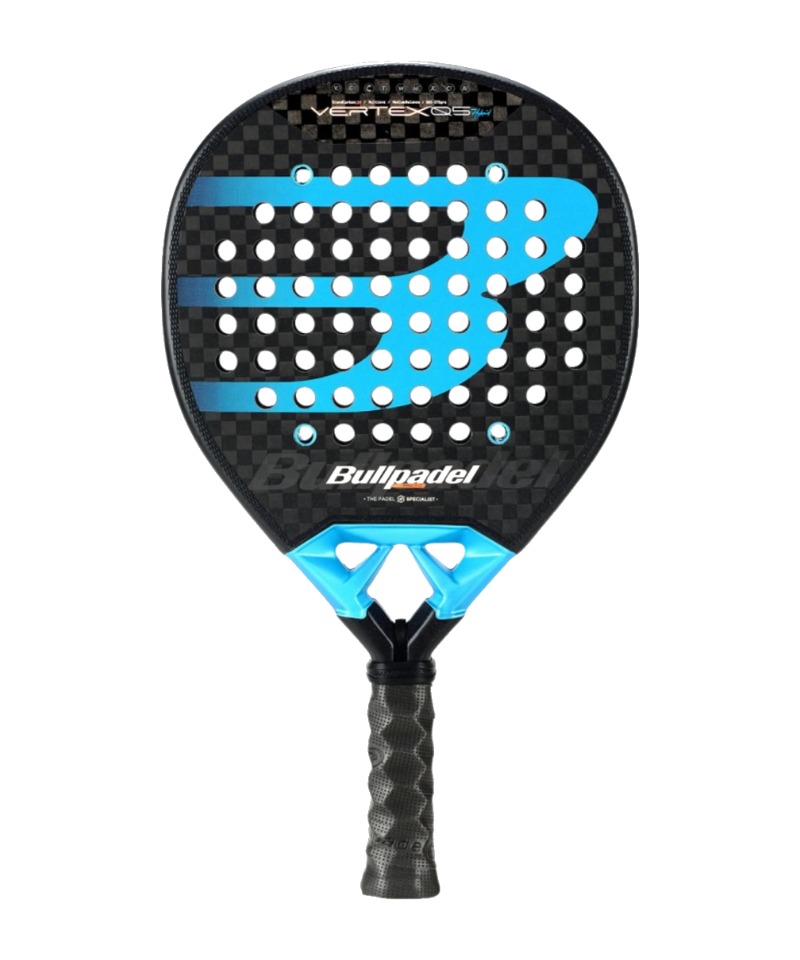
The sweet spot on a diamond racket sits higher and is smaller than on round or teardrop shapes. Owner feedback on the Bullpadel Vertex 05 describes one of the grittiest surfaces in the lineup, with brushed contacts that grab the ball and smashes that load hard — but reviewers are explicit that the shape and head-heavy balance punish a lazy swing. The Bullpadel Hack 04, another diamond frame, draws similar language from owners: it’s built for devastating finishing shots, but described as brutal on a lazy swing and suited only to players who already generate their own racket-head speed.
Why diamond shapes suit advanced/aggressive players
The Head Coello Pro takes this furthest — owner and reviewer commentary describes a smash trajectory most other frames can’t match, but also notes it needs racket-head speed to load properly and trades forgiveness for ceiling. This is the throughline across every diamond racket in the data: none of them are described as beginner-friendly, and all of them reward players who can consistently find the sweet spot rather than relying on the frame to bail out mishits.
Manufacturer Claims vs Evidence
Brands lean hard on shape language in marketing — round means control, diamond means power, teardrop means balance. Aggregated owner reviews mostly confirm the broad strokes, but the details matter more than the slogans.
What brands say about shape and power/control
Nox markets the ML10 Pro Cup with an internal control/power score favoring control heavily. Bullpadel and Head both position their diamond flagships around finishing power and spin generation. Entry-level brands like Babolat and Adidas lean on comfort and forgiveness language for their round and low-balance frames.
What aggregated owner reviews and published specs actually show
The claims mostly hold up directionally, but owner reviews add nuance brands don’t volunteer. Diamond frames really do concentrate power, but multiple reviewers across different diamond models independently flag the same tradeoff: they punish inconsistent swings rather than amplifying whatever swing you bring. Round and teardrop arm-friendly claims also check out in the data — the Babolat Contact and Head Evo Extreme both get repeated, independent mentions of comfort and vibration reduction, and the Nox AT10 Pro Cup Soft’s vibration-reduction claim is one of the few in this space backed by a named independent testing lab rather than just marketing copy.
| Manufacturer Claim | What Owner Data/Specs Show |
|---|---|
| Diamond shape = maximum power | Confirmed directionally, but only for players with clean technique; mishits punished harder than on other shapes |
| Round shape = beginner comfort | Confirmed consistently across entry-level round frames like the Babolat Contact |
| Teardrop = balanced power/control | Confirmed as a genuine middle ground, though some models lean control-heavy (Head Evo line) and others lean power (Nox AT10 Genius) |
| Nox Custom Grip cuts vibration 29% | Backed by named independent lab (Testea Padel), one of the few specific, sourced vibration claims in the category |
Shape-by-Player-Type Quick Reference
Beginners
Round or teardrop, low balance, soft EVA core. The Babolat Contact, Head Evo Speed, and Adidas Drive 3.4 all fit this profile and get consistent beginner-friendly praise in owner reviews.
Intermediate/control players
Teardrop or round with a bit more face tension. The Nox ML10 Pro Cup and Nox AT10 Pro Cup Soft both serve this group well, according to aggregated reviews, balancing control with enough pop to not feel outgrown immediately.
Advanced/power players
Diamond, high balance, denser multi-layer EVA. Bullpadel Vertex 05, Bullpadel Hack 04, and Head Coello Pro dominate this segment in owner sentiment, all explicitly described as unforgiving of poor technique but rewarding for players who can load them properly.
Players with arm sensitivity
Round or teardrop with a documented vibration-dampening system. The Babolat Contact and Nox AT10 Pro Cup Soft stand out here — the former for its Vibrasorb system and repeated arm-friendly praise, the latter for its independently tested 29% vibration reduction claim.
At-a-Glance: Best Shape Picks by Category
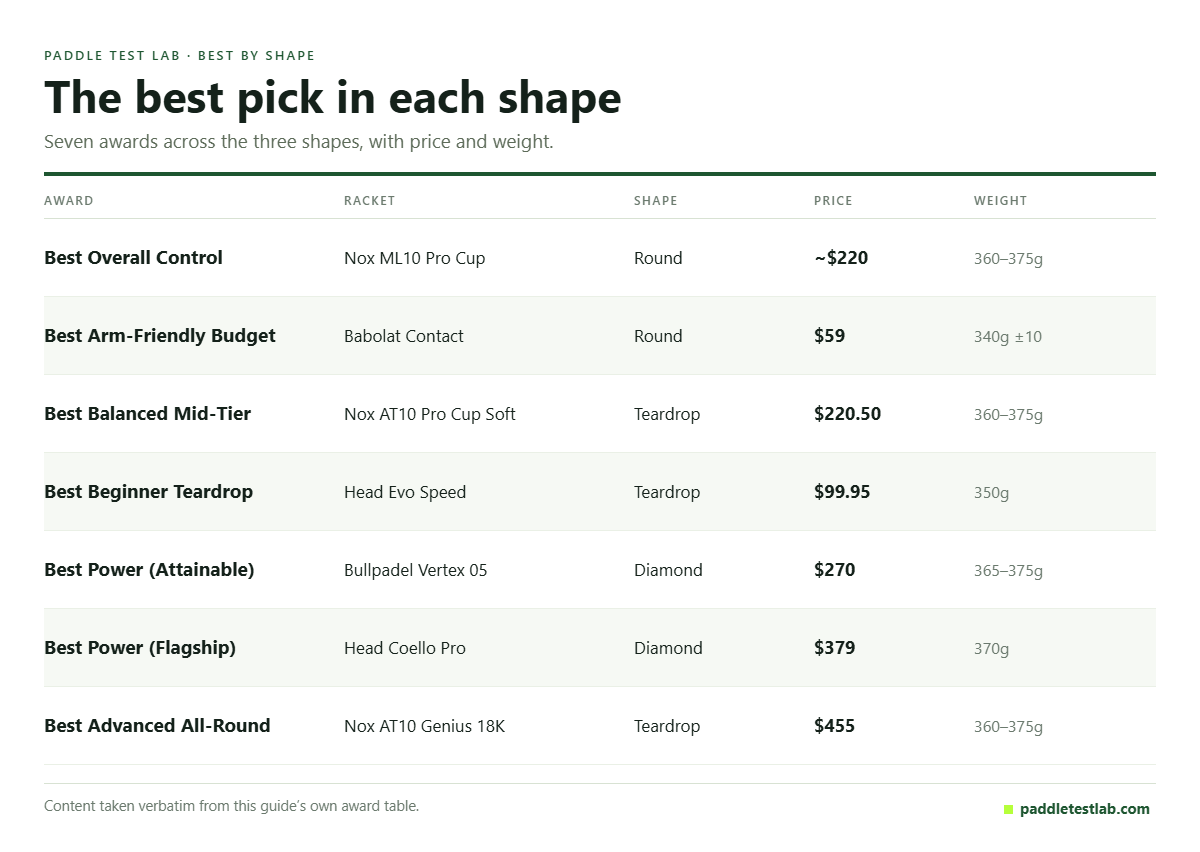
Award summary table
| Award | Racket | Shape | Price | Weight |
|---|---|---|---|---|
| Best Overall Control | Nox ML10 Pro Cup | Round | ~$220 (est. from UK pricing) | 360-375g |
| Best Arm-Friendly Budget | Babolat Contact | Round | $59 | 340g ±10 |
| Best Balanced Mid-Tier | Nox AT10 Pro Cup Soft | Teardrop | $220.50 | 360-375g |
| Best Beginner Teardrop | Head Evo Speed | Teardrop | $99.95 | 350g (conflicting retailer specs) |
| Best Power (Attainable) | Bullpadel Vertex 05 | Diamond | $270 street | 365-375g |
| Best Power (Flagship) | Head Coello Pro | Diamond | $379 street | 370g |
| Best Advanced All-Round | Nox AT10 Genius 18K Alum | Teardrop | $455 (retailer figure; another source cites $300) | 360-375g |
Final Verdict: Which Shape Should You Choose
Decision framework by skill level and play style
Start with honesty about your swing, not your ambition. If you mishit often, round shapes forgive you and let you build consistency. If you’ve got a repeatable, clean stroke and want your smash to actually hurt, diamond shapes reward exactly that — and punish everything else. Teardrop is the sensible middle path for players who’ve moved past pure beginner status but aren’t chasing tournament-level power yet. Across every shape category, arm comfort claims track closely with soft-core, round or teardrop construction — if your elbow is a concern, that should outweigh brand loyalty or shape trends. For a deeper look at how core material and weight interact with shape, see our padel racket core and weight guide, and check our full rankings in best padel rackets 2026.
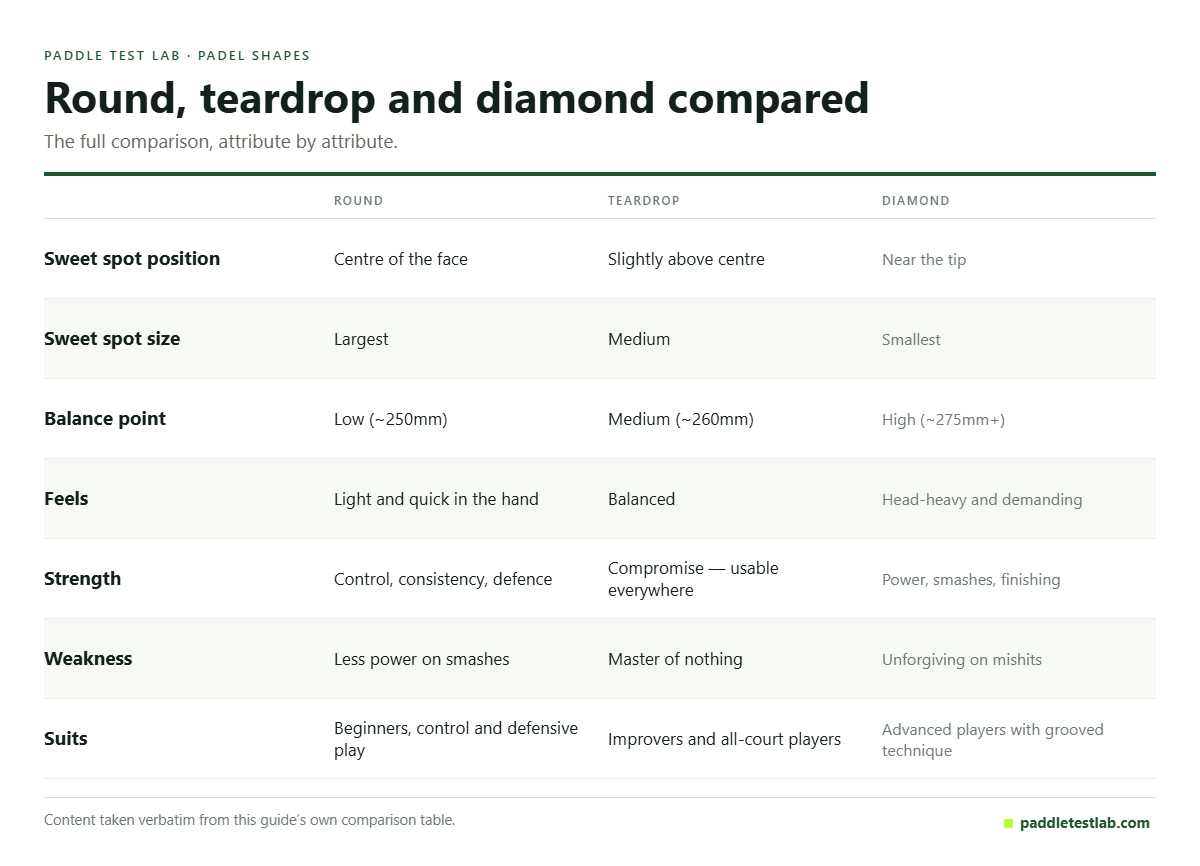
Round vs Teardrop vs Diamond: The Full Comparison
Padel shape is not cosmetic. It moves the sweet spot, changes the balance point, and determines how much the racket forgives you. Here is the whole trade-off in one place.
| Round | Teardrop | Diamond | |
|---|---|---|---|
| Sweet spot position | Centre of the face | Slightly above centre | Near the tip |
| Sweet spot size | Largest | Medium | Smallest |
| Balance point | Low (~250mm) | Medium (~260mm) | High (~275mm+) |
| Feels | Light and quick in the hand | Balanced | Head-heavy and demanding |
| Strength | Control, consistency, defence | Compromise — usable everywhere | Power, smashes, finishing |
| Weakness | Less power on smashes | Master of nothing | Unforgiving on mishits |
| Suits | Beginners, control players, defensive positions | Improvers and all-court players | Advanced players with grooved technique |
The rule most buyers get wrong: shape and balance are not separate decisions. Choosing a diamond means choosing a high balance point, because the shape puts mass at the tip. You cannot have a diamond’s power with a round’s manoeuvrability — the geometry does not allow it.
Padel racket balance point explained
Balance is measured in millimetres from the butt of the handle to the racket’s centre of mass, and it is the spec that most changes how heavy a racket feels as opposed to how heavy it is.
A low balance around 250mm keeps mass near your hand. The racket comes round faster, defends better at the net, and tires your arm less — which is why round frames dominate among beginners and defensive players. A high balance of 275mm or more puts mass toward the tip, generating leverage and racket-head speed on a smash, at the cost of manoeuvrability and forgiveness.
The practical consequence: a 355g diamond can feel considerably heavier in play than a 375g round. If you have picked up a racket that felt unwieldy despite a reasonable stated weight, balance was the reason. Our guide to choosing a padel racket covers how weight, balance, core and face interact.
Diamond rackets for intermediate players
Diamond is the shape intermediates most often buy too early. The appeal is obvious — it is what the professionals use and it produces the biggest smashes — but the small, tip-positioned sweet spot punishes the inconsistent contact that defines intermediate play.
The honest test: if your smash is already a genuine weapon and your problem is finishing points rather than constructing them, a diamond will help. If you are still losing points on defensive lobs and volleys that catch the frame, it will cost you more than it gains. A teardrop is the sensible bridge — enough tip weight to punish a short ball, enough central forgiveness to keep you in rallies. Our padel racket roundup covers the options across all three shapes.
FAQs
Which padel racket shape has the biggest sweet spot?
Round, comfortably. The round shape distributes the face area around the geometric centre, which is also where the majority of contacts land, so more of your shots hit the responsive part of the face. Teardrop is next, with the sweet spot shifted slightly upward. Diamond has the smallest and it sits near the tip.
This is why round is the near-universal recommendation for beginners, and why so many advanced defensive players stay on round frames throughout their careers. A larger sweet spot is not a beginner’s compromise — it is a legitimate tactical choice for anyone whose game is built on consistency rather than finishing. Our beginner racket guide covers what else to prioritise on a first frame.
What is the best padel racket shape for control?
Round, paired with a low balance point and a soft or medium EVA core. That combination maximises dwell time and keeps the mass where you can manage it, which is what control actually consists of — the ball staying on the face long enough for you to direct it.
Adding a fibreglass face increases forgiveness further, though it costs some precision. If you want control and precision, a round frame with a carbon face is the combination — stiffer and more accurate, but less tolerant of off-centre contact. Our comparison of face materials and core densities covers that trade-off in detail.
What is the difference between round, teardrop, and diamond padel rackets?
Round shapes keep mass low and near the handle for a big sweet spot and low balance. Diamond shapes push mass toward the tip for concentrated power and a smaller, higher sweet spot. Teardrop sits structurally between the two, offering a compromise on both sweet spot size and balance.
Which padel racket shape is best for beginners?
Round is the most commonly recommended shape for beginners in owner reviews, thanks to forgiveness on mishits and lower arm strain. Soft teardrop frames like the Head Evo Speed are also frequently recommended as beginner-friendly, particularly for players who expect to progress quickly.
Do diamond-shaped padel rackets really hit harder?
Owner reviews and manufacturer positioning both support this — diamond shapes concentrate mass toward the head, generating more leverage on clean contact. The tradeoff, repeated across multiple diamond models in owner feedback, is that mishits are punished harder and the sweet spot is smaller.
Is a round padel racket more arm-friendly?
Generally yes. Owner reviews of round-shaped, soft-core rackets like the Babolat Contact consistently describe them as among the most arm-friendly options available, largely due to low balance and softer EVA cores rather than shape alone — though shape contributes to the lower swingweight that reduces strain.
What shape should intermediate players choose?
Teardrop is the most frequently recommended shape for intermediate players in aggregated owner feedback, offering enough sweet spot forgiveness to avoid frustration while introducing more power potential than a pure round beginner frame.
Does racket shape affect sweet spot size?
Yes, significantly. Round shapes produce the largest, most centered sweet spots. Diamond shapes produce the smallest, positioned higher on the face. Teardrop falls in between. This pattern is consistent across every model reviewed in this guide, regardless of brand or price tier.
Related guides

Isacc Shah
Isacc Shah writes PaddleTestLab. He does not test paddles in a lab and says so plainly — there is no rig, no radar gun, no staff hitting balls. Instead he aggregates independent bench measurements, manufacturer specifications, USA Pickleball's approval database and hundreds of verified owner reviews per product, then reports where those sources disagree. Every score on the site carries its evidence count. Where a specification is not published, the site writes UNKNOWN rather than estimating it, and the criticism is printed next to the praise.