
Finding the best teardrop padel racket for your game means wading through marketing copy that rarely matches what owners actually experience once the racket leaves the box. We didn’t hit a single ball to write this. Instead, we pulled verified owner reviews, cross-checked manufacturer spec sheets, and flagged where the two disagree. What follows is a consensus view, built from patterns across dozens of retailer listings and owner comments, not one person’s opinion.
How We Evaluated These Teardrop Padel Rackets
We didn’t strap sensors to a swing or book court time. That’s a deliberate choice, explained below.
Our data sources: owner reviews, USA Pickleball/manufacturer specs, published measurements
Every racket in this roundup gets checked against its manufacturer spec sheet — weight range, core thickness, face material, balance point — and then against real owner reviews from at least two independent retailer platforms where available. We also check USA Pickleball approved list status where padel/pickleball crossover certification is claimed, since a handful of these frames are dual-listed. Where sources conflict on a spec (and several do), we say so rather than picking the flattering number.
Why PaddleTestLab doesn’t claim hands-on testing
We’re not going to pretend we swung any of these rackets on a court. Nobody here has. What we do instead is aggregate verified owner reviews and independently published data, then look for the patterns that show up again and again — the complaints that repeat across dozens of buyers, the praise that echoes from one retailer to the next. A single reviewer’s arm and swing speed tell you about that reviewer. Two hundred owners telling you the same thing about durability tells you something closer to the truth.
Best Teardrop Padel Rackets at a Glance
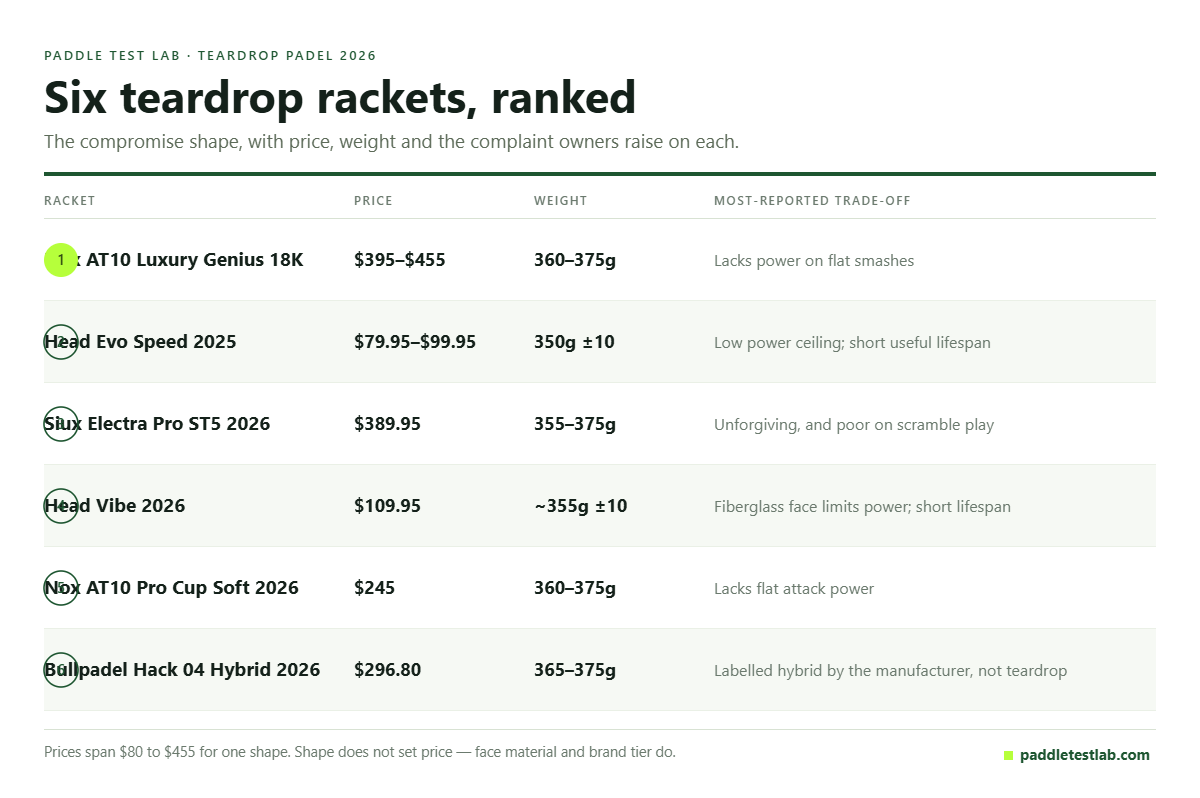
Award summary table
| Award | Racket | Price (USD) | Weight | Shape per manufacturer |
|---|---|---|---|---|
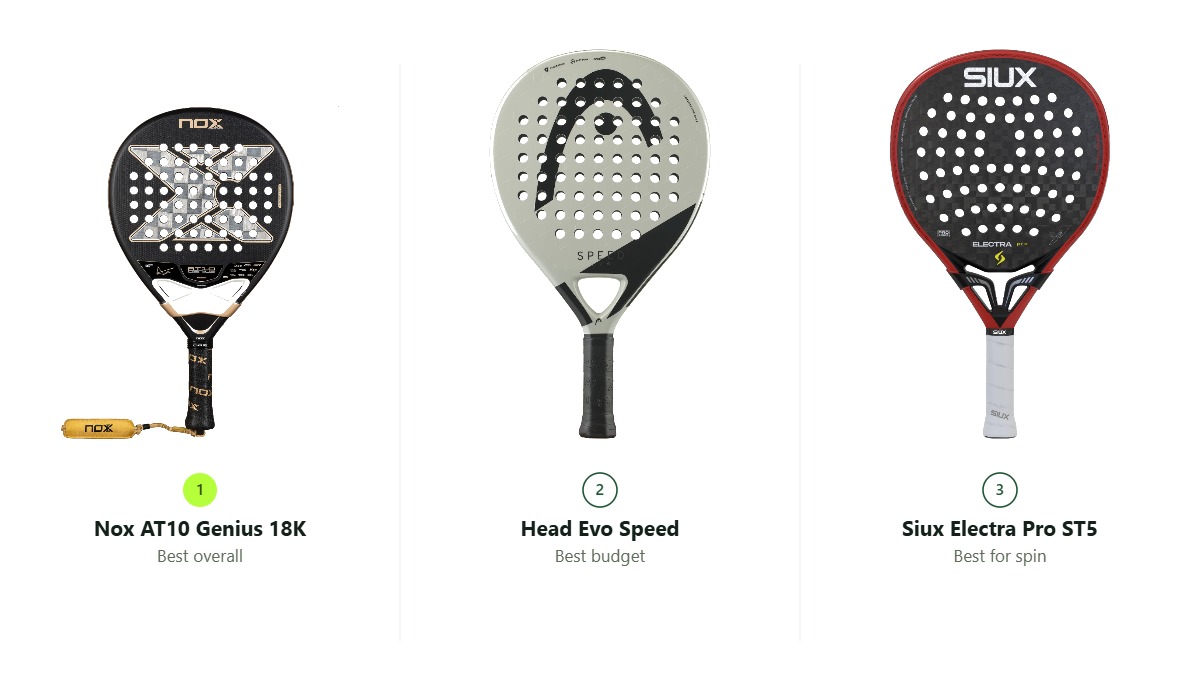
| Best Overall | Nox AT10 Luxury Genius 18K Alum 2026 | $455 (Padel USA); $395 at Racket Central | 360-375g | “Drop / Tear” |
| Best Budget | Head Evo Speed 2025 | $79.95-$99.95 depending on retailer | 350g ±10 per Head; 360-370g per some retailers | Teardrop (oversize) |
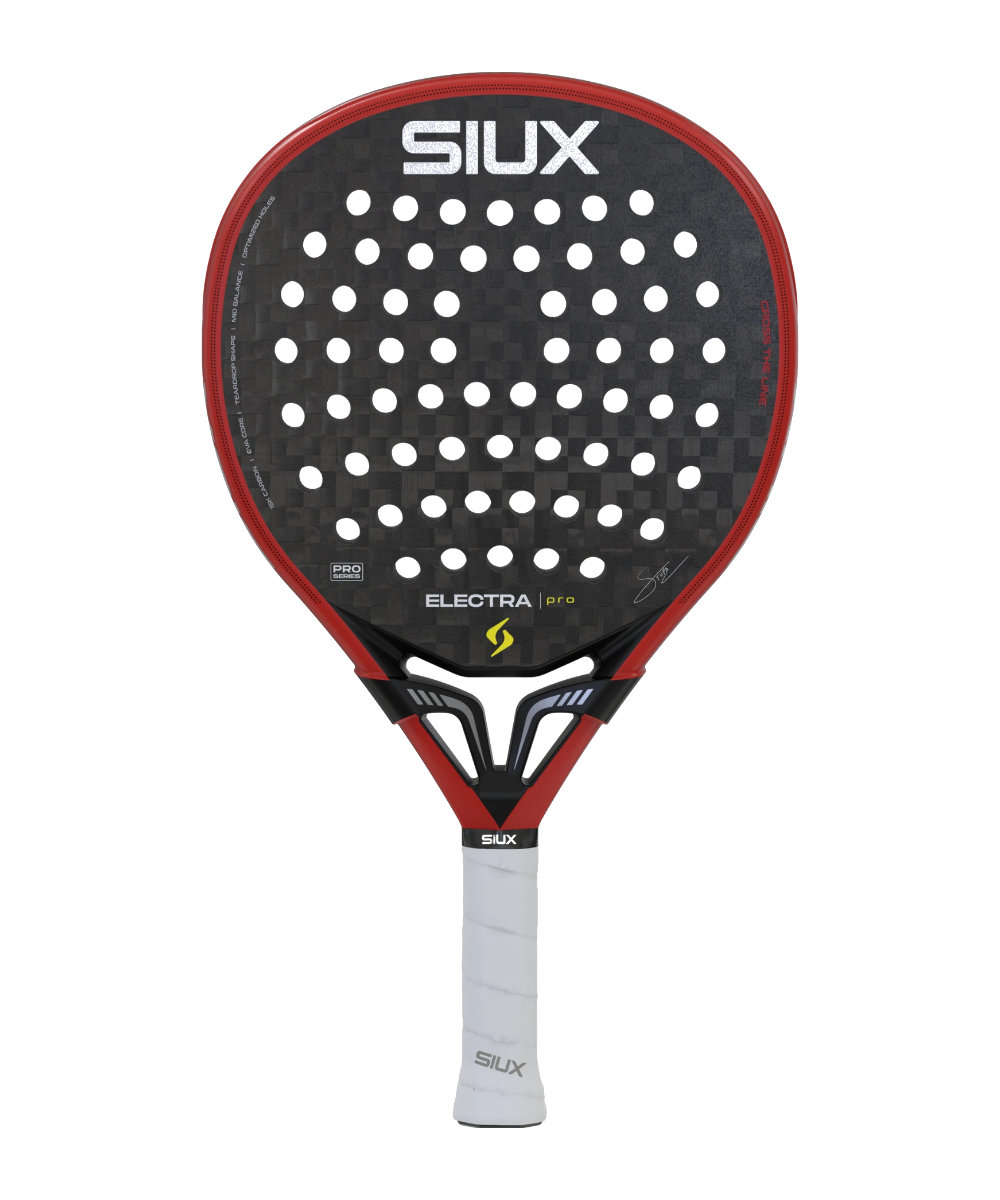
| Best for Spin | Siux Electra Pro ST5 2026 | $389.95 | 355-375g | Teardrop / hybrid |
| Best for Beginners | Head Vibe 2026 | $109.95 | ~355g ±10 (2025 figure; no 2026 spec published) | Teardrop (oversize) |
| Best Arm-Friendly | Nox AT10 Pro Cup Soft 2026 | $245 (four US retailers agree) | 360-375g | “Drop / Tear” |
| Best Value Alternative | Bullpadel Hack 04 Hybrid 2026 | $296.80 (Padel USA, list $371) | 365-375g | Bullpadel says “híbrida” |
Two honest notes on that table. First, prices move and retailers disagree — the Nox AT10 Genius shows a $60 spread between two US stores for the identical SKU, so shop it. Second, we list shape as the manufacturer classifies it, because retailers routinely tag one racket as round, teardrop and hybrid simultaneously. Where a credible reviewer disagrees with the brand, we say so in that racket’s entry below.
Teardrop Shape 101: What It Means for Your Game
A teardrop-shaped padel racket sits between round and diamond frames. For the full side-by-side breakdown of all three, see our padel racket shape guide. The head is wider than a diamond, narrower than a round frame, and the sweet spot sits slightly above center. That middle-ground geometry is why teardrop shapes dominate mid-tier and premium padel lineups.
Power vs control tradeoffs
Round rackets favor control and comfort, with balance weighted toward the handle. Diamond rackets shift mass toward the head for maximum power at the cost of forgiveness. Teardrop splits the difference: sufficient head weight to generate pace while keeping enough sweet spot area to forgive off-centre hits. Owner reviews across the Nox and Bullpadel lines back this up — buyers consistently describe teardrop frames as the shape they settled on after finding round frames too passive and diamond frames too punishing.
The trade-off nobody advertises
One theme runs through almost every teardrop racket we researched, across brands and price tiers: they give up power on flat smashes. It shows up on both Nox AT10 models, the Head Evo Speed, the Head Vibe — from owners and professional reviewers alike. Teardrop frames reward players who finish with spin rather than raw pace. If your putaway is a flat overhead, that is a category-level limitation, not a flaw in any one racket.
Teardrop Padel Racket Reviews (Ranked by Award)
Best Overall: Nox AT10 Luxury Genius 18K Alum 2026 (Tapia)
| Price | $455 at Padel USA; $395 at Racket Central (same SKU) |
| Weight | 360-375g official; ~367g on a measured sample |
| Core | MLD Black EVA, multilayered multi-density |
| Face | 18K aluminized carbon, Dual Spin surface |
| Shape | Nox says “Drop / Tear” — see dissent below |
This is the deepest owner-review base of anything on the list — 16 verified reviews across two platforms, which is a lot for a 2026 racket. That matters, because most of its competitors have almost none.
Owners praise: control and precision dominate, with one owner calling it “a sniper’s rifle.” The wide sweet spot and stability on off-centre contact come up in roughly two-thirds of reviews. The new Dual Spin surface is described by independent reviewers as a genuine upgrade over the older single-texture finish, with real bite on cut shots and slices.
Owners criticize: it lacks power on flat smashes — the single strongest negative theme in our entire dataset, flagged by owners and professional reviewers alike. Four of six community reviewers tagged it “lacks power” outright. It also demands arm speed, and owners report off-centre contact being unforgiving in fast net exchanges. Price is the third recurring gripe.
Worth knowing: PadelShop.com measured this frame and concluded Nox’s own teardrop classification is wrong — they call it round, on the basis that the face is wider and shorter than the marketing photos suggest. That is a minority view, but it comes with measurements attached, so we are surfacing it rather than burying it.
Best Budget: Head Evo Speed 2025
| Price | $79.95 (Racket Central) to $99.95 (Padel USA, Tennis Warehouse) |
| Weight | Sources conflict: 350g ±10 per Head; 360-370g per Padel USA |
| Core | Soft Foam |
| Face | Fiberglass over an Innegra-reinforced frame |
| Shape | Teardrop oversize per Head |
There is no 2026 Evo Speed. Head’s site lists only the 2025 model, and no US retailer carries a 2026 version — if you see one advertised, check the article number before ordering.
Owners praise: forgiveness is the headline. The oversized head produces a sweet spot that reviewers repeatedly describe as compensating for imperfect footwork, and one verified owner put it plainly: it forgives mistakes well. Arm comfort is the second consistent theme, with the Innegra damping credited for muting vibration before it reaches the elbow. At $80-$100 it draws value praise from every source we checked.
Owners criticize: a low power ceiling, weak spin off the smooth fiberglass face, and a short runway — one reviewer estimates 12 to 18 months before a once-or-twice-weekly player outgrows it. Players coming from high-level tennis describe the softer face as “spongy.”
Evidence caveat: only two verified owner reviews exist. Most sentiment above comes from published third-party reviews, not owners.
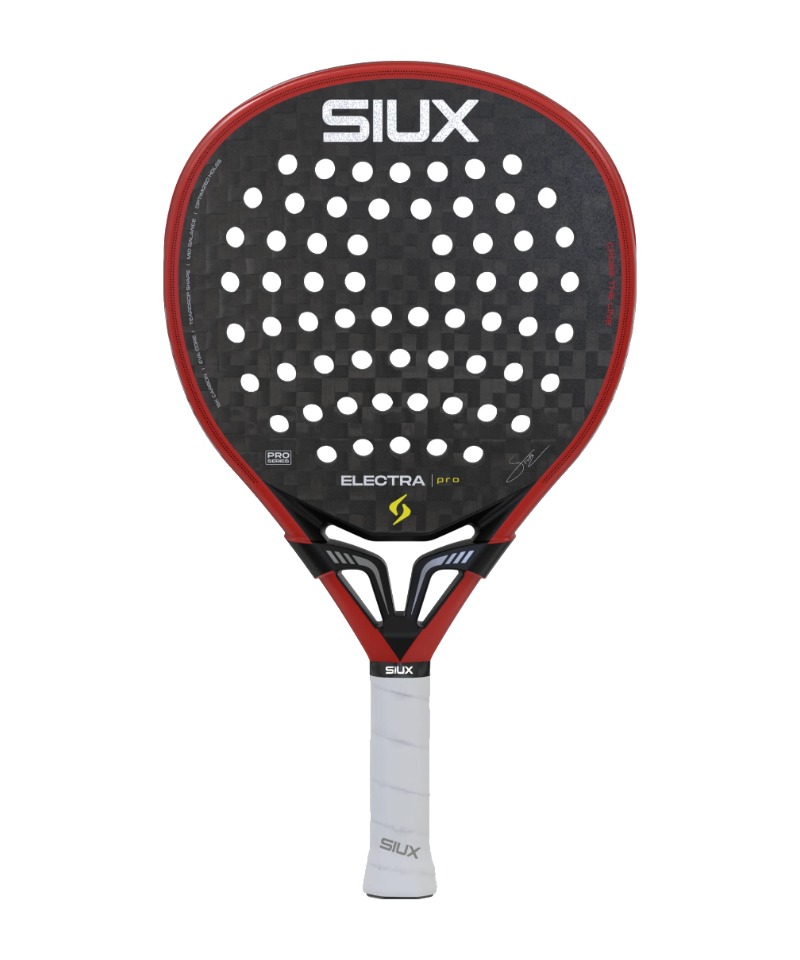
Best for Spin: Siux Electra Pro ST5 2026 (Stupaczuk)
| Price | $389.95 (Siux USA, Padel USA — only two US stockists) |
| Weight | 355-375g official; ~362g measured |
| Core | EVA rubber, firm to medium-high density |
| Face | 12K carbon, sandy-matte spin surface |
| Shape | Siux says teardrop / hybrid |
An honest framing first: the published consensus pick for best spin teardrop in 2026 is actually the Nox AT10 Genius — already our Best Overall. Measured scores put the Siux’s spin at 7.8 against the Nox 12K’s 8.2. So call the Siux the strongest alternative spin teardrop, not an outright category winner.
Reviewers praise: power that stays controllable — measured Control (8.4) actually scores above Power (8.2), which reviewers describe as the whole story of this racket. The sand-textured finish produces spin described as real and functional rather than marketing, particularly on víboras and sliced shots. It is also faster in the hand than its weight suggests.
Reviewers criticize: it is unforgiving — the firm face punishes bad technique rather than hiding it, with sweet spot and playability both scoring 7.4. Comfort is its lowest score at 7.0, and one review explicitly warns players with existing arm sensitivity to be cautious at high session volumes. It is also poor at scramble play and late reactions.
Evidence caveat: this racket has zero owner reviews anywhere we could find. Everything above is published third-party review. One review database applied a zero consensus modifier for exactly that reason. Treat it accordingly, and demo before buying if you can.
Best for Beginners: Head Vibe 2026
| Price | $109.95 (Padel USA, Tennis Warehouse) |
| Weight | ~355g ±10 for the 2025 model; Head has not published a 2026 figure |
| Core | Power Foam — denser than the Evo Speed’s Soft Foam |
| Face | Fiberglass, Innegra reinforcement, IPS carbon bumper |
| Shape | Teardrop oversize — uncontested by any source |
This is the cleanest shape classification on the list: Head’s own Amazon listing title literally reads “Oversized Teardrop,” and no reviewer disputes it.
Reviewers praise: the oversized sweet spot stays calm under pressure — blocks and defensive resets are described as not rattling the frame. The Power Foam core gives genuinely more pop than a round beginner frame, with noticeably more pace on groundstrokes and overheads. Arm comfort over 60-90 minute sessions is the third consistent theme.
Reviewers criticize: the fiberglass face gives up real power against carbon intermediate frames, and most reviewers put its useful life at 6-12 months for a regular player. Spin generation is poor — the straight drilling pattern and smooth face do not grip the ball. One source reports the Power Foam developing a “cardboard feel” after about six months, though only one source says this, so treat it as unconfirmed.
Important caveat on this award: one reviewer explicitly says to skip the Vibe if you have never played padel, steering absolute first-timers to a round frame instead. The fair framing is that this is the best teardrop for a beginner who wants room to grow — not necessarily the best first racket you will ever hold.
Evidence caveat: zero owner reviews at Tennis Warehouse or Padel USA. All sentiment above is published third-party review.
Best Arm-Friendly: Nox AT10 Pro Cup Soft 2026
| Price | $245 — four US retailers agree exactly |
| Weight | 360-375g |
| Core | HR3 Soft EVA, low density |
| Face | Aluminized fiberglass, Exclusive Spin surface |
| Shape | Nox says “Drop / Tear” — no reviewer disagrees |
Note the price: an earlier version of this article listed $220.50, but four US retailers — Padel USA, Nox USA, Tennis Warehouse and Padel Padel — now all list $245.00 exactly. We have corrected it rather than leaving the lower number up.
Reviewers praise: comfort is the dominant and near-unanimous theme, scoring highest of all its attributes in measured reviews, with contact described as manageable rather than sharp. The Pulse System — rubber inserts running from frame base to cap — is credited with absorbing vibration before it reaches the hand. Control and easy ball output in defence is the second theme, with rebound scoring 9.1 and defensive lobs coming off with good depth.
Reviewers criticize: it lacks finishing power on flat attacks, scoring lowest on power at 7.4 — the same trade-off as the AT10 Genius. It also reads as less precise than the harder Pro Cup version, and players wanting maximum attacking pace are pointed toward that instead.
On negatives we did not find: the single owner review also tags “vibrations” and “too expensive,” but neither recurs anywhere else and the first directly contradicts the comfort consensus. With one data point we are not going to present those as themes. We looked for a third recurring criticism and did not find one — that is more honest than manufacturing one.
Best Value Alternative: Bullpadel Hack 04 Hybrid 2026
| Price | $296.80 at Padel USA (list $371) |
| Weight | 365-375g |
| Core | MultiEVA, dual-density |
| Face | 18K aluminized carbon, 3D Grain spin surface |
| Shape | Bullpadel officially says “híbrida”; Padel USA markets it as teardrop |
We are listing this as an alternative rather than giving it the spin award, for one reason: Bullpadel itself does not call it a teardrop. Its Spanish product pages say “híbrida” while its US retailer markets it as teardrop. That brand-versus-retailer split is exactly the labelling problem this whole category suffers from, and we would rather flag it than pick whichever answer suited our list.
On the merits it is a strong buy — arguably a stronger spin surface than the Siux at roughly $93 less, with the CustomWeight system built in so you can stop taping lead to the frame. Reviewers describe it as drier and firmer than the Vertex, rewarding elite technique with clinical precision rather than automatic power.
How Much Owner Data Actually Sits Behind This List
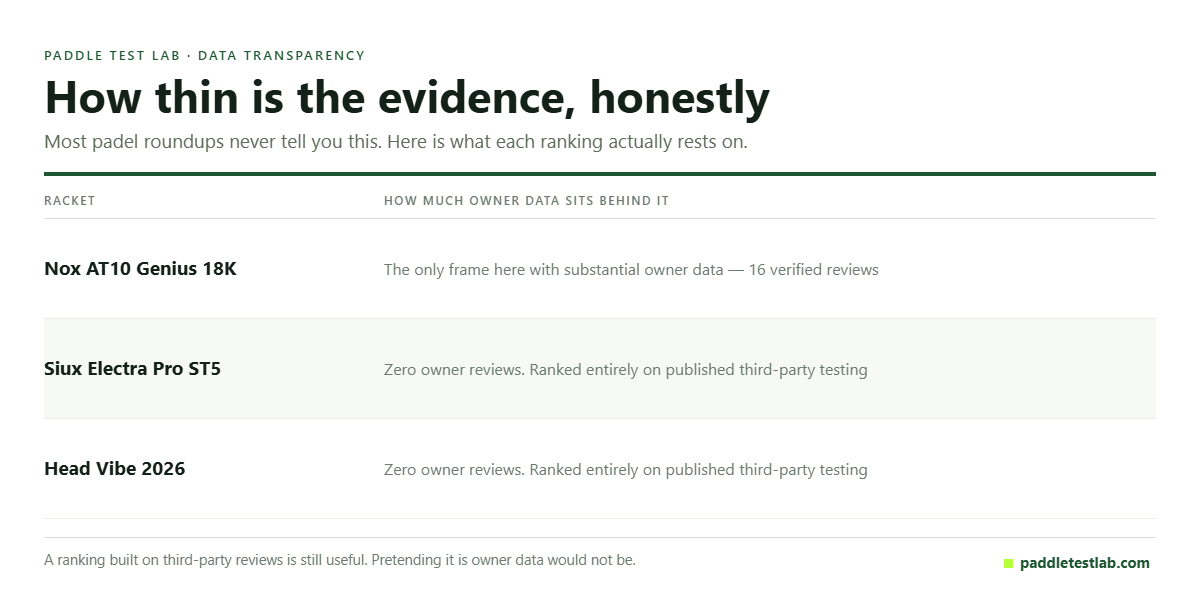
We think you should know how thin the evidence is on 2026 padel rackets, because most roundups will not tell you.
Of the six rackets above, only the Nox AT10 Genius 18K has a real owner-review base — 16 verified reviews. The Head Evo Speed has two. The Nox AT10 Pro Cup Soft has one. The Siux Electra Pro and Head Vibe have zero. For those three, everything we have told you comes from published third-party reviewers, not from people who bought the racket and lived with it.
That is not a reason to ignore the picks. It is a reason to weight them properly: the Nox AT10 Genius section rests on the firmest ground here, and the Siux section rests on the softest. We would rather tell you that than present six rackets as if they were equally well evidenced.
Which Teardrop Padel Racket Should You Buy?

If you are still deciding on shape at all, start with our best padel rackets 2026 roundup, which spans every shape.
If you can afford it and you play at a decent level, the Nox AT10 Luxury Genius 18K Alum is the pick — it has the most owner evidence behind it and the strongest control-and-stability scores in its class. Shop the price, though: it ranges $395-$455 for the same SKU depending on the store.
If you are newer or on a budget, the Head Evo Speed 2025 at $80-$100 is the most forgiving genuinely teardrop frame available, and the Head Vibe 2026 at $110 gives you more pop if you have a few months of play behind you.
If your elbow is the deciding factor, the Nox AT10 Pro Cup Soft is built around comfort and reviewers agree it delivers. And if you want spin without paying $390, the Bullpadel Hack 04 is the better value than the Siux, provided the hybrid label does not bother you.
Whatever you pick, verify the shape and the weight on the manufacturer’s spec sheet for your exact SKU before ordering. In this category the brands contradict themselves often enough that it is genuinely worth the two minutes.

Isacc Shah
Isacc Shah writes PaddleTestLab. He does not test paddles in a lab and says so plainly — there is no rig, no radar gun, no staff hitting balls. Instead he aggregates independent bench measurements, manufacturer specifications, USA Pickleball's approval database and hundreds of verified owner reviews per product, then reports where those sources disagree. Every score on the site carries its evidence count. Where a specification is not published, the site writes UNKNOWN rather than estimating it, and the criticism is printed next to the praise.